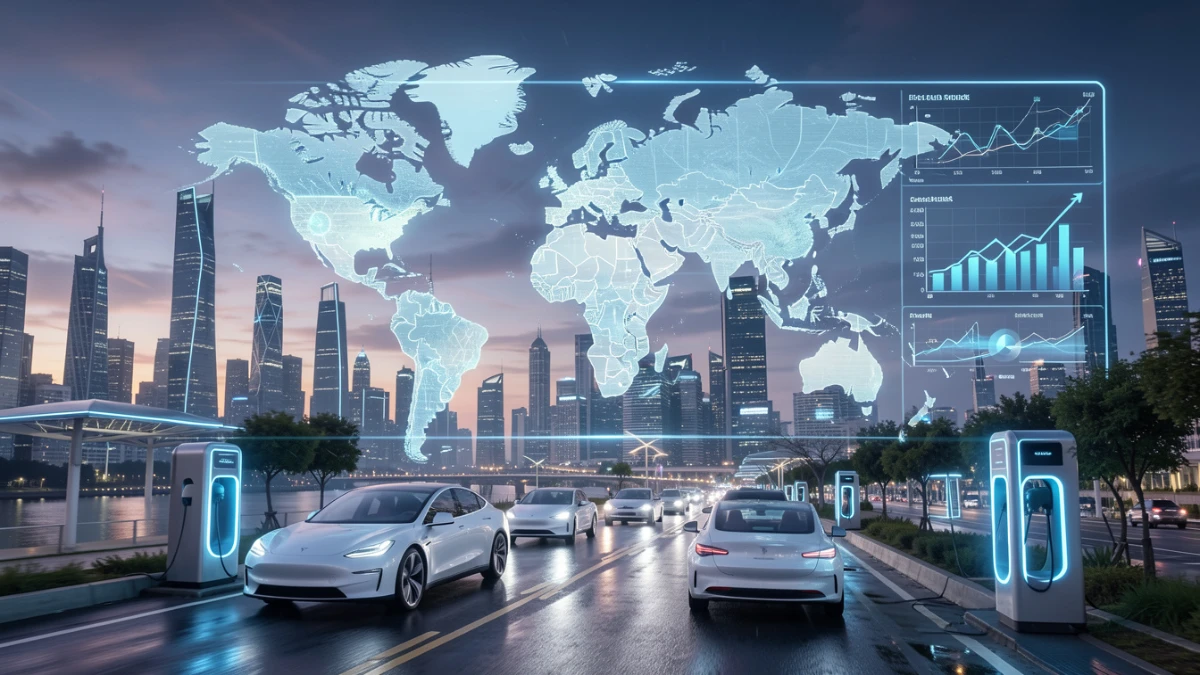
TL;DR: What if I told you that more electric cars were sold in China alone in 2025 than the entire world sold just two years ago?
What if I told you that more electric cars were sold in China alone in 2025 than the entire world sold just two years ago? That’s not a forecast — it happened. And it’s just one data point in a global EV story that is accelerating faster than most analysts predicted.
The global electric vehicle market has crossed a historic threshold. According to Benchmark Mineral Intelligence, over 20.7 million EVs were sold worldwide in 2025, representing 20% growth year-on-year. For the first time, roughly one in four new cars sold globally was electric.
In this article, I’ll walk you through everything you need to understand about the current state of the global EV market — where the growth is happening, which regions are pulling ahead, what’s driving adoption, where the headwinds are, and what the road ahead looks like through 2030. Whether you’re a prospective buyer, an investor, or simply an EV enthusiast like me, there’s a lot to unpack here.
Section 1: The Big Picture — A Market That Has Crossed the Tipping Point
Global Sales at a Glance
Just a few years ago, the idea of selling 20 million EVs in a single year was an ambitious target pencilled in for the late 2020s. We got there in 2025.
Here’s a quick snapshot of how global EV sales have evolved:
| Year | Global EV Sales | YoY Growth |
|---|---|---|
| 2020 | ~3 million | — |
| 2022 | ~10 million | ~55% |
| 2024 | ~17 million | ~21% |
| 2025 | 20.7 million | ~20% |
Sources: IEA Global EV Outlook 2025, Benchmark Mineral Intelligence
The global EV fleet — all electric cars on roads worldwide — had already grown to nearly 58 million vehicles by end of 2024, and that number keeps climbing. What’s really striking is how consumer spending has shifted: total global consumer spending on electric cars reached USD $560 billion in 2024, even as government subsidies fell to less than 7% of total EV spending. That’s the market maturing. Buyers are no longer depending on government handouts to make the EV math work.
The Model Explosion
There’s another factor fueling this momentum that doesn’t get enough attention: choice. In 2024, consumers had access to 785 different electric car models globally — a 15% jump from the year before. By 2026, that number is expected to crack 1,000. More choice means more buyers finding the right vehicle for their needs, whether that’s a compact city runabout or a full-size family SUV.
Section 2: Regional Breakdown — Three Markets, Very Different Stories
The global EV market can’t be understood as a single story. You really need to look at it region by region, because what’s happening in China, Europe, and the United States couldn’t be more different.
China: The Undisputed EV Superpower
If you want to understand global EV trends, you start with China — full stop. The country accounted for around 60% of global EV sales in 2025, a dominance that shows no signs of fading. The Chinese EV market grew by 17% overall in 2025, with battery electric vehicles (BEVs) surging 26% year-on-year.
The big driver? Affordable, high-quality vehicles from domestic manufacturers like BYD, which alone sold nearly 1.9 million EVs in just the first half of 2025. Combined with government trade-in schemes, infrastructure investment, and deeply competitive pricing, China has essentially made EV ownership mainstream. When 60% of new cars sold in a country are electric, you’re no longer talking about a niche — you’re talking about the dominant choice.
Europe: A Rocky Road With Signs of Recovery
Europe’s story in 2024 was frustrating for EV advocates. Subsidy reductions in Germany and France caused the market to stall. But 2025 told a very different story.
The European EV market grew by an impressive 33% over the year, driven in part by re-energized policy frameworks and new purchase incentives. Germany rebounded with 48% growth, while the UK grew 27%. Italy’s market expanded by roughly two-thirds year-on-year, supported by scrappage funding. Even France, which had a rocky start to the year, finished 2025 with modest positive growth after recovering in the final months.
One important development: the European Commission softened its 2025 CO2 compliance targets in March 2025, giving automakers flexibility to average their emissions over 2025–2027 rather than hitting a hard target in a single year. This provided welcome relief to manufacturers while keeping long-term electrification goals firmly in place.
EVs now make up around 20-25% of new car sales across the EU, with expectations of reaching close to 60% by 2030.
United States: A Year of Turbulence
The US story in 2025 is the one that stings a little. Federal EV tax credits were eliminated on September 30, 2025, which caused a dramatic surge in purchases in August and September as consumers rushed to beat the deadline — followed by a 49% crash in EV sales in Q4 2025 compared to Q3. For the full year, US EV sales grew by just 1%.
The removal of incentives, combined with reduced fuel economy standards and a general policy retreat from electrification, has put significant headwinds in front of the American EV market going into 2026. The outlook remains uncertain. That said, range-extended electric vehicles (REEVs) are gaining traction as a middle-ground option better suited to US driving patterns and charging infrastructure gaps — with models from Ford, Stellantis, Scout, and Volvo expected to enter the market in coming years.
Section 3: The Surprise Story — Emerging Markets Are Leapfrogging the West
Here’s the part of the 2025 EV story that genuinely took me by surprise, and I follow this industry closely. Emerging markets didn’t just catch up with advanced economies in EV adoption — in several cases, they overtook them.
Southeast Asia Leads the Charge
Vietnam has become a genuine EV powerhouse. Close to 40% of new car sales in Vietnam are now electric, nearly all of them battery EVs made by domestic manufacturer VinFast. That figure has doubled since 2024, and it now exceeds the EU average. Thailand crossed 20% EV market share for the first time in 2025 — a staggering jump from just 1% back in 2019.
Singapore, Thailand, and Vietnam all now have higher BEV penetration than the EU average. Let that sink in for a moment.
Latin America and Beyond
Brazil and Mexico are also making rapid moves. India, Mexico, and Brazil now have a higher EV sales share than Japan — a country that has long been considered an automotive technology leader. Indonesia’s EV market share hit 15% in 2025, overtaking the United States.
Much of this growth is being fueled by affordable Chinese EV exports finding new homes in non-OECD markets. Since mid-2023, non-OECD nations have been responsible for all the growth in Chinese EV exports, with Mexico, Brazil, the UAE, and Indonesia among the top destinations.
This is a genuinely significant geopolitical and economic shift. The assumption that EV growth would be limited to wealthy Western nations and China has been thoroughly disproven.
Section 4: What’s Actually Driving Adoption — Beyond the Headlines
When people ask me why EVs are suddenly everywhere, my answer is: it’s not one thing, it’s five things hitting at once.
1. Battery Costs Have Collapsed
The cost barrier to EV ownership has been crumbling for years, but 2025 accelerated the trend. Battery cell manufacturing capacity — heavily concentrated in China but expanding rapidly elsewhere — has created significant overcapacity, which has helped drive battery prices down. Cheaper batteries mean cheaper vehicles, plain and simple.
2. The Model Range Has Exploded
I mentioned the 785+ models available in 2024. But it’s not just quantity — it’s the type of vehicles now going electric. Full-size trucks, three-row SUVs, compact city cars, affordable entry-level models — there’s now an electric option in virtually every major vehicle segment. That’s a very different world from five years ago when EV choice was limited to a handful of premium sedans and one dominant hatchback.
3. Charging Infrastructure Is Growing Fast
Charging anxiety — the fear of being stranded with a flat battery — was a genuine concern not long ago. It’s still real in some markets, but the infrastructure gap is closing. More charging points are being built globally every year, and fast-charging technology continues to improve. The IEA’s Global EV Data Explorer tracks consistent year-on-year expansion of public charger networks across all major markets.
4. Policy Still Matters (A Lot)
The US experience in Q4 2025 demonstrated something important: policy matters enormously. The removal of federal tax credits caused an immediate, dramatic contraction. Conversely, Germany’s €3 billion incentive package for low- and middle-income households (starting in 2026) and Italy’s scrappage funding helped drive double-digit growth. Markets with supportive, consistent policy tend to see durable EV adoption. Markets that pull back create uncertainty that buyers respond to immediately.
5. The Total Cost of Ownership Equation Is Shifting
For many buyers, the higher upfront cost of an EV used to be the dealbreaker. That calculation is changing. Lower fuel costs, reduced maintenance needs (no oil changes, fewer brake replacements due to regenerative braking), and falling vehicle prices are making the lifetime cost of an EV increasingly competitive with — and in some markets, better than — a comparable gasoline car.
Section 5: What About Trucks, Buses, and the Broader Picture?
The passenger car focus tends to dominate EV headlines, but the electrification of commercial vehicles deserves attention too — particularly because the climate math is so compelling. Heavy-duty trucks make up just about 10% of all combustion-engine vehicles, yet they account for over 70% of ICE CO2 emissions from road transport. Electrifying even a portion of the heavy-duty fleet has an outsized climate benefit.
Global electric truck sales surged in 2025, and electrified buses have already reached very high adoption levels in China and growing levels in Europe. The Vehicle-to-Grid (V2G) technology — which allows EVs to push stored electricity back to the grid — is also gaining traction, with Transport & Environment estimating that Europe will save 20 million tonnes of CO2 in transport emissions in 2025 thanks to rising EV uptake.
Section 6: Where Is the Market Headed Through 2030?
The forecasts are striking. The global EV market, valued at approximately USD $1.3 trillion in 2025, is projected to reach nearly USD $5 trillion by 2032, expanding at a compound annual growth rate of roughly 20.9% according to MMR Statistics.
What does that mean in practical terms?
- By 2026, 1 in 4 new cars globally will be electric (BloombergNEF)
- By 2030, the EU projects close to 60% of new car sales will be electric
- China is expected to maintain its dominant position, with EV share potentially staying above 60% of new car sales
- Emerging markets will increasingly shape the global trajectory, with Southeast Asia and Latin America among the fastest-growing regions
The shift from “policy-led adoption to execution-driven industrial transformation” — as one senior analyst at MMR Statistics put it — is well underway. The question is no longer if EVs become mainstream. It’s how fast and who captures the value.
Key Takeaways
- 2025 was a landmark year: Over 20.7 million EVs were sold globally, with one in four new cars now electric.
- China is dominant: Accounting for ~60% of global EV sales, China is the undeniable epicenter of electric mobility.
- Emerging markets are the surprise story: Vietnam, Thailand, Indonesia, and Brazil are overtaking legacy auto markets in EV penetration.
- Policy drives outcomes: The US slowdown (1% growth after losing tax credits) vs. Europe’s 33% growth (with renewed subsidies) shows how directly government action shapes adoption.
- The trajectory is clear, even if bumpy: Despite regional setbacks, the global EV market is structurally committed to continued growth through 2030 and beyond.
Final Thoughts: The Road Ahead
The global EV market in 2025 is the most dynamic, complex, and frankly exciting chapter in automotive history. It’s not a smooth upward line — it’s a story full of regional divergence, policy swings, technological breakthroughs, and unexpected leaders. But zoom out, and the direction is unmistakable.
If you’re thinking about going electric, the market has more options, better infrastructure, and stronger value than at any point in history. If you’re watching the industry from an investment or policy perspective, the action has moved well beyond the traditional auto powers — the global south is writing its own electric story, and it’s moving fast.
I’ll keep tracking these trends closely. The next few years are going to be fascinating.
Sources:
- IEA Global EV Outlook 2025
- Benchmark Mineral Intelligence – Global EV Sales 2025
- BloombergNEF Electric Vehicle Outlook
- Ember – The EV Leapfrog: Emerging Markets
- Virta – Global EV Market 2025
- MMR Statistics – Global Electric Vehicle Market Report 2025–2032