You’re sitting in bumper-to-bumper traffic—again. The gas gauge is dropping, your stress is rising, and you can’t help but notice that nearly every car around you has just one person inside. Sound familiar?
Here’s the thing: carpooling apps are quietly revolutionizing how millions of people commute, and the benefits go way beyond just saving a few bucks on gas. Whether you’re a daily commuter burning through $200+ monthly on fuel, an environmental advocate looking to reduce your carbon footprint, or simply someone tired of the soul-crushing solo commute, these digital platforms offer practical solutions that actually work.
Throughout this guide, I’ll walk you through the seven most compelling advantages of carpooling apps—from the obvious financial savings to the surprising social and professional benefits you might not have considered. By the end, you’ll understand exactly how these apps work, what makes them different from old-school carpool arrangements, and whether they’re the right fit for your lifestyle.
Let’s dive into why over 30 million Americans are already using carpooling apps to make their daily commute more affordable, sustainable, and surprisingly enjoyable.
1. Substantial Financial Savings That Add Up Fast
Let’s talk money first, because this is often what gets people interested in carpooling apps in the first place—and for good reason.
The Real Cost of Solo Driving
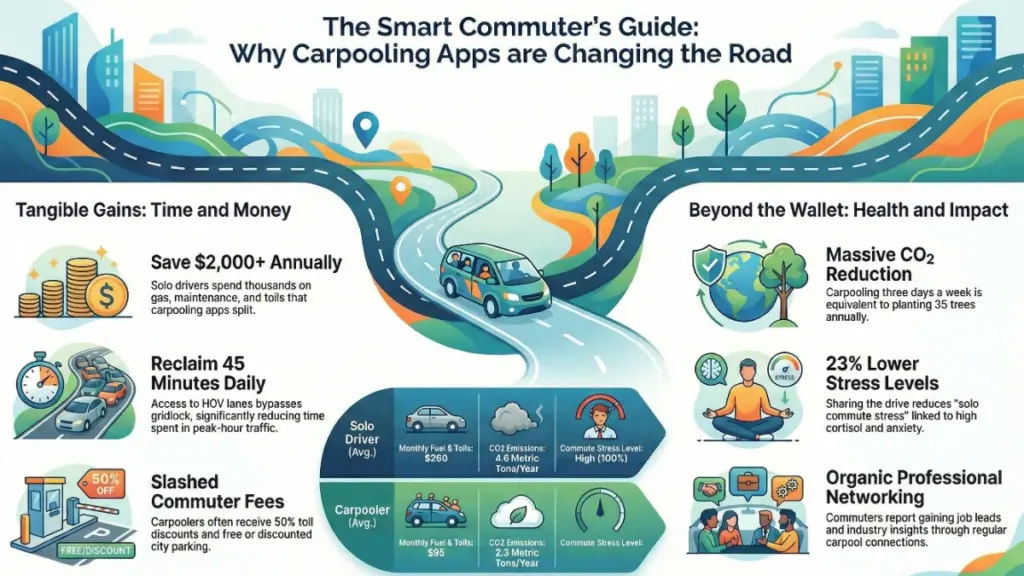
On average, Americans spend between $2,000 and $3,000 annually just on commuting costs when driving alone. This includes gas, wear and tear, parking fees, and tolls. Furthermore, if you’re commuting 30 miles each way to work (about the national average for suburban commuters), you could be spending $250-$350 per month on transportation alone.
How Carpooling Apps Cut Your Costs
When you share rides through apps like Waze Carpool, Scoop, or BlaBlaCar, you’re splitting these expenses among multiple passengers. Consequently, here’s what that looks like in practice:
- Gas costs reduced by 50-75%: With two riders, you immediately cut fuel expenses in half. With three or four passengers? The savings become even better.
- Parking fees slashed: Additionally, many cities offer discounted or free carpool parking. In San Francisco, for example, carpool parking at certain lots can save you $15-$20 daily.
- Toll discounts: Similarly, HOV lanes often mean reduced tolls. On bridges like the San Francisco-Oakland Bay Bridge, carpools save $3-$5 per crossing.
- Lower vehicle depreciation: Moreover, fewer miles on your personal car means it retains value longer.
Real-World Example
Sarah, a marketing manager from Austin, shares her experience: “I was spending about $280 a month on my commute—gas, parking, tolls, the works. After three months of using a carpooling app where I alternate driving weeks with two colleagues, I’m down to about $95 a month. As a result, that’s over $2,200 a year I’m saving, which basically covered a vacation to Costa Rica.”
Ultimately, the financial math is simple: fewer solo trips means dramatically lower transportation costs, period.
2. Significant Environmental Impact (And Why It Actually Matters)
You’ve probably heard that carpooling is “good for the environment,” but let’s get specific about what that really means in 2025.
The Carbon Footprint Reality Check
According to the EPA, a single passenger vehicle emits approximately 4.6 metric tons of carbon dioxide per year. When you carpool with just one other person, you’re essentially cutting that figure in half per person. Moreover, when you scale that across millions of users, the impact becomes massive.
Current Environmental Benefits by the Numbers
As it turns out, the statistics are quite impressive:
- Reduced emissions: Notably, each carpooling trip removes approximately 0.5-1.5 cars from the road, depending on the number of passengers
- Fuel conservation: Furthermore, carpooling apps have collectively saved an estimated 85 million gallons of gasoline in the U.S. in 2024 alone
- Air quality improvement: In addition, cities with high carpooling adoption rates (like Seattle and Portland) show measurable improvements in local air quality indexes
Beyond Just CO2
It’s not only about carbon emissions. In fact, carpooling reduces several other harmful pollutants:
- Particulate matter that causes respiratory issues
- Nitrogen oxides contributing to smog
- Road wear and infrastructure degradation
- Urban heat island effects from excessive pavement
Making It Personal
Consider this: if you carpool three days a week for a year instead of driving solo, you’re preventing roughly 1.5 tons of CO2 from entering the atmosphere. That’s equivalent to planting about 35 trees or taking 350 pounds of coal out of power plants.
For many users, knowing their daily commute choice has measurable environmental impact provides a genuine sense of purpose. As Michael, a carpooler from Denver, puts it: “I’m not a hardcore environmentalist, but it feels good knowing that my Tuesday and Thursday rides with coworkers mean two fewer cars idling in traffic. Overall, it’s a small thing that adds up.”
3. Access to High-Occupancy Vehicle (HOV) Lanes: The Time-Saving Secret
This might be the most underrated advantage of carpooling apps—and it’s absolutely massive if you live in a major metropolitan area.
What Are HOV Lanes, Really?
High-Occupancy Vehicle lanes (also called carpool lanes or diamond lanes) are restricted highway lanes reserved for vehicles with two or more occupants. Specifically, they’re designed to incentivize carpooling by offering faster, less congested travel routes.
The Time-Savings Reality
In cities with extensive HOV lane networks, the time difference is striking. For instance:
- Los Angeles: During peak hours, HOV lanes can save 20-45 minutes on major corridors like the I-405 and I-10
- Washington D.C.: Similarly, commuters report saving 15-30 minutes on routes like I-95 and I-66
- San Francisco Bay Area: Likewise, HOV access on Highway 101 and I-880 can cut commute times by 25-40%
- Houston: Additionally, the extensive managed lane system offers time savings of 15-35 minutes depending on the route
It’s Not Just About Speed
Beyond the raw time savings, HOV lanes offer several additional advantages:
- More predictable commute times: Specifically, less congestion means fewer surprise delays
- Lower stress levels: In particular, smooth-flowing traffic is significantly less mentally taxing than stop-and-go gridlock
- Better fuel efficiency: Furthermore, consistent speeds mean better gas mileage than constant acceleration and braking
The Catch (And How Apps Solve It)
Traditionally, the main challenge with HOV lanes was finding reliable carpool partners with matching schedules. Fortunately, this is exactly where modern carpooling apps excel—they use algorithms to match you with people traveling the same route at the same time, thereby making HOV lane access practical and consistent.
Jennifer, who commutes from Fremont to San Jose, shares: “Before using a carpooling app, my commute was 65-75 minutes of pure stress. Now that I regularly carpool and use the HOV lanes, it’s down to 35-40 minutes. Consequently, I get home an hour earlier and actually have time to go to the gym or cook dinner. It’s been life-changing.”
4. Reduced Stress and Mental Health Benefits
This advantage surprised me when I first started researching carpooling apps, but the psychological benefits are backed by solid data and countless user testimonials.
The Solo Commute Stress Factor
Driving alone in heavy traffic is consistently ranked as one of the most stressful daily activities. In fact, studies from the American Psychological Association show that long solo commutes are linked to:
- Increased cortisol levels (the stress hormone)
- Higher rates of anxiety and depression
- Reduced life satisfaction
- Physical health issues like elevated blood pressure
How Carpooling Changes the Experience
When you share your ride, several stress-reducing factors come into play. In particular:
Shared Responsibility
- On days you’re not driving, you can completely disconnect—read, catch up on emails, listen to podcasts, or simply rest
- Moreover, the mental break from navigating traffic provides genuine cognitive recovery time
Social Connection
- Casual conversation during rides combats the isolation of solo commuting
- Additionally, building relationships with regular carpool partners creates a sense of community
- Furthermore, shared experiences (traffic rants, podcast recommendations, local news discussions) make the time pass more pleasantly
Reduced Decision Fatigue
- First, apps handle the logistics of matching, route optimization, and coordination
- Second, you’re not constantly wondering if you should take this exit or that route
- Finally, less mental energy spent on commute planning leaves you fresher for work
Real Commuter Experiences
David, an accountant from Chicago, explains: “I used to arrive at work already exhausted from an hour of aggressive highway driving. Now I carpool three days a week—two days I drive, one day I’m a passenger. That one day where I can just sit back, answer a few emails, and have a normal conversation? Ultimately, it sets a completely different tone for my entire day.”
Notably, research from Stanford University found that commuters who regularly carpool report 23% lower stress levels compared to solo drivers covering the same routes. That’s not trivial—rather, it’s the difference between arriving at work already frazzled versus arriving refreshed and ready to be productive.
5. Professional Networking and Social Opportunities
This is the advantage that often catches people off guard—carpooling apps don’t just save you money and time, they can actually advance your career and expand your social circle.
The Unexpected Networking Hub
Think about it: you’re spending 30-60 minutes in a car with the same people multiple times per week. That’s more face time than you get with many of your coworkers. As a result, these consistent, low-pressure interactions create unique networking opportunities.
Professional Benefits
Many carpoolers report tangible career advantages. Notably:
- Industry insights: Sharing rides with people from different companies in your field provides valuable perspective on industry trends, company cultures, and job opportunities
- Mentorship opportunities: In addition, mixing experience levels naturally leads to knowledge sharing and advice
- Collaboration ideas: Furthermore, casual conversations often spark professional insights you wouldn’t get in formal settings
- Job leads: Moreover, multiple users report learning about job openings through carpool connections before they’re publicly posted
Building Genuine Relationships
Unlike forced networking events, carpooling creates organic relationship-building opportunities. For example:
- Shared experiences create bonds (everyone remembers “that time traffic was backed up for two hours”)
- Regular interaction naturally builds trust and familiarity
- The low-pressure environment makes authentic conversation natural
- Additionally, common ground (similar commute routes) provides easy conversation starters
Success Stories
Rachel, a software engineer in Seattle, shares: “I started carpooling with three other tech workers through Scoop. One was a senior developer at a company I’d always wanted to work for. After six months of morning commutes together, when a position opened up on her team, she personally recommended me. Subsequently, I got the job, and it came with a 25% raise. I literally would not have that opportunity without carpooling.”
Mark, from the suburbs of Philadelphia, adds: “My carpool partner introduced me to his kickball league. Now I’ve got a whole new friend group, and my weekends are way more fun. It sounds silly, but sharing a commute opened up my social life in a city where I’d been struggling to meet people.”
Not Everyone Wants to Talk—And That’s Okay
It’s worth noting that most carpooling apps let you indicate your preference for conversation or silence. If you’d rather have quiet time, you can match with like-minded riders. Therefore, the social benefit is there if you want it, but it’s not mandatory.
6. Enhanced Safety and Security Features
Modern carpooling apps have learned from the ride-sharing revolution and built robust safety features that address the legitimate concerns people have about sharing rides with strangers.
Built-In Safety Mechanisms
Today’s leading carpooling platforms include several protective features:
Identity Verification
- Phone number verification
- Email confirmation
- Social media profile linking (LinkedIn, Facebook)
- Driver’s license verification for drivers
- Background checks (varies by platform)
Real-Time Tracking and Sharing
- GPS tracking of every ride
- Additionally, the ability to share your route with emergency contacts
- Arrival time estimates for family and friends
- Furthermore, complete trip history logs
Rating and Review Systems
- Both drivers and passengers rate each other
- Importantly, low-rated users may be suspended
- Comments provide context beyond star ratings
- Moreover, reputation scores help you choose compatible carpool partners
In-App Communication
- No need to share personal phone numbers
- All messages logged and monitored
- Report buttons for inappropriate behavior
- Additionally, customer support access during trips
Emergency Features
- One-touch emergency contact buttons
- Ability to contact support during rides
- Automated alerts if a ride deviates significantly from planned route
How This Compares to Traditional Carpooling
Remember old-school carpooling arranged through work bulletin boards or community centers? There was minimal vetting, no tracking, and if something went wrong, you had little recourse. In contrast, modern apps have completely transformed the safety landscape.
Statistical Safety Record
Reassuringly, the data shows carpooling apps report incident rates significantly lower than general driving, largely because:
- Users are pre-screened
- All rides are tracked and logged
- Accountability is built into the rating system
- Users can be immediately reported and removed for violations
User Perspective
Lisa, a mother of two from Austin, initially hesitated about carpooling: “I was nervous about getting in a car with strangers. However, after seeing that my potential carpool partners had 4.8+ star ratings, verified profiles, and dozens of completed trips, I felt comfortable. The app shows me exactly who I’ll be riding with, their route history, and I can share my trip with my husband in real-time. Ultimately, it’s actually made me feel safer than driving alone—if something happened to me on the highway by myself, nobody would know for potentially hours.”
7. Convenience and Flexibility Through Smart Technology
The final major advantage is how carpooling apps have eliminated the traditional headaches that made old-school carpooling frustrating for many people.
The Old Carpooling Problems (Solved)
Traditional carpooling arrangements often failed because of several persistent issues:
- Rigid schedules: Miss your ride by 5 minutes, and you’re out of luck
- Limited partner options: You were stuck with whoever happened to live near you and work near you
- Difficult coordination: Phone calls, schedule changes, last-minute cancellations
- Lack of flexibility: If you needed to stay late at work or leave early, you disrupted everyone
How Modern Apps Fix These Issues
Fortunately, technology has addressed each of these pain points systematically.
Dynamic Matching Algorithms
Apps continuously match you with compatible riders based on:
- Route compatibility (pickup/dropoff proximity)
- Schedule alignment (departure times within 10-15 minute windows)
- Preferences (conversation level, music, temperature, etc.)
- Ratings and compatibility scores
Flexible Scheduling
- Some apps let you schedule rides days in advance
- Alternatively, others offer on-demand matching for that day
- Easy cancellation and rescheduling (usually up to a few hours before)
- Additionally, the ability to carpool just some days, not every day
Seamless Payment Integration
- Automated cost-splitting calculations
- Digital payment processing (no awkward cash exchanges)
- Transparent pricing models
- Furthermore, expense tracking for tax deductions or reimbursement
Route Optimization
- Apps calculate the most efficient pickup/dropoff sequence
- Real-time traffic integration for route adjustments
- Turn-by-turn navigation provided
- Minimal detour for all passengers
Communication Tools
- In-app messaging for coordination
- Arrival notifications
- Running late alerts
- Easy rescheduling interfaces
Multiple Platform Options
Different apps cater to different needs:
- Waze Carpool: Great for consistent commutes, affordable, large user base
- Scoop: Focused on daily work commutes, employer partnerships
- BlaBlaCar: Excellent for longer inter-city trips
- RideShare: Specialized regional options depending on your area
Real-World Flexibility
Tom, a consultant from Boston, explains: “My schedule is unpredictable—some days I’m in the office at 7 AM, other days not until 10 AM. I thought carpooling would be impossible. However, with the app, I just enter my schedule each morning, and it finds matches. On days when nobody’s going my way, I drive solo. Essentially, it’s the perfect balance of savings when available without being locked into rigid arrangements.”
The Backup Plan Feature
Most apps encourage users to have a backup transportation option (like a transit pass or parking permit) for days when carpooling doesn’t work out. Importantly, this built-in flexibility means you’re never stranded, which removes one of the biggest psychological barriers to trying carpooling.
Making the Switch: Is Carpooling Right for You?
After exploring these seven advantages—financial savings, environmental impact, HOV lane access, reduced stress, networking opportunities, enhanced safety, and technological convenience—you might be wondering if carpooling apps are worth trying.
The Ideal Candidates
Carpooling apps work exceptionally well if you:
- Have a regular commute of 15+ miles
- Live in or near a metropolitan area with other commuters
- Work standard business hours (though flexibility exists for other schedules)
- Are open to sharing your ride a few times per week (even 2-3 days offers significant benefits)
- Want to reduce transportation costs without sacrificing convenience
Getting Started Is Low-Risk
Here’s the beautiful part: there’s virtually no downside to trying carpooling apps. Moreover:
- Most are free to download and use
- No long-term commitments required
- You can start with just one or two days per week
- Easy to pause or stop if it’s not working for you
- Many offer trial periods or first-ride incentives
Common Concerns Addressed
“What if I don’t like my carpool partners?”
- Rate them low, and the app won’t match you again
- Additionally, most apps let you preview partner profiles before committing
“What if my schedule changes?”
- Most apps allow cancellations with a few hours’ notice
- Furthermore, you’re never locked into any specific arrangement
“What if I need my car during the day?”
- Only carpool on days when you don’t need your vehicle
- Alternatively, many people alternate: carpool three days, drive solo two days
The Bottom Line
Carpooling apps represent a rare win-win-win scenario: you save money, reduce environmental impact, and often improve your quality of life through reduced stress and unexpected social connections. Additionally, the technology has eliminated most traditional carpooling frustrations, thereby making it easier than ever to give it a try.
Clearly, the question isn’t really whether carpooling apps offer advantages—the data shows they do. Rather, the question is whether those specific advantages align with your personal priorities and lifestyle. For the 30+ million Americans already using these platforms, the answer has been a resounding yes.
Your Next Step
If you’re spending $150+ monthly on commuting, sitting alone in traffic wishing there was a better way, or simply curious about whether carpooling could work for you, download one of the major apps this week. Commit to trying it for just two weeks—four or five rides total. Then, see how it feels, calculate your actual savings, and assess whether the benefits match your expectations.
Chances are, like millions of others, you’ll wonder why you didn’t make the switch sooner. Your wallet, your stress levels, and the planet will thank you.
.