TL;DR: The federal EV tax credit expired on September 30, 2025, but you can still save big on electric cars through state programs. Seventeen-plus states offer rebates and tax credits ranging from $1,500 to $12,000, with California, Oregon, Maine, and New Jersey leading the pack. Stack these with utility rebates ($200–$2,500) and manufacturer discounts to cut thousands off your purchase price. The federal EV charger credit (30% up to $1,000) still runs through June 30, 2026, if your home qualifies. Use the DOE’s AFDC website to find every incentive available at your address, act before deadlines, and you can still drive electric for significantly less than sticker price—just without the simple federal checkbox of years past.
The New Reality of EV Incentives in 2026
The landscape for electric vehicle incentives has fundamentally shifted. Consequently, if you were counting on the federal EV tax credit of $7,500 to make your electric car purchase affordable, here’s the critical update: that credit officially expired on September 30, 2025, following the enactment of the “One Big Beautiful Bill” signed by President Trump on July 4, 2025.
This change has sent shockwaves through the EV market, leaving many prospective buyers wondering: Are there still ways to save money on electric cars? Fortunately, the answer is a resounding yes — however, the savings now come from a different source. Specifically, state EV incentives, utility rebates, and manufacturer discounts have become the primary pathways to affordable electric vehicle ownership. Moreover, depending on your location, you could still unlock $1,500 to $12,000 in savings on your next EV purchase.
Therefore, this comprehensive guide reveals every active state electric car rebate and EV tax credit available in 2026, explains exactly how to qualify, and furthermore shows you the proven strategy for stacking multiple incentives to maximize your savings.
Quick Answer: What EV Savings Are Available in 2026?
The federal EV tax credit ended October 1, 2025. Nevertheless, 17+ states continue offering their own electric vehicle rebates, state tax credits, and utility incentives — some worth up to $12,000. Ultimately, your total savings depend on your state of residence, household income, vehicle choice, and willingness to research utility programs.
Key Takeaway: The era of simple federal savings is over. Instead, the era of strategic, multi-layered incentive stacking has begun.
Federal EV Tax Credit Expiration: What Actually Changed
The Death of the $7,500 Federal Credit
For nearly three years, the Inflation Reduction Act (IRA) provided the backbone of American EV adoption through substantial federal tax credits. Specifically, these included up to $7,500 for qualifying new electric vehicles and up to $4,000 for qualifying used electric vehicles. As a result, these incentives drove millions of Americans toward electric mobility. Then came the “One Big Beautiful Bill” — comprehensive legislation that terminated these credits for any vehicle acquired after September 30, 2025.
The Narrow Exception: Pre-October 2025 Purchases
If you executed a binding written contract and made a payment before the September 30, 2025 deadline, you may still claim the credit on your 2025 federal tax return (filed in 2026). In this case, required documentation includes IRS Form 8936, vehicle VIN, plus contract date and payment proof.
Alternatively, for everyone else shopping in 2026, the federal well has run dry — but state programs are flowing stronger than ever.
The Surviving Incentive: EV Charger Tax Credit (30C)
One federal lifeline remains: the Alternative Fuel Vehicle Refueling Property Credit (Section 30C). In particular, this EV charger tax credit provides 30% of hardware and installation costs, up to $1,000 for residential installations, and up to $100,000 per port for commercial installations (with wage/apprenticeship requirements).
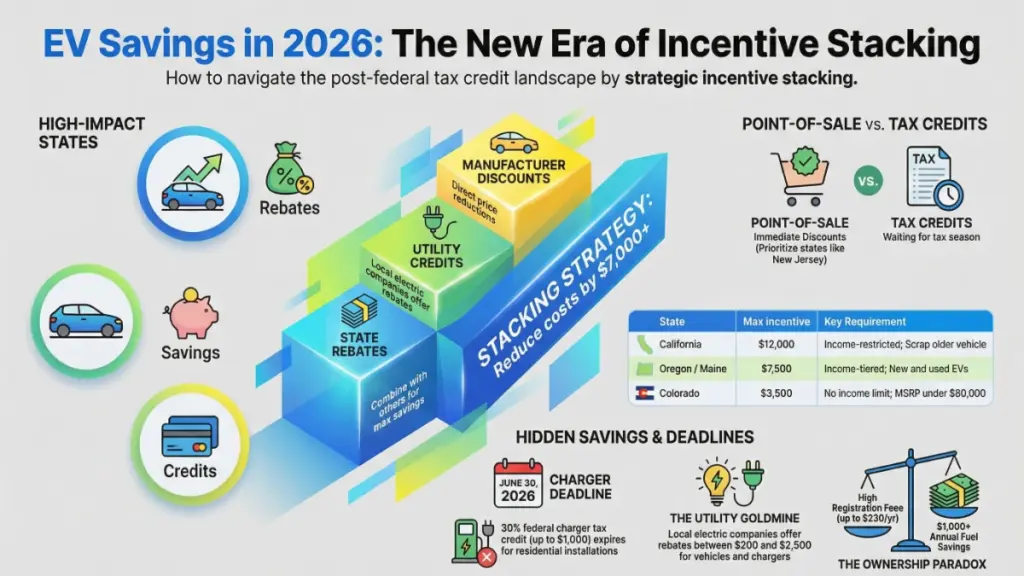
Critical Deadline: June 30, 2026 — installations must be operational by this date.
Location Restriction: Additionally, the property must be in an eligible census tract (typically low-income or rural areas). Therefore, check your eligibility using the DOE’s mapping tool.
Why State EV Incentives Matter More Than Ever in 2026
With federal support eliminated, state-level EV programs have become the primary mechanism for reducing upfront electric vehicle costs. In fact, several states have actually expanded their programs to fill the federal void.
Types of State EV Incentives
1. Point-of-Sale Rebates
- Immediately reduce price at dealership
- Consequently, no waiting for tax season
- For example, New Jersey Charge Up NJ and Delaware rebates
2. State Tax Credits
- Reduce your state tax liability
- However, require sufficient tax burden to utilize fully
- For instance, Colorado and Oregon offer these
3. Income-Qualified Programs
- Targeted assistance for lower-income households
- Often, these provide the most generous incentives available
- Notably, California CC4A and Nevada NV Energy programs exemplify this
4. Utility Company Rebates
- Separate from state government programs
- Furthermore, these can stack with state incentives
- Examples include PG&E, Xcel Energy, and Duke Energy
The Stacking Strategy
Smart buyers combine multiple incentive layers. First, claim your state rebate or tax credit for primary savings. Second, add utility rebates for secondary savings. Third, secure manufacturer discounts for tertiary savings. Fourth, claim the charger credit if eligible. Finally, factor in fuel and maintenance savings for long-term value.
As a result, a $45,000 EV can realistically cost under $38,000 out-of-pocket — even without federal help.
Complete State-by-State EV Incentive Guide (2026)
The following table summarizes major active programs. Critical note: Funding levels change, income limits vary, and programs can pause — therefore, always verify current status with your state energy office before purchasing.
| State | Incentive Type | Maximum Amount | Key Details |
|---|---|---|---|
| California | Grant/Rebate (CC4A/DCAP) | Up to $12,000 | Income-restricted; air district specific; includes charger assistance |
| Colorado | State Tax Credit | Up to $3,500 | No income limit; MSRP cap $80,000; new EVs only |
| Connecticut | Rebate (CHEAPR) | Up to $4,000+ | New & used eligible; income bonuses available |
| Delaware | Point-of-Sale Rebate | Up to $2,500 | PHEV up to $1,000; dealer participation required |
| Illinois | Rebate | Up to $4,000+ | IEPA program; check funding availability |
| Maine | Rebate | Up to $7,500 | Matches Oregon-level generosity; income tiers |
| Massachusetts | MOR-EV Rebate | Up to $3,500 | Battery-capacity based; used EVs eligible |
| Minnesota | Commerce Rebate | Up to $2,500 | New/used BEV & PHEV; income tiers apply |
| Nevada | Utility Rebate (NV Energy) | Up to $2,500 | Income-qualified households only |
| New Jersey | Charge Up NJ | Up to $4,000 | $2,000 base + $2,000 income bonus; point-of-sale |
| New Mexico | State Tax Credit | Varies | Recently introduced program |
| Oregon | State Tax Credit | Up to $7,500 | Among the most generous state programs |
| Rhode Island | State Incentive | Up to $1,500 | Available through state energy office |
| Vermont | MileageSmart Rebate | Up to $5,000 | Income-based; used EVs included |
| Washington D.C. | Charger Credit | Up to $1,000 | 50% of charger installation costs |
Sources: Tax Foundation, Electrek, Kelley Blue Book, Insurify, AFDC — compiled February 2026. Programs subject to change.
Deep Dive: The Most Generous State EV Programs
California: Up to $12,000 for Low-Income Buyers
California’s Clean Cars 4 All (CC4A) and Driving Clean Assistance Program (DCAP) represent the most aggressive state EV incentives in America. Specifically, these programs target lower-income residents who scrap older, high-polluting vehicles for electric replacements.
Total Package Includes:
- EV purchase grants (up to $12,000 depending on air district and income)
- Home charger installation assistance (up to $2,000)
- Prepaid charging cards (if home installation isn’t feasible)
- Public transit incentives
Requirements:
- Meet income limits (typically 300-400% of federal poverty level)
- Reside in qualifying air district
- Own eligible scrap vehicle (typically 2009 or older)
Even without CC4A eligibility, Californians can access utility rebates through PG&E (Pacific Gas & Electric), SCE (Southern California Edison), and SDG&E (San Diego Gas & Electric). Combined, these provide hundreds of dollars in additional charging credits.
Oregon & Maine: $7,500 State Credits Matching Federal Levels
Oregon and Maine have each constructed state EV tax credit programs worth up to $7,500 — effectively replacing the expired federal credit for their residents.
Oregon’s Program:
- Consistently well-funded since inception
- Features income-tiered structure (higher earners receive less)
- Covers both new and used EVs
Maine’s Program:
- Recently expanded to meet growing demand
- Matches Oregon’s generosity
- Maintains strong focus on rural accessibility
Consequently, for buyers in these states, the federal credit expiration creates minimal financial impact.
Colorado: $3,500 With No Income Restrictions
Colorado’s EV tax credit stands out as one of the few major programs without income limits. As such, any Colorado resident purchasing or leasing a new EV with MSRP up to $80,000 can claim up to $3,500.
Key Features:
- Nonrefundable tax credit (requires sufficient state tax liability)
- Stacks with Xcel Energy rebates
- Colorado Springs Utilities offers additional charger incentives
- Off-peak charging programs provide ongoing savings
New Jersey: Immediate Point-of-Sale Savings
New Jersey’s Charge Up NJ program delivers what buyers love most: instant savings at the dealership.
Structure:
- $2,000 base rebate (applied at purchase)
- Additional $2,000 for income-qualifying buyers
- Total potential: $4,000
Important Note: As of July 2025, zero-emission vehicles are subject to standard 6.625% sales tax (previously exempt). Nevertheless, the rebate typically more than offsets this tax burden.
Connecticut: The CHEAPR Program Evolution
Connecticut’s CHEAPR (Connecticut Hydrogen and Electric Automobile Purchase Rebate) program has adapted to the post-federal landscape. Currently, it offers up to $4,000+ for new EVs, used EV eligibility (with price caps), income-qualified bonuses, and requires dealer participation for point-of-sale application.
Hidden Goldmine: Utility Company EV Rebates
The most overlooked savings source in 2026? Your local electric utility company. Indeed, these EV rebates stack on top of state incentives and can add $200–$2,500 in additional savings.
Common Utility EV Incentive Types
1. Home Charger Rebates
- Range from $200–$600
- Available through Duke Energy, PG&E, Xcel Energy, and Florida Power & Light
- Require purchase and installation of qualifying Level 2 charger
2. Time-of-Use (TOU) Rate Discounts
- Save $300–$800/year
- Offer reduced electricity rates for overnight EV charging
- Result in lower operational costs throughout ownership
3. Monthly Bill Credits
- Provide $5–$10/month
- Require enrollment in managed charging program
- Yield $60–$120 annual value
4. Income-Qualified EV Purchase Rebates
- For example, Nevada Energy (NV Energy) offers $2,500 exclusively for low-income EV buyers
- Furthermore, these combine with state programs for massive total savings
Finding Your Utility’s EV Programs
The U.S. Department of Energy’s Alternative Fuels Data Center (AFDC) operates the definitive searchable database. To use it, simply visit afdc.energy.gov, enter your ZIP code, filter by Vehicle Incentives and Charging Incentives, then review federal, state, and utility programs specific to your location.
Pro Tip: This database updates regularly and remains the most reliable resource for current incentive information.
The Hidden Cost: Rising EV Registration Fees
Honest EV economics requires acknowledging rising state registration fees. As EV adoption grows, states face declining gas tax revenue (which funds road maintenance). Therefore, many have implemented EV-specific registration fees to compensate.
States With Notable EV Registration Fee Increases (2025-2026)
| State | Annual EV Registration Fee | Gas Car Comparison |
|---|---|---|
| Indiana | $230/year | ~$40-50 higher |
| Tennessee | $200/year | ~$30-40 higher |
| Wisconsin | $175/year | ~$25-35 higher |
| North Carolina | $214.50/year | ~$35-45 higher |
| Kansas | $165/year | ~$20-30 higher |
| Nebraska | $150/year | ~$20-25 higher |
The Paradox: Eleven states currently offer EV purchase incentives while simultaneously charging higher registration fees than gas vehicles.
Bottom Line: Even with elevated registration costs, the total cost of ownership for EVs remains favorable due to fuel savings ($1,000+/year), maintenance savings (reduced oil changes, brake wear, engine repairs), and 5-year ownership advantage ($5,000+ in operational savings).
The Complete EV Incentive Stacking Strategy (2026 Edition)
Follow this systematic approach to maximize your electric vehicle savings:
Step 1: Research State Programs
First, visit your state energy office website. Then, identify current rebate amounts and income restrictions. Next, verify eligible vehicle lists (some states exclude luxury EVs). Finally, check funding availability (popular programs can exhaust budgets).
Step 2: Investigate Utility Rebates
Begin by searching your utility’s website for “EV rebates” or “electric vehicle incentives.” Subsequently, call customer service to ask about charger installation rebates, EV purchase incentives, and time-of-use rate programs. Meanwhile, document all available programs.
Step 3: Explore Manufacturer Incentives
With federal credits gone, automakers have introduced aggressive discount programs. Specifically, these include:
- GM (Chevrolet Bolt, Equinox EV, Lyriq)
- Ford (F-150 Lightning, Mustang Mach-E)
- Hyundai/Kia (IONIQ 5/6, EV6, EV9)
- Tesla (Model 3, Model Y regional discounts)
- Rivian (R1T, R1S fleet incentives)
Action: Contact multiple dealers for current regional incentives and fleet pricing opportunities.
Step 4: Verify Charger Credit Eligibility
Initially, check if your home address falls within an eligible census tract using the DOE mapping tool. If eligible, plan charger installation before June 30, 2026. Subsequently, budget for 30% savings (up to $1,000) on equipment and installation.
Step 5: Calculate Total Cost of Ownership
Start with purchase price minus all incentives. Then, subtract annual registration fees. Next, add estimated annual fuel savings ($1,000+) and maintenance savings ($300-500). Finally, this equals your true 5-year ownership cost.
Frequently Asked Questions About 2026 EV Incentives
Can I still get the federal EV tax credit in 2026?
Only if you purchased your EV before October 1, 2025 AND have a signed written contract dated before deadline plus payment confirmation from before deadline. If eligible, claim using IRS Form 8936 on your 2025 tax return (filed in 2026).
Do state EV incentives apply to used electric vehicles?
Sometimes. State programs vary significantly. For example, California CC4A includes used EVs, whereas Massachusetts MOR-EV has a used component, and Minnesota covers both new and used. Conversely, New Jersey Charge Up NJ has limited used provisions, and Colorado excludes used EVs entirely. Therefore, always verify specific “used EV” definitions and price caps.
Are plug-in hybrids (PHEVs) eligible for state incentives?
Generally yes, but at lower amounts. For instance, Delaware offers $2,500 for BEVs versus $1,000 for PHEVs. Similarly, New Jersey includes PHEVs at reduced rates. Meanwhile, Minnesota covers both BEV and PHEV. Ultimately, full battery EVs typically receive higher rebates than plug-in hybrids.
Which states have NO EV incentives in 2026?
Several states offer minimal or no direct purchase incentives. Specifically, Kentucky provides no state EV rebates or tax credits. Likewise, Florida limits support to utility programs only. Meanwhile, Texas has no statewide program (though some local utilities offer rebates). Similarly, Ohio focuses primarily on utility-based incentives.
If you live in these states, consequently focus on utility rebates (often substantial), manufacturer discounts, and the charger credit (if your location qualifies).
How do I find every incentive available to me?
Use the AFDC incentive search tool. First, go to afdc.energy.gov/laws. Then, enter your ZIP code. Next, select “Personal Incentives.” Finally, review all federal, state, and local programs. This tool updates continuously and provides official program links for verification.
Final Verdict: EV Savings Still Exist in 2026
The expiration of the federal EV tax credit undeniably complicates the electric vehicle purchase equation. Indeed, for buyers in states without robust programs, the financial barrier has risen.
However, for residents of California, Oregon, Maine, Colorado, New Jersey, Massachusetts, and Connecticut, the savings opportunities remain compelling — often exceeding the expired federal credit when properly stacked.
Your 2026 EV Purchase Action Plan
Before visiting any dealership:
- Visit afdc.energy.gov — Search incentives by your exact address
- Check your state energy office — Verify current program funding and eligibility
- Contact your electric utility — Ask about EV purchase rebates and charger programs
- Request manufacturer incentives — Ask dealers about regional discount programs
- Consult a tax professional — If pursuing state tax credits or the charger credit
The Bottom Line
Electric mobility continues advancing, but the financial landscape has shifted from simple federal support to strategic, location-specific optimization. Consequently, buyers willing to research, stack incentives, and act before deadlines (especially the June 30, 2026 charger credit cutoff) can still achieve compelling total costs on electric vehicles.
The savings are there. The programs are active. The opportunity remains.
Your task: Navigate the new terrain, combine every available incentive, and drive electric for less than you might expect.