
TL;DR: Electric bicycles offer a transformative transportation solution that combines significant financial savings ($5,000–$10,000+ annually compared to cars), genuine health benefits through adjustable physical activity, and 90% lower carbon emissions than automobiles. Modern e-bikes in 2025 feature advanced technology like smart motors, 80+ mile ranges, and seamless connectivity, making them ideal for commuting, errands, and recreation. With predictable journey times, free parking, minimal charging costs, and expanding tax incentives, e-bikes have evolved from niche gadgets to practical car replacements for millions of riders—providing faster urban travel, reduced stress, and inclusive accessibility for all fitness levels while requiring minimal infrastructure investment.
The Transportation Revolution on Two Wheels
What if your daily commute cost less than a cup of coffee, improved your cardiovascular health, and guaranteed you’d never sit in rush-hour traffic again? This isn’t a futuristic fantasy—it’s the reality millions of people are discovering through electric bicycle ownership in 2025.
Electric bikes, commonly known as e-bikes, have evolved from niche gadgets to mainstream transportation solutions. According to the Confederation of the European Bicycle Industry, global e-bike sales exceeded 49 million units in 2024, and market analysts project continued explosive growth throughout 2025 and beyond. Whether you’re a daily commuter battling urban congestion, a weekend warrior seeking outdoor adventure, or a environmentally conscious consumer looking to reduce your carbon footprint, electric bicycle benefits extend far beyond simple transportation.
In this comprehensive guide, we’ll explore every major advantage of electric bikes—from substantial financial savings and proven health benefits to environmental impact and unmatched practicality. By the end, you’ll understand exactly why an e-bike might be the smartest investment you make this year.
What Is an Electric Bicycle? Understanding the Basics
Before diving into the benefits, let’s clarify what distinguishes an electric bicycle from traditional bikes and electric motorcycles.
An electric bicycle is essentially a standard bicycle enhanced with a battery-powered electric motor that provides pedal assistance (often called “pedelec” mode) or, in some models, throttle-controlled power. Unlike electric motorcycles or scooters, the motor doesn’t completely replace your pedaling effort—it amplifies it. Imagine having a consistent tailwind pushing you forward, making hills feel flat and long distances feel manageable.
Understanding E-Bike Classification in 2025
In the United States, electric bicycles typically fall into three distinct classes, and understanding these categories is crucial for legal compliance and choosing the right model:
| Class | Motor Operation | Maximum Speed | Best For |
|---|---|---|---|
| Class 1 | Pedal-assist only | 20 mph | Bike paths, mixed-use trails, beginners |
| Class 2 | Throttle-assisted | 20 mph | Commuters, those needing full motor control |
| Class 3 | Pedal-assist | 28 mph | Experienced riders, longer commutes, road use |
These classifications determine where you can legally ride, with Class 1 bikes generally having the most access to bike paths and trails. However, regardless of classification, the core electric bike advantages remain consistent—and they’re genuinely transformative.
1. Financial Benefits: How E-Bikes Save You Thousands
Let’s address the most immediate concern for most buyers: cost. The financial case for electric bicycles is remarkably compelling when compared to automobile ownership.
The True Cost of Car Ownership vs. Electric Bikes
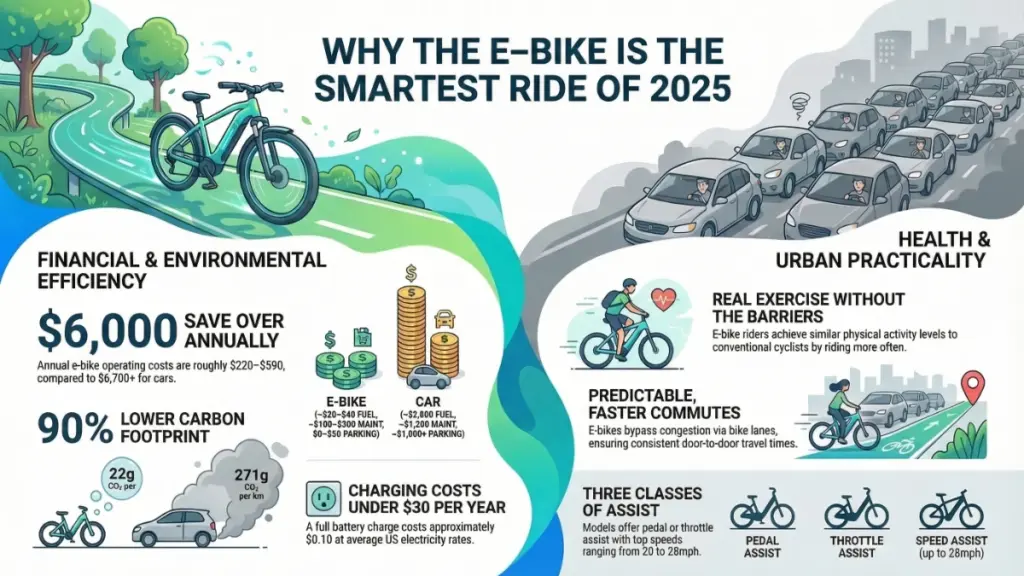
The American Automobile Association’s 2024 Your Driving Costs study reveals a startling reality: the average American spends over $12,000 annually on car ownership. This figure encompasses fuel, insurance premiums, maintenance, depreciation, and financing costs. In stark contrast, operating an electric bicycle costs approximately $100–$400 per year, covering electricity for charging and basic maintenance like brake pads and tire replacements.
Consider this scenario: even a premium e-bike with a $3,000 price tag pays for itself within months if it replaces regular car usage for commuting. The return on investment is remarkably fast.
Annual Cost Comparison: Car vs. Electric Bicycle
| Cost Category | Car (Annual) | E-Bike (Annual) |
|---|---|---|
| Fuel / Electricity | ~$2,800 | ~$20–$40 |
| Insurance | ~$1,700 | ~$100–$200 |
| Maintenance | ~$1,200 | ~$100–$300 |
| Parking | ~$1,000+ | $0–$50 |
| Total Annual Cost | ~$6,700+ | ~$220–$590 |
Sources: AAA 2024 Driving Costs Report; Bosch eBike Systems efficiency data
Charging Costs Are Negligible
One of the most surprising electric bicycle benefits is the minimal cost of charging. A typical 500Wh e-bike battery costs approximately $0.07–$0.12 to charge from empty to full at average U.S. electricity rates. For a commuter traveling 20 miles round-trip daily, annual charging costs remain under $30. Compare this to gasoline expenses for the same distance, which would easily reach hundreds of dollars annually.
Eliminating Parking Expenses
Urban parking represents a hidden financial burden for car owners. In major cities like New York, Boston, San Francisco, and Chicago, daily parking garage rates range from $30–$50. Monthly parking permits can exceed $400. Electric bicycles eliminate this expense entirely—bike racks are free and abundant in most urban areas. Over a year of daily commuting, parking savings alone can total $5,000–$10,000.
Reduced Maintenance and Repair Costs
Automobile maintenance is notoriously expensive. Oil changes, transmission services, brake replacements, and unexpected repairs quickly add up. Electric bicycles feature simpler mechanical systems with fewer components requiring regular service. Annual maintenance typically involves basic tasks like chain lubrication, brake adjustments, and occasional tire replacement—procedures that cost a fraction of automotive service.
2. Health Benefits: Electric Bikes Provide Real Exercise
Perhaps the most persistent myth about electric bicycles is that they eliminate physical activity. Research definitively proves otherwise.
Scientific Evidence: E-Bikes Deliver Meaningful Exercise
A landmark 2019 study published in the International Journal of Environmental Research and Public Health compared physical activity levels between conventional cyclists and e-bike riders. The findings were surprising: e-bike riders achieved similar levels of moderate physical activity compared to traditional cyclists. More importantly, e-bike owners rode significantly more frequently and for longer distances than their conventional cycling counterparts.
The explanation is intuitive. Traditional cycling barriers—arriving at work sweaty, struggling up steep hills, or exhausting yourself before reaching your destination—disappear with pedal assistance. When exercise becomes enjoyable rather than grueling, consistency improves dramatically.
Cardiovascular and Muscular Benefits
Riding an electric bicycle still engages your:
- Leg muscles (quadriceps, hamstrings, calves)
- Core stability muscles
- Cardiovascular system
- Balance and coordination
The key difference is control. You determine the assistance level, allowing you to maintain elevated heart rate without overexertion. This makes e-bikes particularly valuable for interval training and sustained aerobic exercise.
Mental Health and Stress Reduction
The mental health benefits of electric bicycle commuting are equally significant. Research consistently demonstrates that regular cycling reduces:
- Cortisol levels (stress hormone)
- Anxiety and depression symptoms
- Cognitive fatigue
- Sleep disturbances
Swapping a stressful, congested freeway commute for an invigorating e-bike ride through neighborhoods and parks creates a profound psychological shift. You’re not just changing transportation modes—you’re transforming your daily experience of movement and outdoor exposure.
Accessibility for All Fitness Levels
Electric bicycles democratize cycling fitness. They’re ideal for:
- Returning riders recovering from injury or illness
- Older adults maintaining mobility and independence
- Individuals with chronic conditions requiring exercise modification
- Fitness beginners building cardiovascular endurance gradually
The adjustable assistance levels mean you can push hard on energetic days and conserve energy when needed. This flexibility makes e-bikes one of the most inclusive forms of active transportation available.
3. Environmental Impact: Why E-Bikes Are the Green Choice
Environmental consciousness drives many electric bicycle purchases, and the ecological advantages are substantial.
Carbon Emissions: The Numbers Tell the Story
The European Cyclists’ Federation conducted comprehensive lifecycle analyses comparing transportation modes. Their findings are striking:
- Electric bicycle: ~22 grams CO₂ per kilometer (full lifecycle including battery manufacturing and electricity generation)
- Average automobile: ~271 grams CO₂ per kilometer
This represents a 90%+ reduction in carbon emissions when choosing an e-bike over a car. As electrical grids incorporate increasing renewable energy sources, this advantage continues growing.
Resource Efficiency and Infrastructure Impact
Automobiles require massive infrastructure investments: widened highways, expansive parking structures, complex traffic management systems, and continuous road maintenance. These projects consume enormous material resources and generate significant construction-related emissions.
Bicycles, including electric models, require minimal infrastructure. A single bike lane can transport more people per hour than a car lane using a fraction of the physical space and construction materials. The environmental savings extend beyond direct emissions to encompass urban planning and resource allocation.
Battery Technology and Recycling Progress
Critics often cite lithium-ion battery disposal as an environmental concern. While this issue deserves attention, the industry has responded proactively:
- Major manufacturers (Bosch, Shimano, Yamaha) operate comprehensive battery take-back programs
- Recycling infrastructure is scaling rapidly with improving recovery rates
- Battery longevity has increased significantly, with modern e-bike batteries lasting 3–5 years or 500–1,000 charge cycles
- Second-life applications repurpose aging batteries for stationary energy storage
When compared to the environmental cost of gasoline extraction, refining, and combustion—not to mention automotive manufacturing—e-bike battery impact is minimal.
4. Practical Convenience: Real-World Problem Solving
Beyond quantifiable metrics, electric bicycles solve everyday transportation challenges in ways that transform daily routines.
Defeating Urban Traffic Congestion
The INRIX 2024 Global Traffic Scorecard reports that average American commuters spend over 50 hours annually stuck in traffic. This represents more than a full work week of wasted time, not to mention associated stress and fuel costs.
Electric bicycles bypass congestion entirely. Bike lanes, multi-use paths, and urban shortcuts inaccessible to cars create efficient travel corridors. Many urban e-bike commuters discover their door-to-door journey time actually decreases compared to driving, especially during peak hours.
Extended Range Without Physical Exhaustion
Modern electric bicycles eliminate traditional cycling limitations. Current models offer ranges of 40–100+ miles per charge, depending on battery capacity, assist level, terrain, and rider input. This means:
- 15-mile uphill commutes arrive without sweat or fatigue
- Weekend adventures cover 50+ miles without concern for return energy
- Errand running extends to multiple destinations without cumulative exhaustion
Leading 2025 models like the Trek Rail 9.9 XTR and Specialized Turbo Vado SL 5.0 deliver 80+ mile ranges with smooth, natural-feeling assistance that enhances rather than replaces your pedaling.
Cargo Capacity and Family Transportation
Cargo electric bicycles have revolutionized family transportation. Models like the Tern GSD S10 and Urban Arrow Family demonstrate that e-bikes can genuinely replace second cars for many households. These capable machines transport:
- Multiple children with safety seats
- Weekly grocery loads
- Bulky items and sports equipment
- Home improvement supplies
In cycling-friendly cities like Amsterdam and Copenhagen, cargo e-bikes have largely replaced automobiles for family errands and school runs. American cities are rapidly following this model as infrastructure improves.
Parking Simplicity and Security
Finding parking ranks among the most frustrating aspects of urban driving. Electric bicycles eliminate this stress entirely. Locking up takes seconds, racks are typically located near building entrances, and many employers provide secure indoor bike storage. No circling blocks, no meter feeding, no garage fees.
5. Commuting Advantages: The Ultimate Transportation Solution
For daily commuters, electric bicycles offer specific advantages that make them arguably the best urban transportation investment available.
Predictable Journey Times
Automobile commute times vary wildly based on traffic accidents, weather conditions, road construction, and rush-hour congestion. This unpredictability creates chronic stress and complicates schedule planning.
E-bike commutes are remarkably consistent. Once you establish your route, you can predict arrival times within minutes regardless of external conditions. This reliability transforms morning routines and reduces transportation-related anxiety.
Integration with Public Transit
Many commuters combine electric bicycles with public transportation for longer journeys. Most transit systems accommodate bikes, and folding e-bike models make multimodal commuting seamless. This flexibility extends your effective range without requiring automobile dependency.
Employer Benefits and Tax Incentives
The financial advantages of e-bike commuting extend to tax benefits:
- IRS Qualified Bicycle Commuting Reimbursement allows pre-tax reimbursement for cycling-related expenses
- State-level e-bike tax credits are expanding rapidly in 2025
- California, Colorado, and Connecticut currently offer purchase incentives
- Employer subsidy programs are increasingly common as companies promote sustainable commuting
Check your state’s energy office or department of transportation website for current incentive programs—these can reduce upfront costs by $500–$1,500.
Workplace Wellness Benefits
Progressive employers recognize that e-bike commuting employees arrive energized, alert, and ready to work. Some organizations offer:
- Secure indoor bike storage and charging stations
- On-site shower and locker facilities
- Subsidized e-bike purchase programs
- Guaranteed ride-home programs for unexpected situations
6. Technology and Innovation: 2025’s Best E-Bike Features
Electric bicycle technology has matured remarkably. Today’s models bear little resemblance to the heavy, clunky designs of five years ago.
Advanced Motor Systems
Leading manufacturers have developed sophisticated mid-drive motors that deliver:
- Bosch Performance Line CX: Intelligent torque sensing, 85Nm power output, whisper-quiet operation
- Shimano EP8: Compact design, 85Nm torque, customizable power profiles
- Yamaha PW-X3: Responsive cadence detection, high-efficiency power delivery
These systems respond instantaneously to your pedaling input, creating natural-feeling assistance that enhances rather than dominates your riding experience.
Battery Innovation
Modern e-bike batteries feature:
- Increased energy density (more range in smaller packages)
- Reduced weight (many systems under 6 pounds)
- Fast charging capability (0-80% in 2-3 hours)
- Smart management systems optimizing longevity and performance
Total bike weights have decreased significantly, with many quality e-bikes now weighing 37–48 pounds—manageable for most riders and dramatically lighter than any automobile.
Connectivity and Smart Features
2025 electric bicycles incorporate technology previously found only in electric cars:
- Bluetooth and ANT+ smartphone connectivity
- GPS tracking and anti-theft systems
- Real-time range and battery health monitoring
- Automatic motor adjustment based on GPS route data
- Over-the-air software updates
- Fitness tracking and ride analytics
These features enhance security, optimize performance, and integrate cycling into your digital lifestyle.
7. Choosing the Right Electric Bicycle: A Buyer’s Guide
With countless models available, selecting the right e-bike requires understanding your specific needs.
Determine Your Primary Use Case
Commuting: Prioritize reliability, weather protection, and integrated lights. Consider Class 3 models for longer distances.
Recreation: Focus on comfort, suspension quality, and versatile tire selection. Class 1 or 2 bikes often suffice.
Cargo/Family: Evaluate weight capacity, stability, and safety features for passenger transport.
Off-Road: Seek robust suspension, high-torque motors, and durable construction.
Essential Features to Evaluate
| Feature | What to Look For | Why It Matters |
|---|---|---|
| Battery Capacity | 400–700Wh for most uses | Determines range and longevity |
| Motor Placement | Mid-drive preferred | Better weight distribution and efficiency |
| Brakes | Hydraulic disc brakes | Essential for safety at e-bike speeds |
| Drivetrain | Quality derailleur or internal hub | Reliability and low maintenance |
| Frame Material | Aluminum or carbon fiber | Weight and durability balance |
Test Riding: The Essential Step
Specifications only tell part of the story. Always test ride before purchasing. Pay attention to:
- Motor engagement smoothness
- Handling characteristics
- Comfort over varied terrain
- Control interface intuitiveness
- Overall build quality
Reputable dealers encourage extended test rides and provide expert guidance based on your specific requirements.
Conclusion: Is an Electric Bicycle Right for You?
Electric bicycles won’t replace every automobile journey—and acknowledging limitations is important. Long highway trips, transporting large groups, or residing in areas without safe cycling infrastructure present genuine challenges.
However, for the vast majority of daily transportation needs—commuting, errands, recreation, and short-to-medium distance travel—electric bikes offer genuinely superior solutions across virtually every meaningful metric.
Key Takeaways: Why 2025 Is the Year to Go Electric
Financial savings of $5,000–$10,000+ annually compared to car ownership
Documented health benefits including cardiovascular fitness and mental wellness
90%+ reduction in carbon emissions versus conventional automobiles
Faster, more predictable commutes in urban environments
Unmatched technology making e-bikes more capable than ever
Inclusive accessibility for riders of all ages and fitness levels
The electric bicycle revolution isn’t coming—it’s here. With improving infrastructure, advancing technology, and growing cultural acceptance, 2025 represents an ideal moment to embrace this transportation transformation.
Your next step: Visit a local electric bicycle dealer for a test ride. No amount of research captures the genuine sensation of effortless hill climbing, the freedom of bypassing traffic, or the satisfaction of arriving energized rather than stressed. Experience the electric bicycle advantage firsthand, and discover why millions of riders are making the switch.
Ready to explore electric bicycle options? Share this guide with friends considering the switch, and start your journey toward smarter, healthier, more sustainable transportation today.