TL;DR: Electric vehicles are transforming from mere transportation into intelligent components of urban infrastructure through technologies like Vehicle-to-Grid (V2G) and bidirectional charging. These systems allow EVs to store energy during low-demand periods and sell it back to the grid during peak hours, reducing strain on electrical infrastructure while generating income for drivers. Smart cities worldwide—from Utrecht to Shenzhen—are implementing integrated charging hubs, adaptive traffic systems, and Zero Emission Zones that prioritize EVs, cutting urban pollution by over 30% in some areas. Despite challenges around grid capacity, equity, and data privacy, the V2G market is projected to grow from $1.4 billion in 2024 to $12.5 billion by 2034, signaling that the future of urban mobility is already here and electric vehicles are its cornerstone.
The Future of Urban Mobility Is Already Here
Picture this: You’re stopped at a red light in your electric vehicle, and silently, automatically, your car’s battery sells stored energy back to the city grid. That power helps stabilize the neighborhood’s electricity demand during the evening rush. No buttons pressed, no apps opened—just your EV functioning as a mobile power station within an intelligent urban ecosystem.
This isn’t science fiction. This is vehicle-to-grid technology (V2G) in action, already operational in Utrecht, Netherlands, and Columbus, Ohio. The integration of electric vehicles into smart city infrastructure represents the most significant urban transformation of our decade—affecting your daily commute, electricity costs, and the very air you breathe.
In this comprehensive guide, we’ll explore how bidirectional charging technology, smart charging infrastructure, and zero emission zones are creating interconnected urban systems where EVs serve as energy assets, data sources, and mobility solutions. Whether you’re an EV owner, urban planner, or sustainability advocate, understanding these integrations is crucial for navigating the cities of tomorrow.
What Is a Smart City? Understanding the EV Integration Framework
A smart city leverages digital technology, IoT sensors, and data analytics to optimize urban operations—improving efficiency, sustainability, and quality of life. Think of it as upgrading from a rotary phone to a 5G smartphone: interconnected, intelligent, and responsive.
Electric vehicles fit into this ecosystem uniquely. Unlike internal combustion engine vehicles, EVs are fundamentally digital devices. They communicate with smart charging networks, respond to dynamic pricing signals, store renewable energy, and generate valuable operational data. This transforms them from mere transportation tools into mobile nodes within urban digital infrastructure.
The Three Critical Roles of EVs in Smart Cities
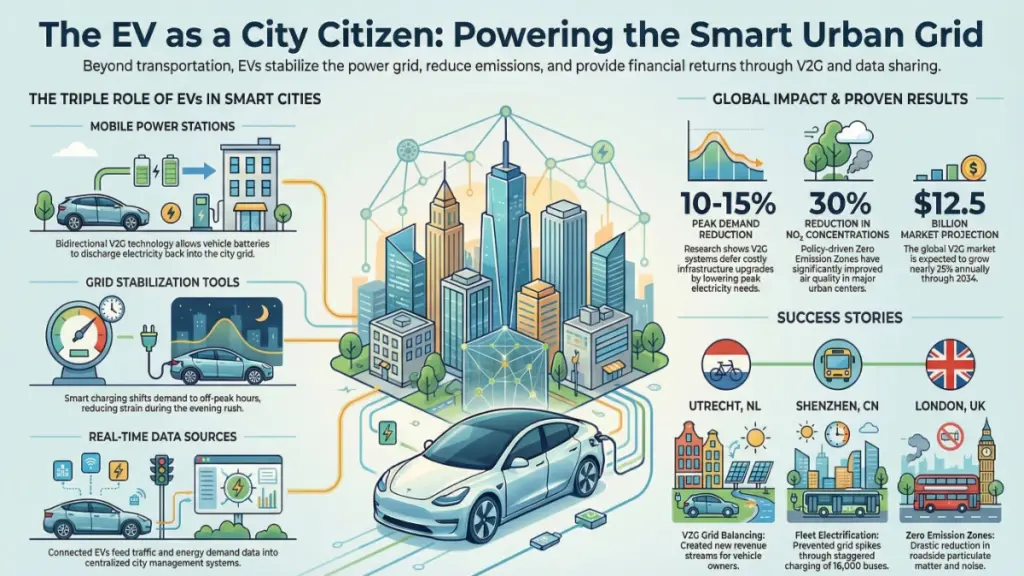
- Energy Storage Assets: Through bidirectional EV charging, vehicle batteries store and discharge electricity, effectively turning your car into a distributed power station when plugged in.
- Real-Time Data Sources: Connected EVs feed location, traffic patterns, and grid demand data into centralized city management systems, enabling predictive urban planning.
- Grid Stabilization Tools: Smart charging behavior shifts based on real-time grid conditions, reducing peak demand strain and supporting renewable energy integration.
This triple functionality makes EV-smart city integration exponentially more impactful than simply replacing gasoline with electricity—it’s about creating responsive, resilient urban energy ecosystems.
Vehicle-to-Grid Technology (V2G): Your EV as a Power Plant
Among all EV-smart city technologies, Vehicle-to-Grid (V2G) stands out as the most transformative. Rather than merely drawing electricity from the grid, bidirectional charging enables your EV to push energy back during high-demand periods.
Why V2G Technology Matters for Grid Stability
Electricity grids face constant balancing challenges. Demand spikes at 6 PM when residents return home, cook dinner, and activate climate control. Meanwhile, solar generation peaks at midday. V2G technology bridges this gap elegantly: your EV charges during low-cost, high-sunlight hours, then returns stored energy during expensive peak periods.
Real-World V2G Results and Market Growth:
The bidirectional EV charging market is experiencing explosive growth. According to recent market analysis, the global V2G/V2H system market was valued at USD 1.4 billion in 2024 and is projected to reach USD 12.5 billion by 2034, representing a CAGR of 24.8%. This growth reflects increasing recognition of vehicle-to-grid technology as essential infrastructure.
In Utrecht, Netherlands, Nissan Leaf owners participating in the We Drive Solar V2G pilot earn income while supporting local grid stability. Research from the University of Delaware demonstrates that well-managed V2G systems can reduce peak grid demand by 10-15%—deferring costly infrastructure upgrades while creating revenue streams for drivers.
The Financial Case for Bidirectional Charging
For drivers, bidirectional charging offers tangible economic benefits. Participants in V2G pilot programs have effectively reduced net annual charging costs to near zero by selling energy during peak pricing windows. As bidirectional charging becomes standard equipment—already available in the Nissan Leaf, Ford F-150 Lightning, and Hyundai IONIQ 5—millions will access these opportunities.
Addressing Battery Concerns:
Critics note that V2G technology adds charge cycles to vehicle batteries. However, automakers and researchers are developing smart charging protocols that protect long-term battery health. Early evidence indicates that properly managed bidirectional charging has minimal impact on pack longevity, especially when compared to the economic benefits generated.
Smart Charging Infrastructure: Building the Connected Grid
Not all EV-grid interactions require bidirectional flow. Smart charging—where vehicles charge based on grid conditions and energy prices—is already delivering significant benefits globally.
How Intelligent Charging Systems Work
Smart charging infrastructure uses real-time electricity pricing to shift demand away from peak hours. If your city’s grid experiences strain between 5-9 PM, your charger automatically delays charging until 11 PM when prices drop and grid stress decreases. You wake to a full battery; the city avoids a demand spike.
EV Charging Hubs as Urban Infrastructure
Modern cities are designing EV charging hubs as core infrastructure—comparable to subway stations or transit depots. These multi-functional facilities provide:
- High-speed DC fast charging for rapid vehicle turnaround
- Grid-scale battery storage using stationary banks alongside vehicle batteries
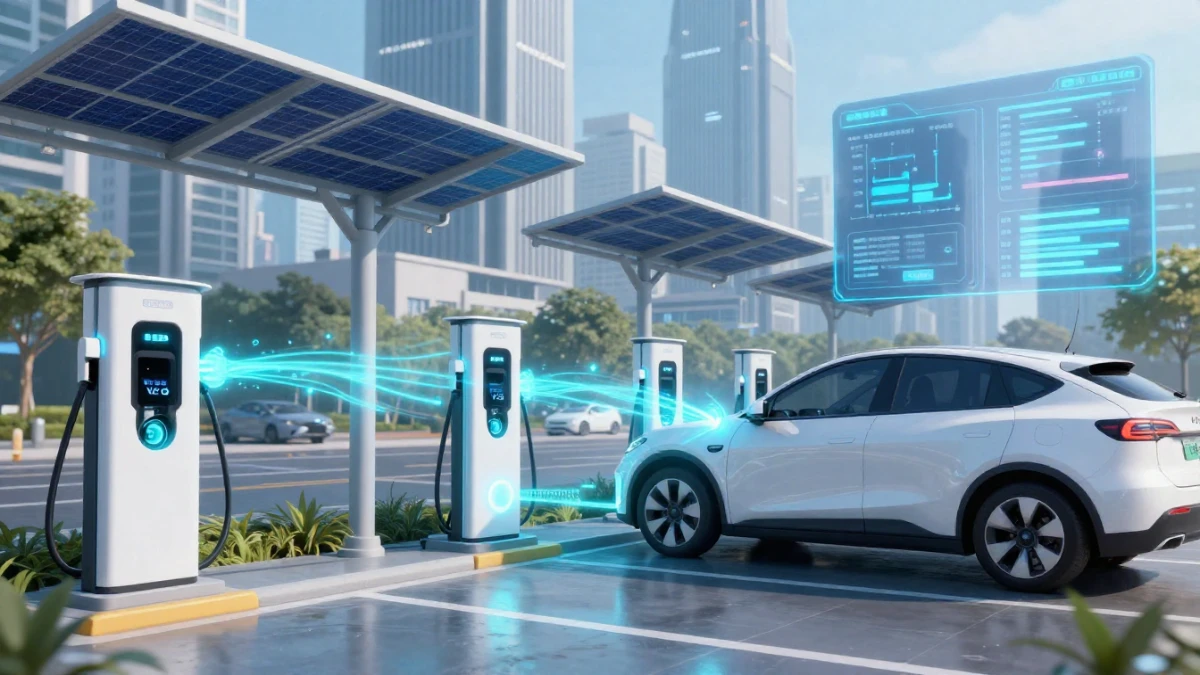
- Solar canopies generating renewable power on-site
- Data collection points feeding city traffic and energy management systems
Shenzhen, China exemplifies this model at scale. After fully electrifying its 16,000+ bus fleet, the city deployed a smart charging network coordinating hundreds of depots. By staggering charging loads, Shenzhen prevents grid spikes while ensuring fleet readiness. The result: cleaner air, reduced noise pollution, and enhanced grid resilience.
EV Integration Across Smart City Systems: Global Implementation
The following overview illustrates how electric vehicle integration functions across different smart city domains, with real examples from leading municipalities:
| Smart City Feature | EV Role | Primary Benefit | Leading Example |
|---|---|---|---|
| V2G Grid Balancing | Battery storage | 10-15% peak demand reduction | Utrecht, Netherlands |
| Adaptive Traffic Signals | Real-time routing data | 20%+ idle emission reduction | Columbus, Ohio |
| Smart Parking Systems | EV bay allocation | Reduced traffic congestion | Amsterdam, Netherlands |
| Renewable Integration | Solar/wind buffering | Stabilized intermittent supply | Oslo, Norway |
| Shared Mobility Hubs | Fleet electrification | Lower per-mile emissions | Shenzhen, China |
| Zero Emission Zones | Zero-tailpipe operation | 30%+ PM2.5 reduction | London, UK |
This geographic diversity demonstrates that smart EV integration is a global phenomenon addressing universal urban challenges: congestion, air quality, grid reliability, and climate targets.
Traffic Management, Zero Emission Zones, and Urban Mobility Revolution
Beyond energy applications, electric vehicles are fundamentally reshaping urban traffic management. Smart systems utilize EV data to optimize traffic flow, reduce idle time, and prioritize low-emission vehicles in congested corridors.
Adaptive Traffic Signals and EV Optimization
Columbus, Ohio—winner of the U.S. Department of Transportation Smart City Challenge—has deployed adaptive signal systems using real-time vehicle data to reduce intersection wait times. For EVs specifically, reduced idling translates to improved efficiency and lower energy consumption.
The DOT’s Smart Columbus project found that optimized signals can reduce vehicle emissions at intersections by over 20%. Additionally, navigation apps integrated with city traffic systems now route EVs along corridors with available fast charging, accounting for both travel time and charging needs—reducing range anxiety while distributing charging demand evenly.
Zero Emission Zones: Policy Driving Adoption
Zero Emission Zones (ZEZs) represent powerful policy tools accelerating EV adoption. Cities including London, Amsterdam, and Oslo have implemented ZEZs—urban areas restricting access to electric and hydrogen vehicles during specific hours.
London’s Ultra Low Emission Zone (ULEZ), expanded in 2023 to cover all of Greater London, has reduced roadside NO₂ concentrations by over 30% in affected areas according to Transport for London data. These zones create compelling market incentives for EV adoption while delivering immediate air quality improvements.
For urban planners, zero emission zones work synergistically with EV infrastructure investment: build the charging network, restrict polluting vehicles, and watch the transition accelerate.
Challenges in EV-Smart City Integration
Despite tremendous promise, smart city EV integration faces significant obstacles requiring coordinated solutions:
Infrastructure Limitations
Many urban grids, particularly in older cities, weren’t designed for large-scale EV charging demand. Upgrading distribution infrastructure requires substantial investment and time—challenges that must be addressed through public-private partnerships and innovative financing models.
Equity and Access Concerns
Smart charging, V2G programs, and EV incentives have historically benefited higher-income residents with garages and home charging capabilities. Ensuring apartment dwellers and lower-income communities access these benefits is a critical policy priority. Successful cities are implementing curbside charging, community charging hubs, and income-based incentives to democratize access.
Data Privacy and Security
Connected EVs generate vast quantities of location and behavioral data. Robust governance frameworks are essential to prevent misuse and protect driver privacy. Cities must establish clear data ownership rights, anonymization standards, and cybersecurity protocols.
Interoperability Standards
Different automakers, charging networks, and city systems often employ incompatible protocols. Emerging standards like ISO 15118 are bridging these gaps, but full interoperability remains a work in progress. Industry-wide adoption of open standards is crucial for seamless V2G implementation.
These challenges aren’t insurmountable—they require intentional investment, thoughtful policy, and cross-sector collaboration. Cities treating EV integration as systems-level transformation rather than simple infrastructure procurement are achieving the best outcomes.
What Smart City EV Integration Means for Drivers
If you currently drive an electric vehicle—or are considering the switch—the smart city revolution delivers tangible benefits:
Intelligent Charging Convenience: Mobile apps now locate available chargers, reserve spots, and schedule overnight charging based on grid pricing—maximizing convenience while minimizing costs.
V2G Income Potential: As bidirectional charging spreads, earning money by selling stored energy during peak hours becomes increasingly accessible. Early adopters in pilot programs report offsetting most or all of their charging costs.
Optimized Navigation: Next-generation routing systems integrate your charge level, nearby fast charging options, and real-time traffic into seamless journey planning—eliminating range anxiety.
Zero Emission Zone Access: As ZEZs expand, EV drivers gain exclusive access to city center areas restricted to combustion vehicles—saving significant time in congested urban cores.
Reduced Total Cost of Ownership:Smart charging and time-of-use pricing make charging at the cheapest possible times effortless, further improving the economic case for electric mobility.
The trajectory is clear: your EV will become increasingly intelligent, and the city around it will evolve to maximize its value. Early adopters stand to benefit most from this symbiotic evolution.
The Road Ahead: Designing Cities for Electric Mobility
The integration of electric vehicles into smart city infrastructure represents one of the most consequential urban transformations underway—and acceleration is imminent. From V2G grid balancing to zero emission zones, from adaptive traffic management to intelligent charging hubs, EVs are evolving from clean transportation into active urban system participants.
Cities thriving in coming decades will be those investing today at the intersection of electrification, connectivity, and smart infrastructure. Drivers who recognize their EV as more than transportation—but as a technology platform embedded within living urban systems—will capture maximum value.
Key Takeaways for Urban Stakeholders
- Vehicle-to-grid technology transforms EV batteries into city-scale grid assets, reducing peak demand while creating driver income opportunities
- Smart charging infrastructure shifts demand to off-peak hours, simultaneously lowering costs and grid strain
- Zero emission zones accelerate EV adoption while delivering measurable air quality improvements
- Global leaders from Utrecht to Shenzhen demonstrate these integrations work at scale
- Addressing equity, grid capacity, and data privacy through intentional policy ensures broad-based benefits
The smart city isn’t approaching—it’s already here, and your electric vehicle is its most capable, connected citizen.