TL;DR: For commuting in 2025, pick a hub-drive e-bike (like the $999 Lectric XP 3.0) for flat city rides under 10 miles, or a mid-drive (like the $3,500 Specialized Turbo Vado SL) for hills and distances over 15 miles. The Aventon Level.2 ($1,499) hits the sweet spot with premium features at mid-range pricing. Budget $1,500–$2,000 for a quality build with hydraulic brakes, integrated lights, and UL-certified batteries. Expect 70% of advertised range in real-world conditions and $2,000+ annual savings versus driving. Most commuters break even within 18 months.
Why 2025 Is the Year to Switch to an Electric Commuter Bike
If you’re tired of sitting in gridlock traffic watching cyclists fly past in dedicated bike lanes, you’re not alone. The commuting landscape has fundamentally shifted—and electric bikes for commuting have emerged as the definitive solution for urban mobility. Unlike traditional bicycles that leave you sweaty and exhausted, modern commuter e-bikes combine pedal power with intelligent electric assistance to transform your daily travel experience.
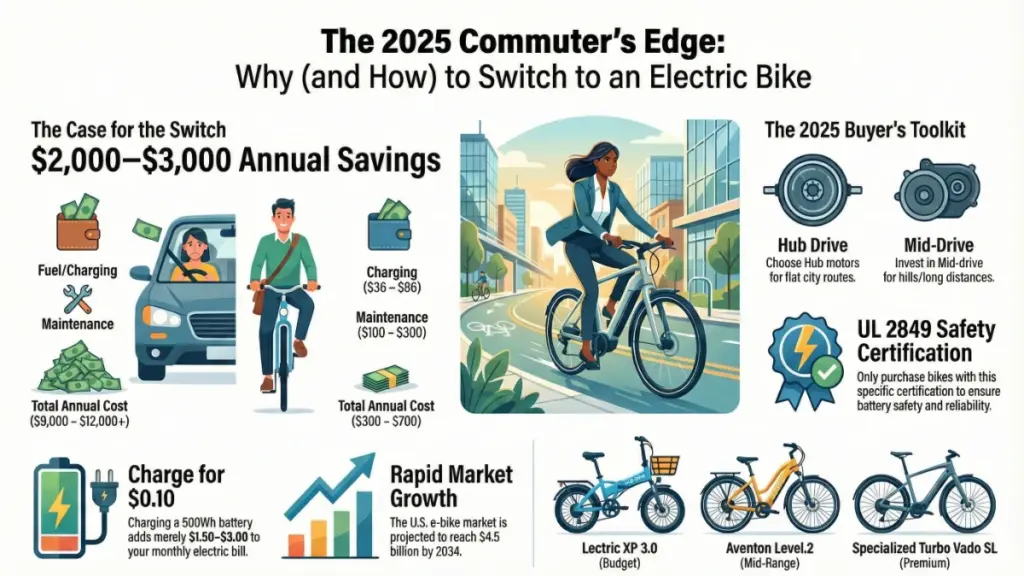
Here’s the compelling case: 82% of the e-bike market is now dominated by urban commuters, with riders reporting average annual savings of $2,000–$3,000 compared to car ownership. The U.S. e-bike market reached $2.2 billion in 2024 and is projected to hit $4.5 billion by 2034, growing at 7.9% annually. In cities like New York, daily bike trips have surged past 500,000, with roughly two-thirds of all bike-share trips now taken on e-bikes.
But not every electric bicycle delivers the same commuting experience. A mountain e-bike optimized for trails will drain its battery rapidly on paved streets. A featherweight road e-bike might collapse under the weight of your work gear. Before investing $1,000–$5,000, you need to understand exactly what separates exceptional commuter e-bikes from mediocre ones.
This comprehensive guide covers everything from motor systems and battery technology to the best electric bikes for commuting in 2025, real-world range expectations, safety protocols, and whether an e-bike genuinely fits your specific route. Let’s dive into the details that matter.
What Makes the Best Electric Bicycle for Commuting?
Selecting the right electric commuter bike requires understanding how different components affect daily performance. These aren’t recreational toys—they’re transportation tools that must deliver reliability day after day.
Motor Systems: Hub Drive vs. Mid-Drive Motors Explained
Your motor choice represents the most critical technical decision. Here’s how the two architectures compare:
Hub Drive Motors (mounted in the front or rear wheel)
- Price range: $800–$2,500
- Maintenance: Minimal—motor operates independently of gears
- Performance: Excellent for flat to rolling terrain
- Efficiency: Good, but less optimized for steep gradients
- Top 2025 models: Lectric XP 3.0, Rad Power Bikes RadCity 5 Plus, Aventon Level.2
Mid-Drive Motors (integrated at the crankset)
- Price range: $2,500–$6,000+
- Maintenance: Moderate—integrated with drivetrain
- Performance: Superior hill climbing and torque delivery
- Efficiency: Excellent—leverages your gear ratios for optimal power
- Top 2025 models: Specialized Turbo Vado SL, Trek Verve+ 4, Bosch-equipped Cannondale models
The Verdict: If your commute includes significant elevation changes or exceeds 15 miles each way, invest in a mid-drive system. For flat urban routes under 10 miles, quality hub drives deliver exceptional value. The latest 2025 hub motors from brands like Lectric and Aventon now feature torque sensors that close the performance gap significantly.
Battery Technology: Calculating Your Actual Range Needs
Battery capacity, measured in watt-hours (Wh), determines your effective range. However, manufacturer claims often inflate real-world performance by 25–30%.
| Battery Capacity | Real-World Range | Ideal Commute Distance |
|---|---|---|
| 250–400Wh | 20–35 miles | Short trips under 8 miles |
| 400–600Wh | 35–55 miles | Medium commutes 10–18 miles |
| 600–800Wh | 50–75 miles | Long commutes or hilly terrain |
| 800Wh+ (dual battery) | 75–100+ miles | Extended commutes 20+ miles |
Critical 2025 Update: UL 2849 battery certification has become the industry safety standard. Never purchase an e-bike lacking this certification—brands without transparent certification face higher failure rates and regulatory complications. Cold weather reduces range by 15–25%, so winter commuters should size up accordingly.
Essential Commuter E-Bike Features
These components separate professional-grade commuters from recreational models:
- Integrated lighting systems: Front and rear lights powered by the main battery, not disposable cells
- Full-coverage fenders: Essential for arriving clean during unexpected weather
- Rear rack compatibility: Rated for 25–50+ lbs of cargo capacity
- Hydraulic disc brakes: Superior modulation and wet-weather performance versus mechanical discs
- Step-through frame options: Critical for riders in business attire or with mobility considerations
- Torque sensors vs. cadence sensors: Torque sensors deliver natural, efficient power delivery; cadence sensors feel abrupt but cost less
Top 10 Best Electric Bikes for Commuting in 2025
After analyzing industry trends, expert reviews, and real commuter feedback, these models represent the best investments across every price category.
Best Budget Electric Commuter: Lectric XP 3.0 ($999)
The Lectric XP 3.0 dominates the sub-$1,000 category through intelligent design rather than corner-cutting. This folding electric bike integrates a 500Wh battery delivering 35–45 miles of real-world range, paired with a 500W rear hub motor that handles moderate inclines competently.
Why it wins: Complete accessory inclusion—fenders, lights, rear rack, and folding capability come standard. For apartment dwellers or multi-modal commuters using public transit, the compact folded footprint is invaluable. Lectric’s customer support infrastructure has proven responsive, addressing the primary concern with budget e-bike brands.
Limitations: The 20 mph top speed (Class 2) may frustrate riders in bike-friendly cities where Class 3 (28 mph) speeds improve traffic flow safety.
Best Mid-Range Commuter E-Bike: Aventon Level.2 ($1,499)
Aventon has refined their commuter formula, and the Level.2 represents the sweet spot for most urban professionals. This Class 2/3 convertible e-bike features a torque sensor—a rarity at this price point—delivering natural power assistance that responds to your pedaling effort rather than simply detecting crank rotation.
Key specifications: 500W motor, 672Wh battery (45–60 mile range), integrated lights with turn signals, hydraulic disc brakes, and a rear rack rated for 55 lbs. The torque sensor transforms the riding experience, eliminating the “on/off” jerkiness common in budget e-bikes.
Expert consensus: Bicycling magazine rated this “the best commuter electric bicycle under $2,000 and one of the best overall”.
Best Premium Urban Commuter: Specialized Turbo Vado SL ($3,500–$4,500)
When budget permits exceptional engineering, the Specialized Turbo Vado SL delivers. Weighing under 33 lbs—remarkably light for a fully-equipped commuter—this Class 3 e-bike uses Specialized’s proprietary 240W motor system that amplifies rather than replaces your pedaling effort.
The experience: The Vado SL feels like a high-performance road bike with invisible assistance. The whisper-quiet operation and balanced handling justify the premium for riders who prioritize ride quality alongside utility. At 28 mph assisted speeds, it matches urban traffic flow safely.
Best for: Professionals commuting 10–20 miles who refuse to compromise on performance or aesthetics.
Best Long-Distance Commuter: Trek Verve+ 4 ($3,499)
For commuters facing 15+ mile one-way distances, the Trek Verve+ 4 with Bosch’s Performance Line motor system offers unmatched reliability. The 500Wh base battery extends to 1,000Wh with Bosch’s Range Extender option—effectively eliminating range anxiety for epic commutes.
Why Bosch matters: The German manufacturer’s drive systems represent the gold standard for refinement and durability. Trek’s dealer network ensures professional service availability, crucial for daily riders who can’t afford downtime.
Best Lightweight Commuter: Velotric T1 ST Plus ($1,299)
Weighing just 39 lbs, the Velotric T1 ST Plus proves that commuter e-bikes don’t require SUV-like bulk. The 350W rear hub motor and 352.8Wh battery deliver up to 70 miles of range in an agile package ideal for city centers with stairs, tight storage, or frequent stop-and-go traffic.
Tech integration: Apple Find My compatibility, GPS tracking, and USB-C charging address modern connectivity expectations. The absence of a throttle encourages active pedaling, making this ideal for fitness-conscious commuters.
Best Folding Electric Bike: Brompton Electric P Line Urban ($3,960)
When storage space commands premium pricing, Brompton’s Electric P Line Urban justifies its cost through engineering excellence. The titanium and steel frame folds to briefcase dimensions in under 20 seconds, weighing just 34 lbs—exceptional for an e-bike with a 300Wh battery and 45-mile range.
The trade-off: Portability premium pricing. For multi-modal commuters combining cycling with trains, buses, or office elevator storage, no competitor matches Brompton’s compact folded footprint.
Best Cargo Commuter: Ride1Up Vorsa ($1,595)
The Ride1Up Vorsa blurs categories with SUV-like capability. Its 750W motor produces 95Nm of torque (peaking at 1,400W), handling 440-lb total payload capacity including a 150-lb rear rack rating. The 720Wh battery achieves 85-mile range estimates under moderate assist.
Versatility: Modular frame design accommodates passenger kits, making this suitable for parents dropping children at school before continuing to offices. The dual-sensor system allows switching between torque and cadence sensing based on preference.
Best Value Mid-Drive: Cannondale Treadwell Neo 2 ($1,540)
Cannondale’s Treadwell Neo 2 democratizes mid-drive technology, offering Bosch Active Line reliability at hub-drive pricing. The 250W motor and 400Wh battery prioritize efficiency over raw power, perfectly suited for flat to moderately hilly urban environments.
Included benefits: REI’s one-year free adjustment policy and established service infrastructure reduce ownership anxiety for first-time e-bike buyers.
Best High-Performance Commuter: Lectric ONE ($2,619)
The Lectric ONE disrupts premium pricing with Pinion gearbox technology and Gates belt drive—features typically reserved for $4,000+ models. The maintenance-free drivetrain eliminates chain lubrication concerns, while the 750W hub motor delivers Class 3 performance.
Why it matters: For riders seeking a single “forever bike” that handles commuting, errands, and weekend recreation without constant adjustment, the ONE delivers exceptional value.
Best Entry-Level Commuter: Co-op Cycles Generation e1.1 ($899)
REI’s house brand Generation e1.1 provides quality assurance at minimal investment. The 350W motor, hydraulic disc brakes, and included rack/lighting package cover commuting fundamentals without premium pricing.
The REI advantage: Member benefits include free flat repair and two years of adjustments, plus physical service locations nationwide—critical support infrastructure missing from direct-to-consumer brands.
Electric Bike Commuting Costs: The Real Financial Analysis
The economic case for e-bike commuting has never been stronger. Let’s examine actual numbers using New York City as a representative major metro:
Annual Cost Comparison: Car vs. E-Bike Commuting
| Expense Category | Car Ownership | Electric Bike |
|---|---|---|
| Monthly parking | $300–$500 | $0 |
| Fuel/charging | $120–$200/month | $3–$8/month |
| Insurance | $150–$300/month | $10–$25/month (optional) |
| Maintenance | $800–$1,500/year | $100–$300/year |
| Registration/taxes | $200–$500/year | $0 |
| Total Annual Cost | $8,000–$12,000+ | $300–$700 |
| Net Annual Savings | — | $7,000–$11,000 |
ROI Timeline: A $1,800 mid-range e-bike pays for itself in 2–3 months versus car ownership, or 12–18 months versus public transit passes ($100–$150/month in major cities).
Electricity Costs: Negligible Impact
Charging a 500Wh battery costs approximately $0.05–$0.10 per full charge at standard residential rates. Even daily charging adds merely $1.50–$3.00 monthly to your electric bill—essentially free transportation fuel.
Practical E-Bike Commuting: Charging, Maintenance & Safety
Charging Strategies for Daily Commuters
Modern lithium-ion batteries charge from standard 110V outlets in 4–6 hours. Most commuters follow these protocols:
- Overnight home charging: Plug in upon arrival home; full battery by morning
- Workplace opportunity charging: Many employers now accommodate e-bike charging; inquire about secure storage with outlet access
- Battery health optimization: For storage exceeding two weeks, maintain 40–60% charge rather than 100% to prolong cell longevity
Winter Protocol: Cold temperatures reduce capacity temporarily. Store batteries indoors when temperatures drop below freezing, and expect 15–25% range reduction during winter commutes.
Maintenance Requirements: Simpler Than You Expect
E-bike maintenance proves remarkably minimal compared to automobiles:
- Weekly: Tire pressure check (proper inflation prevents flats and maximizes range)
- Monthly: Chain lubrication (every 100–150 miles or after wet rides)
- Bi-annually: Brake pad inspection and adjustment
- Annually: Professional tune-up ($75–$150) including drivetrain cleaning, bolt torque verification, and electrical system diagnostic
Motor longevity: Quality hub and mid-drive systems are rated for 10,000+ miles before significant service needs. The sealed electrical components require zero user maintenance beyond software updates available through manufacturer apps.
Safety Protocols for Urban E-Bike Commuting
Riding a 28 mph Class 3 e-bike in traffic demands heightened awareness:
Essential protective gear:
- MIPS-equipped helmet (non-negotiable; many jurisdictions mandate this by law)
- High-visibility clothing or reflective accessories for dawn/dusk riding
- Front white and rear red lights (even daytime running lights improve visibility 47%)
Riding technique adjustments:
- Braking distance: E-bikes weigh 45–70 lbs—significantly more than acoustic bikes. Increase following distances and anticipate stops earlier.
- Intersection positioning: Take the lane when necessary; right-hook collisions represent the primary urban cycling danger.
- Speed management: Match your velocity to infrastructure; 28 mph on protected bike lanes, slower speeds in mixed traffic or crowded paths.
Theft prevention:
- Invest in quality U-locks (Kryptonite New York Series or equivalent) plus cable for wheels
- Remove batteries when parking in high-risk areas (they represent 30–40% of replacement cost)
- Consider dedicated e-bike insurance through Velosurance or Markel ($100–$200 annually) for theft and liability coverage
Is an Electric Bike Right for Your Specific Commute?
E-bikes solve numerous transportation challenges but aren’t universal solutions. Evaluate your situation honestly:
Ideal E-Bike Commuting Scenarios
Distance: 3–25 miles one-way (beyond this, charging logistics become challenging)
Infrastructure: Access to bike lanes, protected paths, or low-traffic streets for significant route portions
Storage: Secure indoor parking at both origin and destination
Climate: Regions with <100 days of prohibitive weather annually
Physical considerations: Riders seeking low-impact exercise or managing health conditions
When E-Bike Commuting Faces Challenges
Excessive distance: 30+ mile one-way commutes without workplace charging
Dangerous infrastructure: High-speed arterial roads without shoulders or bike lanes
Cargo requirements: Regular transport of large equipment or multiple children
Security concerns: No secure storage options at workplace.
Reality check: Many perceived barriers prove manageable. The “sweat factor” disappears with moderate pedal assist levels. Workplace bike storage has expanded dramatically—67% of urban employers now provide secure parking. Weather concerns diminish with proper fenders and clothing investment.
The Future of Electric Bike Commuting: 2025 and Beyond
The e-bike revolution accelerates through technological and infrastructural evolution:
Solid-state batteries: By 2027, next-generation batteries promise 100+ mile ranges at current weights and pricing, eliminating the final range anxiety barrier for long-distance commuters.
Smart security integration: GPS tracking, app-based immobilization, and automatic theft alerts are becoming standard on mid-range and premium 2025 models.
Infrastructure investment: Following European models, U.S. cities including New York, Chicago, and Los Angeles have accelerated protected bike lane construction. New York now boasts 1,550 miles of bike lanes with 99% of residents within one mile of cycling infrastructure.
Financial incentives: The federal E-BIKE Act proposes 30% tax credits up to $1,500, while states like California, New York, and Colorado offer substantial rebate programs. These incentives reduce effective purchase prices significantly.
Corporate adoption: Companies increasingly include e-bikes in wellness programs and commuter benefits, creating B2B demand channels that drive further market growth .
Final Recommendations: Choosing Your 2025 Commuter E-Bike
After analyzing specifications, real-world performance, and value propositions, here are my definitive recommendations:
Budget-conscious commuters ($1,000–$1,500): The Lectric XP 3.0 or Aventon Level.2 deliver exceptional functionality without compromise. The Level.2’s torque sensor justifies the premium if your budget stretches to $1,499.
Mid-range optimizers ($1,500–$2,500): The Velotric Discover 2 offers dual-sensor technology, 75-mile range, and UL certification that future-proofs your investment.
Premium experience seekers ($3,000+): The Specialized Turbo Vado SL or Trek Verve+ 4 provide refined riding dynamics and dealer support networks that justify higher upfront costs through longevity and service availability.
Multi-modal commuters: The Brompton Electric P Line remains unmatched for foldability and transit integration despite premium pricing.
The transformation of your daily commute from stressful obligation to enjoyable activity represents the true value proposition. With quality e-bikes available from $999 to $4,500, every budget accesses this mobility revolution. Calculate your current transportation costs, evaluate your route infrastructure, and join the millions of commuters who have already discovered that the best part of their workday is the journey itself.