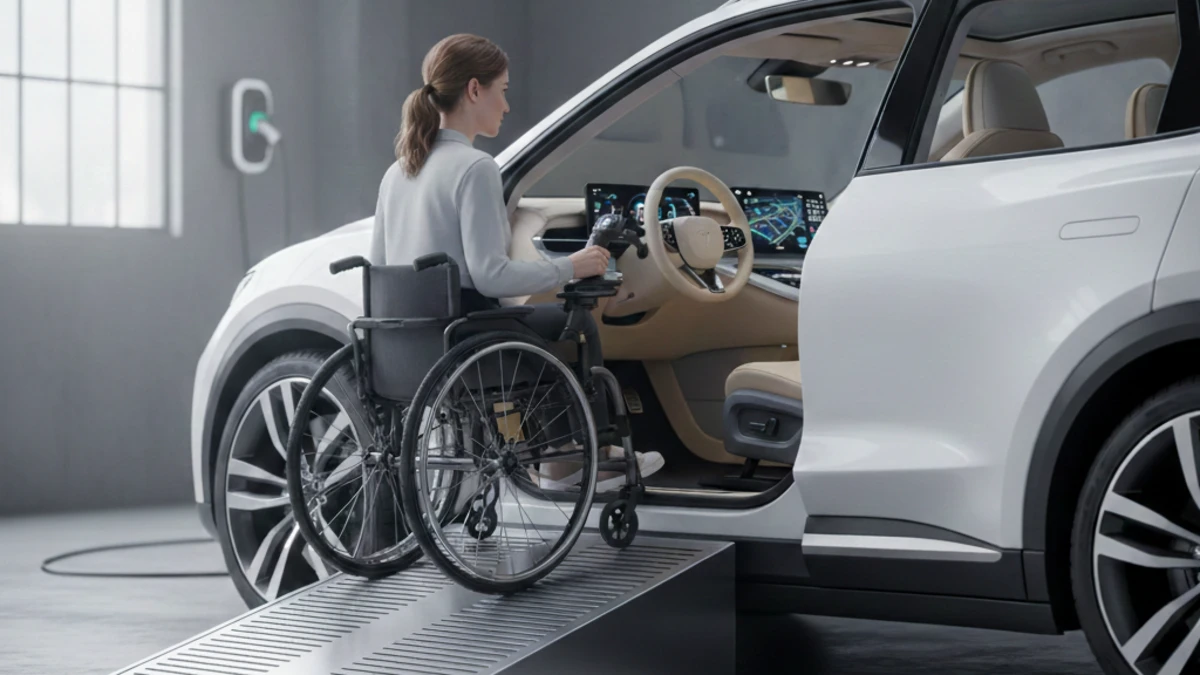
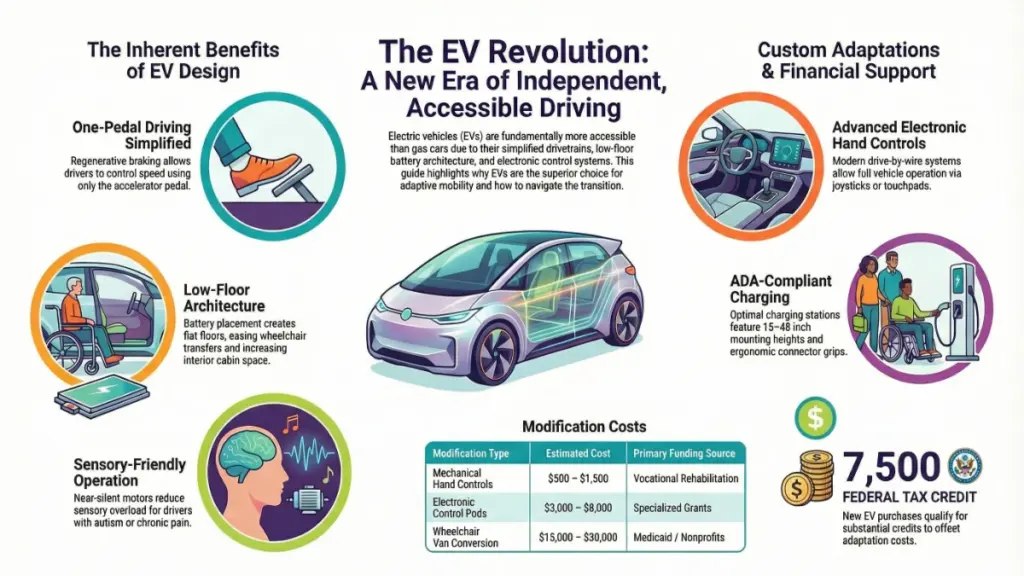
TL;DR: Electric vehicles are proving to be game-changers for drivers with disabilities, offering inherent advantages like simplified controls (no gear shifting, lighter pedals, one-pedal driving), lower step-in heights, and quieter cabins that reduce sensory stress. Modern EVs integrate seamlessly with adaptive equipment—from basic hand controls to sophisticated electronic joystick systems—while home charging eliminates the physical challenges of public stations. Financial support is substantial, including federal tax credits up to $7,500, Vocational Rehabilitation funding for equipment and modifications, and state utility incentives. Looking ahead, autonomous driving, AI-powered adaptive interfaces, and purpose-built accessible EVs promise even greater independence. For disabled drivers considering the switch, starting with a Certified Driver Rehabilitation Specialist evaluation is the essential first step toward customized, affordable, accessible electric mobility.
Introduction: The Silent Revolution in Accessible Transportation
For millions of people living with physical, sensory, or cognitive disabilities, the freedom of independent driving has historically come with significant compromises. Traditional vehicles often require expensive aftermarket modifications, present physical barriers to entry, and demand complex coordination that many disabled drivers find exhausting or impossible.
Electric vehicles are changing this reality fundamentally.
What started as an environmental movement has unexpectedly become one of the most significant advances in automotive accessibility in decades. EVs offer inherent design advantages—simplified drivetrains, low-floor architectures, electronic controls, and quiet operation—that make them naturally more accommodating for disabled drivers than internal combustion engine (ICE) vehicles ever were.
This comprehensive guide explores how electric cars are transforming mobility for the disability community in 2025. Whether you’re a disabled driver researching your first EV, a caregiver evaluating options, or a fleet manager seeking accessible vehicles, you’ll find actionable insights on adaptive equipment, charging solutions, financial assistance, and the cutting-edge innovations making independent driving more achievable than ever.
Why Electric Vehicles Are Inherently More Accessible Than Gas Cars
Before examining specific adaptations, understanding EVs’ fundamental accessibility advantages explains why so many disabled drivers are making the switch.
Elimination of Physical Control Barriers
Traditional vehicles demand complex physical coordination: clutch engagement, gear selection, and heavy pedal resistance create significant barriers for drivers with limited mobility or strength. Electric vehicles eliminate these challenges through their single-speed transmissions and electronic control systems.
Key accessibility benefits include:
- No gear shifting or clutch operation – EVs use single-speed reduction gears, removing the need for manual transmission coordination
- Reduced pedal force requirements – Brake-by-wire systems in modern EVs require substantially less leg strength than hydraulic brake systems
- One-pedal driving capability – Regenerative braking allows drivers to control acceleration and deceleration using only the accelerator pedal, reducing the need for rapid foot transitions between pedals
For drivers managing conditions like cerebral palsy, multiple sclerosis, spinal cord injuries, or lower limb amputations, these simplifications transform driving from a physically demanding task into a manageable, sustainable activity.
Low-Floor Architecture and Entry Accessibility
EV battery packs mount beneath the vehicle floor, creating several accessibility advantages:
- Lower step-in heights – The flat floor design typically results in lower sills than comparable ICE vehicles
- Spacious interior packaging – Without transmission tunnels or exhaust systems, cabin space opens up for wheelchair transfers and mobility device storage
- Flat load floors – Cargo areas accommodate wheelchairs, walkers, and medical equipment more easily
The Tesla Model 3 demonstrates this advantage clearly—its sill height facilitates wheelchair transfers more straightforwardly than many conventional SUVs. Meanwhile, electric trucks like the Ford F-150 Lightning and Rivian R1T deploy power running boards that automatically lower when doors open, bridging the gap between ground and cabin for drivers with limited stepping ability.
Sensory-Friendly Environment
The near-silent operation of electric motors creates cabins significantly quieter than ICE vehicles. For individuals with:
- Autism spectrum disorder
- Sensory processing disorders
- Anxiety disorders
- Auditory processing difficulties
- Migraine or chronic pain conditions
This absence of engine vibration and noise reduces sensory overload, making driving and riding experiences calmer and more manageable. The smooth, vibration-free acceleration characteristic of EVs further reduces sensory stress compared to the mechanical harshness of combustion engines.
Comprehensive Guide to EV Adaptive Driving Equipment
Modern EVs’ electronic architectures integrate adaptive equipment more seamlessly than traditional vehicles. Here’s the complete breakdown of available technologies in 2025:
Mechanical and Electronic Hand Control Systems
Traditional Push-Pull Controls
Mechanical hand control systems remain widely compatible with electric vehicles. These devices mount near the steering wheel and allow foot-free operation:
- Push-to-brake, pull-to-accelerate (or reverse configurations)
- Compatible with most EV brake-by-wire systems
- Installation cost: $500–$1,500
- Primary manufacturers: Sure Grip, MPS (Mobility Products & Design), Veigel
Because EVs use electronically-activated braking rather than purely hydraulic systems, aftermarket hand controls integrate more cleanly with vehicle braking responses, providing smoother, more predictable operation.
Advanced Electronic Control Pods
For drivers with quadriplegia, limited upper body range of motion, or complex mobility needs, fully electronic systems offer comprehensive control:
- Single joystick or touchpad operation manages acceleration, braking, steering, and secondary functions
- Programmable sensitivity settings accommodate varying strength levels
- Integration with vehicle CAN bus for seamless electronic communication
- Installation cost: $3,000–$8,000
- Leading systems: MPS Monarch, Sure Grip Digital, Veigel Commander
These systems represent the cutting edge of adaptive technology, essentially converting the vehicle into a drive-by-wire system controlled entirely through adapted interfaces.
Steering Modifications and Assistive Devices
Electric power steering (EPS)—standard across all EVs—provides inherently lighter steering effort than hydraulic systems. This foundation enables several adaptations:
Reduced-Effort Steering Modifications
Certified mobility equipment dealers (CMEDs) can reprogram EPS torque profiles to further reduce steering effort, benefiting drivers with limited arm strength or conditions affecting grip strength.
Mechanical Steering Aids
- Spinner knobs ($100–$300) – Allow single-handed steering using palm or wrist motion
- Tri-pin grips ($150–$400) – Secure the hand for drivers with limited finger function
- Palm grips ($100–$250) – Support drivers who cannot grasp traditional steering wheels
- Remote steering systems – Joystick or touchpad steering for drivers unable to use conventional steering wheels
These adaptations leverage the light steering feel EVs provide, making them more effective and safer than equivalent modifications to heavier-steering ICE vehicles.
Voice and Touchscreen Accessibility Integration
Major EV manufacturers have invested heavily in voice-command systems that reduce physical control demands:
Tesla
- Natural language processing for climate, navigation, media, and vehicle settings
- Minimal physical button requirements
- Customizable voice commands through software updates
General Motors (Ultium Platform)
- Integration with Amazon Alexa for hands-free control
- Steering wheel voice activation buttons
- Accessibility-focused interface design in 2025 models
Ford (SYNC 4/5)
- Advanced voice recognition with natural language understanding
- Physical button backup for critical functions
- Compatibility with third-party accessibility apps
Apple CarPlay and Android Auto
Standard across 2024–2025 EVs, these platforms support:
- Third-party AAC (augmentative and alternative communication) apps
- Voice-controlled navigation and communication
- Predictive text and command suggestions for users with speech impairments
Wheelchair-Accessible Electric Vehicles: Conversions and Purpose-Built Solutions
The wheelchair-accessible vehicle (WAV) market is rapidly electrifying, offering options from converted minivans to ground-up accessible designs.
Popular EV Platforms for WAV Conversion
Chrysler Pacifica Hybrid
The most widely converted accessible EV platform in North America offers:
- Proven hybrid reliability with 32+ miles electric range
- Spacious interior accommodating full wheelchair ramps
- Conversion specialists: BraunAbility, VMI (Vantage Mobility International), Rollx Vans
- Conversion cost: $15,000–$30,000 above vehicle price
- Features: In-floor ramp systems, lowered floors, wheelchair tie-downs, transfer seats
Toyota Sienna Hybrid
- All-wheel-drive availability for weather versatility
- Excellent reliability record for long-term ownership
- Growing converter network specializing in accessible modifications
- Similar conversion costs and features to Pacifica
Emerging Dedicated Accessible EV Platforms
Canoo Lifestyle Vehicle
Despite financial challenges, Canoo’s accessible van concept represents the future of purpose-built accessible EVs:
- Flat-floor skateboard platform designed for wheelchair users from inception
- No conversion required – accessibility engineered into original design
- Removable seating for flexible wheelchair positioning
- Target market: Commercial fleets and individual consumers requiring maximum accessibility
Rivian Commercial Van Platform
Rivian’s electric delivery van architecture is being evaluated by WAV converters for passenger accessibility applications:
- Low floor height ideal for ramp deployment
- Robust construction supporting heavy mobility equipment
- Fleet-focused design potentially serving paratransit and accessible transportation services
Accessibility Comparison: Leading EV Models (2025)
| Model | CMED Ready | Entry Height | Voice Control | WAV Availability | Best For |
|---|---|---|---|---|---|
| Tesla Model 3 | Yes | Low (14.2″ sill) | Advanced (AI voice) | Limited | Tech-savvy drivers, sensory sensitivity |
| Tesla Model Y | Yes | Moderate | Advanced | Limited | Small families, cargo needs |
| Ford F-150 Lightning | Yes | Power deployable boards | SYNC 4 + Alexa | Available | Rural drivers, equipment transport |
| Chrysler Pacifica Hybrid | Yes | Excellent (converted) | Uconnect 5 | Widely available | Full wheelchair accessibility |
| Rivian R1S | Growing | Air suspension adjustable | Good | In development | Adventure/outdoor accessibility |
| Chevy Equinox EV | Yes | Moderate | Google Built-In | Limited | Budget-conscious buyers |
| Toyota bZ4X | Yes | Moderate | Toyota Assistant | Limited | Reliability-focused buyers |
Solving the Charging Challenge: Accessible EV Charging Solutions
Public charging infrastructure remains the most significant barrier for disabled EV drivers, but solutions are rapidly emerging across home, public, and wireless applications.
Home Charging: The Accessibility Foundation
For most disabled EV drivers, home charging eliminates the primary barrier to EV ownership. A properly designed home charging setup provides:
Level 2 Home Charger Specifications (Optimal for Accessibility)
- Mounting height: 15–48 inches from floor (ADA-compliant range)
- Cable length: 25+ feet to accommodate various parking configurations
- Connector type: NACS (Tesla) or CCS with ergonomic grips
- Activation method: App-based or RFID card (no physical button pressing required)
- Installation cost: $800–$2,000 (before incentives)
Professional Installation Considerations
Certified electricians experienced with accessibility requirements should:
- Position chargers within reach from wheelchair or transfer height
- Ensure level, stable surfaces for wheelchair positioning during connection
- Install adequate lighting for visual impairments
- Consider smart chargers with scheduling to avoid peak rate periods
Assistive Charging Technologies
Plug-In Assistance Devices
- ChargeBar and similar extensions – Reduce grip force required for connection
- Cable management systems – Counterbalanced or motorized cable supports
- Ergonomic connector adapters – Larger grips for limited hand function
Magnetic and Automated Connection Systems
Multiple manufacturers are developing magnetic connectors that self-align and attach with minimal physical effort. Tesla’s automated charging robotic arm—demonstrated in prototype form—represents the ultimate accessibility solution: fully autonomous connection requiring zero physical interaction.
Connector Ergonomics Comparison
- NACS (Tesla connector): Smaller, lighter, easier one-handed operation
- CCS1 (Combined Charging System): Bulkier, requires more grip strength, but improving with new designs
- CHAdeMO: Declining in North America, heavier connector
Public Charging Accessibility: Current State and Improvements
The 2024 National Disability Rights Network survey revealed significant accessibility gaps in public charging infrastructure. However, 2025 brings substantial improvements:
ADA Compliance Requirements for Public Chargers
- Screen height: No higher than 48 inches from ground
- Reach range: All controls within 15–48 inch vertical range
- Surface conditions: Level, firm, stable ground between parking and charger
- Cable management: Minimum 5 feet of cable beyond connector
- Sensory accessibility: Tactile indicators and audio guidance for visually impaired users
Network Accessibility Initiatives (2025)
- Electrify America: Published comprehensive accessibility roadmap; retrofitting existing stations
- EVgo: Partnering with disability organizations for station design input
- ChargePoint: ADA-compliant designs now standard for new installations
- Tesla Supercharger: Expanding pull-through spaces for vehicles with trailers/wheelchair lifts
Planning Accessible Road Trips
Before traveling, disabled EV drivers should:
- Use PlugShare’s accessibility filter to identify compliant stations
- Contact charging networks directly regarding specific accessibility features
- Plan routes around reliable home charging or known accessible public options
- Consider portable Level 1 chargers as backup for emergency situations
Wireless Inductive Charging: The Accessibility Game-Changer
WiTricity and major automakers are deploying ground-pad inductive charging systems that eliminate plugging entirely:
How It Works
- Charging pad installed in parking space (garage or driveway)
- Vehicle receiver pad integrated into undercarriage
- Automatic alignment through parking guidance systems
- Hands-free operation – charging begins automatically when parked
Timeline and Availability
- BMW and Hyundai: Pilot programs active 2024–2025
- Commercial rollout: Expected 2025–2027 for consumer vehicles
- Significance for accessibility: Eliminates the last physical barrier to EV charging for drivers with severe mobility impairments
Financial Assistance Programs: Making Accessible EVs Affordable
The combination of EV premiums and adaptive equipment costs can seem prohibitive, but substantial financial support exists through federal, state, and nonprofit channels.
Federal Tax Credits and Incentives
Clean Vehicle Tax Credit (Inflation Reduction Act)
- New EVs: Up to $7,500 tax credit
- Used EVs: Up to $4,000 tax credit (2023 and newer, under $25,000 sale price)
- Income limits: $150,000 individual / $300,000 joint (new); $75,000 individual / $150,000 joint (used)
- Price caps: $80,000 SUVs/trucks/vans; $55,000 other vehicles (new only)
Accessibility Considerations
Disabled buyers should note that many accessible vehicle conversions push prices above standard caps. However, commercial wheelchair-accessible vehicles often qualify under different classifications—consult a tax professional familiar with disability-related vehicle deductions.
Vocational Rehabilitation (VR) Funding
State Vocational Rehabilitation programs—federally funded through the Rehabilitation Services Administration—provide comprehensive support for disabled individuals requiring transportation to maintain employment:
Covered Services May Include:
- Comprehensive driving evaluations by Certified Driver Rehabilitation Specialists (CDRS)
- Vehicle modifications including adaptive equipment installation
- Vehicle purchase assistance when necessary for employment
- Training on adaptive equipment use
Eligibility Requirements:
- Disability documentation affecting employment
- Employment goal requiring transportation
- Financial need assessment (varies by state)
Contact your state’s VR agency early in the process—they often have waiting lists and extensive documentation requirements.
State and Local Incentive Programs
California Clean Vehicle Rebate Project (CVRP)
- Up to $7,000 for eligible EVs
- Increased rebates for low-income buyers
- Accessibility modifications may qualify for additional support
Colorado EV Tax Credit
- Up to $5,000 for new EVs (2024–2025)
- Income-qualified buyers eligible for higher rebates
New York Drive Clean Rebate
- Up to $2,000 for new EVs
- Additional incentives for charging infrastructure
Utility Company Programs
Major utilities offer EV-specific benefits:
- Reduced electricity rates for EV charging (time-of-use plans)
- Home charger installation rebates ($200–$1,000)
- Income-qualified enhanced rebates
Nonprofit and Community Resources
National Mobility Equipment Dealers Association (NMEDA)
- Certified dealer locator
- Quality assurance program for adaptive equipment
- Consumer education resources
United Spinal Association
- Peer support networks
- Equipment funding guidance
- Advocacy for accessible transportation policy
Disability Rights Advocates
- Legal support for accessibility discrimination
- Policy advocacy for improved infrastructure
- Resource connection services
Cost Breakdown: Accessible EV Ownership (2025 Estimates)
| Expense Category | Typical Cost | Funding Sources |
|---|---|---|
| EV Purchase (after federal credit) | $25,000–$60,000 | Federal/state tax credits, VR programs |
| Mechanical hand controls | $500–$1,500 | VR, private insurance, out-of-pocket |
| Electronic control systems | $3,000–$8,000 | VR, specialized grants |
| Steering adaptations | $100–$500 | Out-of-pocket, VR |
| Home Level 2 charger + install | $800–$2,000 | Utility rebates, tax credits |
| WAV conversion (if applicable) | $15,000–$30,000 | VR, Medicaid waivers, nonprofits |
| CDRS evaluation | $400–$600 | VR (often covered), private pay |
The Future of Accessible Electric Mobility: 2025 and Beyond
The convergence of electrification and autonomous technology promises unprecedented accessibility advances.
Autonomous Vehicles as Accessibility Tools
Self-driving technology could eliminate the driving barrier entirely for individuals who cannot operate vehicles:
Current Deployments
- Waymo One (Phoenix, San Francisco, Los Angeles): Commercial robotaxi service accepting passengers with folding wheelchairs
- WAV compatibility testing: 2025 evaluation programs for wheelchair-accessible autonomous vehicles
- Significance: On-demand, independent transportation for non-drivers with disabilities
Tesla Full Self-Driving (FSD)
While not fully autonomous, FSD’s advanced driver assistance reduces physical and cognitive driving demands, potentially enabling licensed drivers with certain disabilities to operate vehicles more safely.
AI-Powered Adaptive Interfaces
Machine learning systems are creating personalized driving experiences:
Current Capabilities (2025)
- Driver recognition – Automatic seat, mirror, and climate adjustment
- Regenerative braking customization – AI learns preferred deceleration rates
- Steering sensitivity adaptation – Automatic adjustment based on driving conditions and driver capability
Emerging Technologies
- Predictive accessibility settings – Vehicles that anticipate needs based on time of day, destination, or biometric indicators
- Natural language vehicle control – Conversational AI managing all vehicle functions
- Health monitoring integration – Vehicles that detect medical events and respond appropriately
Purpose-Built Accessible EVs: The Next Generation
Moving beyond conversions, manufacturers are designing EVs around disability needs from inception:
Kenguru
- Wheelchair-user-designed EV – Drive while remaining in wheelchair
- Motorcycle-classification – No traditional driver’s license required in many jurisdictions
- Urban mobility focus – Neighborhood and local transportation
Gallop Mobility
- Modular accessible platform – Configurable for various disability types
- Commercial and consumer applications – Rideshare, personal, and medical transport
- Skateboard architecture – Flat floor, flexible interior design
Industry Trends
Traditional automakers are recognizing the market opportunity:
- Toyota: Accessibility-focused concept vehicles using e-TNGA platform
- GM: Ultium platform flexibility enabling low-floor accessible designs
- Ford: Partnerships with adaptive equipment manufacturers for factory-integrated solutions
Essential Steps: Transitioning to an Accessible Electric Vehicle
For disabled drivers considering the switch to electric, this roadmap ensures successful adoption:
1. Professional Evaluation First
Schedule a Certified Driver Rehabilitation Specialist (CDRS) evaluation before researching vehicles. This assessment determines:
- Your specific physical capabilities and limitations
- Appropriate adaptive equipment recommendations
- Vehicle type suitability (sedan, SUV, van, truck)
- Training requirements for new equipment
Find CDRS professionals through the Association for Driver Rehabilitation Specialists (ADED).
2. Research and Test Drive
Prioritize EVs with strong accessibility reputations:
- Tesla Model 3/Y for tech integration and low entry
- Ford F-150 Lightning for versatility and running board accessibility
- Chrysler Pacifica Hybrid for proven WAV conversion availability
During test drives, evaluate:
- Transfer ease (if applicable)
- Control reach and operation
- Visibility and blind spot management
- Comfort during extended periods
3. Secure Funding
Simultaneously pursue multiple funding streams:
- Federal and state tax credits (timing matters for tax year)
- Vocational Rehabilitation application (start early—processing takes months)
- Utility rebates for home charging infrastructure
- Nonprofit grants for adaptive equipment
4. Plan Charging Infrastructure
Before vehicle delivery:
- Obtain quotes from certified electricians for Level 2 installation
- Ensure installation meets accessibility standards
- Consider future-proofing for wireless charging
- Evaluate solar integration for energy independence
5. Training and Adaptation
Allow time for learning:
- Adaptive equipment training with CMED installers
- EV-specific features (regenerative braking, one-pedal driving)
- Charging routine establishment
- Emergency procedures and roadside assistance protocols
Conclusion: Electric Vehicles as Independence Enablers
The electric vehicle revolution represents far more than environmental progress or technological novelty—for the disability community, it marks a genuine inflection point in transportation independence.
EVs’ inherent characteristics—simplified controls, low floors, quiet operation, and electronic integration—address longstanding barriers that traditional vehicles could never fully resolve. When combined with rapidly advancing adaptive technologies, comprehensive financial support programs, and the promise of autonomous mobility, electric vehicles are becoming the default choice for disabled drivers seeking maximum independence.
The transition requires careful planning, professional guidance, and persistence in navigating funding systems. But the reward—reliable, affordable, accessible personal transportation—justifies the effort many times over.
For disabled individuals who have previously found driving challenging or impossible, 2025 offers unprecedented opportunity. The vehicles exist. The technology works. The support systems are in place. The remaining step is taking action to evaluate your specific situation and begin the journey toward electric mobility.
Your next step: Contact a Certified Driver Rehabilitation Specialist in your area to begin your personalized accessible EV evaluation. The future of independent driving is electric—and it’s accessible to you.
Resources: