Electric bicycle commuting in 2025 is becoming a smarter, cheaper, and more enjoyable alternative to driving. E-bikes cut commuting costs dramatically, reduce stress, improve mood, and often beat traffic for short trips. This guide explains e-bike classes, costs, setup, weather tips, and how to choose the right model to replace or reduce daily car travel.
What if your daily commute cost you less than a dollar a day, got you to work without sitting in traffic, and occasionally gave you a mood boost before 9 a.m.? That’s not a fantasy—it’s what thousands of e-bike commuters are reporting right now.
Electric bicycle commuting has moved well past the early-adopter phase. In 2024, e-bike sales in the United States surpassed 1.1 million units, outpacing electric car sales for the second consecutive year, according to the Light Electric Vehicle Association (LEVA). And the reason isn’t hard to find: for commutes under 15 miles, an electric bike is often faster than a car, dramatically cheaper, and—once you try it—genuinely fun.
Whether you’re tired of $60 fill-ups, looking to squeeze exercise into a busy day, or just curious about what the buzz is about, this guide covers everything you need to know. We’ll walk through how e-bikes work, what to look for when buying one, what a real-world commute looks like, and how to calculate whether the switch makes sense for your life.
What Is an Electric Bicycle—and Why Does It Matter for Commuting?
Let’s start with the basics, because there’s still a lot of confusion out there. An electric bicycle (or e-bike) is a pedal-powered bicycle equipped with an electric motor and a rechargeable battery that assists your pedaling effort. You still pedal—the motor doesn’t replace your effort, it amplifies it.
That distinction matters enormously for commuting. Unlike a moped or scooter, most e-bikes in the U.S. are classified as bicycles under federal law, meaning you don’t need a license, registration, or insurance to ride one in most states. You can take them on bike paths, park them on a sidewalk rack, and bring them indoors without a second thought.
The Three Classes of E-Bikes
Understanding the three U.S. classification tiers helps you choose the right bike and know where you can legally ride:
- Class 1: Pedal-assist only, motor cuts out at 20 mph. Permitted almost everywhere bikes are allowed, including most multi-use trails.
- Class 2: Throttle-assisted, motor also cuts out at 20 mph. Slightly more restricted on certain trails, but still legal on most roads and paths.
- Class 3: Pedal-assist only, motor assists up to 28 mph. Best for road commuting on streets and bike lanes; sometimes restricted from unpaved trails.
For most urban and suburban commuters, a Class 1 or Class 3 e-bike hits the sweet spot between versatility and speed. If your route is mostly on roads and protected bike lanes, Class 3 will get you there faster. If you’re navigating mixed paths and trails, Class 1 keeps more doors open legally.
Quick Answer: An e-bike is a pedal-powered bicycle with motor-assisted propulsion. No license required, no gas needed, and it can legally use most bike infrastructure. For commutes under 15 miles, it’s often the fastest and cheapest option available.
The Real Cost of E-Bike Commuting (vs. Driving)
Here’s where e-bike commuting gets genuinely compelling—the numbers. I want to be transparent: the savings depend heavily on your specific situation, but the math tends to be striking regardless.
What You’ll Spend on an E-Bike
Quality commuter e-bikes span a wide price range. Here’s a realistic breakdown:
| Category | Price Range | Best For |
|---|---|---|
| Budget commuter | $800–$1,200 | Short urban routes (under 10 miles) |
| Mid-range commuter | $1,500–$2,500 | Most suburban commutes (10–20 miles) |
| Premium commuter | $2,800–$5,000 | Long-range, cargo, or all-weather commuting |
| High-end / cargo | $5,000–$8,000+ | Replacing a car entirely, family use |
Top-performing models in 2025 include the Trek FX+ 2 ($2,299, Class 3, 60-mile range), the Rad Power RadCity 5 Plus ($1,999, Class 2, 45-mile range), the Specialized Vado SL 4.0 ($3,500, lightweight Class 3), and the Tern GSD S10 ($5,499, cargo-focused, family-ready).
Annual Running Costs: E-Bike vs. Car
Let’s compare a typical suburban commuter driving a mid-size sedan against someone switching to an e-bike for the same 12-mile daily round trip:
| Cost Category | Car (Annual) | E-Bike (Annual) |
|---|---|---|
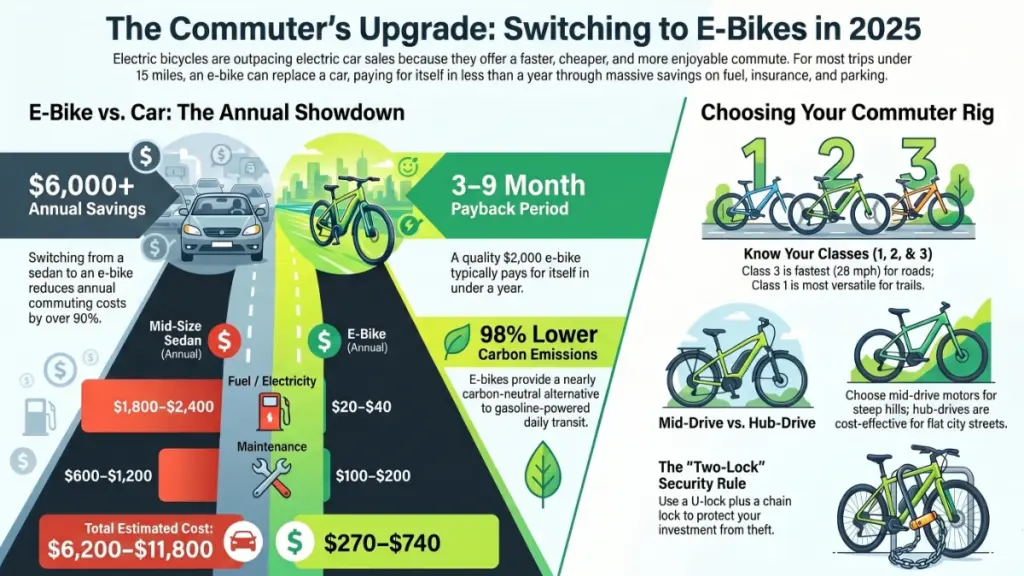
| Fuel / Electricity | $1,800–$2,400 | $20–$40 |
| Insurance | $1,200–$1,800 | $0–$150* |
| Parking | $600–$2,400 | $0–$50 |
| Maintenance | $600–$1,200 | $100–$200 |
| Depreciation | $2,000–$4,000 | $150–$300 |
| Total (est.) | $6,200–$11,800 | $270–$740 |
*E-bike insurance is optional in most states but worth considering for theft.
The payback period on a $2,000 e-bike for someone replacing car commuting typically falls between 3 and 9 months, depending on parking costs in your city. After that, you’re essentially riding for free.
How to Choose the Right E-Bike for Your Commute
Not all e-bikes are created equal, and the wrong choice can turn an exciting new habit into a frustrating one. Here are the four factors that should drive your decision.
1. Range and Battery Capacity
Battery capacity is measured in watt-hours (Wh). As a general rule:
- 250–400 Wh: Reliable for 20–35 miles of assisted riding
- 400–600 Wh: Handles 35–60 miles comfortably
- 600+ Wh: Long-range or cargo bikes, 60+ mile capability
Real-world range drops in cold weather (lithium batteries lose 15–30% efficiency below 40°F), on hilly terrain, and at higher assist levels. If you live somewhere with harsh winters or serious hills—and being from Ohio, I can tell you both are real considerations—buy more battery than you think you need.
2. Motor Placement and Power
- Hub-drive motors (built into the rear wheel) are common on budget and mid-range bikes. They’re simple, reliable, and quiet. The Rad Power lineup uses this approach effectively.
- Mid-drive motors (mounted at the pedal crank) deliver power more naturally by working through the bike’s gears. They’re more efficient on hills and feel more like “real” cycling. Bosch and Shimano mid-drives power most premium commuters.
For flat city riding, a hub drive is perfectly fine. For hilly terrain or longer range, spend the extra money for a mid-drive.
3. Frame Style and Practicality
Think about how you’ll actually use the bike day-to-day:
- Step-through frames make mounting easy—ideal if you’re commuting in work clothes or have any knee/hip mobility concerns.
- Cargo racks and panniers transform a commuter bike into a rolling office bag. Many mid-range bikes include integrated rear racks; front racks add stability for heavier loads.
- Fenders aren’t glamorous, but if you commute in rain or on wet streets, they’re essential for arriving at work dry.
- Integrated lighting (wired to the battery) is far superior to clip-on lights for daily riding.
4. Weight
E-bikes are heavier than traditional bikes—typically 45–70 lbs. That matters if you need to carry the bike upstairs or onto a transit vehicle. Lightweight “sub-light” options like the Specialized Vado SL (33 lbs with motor) are worth considering if portability is a regular need.
What a Real E-Bike Commute Looks Like
Here’s something the spec sheets don’t tell you: the daily experience of e-bike commuting is genuinely different from anything you’ve tried before.
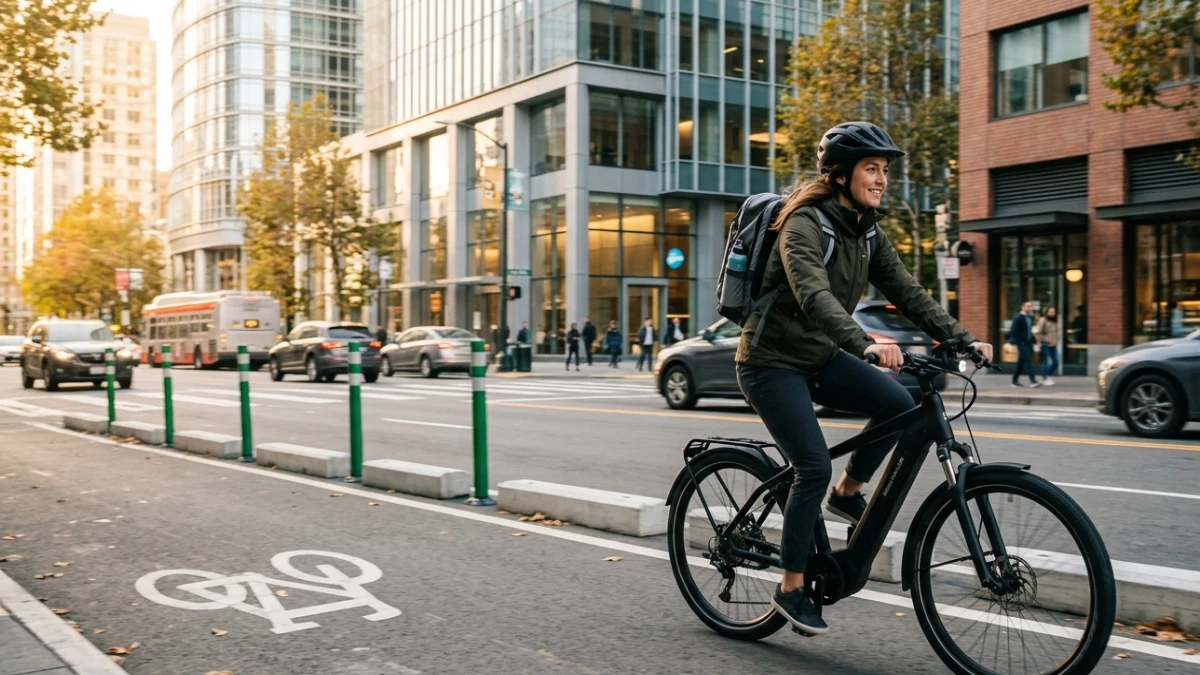
Imagine leaving your house in the morning and arriving at work having broken a light, pleasant sweat—not soaked, not struggling, just pleasantly activated. The motor handles the hard parts (that one nasty hill on Oak Street, the headwind from the west) while you cruise through the neighborhood feeling surprisingly alert.
Studies back this up. A 2023 study published in the International Journal of Environmental Research and Public Health found that regular e-bike commuters reported significantly lower cortisol levels and better self-reported mood compared to car commuters. There’s something about moving your body through space—even with electric assistance—that cars simply can’t replicate.
A Typical Morning:
- Unlock bike from garage or indoor storage — 30 seconds
- Clip on helmet, check tire pressure (quick squeeze test) — 1 minute
- Ride to work — average 35–45 minutes for a 10-mile route, depending on traffic signals
- Lock bike at a designated rack or bring inside if your employer allows it — 2 minutes
- Arrive without hunting for parking, without idling in a backup, without paying $15 to a parking garage
That’s it. No fuel stops, no parallel parking, no road rage.
What About Bad Weather?
This is the question most new e-bike commuters ask first, and it’s fair. Rain, cold, and dark mornings are real. Here’s the honest answer: year-round e-bike commuting is achievable but requires preparation.
A quality rain jacket, waterproof panniers, and fenders handle most wet-weather scenarios. For winter riding, studded tires (for snow and ice), handlebar mitts, and layered merino wool make temperatures down to about 20°F manageable. Below that, most practical commuters have a backup plan—public transit, a carpool, or the occasional car day.
Many experienced e-bike commuters ride 9–10 months per year and consider that a reasonable trade-off. Others ride 12 months. Your comfort level, your route, and your city’s infrastructure all factor in.
Setting Up Your E-Bike Commute for Success
Buying the right bike is step one. Making the commute sustainable long-term comes down to a few practical decisions most guides overlook.
Route Planning
Your e-bike commute route probably shouldn’t be your driving route. Spend 20 minutes on Komoot, Ride with GPS, or your city’s bike infrastructure map to find a route that prioritizes:
- Protected bike lanes over traffic-adjacent painted lines
- Lower-traffic residential streets over arterial roads
- Consistent pavement quality (potholes punish bikes more than cars)
A slightly longer route on quiet streets is almost always a better commute than the fastest driving path on a busy road.
Charging and Range Management
Most e-bike batteries charge fully in 4–6 hours on a standard 110V outlet. For a 10–15 mile daily commute, you likely only need to charge 2–3 times per week. Build a habit: plug in when you get home, unplug in the morning. That’s genuinely all it takes.
Don’t habitually charge to 100% if you’re storing the bike for more than a few days—lithium batteries last longer when kept at 50–80% charge. Most modern Bosch and Shimano systems have a “smart charge” mode that handles this automatically.
Security: Don’t Skip This Step
E-bikes are targets. A quality U-lock plus a chain lock (two-lock system) deters most opportunistic thieves. Look for locks rated sold secure gold standard, such as the Kryptonite New York series or Abus Granit line. Budget at least $100–$150 for locks—your e-bike is worth protecting.
Register your bike’s serial number with the National Bike Registry and your local police department. Many cities also accept e-bike registration for additional theft protection coverage.
Is E-Bike Commuting Right for You? Honest Pros and Cons
No honest guide skips this part. E-bike commuting is genuinely transformative for the right person and the right commute—but it’s not for everyone.
The Real Advantages
- Cost savings are substantial and ongoing
- Commute times are often competitive with cars in urban/suburban settings (no parking search time, no traffic queue)
- Physical health benefits—regular low-intensity exercise reduces cardiovascular risk factors
- Mental health benefits—outdoor time and light exercise improve mood and reduce stress
- Environmental impact—an e-bike produces roughly 98% fewer carbon emissions per mile than a gasoline car
- Parking is essentially free everywhere
- No range anxiety—unlike EVs, you can always pedal home if the battery dies
The Legitimate Challenges
- Upfront cost of $1,500–$3,000 for a quality commuter is a real barrier
- Weather dependency—most riders skip very cold, icy, or severe-storm days
- Physical limitations—not suitable for riders with certain mobility or health conditions without customization
- Infrastructure gaps—in many U.S. cities, protected bike lanes are still inadequate
- Cargo capacity—you can carry a lot with the right setup, but a family grocery run requires planning
- Charging access—apartment renters without secure indoor storage face practical hurdles
The Future of E-Bike Commuting
The trajectory here is clear, and it’s accelerating. In 2025, several developments are reshaping what’s possible:
Battery technology continues improving, with solid-state batteries on the horizon that promise 30–50% better energy density and significantly longer lifespans. Current lithium-ion batteries typically last 500–1,000 charge cycles (roughly 3–5 years of daily commuting).
City infrastructure is catching up, if unevenly. Cities like Austin, Seattle, Denver, and Portland have made substantial investments in protected bike infrastructure since 2022. The federal Bipartisan Infrastructure Law allocated over $3 billion specifically for bike and pedestrian infrastructure, and those projects are now coming online.
E-bike incentives remain fragmented at the federal level, but several states and cities offer meaningful rebates. Colorado currently offers up to $1,100 off qualifying e-bikes for income-eligible residents. Portland offers rebates up to $2,500 for low-income buyers replacing car trips. Check your city or state’s transportation office—these programs are expanding.
Integration with transit is also growing. More rail stations are adding secure e-bike parking and charging, and some cities are experimenting with subsidized e-bike share programs specifically designed for first- and last-mile commuting.
Conclusion: Is Now the Right Time to Make the Switch?
The case for electric bicycle commuting has never been stronger—or more practical. If you have a commute under 15 miles, live in a city with any reasonable bike infrastructure, and can budget for a quality bike, the financial and lifestyle returns are genuinely hard to argue with.
Here are the key takeaways to carry with you:
- E-bikes dramatically cut commuting costs—most commuters see payback in under a year
- Class 3 pedal-assist is the sweet spot for road commuting; Class 1 for mixed paths
- Mid-drive motors are worth the premium for hilly or long-distance routes
- Two locks, always—don’t cheap out on security
- Route planning is as important as bike selection—find the quiet streets
- Weather is manageable with the right gear, though most commuters take occasional car or transit days
The honest truth? I’ve talked to dozens of e-bike commuters in researching this guide, and virtually none of them regret the switch. The common refrain is some version of: “I only wish I’d done it sooner.”
Your next step is simple: map your commute, check your city’s bike infrastructure, and visit a local bike shop to test ride a few options. Most shops offer demo programs. Once you feel that motor kick in on your first hill, the decision tends to make itself.
Sources & Further Reading
- Light Electric Vehicle Association (LEVA) — levassociation.com
- U.S. Consumer Product Safety Commission — E-bike classification guidelines
- Trek Bikes — FX+ 2 specifications — trekbikes.com
- Rad Power Bikes — RadCity 5 Plus — radpowerbikes.com
- Specialized — Vado SL 4.0 — specialized.com
- International Journal of Environmental Research and Public Health — E-bike commuting and stress study, 2023
- Colorado Energy Office — E-bike rebate program — energyoffice.colorado.gov
- People for Bikes — City ratings & infrastructure maps — peopleforbikes.org