You just invested in an electric bike—congratulations! However, here’s something most new e-bike owners don’t realize until it’s too late: proper maintenance can mean the difference between a bike that lasts 3 years and one that’s still going strong after 10. Fortunately, e-bike maintenance is surprisingly straightforward once you understand what actually needs attention.
I’ve been riding and maintaining electric bikes for over six years, and I’ve learned that most e-bike problems are completely preventable with basic upkeep. Whether you’re commuting daily through city streets or hitting weekend trails, this guide will walk you through everything you need to keep your electric bike in peak condition—without spending a fortune at the bike shop.
What you’ll learn in this guide:
- Essential weekly and monthly maintenance tasks
- How to care for your e-bike’s battery (the most expensive component)
- When to DIY and when to visit a professional
- Common problems and how to prevent them
- Seasonal maintenance tips for year-round riders
Let’s dive into the practical maintenance routine that’ll save you money and keep you riding smoothly for years to come.
Understanding Your E-Bike’s Key Components
Before we get into maintenance schedules, you need to know what makes your electric bike different from a regular bicycle. An e-bike combines traditional bike mechanics with electrical systems, and each requires its own care approach.
The main components requiring regular attention:
- Battery system: Your power source, typically lithium-ion, requiring specific charging and storage practices
- Motor: Usually hub-mounted or mid-drive, generally sealed and low-maintenance
- Electrical connections: Wiring, display, and sensor connections that need periodic checks
- Drive system: Chain, cassette, and derailleur (or belt drive on some models)
- Brakes: Critical safety component, working harder due to higher speeds and weight
- Tires: Supporting more weight and speed than regular bike tires
Think of your e-bike as a hybrid between a bicycle and a small electric vehicle. The mechanical parts need traditional bike maintenance, while the electrical components require electronics-focused care. Consequently, this dual nature means e-bike maintenance isn’t difficult—it’s just more comprehensive than regular bike upkeep.
Most e-bike motors are incredibly reliable and require virtually no maintenance thanks to sealed bearings and internal components. On the other hand, your battery is a different story—it’s the heart of your e-bike and deserves special attention since replacement costs can range from $400 to $800 depending on capacity.
Weekly Maintenance: The 10-Minute Check
Consistency beats perfection when it comes to e-bike maintenance. Furthermore, a quick weekly inspection takes about 10 minutes and catches small issues before they become expensive problems.
Your weekly routine should include:
Visual Inspection of Electrical Components
First and foremost, check the display for error messages or unusual behavior. Additionally, look for loose or exposed wiring around the motor and battery. Make sure all connection points are secure and dry, and verify the battery is properly seated in its mount.
Tire Pressure and Condition Check
Inflate to manufacturer’s recommended PSI (usually 40-65 PSI for commuter e-bikes). Meanwhile, look for embedded debris, cuts, or unusual wear patterns. Properly inflated tires improve range by up to 15% and prevent rim damage.
Brake Function Test
Squeeze both brake levers—they should engage firmly with about one inch of lever travel. Next, listen for grinding or squealing sounds that indicate worn pads. Finally, check brake pad thickness (most pads have wear indicators).
Quick Chain Inspection
Wipe down the chain with a clean rag. Subsequently, look for rust, stiff links, or excessive dirt buildup. If the chain looks dry, apply a drop of chain lubricant.
Battery Charge Level
Note your current charge—don’t regularly deplete below 20%. Moreover, if storing the bike for more than a few days, charge to 40-60%.
This weekly check becomes second nature after the first month. In fact, I do mine every Sunday morning before my weekly ride, and it’s caught everything from a slow tire leak to a loose motor cable before they stranded me mid-commute.
Monthly Deep Maintenance: Going Beyond the Basics
Once a month, set aside 30-45 minutes for more thorough maintenance. This deeper inspection addresses wear that accumulates gradually and isn’t obvious during weekly checks.
Chain and Drivetrain Care
Your chain works harder on an e-bike than a regular bicycle due to increased torque from the motor. As a result, e-bike chains typically last 1,500-3,000 miles compared to 3,000-5,000 miles on regular bikes.
Monthly chain maintenance:
- Clean the chain thoroughly: Use a chain cleaning tool or brush with degreaser, removing all black grime
- Inspect for wear: Use a chain checker tool—replace when it shows 0.5% wear (around $15-30 for the chain)
- Lubricate properly: Apply lubricant to each roller, then wipe off excess (too much lube attracts dirt)
- Check the cassette: Look for hooked or worn teeth that don’t mesh smoothly with the chain
I learned this lesson the hard way when I neglected my chain for three months. Ultimately, the $20 chain I should have replaced ended up damaging my $80 cassette. Now I’m religious about monthly chain checks.
Brake System Inspection
E-bikes are heavier and faster than regular bikes, putting extra demand on your brakes. Therefore, most e-bikes come with hydraulic disc brakes, which are powerful but require monitoring.
What to check monthly:
- Brake pad thickness: Replace when pads are down to 1-1.5mm thickness
- Rotor condition: Look for scoring, warping, or contamination
- Hydraulic fluid level (if applicable): Check the reservoir window for proper fill
- Brake alignment: Rotors should spin without rubbing the pads
For mechanical disc brakes, adjust cable tension if the lever feels spongy. In contrast, for hydraulic brakes, unusual lever feel might indicate air in the lines—this requires professional bleeding.
Pro tip: Clean your rotors monthly with isopropyl alcohol and a clean cloth. Brake dust and road grime reduce stopping power gradually, so you might not notice the degradation until you clean them and suddenly have much better braking.
Electrical System Deep Check
While your motor is sealed and maintenance-free, connections and sensors need periodic inspection.
Monthly electrical inspection:
- Clean the battery contacts: Wipe terminals with a dry cloth to remove oxidation or dirt
- Check all cable routing: Look for wear from rubbing against the frame
- Test all electrical features: Display, lights, pedal assist levels, throttle (if equipped)
- Inspect sensor alignment: Cadence or torque sensors should maintain proper clearance
Many connection issues present as intermittent problems—assist cutting in and out, display glitches, or inconsistent power delivery. Fortunately, these symptoms often stem from dirty connections or loose cables rather than serious electrical faults.
Tire and Wheel Examination
Tires are your contact with the road and deserve close attention, especially given e-bike speeds.
Monthly tire check includes:
- Tread depth inspection: Replace tires showing exposed casing or flat spots
- Sidewall examination: Look for cracking, bulges, or embedded glass
- Spoke tension: Squeeze parallel spokes—they should feel uniformly tight
- Hub bearing check: Lift each wheel and spin—it should rotate freely without grinding
E-bike tires typically last 1,500-3,000 miles depending on terrain and riding style. Additionally, upgrading to puncture-resistant tires with reinforced casings can significantly reduce maintenance hassles.
Battery Care: Protecting Your Biggest Investment
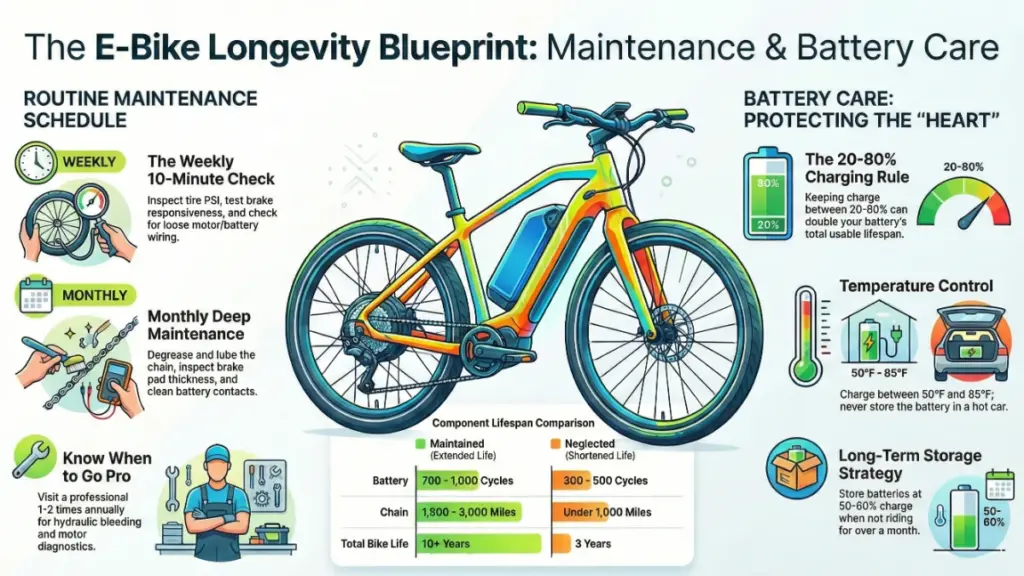
Your battery represents 20-30% of your e-bike’s total cost, so proper care directly impacts your long-term ownership costs. Importantly, modern lithium-ion batteries can last 700-1,000 charge cycles with proper treatment, giving you 20,000-40,000 miles of assisted riding.
Daily Battery Best Practices
Charging habits that extend battery life:
- Avoid temperature extremes: Charge between 50°F and 85°F (10°C-30°C) when possible
- Don’t fully discharge regularly: Stop using assist when the battery reaches 20-30%
- Charge to 80-90% for daily use: Full 100% charges accelerate capacity loss over time
- Use the manufacturer’s charger: Third-party chargers may lack proper voltage regulation
Storage guidelines:
- Short-term (under one week): Any charge level is fine
- Medium-term (1-4 weeks): Store at 40-60% charge
- Long-term (over a month): Store at 50-60% charge, check monthly and top up if needed
I keep my e-bike battery at about 60% charge during winter storage from December through February. As a result, when spring arrives, the battery still holds 95% of its original capacity after five years—far better than friends who stored theirs fully charged and lost 30-40% capacity.
Regular Battery Maintenance Tasks
Every 2-3 months, perform these battery checks:
- Clean the battery casing: Wipe with a damp cloth, avoid spraying water directly
- Inspect for physical damage: Look for dents, cracks, or swelling (swelling requires immediate professional attention)
- Verify secure mounting: Tighten any loose bolts holding the battery in place
- Test the battery lock: Ensure it engages fully to prevent theft or dislodging while riding
Annual Battery Care
Once per year:
- Perform a full discharge-charge cycle: Run the battery down to 10-15%, then charge to 100% (this recalibrates the battery management system)
- Professional inspection: Have a shop check overall battery health and connection quality
Modern battery management systems protect against most forms of damage, but proper charging habits still make a difference. In fact, research from battery manufacturers shows that keeping lithium-ion batteries between 20-80% charge can double their usable lifespan compared to regularly cycling between 0-100%.
Seasonal Maintenance: Adapting to Weather Conditions
Your e-bike faces different challenges depending on the season, and smart riders adjust their maintenance routines accordingly.
Winter Riding Maintenance
Cold weather is tough on batteries and components. Therefore, if you ride through winter (as I do year-round), these practices are essential:
Battery management in cold:
- Bring the battery indoors when not riding (cold temperatures reduce range by 20-40%)
- Warm the battery to room temperature before charging
- Expect reduced range—cold batteries deliver less power even when warmed
- Store the bike in a temperature-controlled space if possible
Component protection:
- Apply extra lubricant to the chain—road salt accelerates corrosion
- Wash the bike more frequently to remove salt and grime
- Consider installing full fenders to protect electrical components from spray
- Check brake pads more often—winter conditions cause faster wear
Road salt corrosion prevention: After each ride in salty conditions, wipe down the frame, chain, and exposed metal parts with a damp cloth. In my experience, this simple habit prevented rust damage that plagued other winter riders in my area.
Summer Riding Considerations
Heat affects batteries differently than cold but requires attention nonetheless.
Hot weather battery care:
- Never leave your e-bike in a hot car (temperatures above 140°F can permanently damage batteries)
- Park in shade when possible during rides
- Allow the battery to cool before charging after a long, hot ride
- Store in a cool, dry location
Additional summer maintenance:
- Check tire pressure more frequently—heat increases pressure
- Inspect tires for dry rot if stored outdoors
- Clean and reapply frame protection to prevent UV damage
- Verify that cooling vents on the motor aren’t clogged with dust
Spring and Fall: Transitional Maintenance
Season changes are perfect times for comprehensive bike inspections:
- Complete drivetrain service: Deep clean, lubricate, and adjust
- Brake system overhaul: Replace pads if needed, check fluid levels
- Bearing inspection: Check headset, bottom bracket, and wheel hubs for smooth operation
- Cable and housing check: Replace if showing wear or corrosion
- Full battery health check: Test range and performance
Common E-Bike Problems and Prevention
Understanding common issues helps you spot warning signs early and avoid roadside breakdowns.
Electrical System Issues
Problem: Display errors or power cutting out
- Causes: Loose connections, dirty contacts, sensor misalignment
- Prevention: Monthly connection checks, proper storage, gentle handling
- Quick fix: Disconnect and reconnect battery, check all visible connections
Problem: Reduced range
- Causes: Battery age, cold weather, low tire pressure, headwinds, high assist levels
- Prevention: Proper battery storage, maintain tire pressure, realistic expectations
- When to worry: Sudden 30%+ range drop suggests battery issues requiring professional diagnosis
Mechanical Failures
Problem: Chain dropping or skipping
- Causes: Worn chain, misaligned derailleur, bent hanger
- Prevention: Regular chain replacement, gentle shifting under power
- Quick fix: Adjust derailleur limit screws, replace worn components
Problem: Brake squealing or poor stopping power
- Causes: Contaminated pads, glazed rotors, low brake fluid
- Prevention: Clean rotors regularly, avoid brake contamination with lubricants
- Quick fix: Clean rotors with isopropyl alcohol, rough up glazed pads with sandpaper
Problem: Flat tires
- Causes: Punctures, pinch flats from low pressure, worn tires
- Prevention: Maintain proper pressure, use puncture-resistant tires, avoid road debris
- Quick fix: Carry patch kit or spare tube, learn basic flat repair
I’ve found that 80% of e-bike problems are preventable with regular maintenance. Meanwhile, the other 20% typically involve component wear that’s normal and expected—chains wear out, brake pads need replacement, and tires eventually need changing.
DIY vs. Professional Service: Making Smart Choices
Not every maintenance task requires professional help, but knowing when to visit a bike shop saves time and prevents expensive mistakes.
You Can Easily Handle:
- Chain cleaning and lubrication
- Tire pressure checks and inflation
- Basic brake adjustments (cable tension)
- Battery removal and cleaning
- Visual inspections and minor tightening
- Replacing brake pads (with basic tools)
- Changing flat tires
Consider Professional Service For:
- Hydraulic brake bleeding
- Motor diagnostics and repairs
- Battery cell replacement or internal repairs
- Wheel truing and spoke replacement
- Bottom bracket or headset bearing service
- Complex electrical troubleshooting
- Suspension servicing (if equipped)
Cost-effective approach: Learn basic maintenance to handle weekly and monthly tasks yourself, but budget for professional service 1-2 times per year for comprehensive inspections and specialized work you’re not comfortable performing.
A basic tune-up at most shops costs $75-125 and includes drivetrain service, brake adjustment, and a safety check. In comparison, this is far less than the $300-500 you might spend on repairs if you ignore maintenance and damage components. Personally, I take my e-bike for professional service every spring and fall—they catch things I miss and ensure everything is dialed in for the season ahead.
Essential Tools and Supplies for E-Bike Maintenance
Building a basic maintenance kit costs $75-150 and covers 90% of routine tasks. Fortunately, you don’t need a professional shop setup to keep your e-bike running well.
Basic tool kit should include:
- Multi-tool with hex wrenches (4mm, 5mm, 6mm most common)
- Chain cleaning tool and brush
- Chain checker gauge
- Tire levers and patch kit
- Floor pump with pressure gauge
- Chain lubricant (wet or dry formula depending on conditions)
- Degreaser
- Clean rags
- Torque wrench for critical bolts (optional but recommended)
Nice-to-have additions:
- Bike stand (makes maintenance much easier)
- Cable cutters (for brake and derailleur cable replacement)
- Spoke wrench (for minor wheel truing)
- Pedal wrench
- Chain breaker tool
I started with just a multi-tool and floor pump, gradually adding tools as I took on more maintenance tasks. Consequently, now I have a complete kit that’s paid for itself many times over in avoided shop visits.
Creating Your Personal Maintenance Schedule
Consistency is more important than perfection. Therefore, here’s a realistic maintenance schedule that balances thoroughness with time constraints:
Weekly (10 minutes):
- Visual inspection
- Tire pressure check
- Brake function test
- Battery charge status
- Quick chain wipe and lube if needed
Monthly (30-45 minutes):
- Deep chain cleaning and lubrication
- Brake pad and rotor inspection
- Electrical connection check
- Tire and wheel examination
- Bolt tightness check
Quarterly (1-2 hours or professional service):
- Complete drivetrain service
- Bearing inspection
- Cable inspection and adjustment
- Battery deep cleaning
- Comprehensive safety check
Annually (professional recommended):
- Full tune-up and safety inspection
- Battery health assessment
- Replace wear components proactively
- Update firmware if applicable
As-needed:
- Chain replacement (every 1,500-3,000 miles)
- Brake pad replacement (every 500-2,000 miles depending on conditions)
- Tire replacement (every 1,500-3,000 miles)
- Battery replacement (after 700-1,000 charge cycles or 5-8 years)
Final Thoughts: Maintenance as an Investment
Think of e-bike maintenance not as a chore but as protecting your investment. Indeed, a well-maintained electric bike will:
- Last 10+ years instead of 3-5 years with neglect
- Maintain better resale value if you decide to upgrade
- Provide safer, more enjoyable rides
- Cost significantly less over its lifetime
- Deliver more reliable transportation when you need it
The total annual maintenance cost for an e-bike runs about $150-300 if you do basic work yourself and use a shop for major service. When you compare this to the $3,000-6,000 cost of a quality e-bike, regular maintenance is clearly worthwhile.
Your next steps:
- Create a maintenance calendar with reminders on your phone
- Assemble your basic tool kit if you haven’t already
- Perform a thorough inspection of your e-bike this weekend
- Schedule a professional tune-up if it’s been more than six months
- Join an e-bike forum or local group to learn from other riders’ experiences
I’ll be honest—when I first got my e-bike, I treated maintenance like an afterthought. However, after an expensive repair bill from neglecting my chain, I committed to the regular routine outlined in this guide. Five years later, my e-bike still rides like new, the battery maintains excellent range, and I’ve spent a fraction of what friends have paid in repairs.
Regular maintenance isn’t glamorous, but it’s the difference between an e-bike that’s a reliable daily transportation tool and one that becomes an expensive garage ornament. Therefore, start with the basics, build the habit, and you’ll enjoy thousands of worry-free miles ahead.
What’s your biggest e-bike maintenance challenge? Whether it’s understanding battery care, dealing with brake adjustments, or keeping the drivetrain clean, focus on that area first, master it, then expand your skills. Every e-bike owner can become competent at basic maintenance—it just takes a little time and consistent practice.