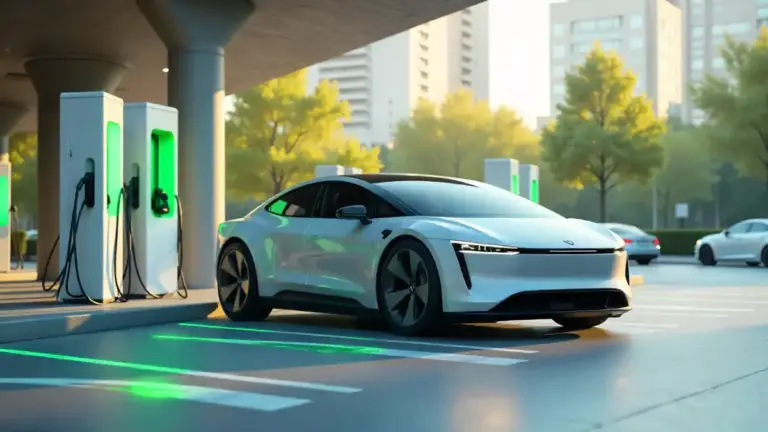
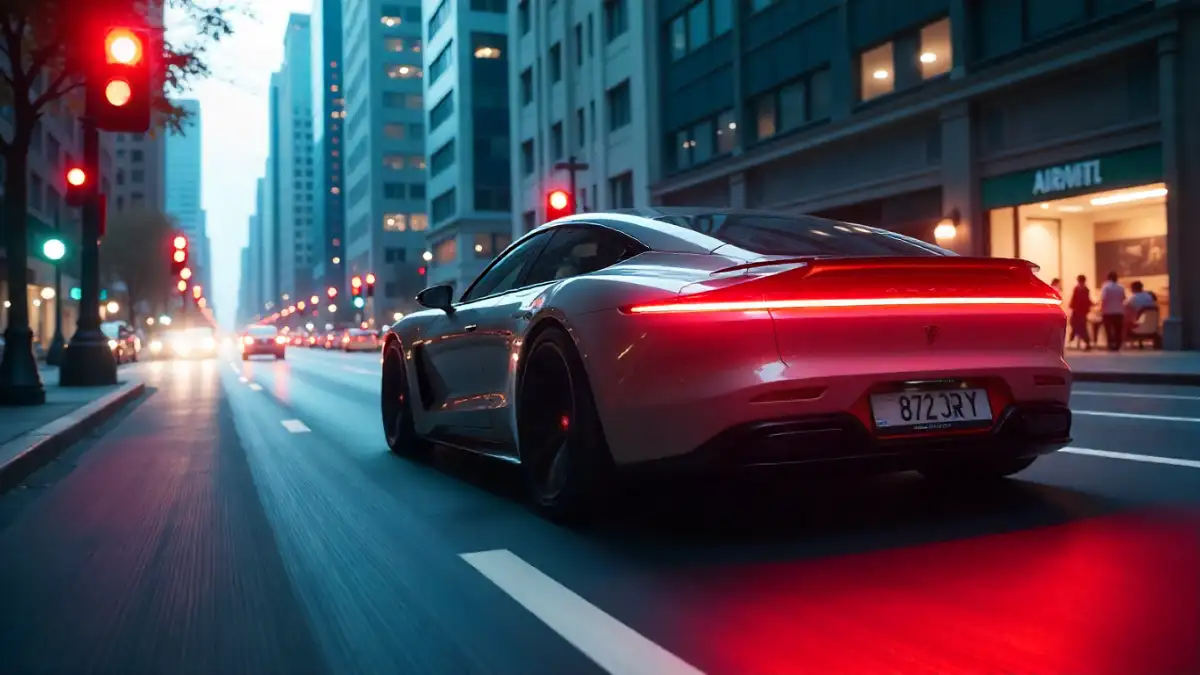
Have you ever been in a car that feels like it’s being shoved forward by an invisible giant hand the moment you touch the accelerator? That’s electric car torque in action, and once you’ve experienced it, gasoline engines feel like they’re warming up for a marathon while EVs are already sprinting.
I still remember the first time I drove a Tesla Model 3. I was at a stoplight, feeling confident in my decades of driving experience, and I gently pressed the accelerator when the light turned green. “Gently” turned out to be relative—the car launched forward with such immediacy that I actually laughed out loud. My passenger’s coffee nearly ended up in their lap. That’s the magic (and sometimes the surprise) of electric torque delivery.
Let’s dive into what makes electric motors so different from their gas-guzzling cousins, and why understanding torque might just change how you think about your next car purchase.
What Exactly Is Torque, Anyway?
Before we get into the electric versus gas debate, let’s demystify torque itself. Think of torque as rotational force—it’s what gets your car moving from a standstill and helps you accelerate up a steep hill. If horsepower is about how fast you can go, torque is about how quickly you can get there.
Here’s a simple way to picture it: imagine opening a door. If you push near the hinges, you need a lot of force to move it. But push near the handle, and the door swings open easily. That leverage you’re using? That’s essentially torque at work. In cars, higher torque means stronger acceleration and better pulling power.
Now, here’s where things get interesting. In traditional gasoline engines, you don’t get maximum torque right away. The engine needs to rev up, building through its RPM range until it hits that sweet spot—often somewhere between 3,000 and 5,000 RPM. You’ve probably felt this: you floor the accelerator, the engine roars, and then—a moment later—the power kicks in. There’s a delay, a buildup.
Electric motors? They laugh at that whole process.
The Electric Advantage: Instant Torque Delivery
This is where electric vehicles completely flip the script. Electric motors deliver their maximum torque from 0 RPM—meaning the instant you press the accelerator pedal, all that rotational force is available immediately. Not after a second. Not after the transmission downshifts. Right. Now.
The physics behind this is actually pretty elegant. In an electric motor, when electricity flows through the coils, it creates a magnetic field that instantly pushes against permanent magnets (or other electromagnets), creating rotation. There’s no waiting for combustion cycles, no need for pistons to fire in sequence, no complex timing of fuel injection and spark plugs. It’s just pure, immediate electromagnetic force.
Let me give you some real numbers to chew on. The Ford Mustang Mach-E GT, for example, produces 634 lb-ft of torque, and every single pound-foot is available the moment you tap the accelerator. Compare that to a traditional Mustang GT with its 5.0-liter V8—it makes 420 lb-ft of torque, but only when the engine reaches 4,600 RPM. In a drag race from a stoplight, the electric Mach-E would leave the gas Mustang eating its dust for the first several seconds.
This instant torque delivery doesn’t just affect acceleration—it fundamentally changes the driving experience. There’s no lag, no waiting for power, no need to “be in the right gear.” You think about accelerating, your foot moves, and the car responds as if it’s reading your mind.
How This Changes Your Daily Driving Experience
You might be thinking, “Okay, that sounds cool for racing, but what about my commute?” Fair question! Here’s where instant torque becomes more than just a party trick—it transforms everyday driving in ways you might not expect.
Merging onto highways becomes effortless. Remember that anxious feeling when you’re trying to merge onto a busy highway and your car seems to take forever to get up to speed? With an EV, you’ve got immediate power. You see your opening, you press the pedal, and you’re at highway speed before you know it. No waiting for your transmission to kick down, no engine screaming as it builds up power.
City driving feels more responsive. Stop-and-go traffic is where electric torque really shines. Each time you need to accelerate from a stop, the car responds instantly. There’s no jerky transmission shifting, no turbo lag, no delay. It’s smooth, immediate, and honestly a bit addictive. Many EV drivers describe city driving as more relaxing in an electric car specifically because of this responsive torque delivery.
Hill starts become drama-free. If you’ve ever driven a manual transmission on a steep San Francisco-style hill, you know the stress of that moment. Even with automatic transmissions, there’s often a slight rollback before the engine delivers power. Electric motors eliminate this completely. The torque is there instantly, holding you in place and pushing you forward simultaneously.
One-pedal driving makes sense. Many EVs offer regenerative braking that’s strong enough to slow the car significantly when you lift off the accelerator. This works because of that same instant torque delivery—just in reverse. The motor can immediately switch from pushing you forward to acting as a generator, creating resistance that slows the car while sending energy back to the battery. Once you get used to it, you’ll rarely touch the brake pedal in normal driving.
The Power Curve: Why EVs Feel Fast at Every Speed
Here’s something that might surprise you: electric cars often feel faster than they actually are, and it’s not just the instant torque at launch—it’s about the power delivery curve.
In a gasoline car, power delivery looks like a mountain. It starts low, builds to a peak somewhere in the mid-range RPMs, then drops off at high RPMs. This is why car enthusiasts talk about engines “coming on the cam” or “hitting VTEC”—they’re describing that point where maximum power arrives. Drivers of turbocharged cars know this even more acutely; there’s a moment of lag, then whoosh, the turbo kicks in and power surges.
Electric motors deliver their power more like a plateau. You get maximum torque instantly at 0 RPM, and while the torque might gradually decrease as speed increases (due to the limits of electrical frequency), the power delivery remains strong and consistent across a wide range of speeds. There’s no hunting for the powerband, no sweet spot you need to keep the engine in. The power is just… there, whenever you need it.
This is why a Porsche Taycan Turbo S, with its 0-60 mph time of 2.6 seconds, feels absolutely savage at any speed. Whether you’re accelerating from 0 to 30 mph or from 50 to 80 mph, the response is immediate and forceful. Contrast this with even high-performance gas cars, where mid-range acceleration often requires a downshift and a brief wait for the engine to spool up.
The Trade-Offs: What About Top Speed?
Now, I’d be doing you a disservice if I didn’t mention the flip side of this instant torque story. While electric motors dominate at low speeds, they do have limitations at the very top end.
Because electric motors deliver maximum torque at 0 RPM, that torque gradually decreases as motor speed increases. This is why many EVs have impressive 0-60 mph times but somewhat less impressive top speeds compared to high-performance gas cars. A Lucid Air Sapphire can hit 60 mph in just 1.89 seconds (yes, you read that right), but its top speed is electronically limited to 205 mph. Meanwhile, gas-powered hypercars regularly exceed 220 mph.
For context, though, when’s the last time you drove over 150 mph? For 99.9% of driving—your commute, highway cruising, even spirited backroad driving—the electric motor’s torque characteristics are actually superior to gasoline engines.
There’s also the matter of sustained high-speed driving. Electric motors and batteries can experience thermal limitations during extended track sessions or prolonged high-speed driving. The Porsche Taycan addressed this with sophisticated thermal management, but it’s still a consideration for anyone planning to regularly track their EV.
Torque Vectoring: Taking Control to the Next Level
Here’s where things get really exciting. Because electric motors are so precise and responsive, some EVs use multiple motors to actively control power delivery to individual wheels—a technology called torque vectoring.
The Rivian R1T truck, for example, has four motors—one for each wheel. The vehicle’s computer can adjust the torque to each wheel hundreds of times per second, dramatically improving handling, traction, and stability. Approaching a corner? The system can send more torque to the outer wheels to help rotate the vehicle. Accelerating on a slippery surface? It can modulate each wheel independently for maximum traction.
This level of control is simply impossible with a traditional internal combustion engine and mechanical drivetrain. Even sophisticated all-wheel-drive systems in gas cars can’t match the precision and speed of electric torque vectoring. It’s like comparing a surgeon’s scalpel to a butter knife—both cut, but one offers infinitely more control.
What This Means for Your Next Car
So you’re probably wondering: should instant torque be a factor in your next car purchase? Here’s my honest take.
If you’ve never driven an EV, the torque delivery will likely be the most immediately noticeable difference from your gas car—even more so than the quiet cabin or the lack of engine vibration. It’s the characteristic that makes people grin on test drives and say, “Wow, that’s different!”
For daily driving, instant torque makes EVs feel more responsive and engaging, even in basic models. A Nissan Leaf or Chevy Bolt won’t win any drag races, but they still have that immediate throttle response that makes them feel peppy around town. You don’t need a six-figure Lucid or Porsche to enjoy this benefit.
However, if you’re coming from a high-performance gas car—especially something with a great-sounding engine—you might find yourself missing the drama and engagement of a traditional powerplant. Some enthusiasts argue that part of the joy of driving is working with the engine, finding the right gear, and hearing that mechanical symphony. EVs deliver their power with clinical efficiency, which is objectively better but perhaps subjectively less involving for some drivers.
The Bottom Line
Electric car torque isn’t just about faster 0-60 times or winning stoplight drag races (though those are fun). It’s about a fundamentally different driving experience that’s more immediate, more responsive, and in many ways more intuitive than what we’ve grown accustomed to with gasoline engines.
The instant torque delivery of electric motors eliminates the delay between your intention to accelerate and the car’s response. This makes EVs feel quicker than their specs might suggest and creates a driving experience that many find more relaxing and confident-inspiring in daily use.
Will instant torque alone convince you to go electric? Probably not—charging infrastructure, range, and price are still the big decision factors. But once you’ve experienced it, that immediate surge of power becomes one of those things you don’t want to give up. It’s the secret sauce that makes EVs feel like they’re from the future, even when you’re just using them to pick up groceries.
Ready to feel it for yourself? I’d strongly encourage taking an extended test drive of any EV you’re considering. Don’t just drive around the block—get it on the highway, try some hills, experience that instant torque in real-world conditions. I’m betting you’ll come back with a big smile on your face, just like I did after that first Model 3 drive. Just maybe warn your passengers before you demonstrate what “instant torque” really means.