TL;DR: Integrated public transport in 2025 connects buses, trains, bikes, and ride-sharing into seamless, app-controlled networks powered by AI scheduling and electric fleets. Leading cities like Singapore and Berlin now run autonomous shuttles and see 70%+ ridership rates. With the MaaS market hitting $185 billion and zero-emission buses capturing 60% of EU sales, unified transit is cutting emissions by 45% and saving households $13,000 yearly.
The Single-Tap Commute Is Here
Imagine tapping your smartphone once and watching an intelligent system orchestrate your entire journey—booking your autonomous shuttle, reserving a shared e-bike for the final mile, and dynamically adjusting your route based on real-time traffic conditions. This isn’t futuristic speculation. This is integrated public transport in 2025, and it’s fundamentally reshaping how cities move.
If you’ve ever sprinted through a station to catch a connection that left thirty seconds early, you understand the frustration of fragmented transit. The breakthrough? Cities worldwide are finally stitching buses, trains, trams, bikes, and on-demand services into unified, electric, data-driven networks that actually work together.
In this comprehensive guide, you’ll discover exactly what integrated public transport means in today’s landscape, why 2025 represents a critical inflection point, which global cities are setting the pace, how electric vehicles and AI are powering this transformation, and what your city needs to implement next. Let’s dive in.
What Is Integrated Public Transport? A 2025 Definition
“Integrated public transport” gets thrown around frequently—often without clarity. Let’s define it precisely.
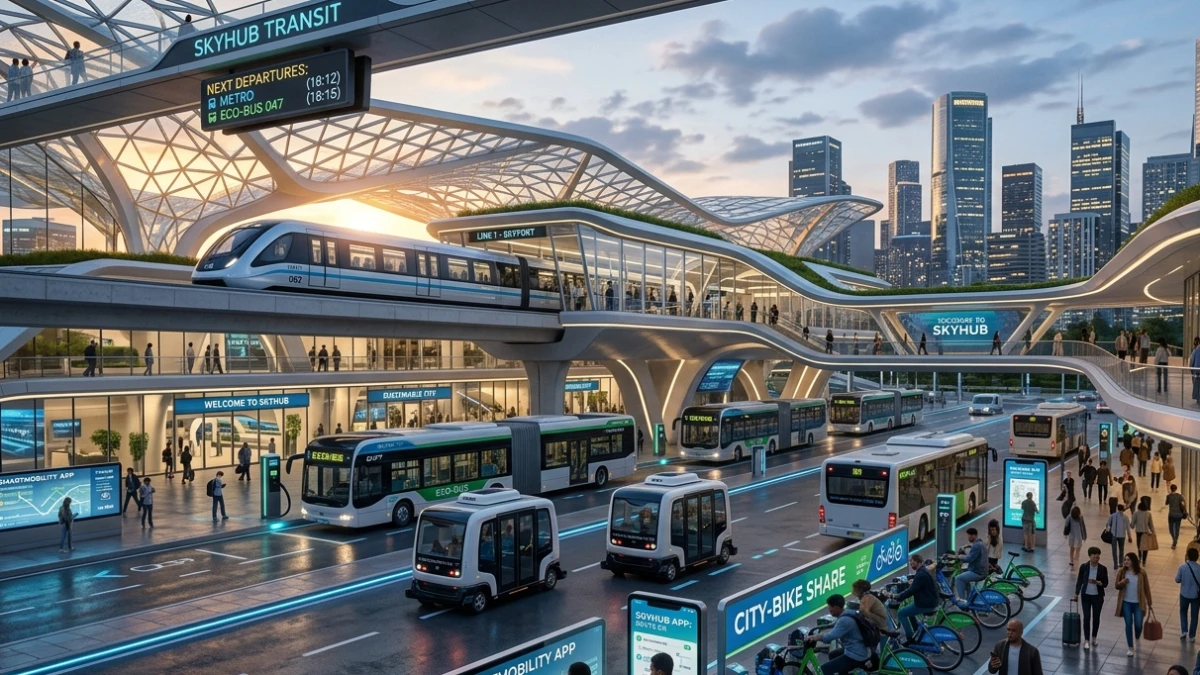
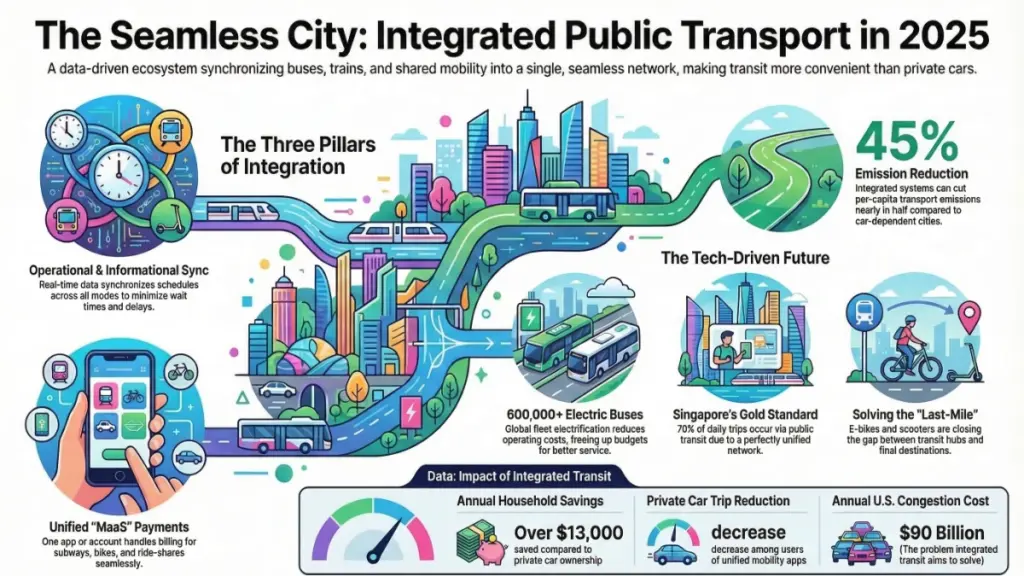
Integrated public transport coordinates multiple transit modes—buses, trains, subways, trams, ferries, bike-shares, and ride-hailing—into one seamless network operating across three critical dimensions:
| Integration Layer | What It Means in 2025 |
|---|---|
| Operational | AI-synchronized schedules minimizing wait times to under 3 minutes |
| Fare | Single digital wallet covering every mode—no physical cards needed |
| Informational | Real-time predictive data across all platforms, accessible via apps, SMS, or voice |
Think of it like your smartphone ecosystem. Just as your devices sync effortlessly across platforms, modern transit aims for that same frictionless experience—and 2025 technology is finally delivering at scale.
Why Integrated Transport Matters More Than Ever in 2025
The Climate Imperative
Transportation accounts for approximately 23% of global energy-related CO₂ emissions, with road vehicles dominating that figure. Even as electric vehicles gain market share, private car ownership remains one of the most carbon-intensive lifestyle choices available—considering manufacturing, battery production, and infrastructure impacts.
Here’s the transformative potential: the global Mobility as a Service (MaaS) market reached $184.92 billion in 2025 and is projected to surge to $893.98 billion by 2034, growing at a CAGR of 25.9%. This explosive growth signals a fundamental shift away from private vehicle dependency.
A European Environment Agency study found that fully integrated transit systems can reduce per-capita urban transport emissions by up to 45% compared to car-dependent cities—not through coercion, but by making public transit the obvious choice.
Economic and Social Impact
- Household savings: APTA estimates transit-using families save over $13,000 annually versus private vehicle ownership
- Congestion costs: The Texas A&M Transportation Institute’s 2024 report found congestion drains $90 billion yearly from U.S. commuters in lost time and fuel
- Equity access: Car-dependent cities effectively exclude lower-income residents, seniors, and people with disabilities from economic opportunity—integrated transit dismantles these barriers
The smart mobility market, valued at $97.59 billion in 2025, is expected to reach $578.05 billion by 2035
—demonstrating massive investor confidence in integrated solutions.
The Technology Stack Powering 2025’s Transit Revolution
Electric Fleets: The Foundation
Electrification is accelerating faster than most projections anticipated. Consider these 2025 milestones:
Europe: Battery-electric bus registrations hit 11,607 units in 2025—a 48% increase from 2024’s 7,855 units. Zero-emission buses now capture 60% of the EU city bus market.
Global projections: Electric buses are expected to exceed 60% of global sales by 2030 and 83% by 2040, with the global fleet projected to be 86% electric by 2050.
Latin America: Santiago de Chile is on track to operate 4,406 electric buses by end of 2025, positioning it as the leading electric transit city outside China.
Why does electrification enable integration? Electric buses offer lower lifetime operating costs, freeing municipal budgets for scheduling software, station upgrades, and expanded service hours.
AI-Driven Dynamic Scheduling
Modern integrated transit relies on machine learning systems processing millions of data points daily—from GPS trackers, passenger flow sensors, weather forecasts, and event calendars. The result? Dynamic scheduling that adjusts in real-time rather than following static timetables.
Helsinki’s HSL system remains the global benchmark, with real-time journey planning that continuously optimizes routing recommendations based on live conditions.
Mobility as a Service (MaaS): The User Interface
MaaS represents the consumer-facing layer of integration. The 2025 market leaders include:
- Whim (Finland): Subscription-based model showing 30% reduction in private car trips within six months of adoption
- Uber, Didi, Lyft: Major players pivoting toward public transit integration
- Regional champions: Grab, Ola, and Careem dominating specific markets
Over 150 cities worldwide have implemented some form of MaaS integration
, though challenges remain: approximately 42% of potential users hesitate due to reliability concerns, highlighting the trust-building imperative.
Global Leaders: Cities Getting It Right in 2025
Singapore: The Gold Standard
Singapore’s Land Transport Authority (LTA) coordinates MRT rail, buses, and ride-hailing under unified EZ-Link digital payment and integrated apps. Synchronized schedules and single-fare structures have achieved a remarkable milestone: over 70% of daily trips occur via public transport—even in a high-income city with widespread car ownership potential.
In October 2025, LTA awarded an $8.14 million contract for autonomous bus pilots on public routes 400 and 191, deploying 16-passenger electric autonomous buses with full fleet management systems.
London: Evolution in Action
Transport for London’s Oyster and contactless payment systems cover the Tube, Overground, Elizabeth Line, buses, river ferries, and Santander Cycles. The Elizabeth Line, fully operational since 2023, now carries 600,000+ passengers daily, significantly reducing parallel Tube line congestion.
TfL’s open data policy has spawned hundreds of third-party journey planning apps, creating a thriving transit tool ecosystem.
Berlin: Autonomous Integration Frontier
Berlin’s BVG launched a groundbreaking pilot in October 2025: five fully electric VW ID. Buzz AD minibuses operating at Level 4 autonomy across 15 square kilometers in northwest Berlin. Covering 55 kilometers and 80 bus stops, this pilot represents a shift from testing to operational integration, with passenger trials beginning early 2026.
The €9.5 million federal investment signals serious commitment to autonomous public transit as a core service component, not a novelty.
Latin America: The Equity-Driven Transition
Santiago, Chile: Targeting 4,400 electric buses by end-2025, with 68% zero-emission fleet coverage.
Bogotá, Colombia: TransMilenio system integrated with expanding metro and 550+ km of protected cycling infrastructure. The city banned new diesel bus procurements, driving rapid electrification.
São Paulo, Brazil: Transit agency SPTrans banned new diesel buses in 2022; by end-2024, the city operated 2,600+ electric buses on municipal lines
.
The Challenges Nobody’s Solving Fast Enough
Funding Fragmentation
The U.S. Infrastructure Investment and Jobs Act (2021) allocated $89 billion over five years—the largest federal transit investment in history. Yet implementation remains uneven. Smart mobility requires sustained, multi-level funding that outlasts political cycles.
Legacy Infrastructure Debt
Cities operating rail and bus networks designed in the 1950s-70s face expensive retrofitting challenges. Modern sensors, payment platforms, and real-time data infrastructure don’t install like software updates—they require physical integration with aging systems.
The Last-Mile Persistence Problem
Even sophisticated networks fail when first/last-mile connectivity breaks down. Living two miles from the nearest stop without safe cycling infrastructure renders elegant central systems irrelevant. Electric micromobility—e-bikes and e-scooters—offers promise, but coverage gaps persist in suburban and rural areas.
The Trust Deficit
Behavior change requires more than good apps. The 42% hesitation rate among potential MaaS users
reflects reliability concerns built through years of transit underinvestment. Systems must deliver consistent performance to overcome historical skepticism.
What’s Next: 2025-2030 Transit Horizon
Autonomous Public Transit Scaling
Beyond Berlin and Singapore, 2025 pilots are expanding:
- Kobe, Japan: Nissan launching autonomous mobility service in Nada Gogo tourist district, targeting commercial operation by 2030
- Las Vegas: Self-driving electric shuttles integrating with wider transit networks
Full deployment remains years away, but the trajectory points toward autonomous vehicles as standard first/last-mile solutions.
Hydrogen Fuel Cell Expansion
For routes where battery-electric isn’t viable—particularly rural and regional lines—hydrogen fuel cell technology is gaining commercial traction. Alstom’s Coradia iLint operates in Germany, while Ballard Power Systems secured 1.5 MW orders in 2025 for Sierra Northern Railway’s switching locomotive conversions and established European footholds with PESA’s Swedish shunter deployment.
Digital Twin Planning
Cities are deploying digital twin technology—virtual transit network replicas—to model changes, test scenarios, and optimize routing before physical implementation. This reduces innovation costs and risks dramatically.
Transit Hub EV Integration
Transit stations are becoming EV charging hubs. The Netherlands and Scandinavia lead this model: commuters park electric vehicles at stations, charge during transit use, and return to full batteries—bridging private and public mobility elegantly.
Key Takeaways for 2025
- Integration delivers measurable results: Higher ridership, reduced emissions, improved economic outcomes
- Electrification is the baseline: 60% of EU city bus sales are now zero-emission; global fleet projections show 86% electric by 2050
- MaaS is the user interface: $184.92 billion market growing at 25.9% CAGR, but trust-building remains critical
- Autonomous transit is transitioning from pilot to operational: Level 4 deployments now in public service preparation
- Challenges are engineering and policy problems, not technical impossibilities: The tools exist; implementation requires sustained commitment
The Future Is Already Operating
Integrated public transport isn’t aspirational—it’s operational reality in dozens of cities right now. The technologies enabling it become more accessible and scalable annually.
The smartest cities in 2025 aren’t merely building better roads or deploying more EVs. They’re weaving every mobility mode into coherent, electric, data-driven ecosystems. Whether you’re in a major metro or a smaller community, the transit investment decisions made today will shape mobility options for the next generation.
The integrated commute isn’t coming. For millions of riders worldwide, it’s already here.