EV battery tech in 2026 is at an inflection point. Lithium-ion (LFP/NMC) remains mature and affordable ($52–115/kWh), while solid-state batteries are finally hitting real roads—Mercedes achieved 1,205 km range, Toyota promises 10-minute charging by 2027, and Factorial Energy leads U.S. commercialization. Sodium-ion alternatives are emerging for budget markets. Solid-state vehicles arrive 2027–2028 for premium buyers; mass-market affordability follows by 2030.
The electric vehicle revolution has reached an inflection point. After years of promises about “game-changing” battery technology, 2026 is delivering on those promises with real vehicles, real production lines, and real road tests. If you’re considering an electric vehicle purchase—or simply want to understand what’s powering the cars of tomorrow—this comprehensive guide breaks down exactly where EV battery technology stands today, what’s coming next, and how it affects your buying decisions.
From solid-state batteries achieving 1,200-kilometer ranges to lithium-ion prices stabilizing after years of decline, the landscape has transformed dramatically. Here’s everything you need to know about EV battery technology in 2026.
The Foundation: How Lithium-Ion Batteries Became the Workhorse of Electrification
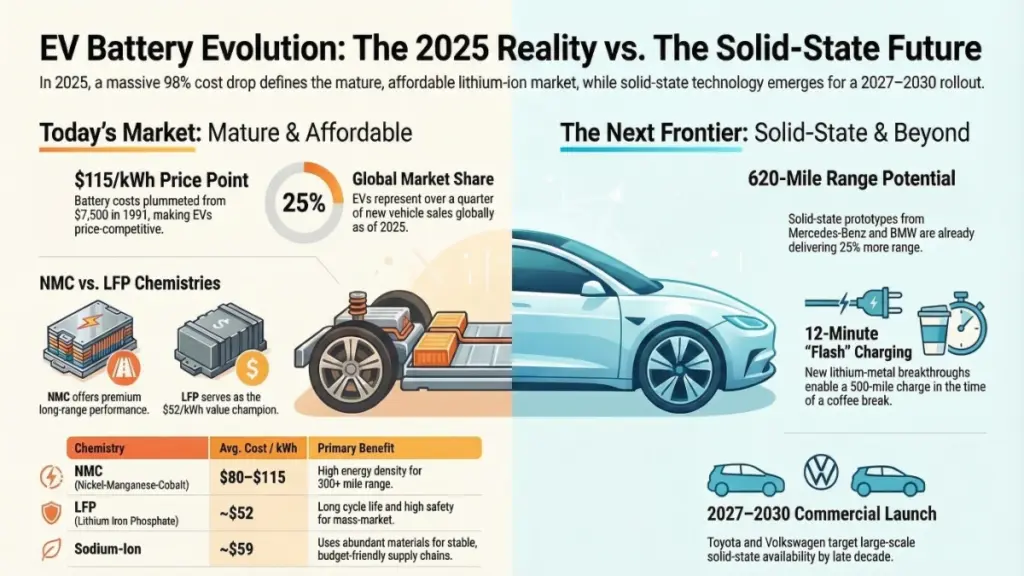
Before diving into tomorrow’s breakthroughs, it’s essential to appreciate how far current technology has come. When Sony commercialized the first lithium-ion battery in 1991, the cost was astronomical equivalent to $7,500 per kilowatt-hour. Today, that figure has plummeted to approximately $115 per kWh as of early 2026, with industry analysts projecting further adjustments based on raw material costs and manufacturing scale.
This 98% cost reduction didn’t come from revolutionary chemistry changes. As Oxford electrochemist Mauro Pasta explains, the transformation resulted primarily from manufacturing economies of scale—automated production lines, improved electrode coatings, and massive gigafactory investments across Asia, Europe, and North America.
The real-world impact is visible across current EV lineups. BMW’s Gen6 battery architecture delivers up to 620 miles of range with 30% faster charging capabilities. Toyota’s latest EV platforms feature enhanced thermal management systems. Hyundai’s battery roadmap projects 30% cost reductions and 15% energy density improvements by 2027 through manufacturing innovations.
However, the cost trajectory has shifted in 2026. After bottoming out in mid-2025, lithium carbonate prices have rebounded significantly—doubling from ¥59,000/ton to over ¥130,000/ton by year-end 2025. Industry forecasts suggest battery-grade lithium carbonate will fluctuate between 80,000 and 150,000 yuan per ton throughout 2026, creating pricing pressures that could affect EV affordability in the short term.
Current Battery Chemistries: NMC vs. LFP vs. The New Contenders
Understanding today’s EV market requires grasping the three dominant battery chemistries—and the emerging technologies challenging their dominance.
NMC (Nickel-Manganese-Cobalt): The Premium Performer
NMC batteries remain the choice for long-range, high-performance electric vehicles. With higher energy density than alternatives, NMC packs enable 300+ mile ranges in compact form factors. The trade-offs include higher costs, more complex supply chains dependent on cobalt and nickel, and slightly reduced cycle life compared to iron-based alternatives.
Current NMC cell costs range from $80–115 per kWh, making them suitable for premium segments but challenging for mass-market adoption without significant subsidies or manufacturing efficiencies.
LFP (Lithium Iron Phosphate): The Value Champion
LFP chemistry has emerged as the dominant force in affordable EVs and energy storage systems. With costs averaging $52 per kWh—roughly half of NMC pricing—LFP offers compelling advantages: exceptional cycle life (2,000–3,000 cycles), inherent thermal stability, and supply chains less vulnerable to nickel and cobalt price volatility.
Chinese manufacturers CATL and BYD have driven LFP innovation, with CATL’s second-generation “Shenxing” battery delivering 520 km (323 miles) of range after just five minutes of charging—even in sub-zero temperatures. This fast-charging capability, announced in April 2026, addresses one of LFP’s traditional weaknesses and makes it increasingly competitive across all market segments.
LMR (Lithium-Manganese-Rich): The Western Alternative
General Motors and Ford are aggressively developing lithium-manganese-rich chemistry, which Ford engineers have dubbed the “LFP of the West.” LMR aims to deliver NMC-comparable energy density at LFP-comparable costs, using abundant manganese rather than scarce nickel and cobalt.
In March 2026, GM and LG Energy Solution announced accelerated development of LMR batteries alongside expanded LFP production for energy storage systems. This dual-chemistry strategy positions American manufacturers to reduce dependence on Asian supply chains while maintaining competitive pricing.
The Solid-State Revolution: From Laboratory to Highway
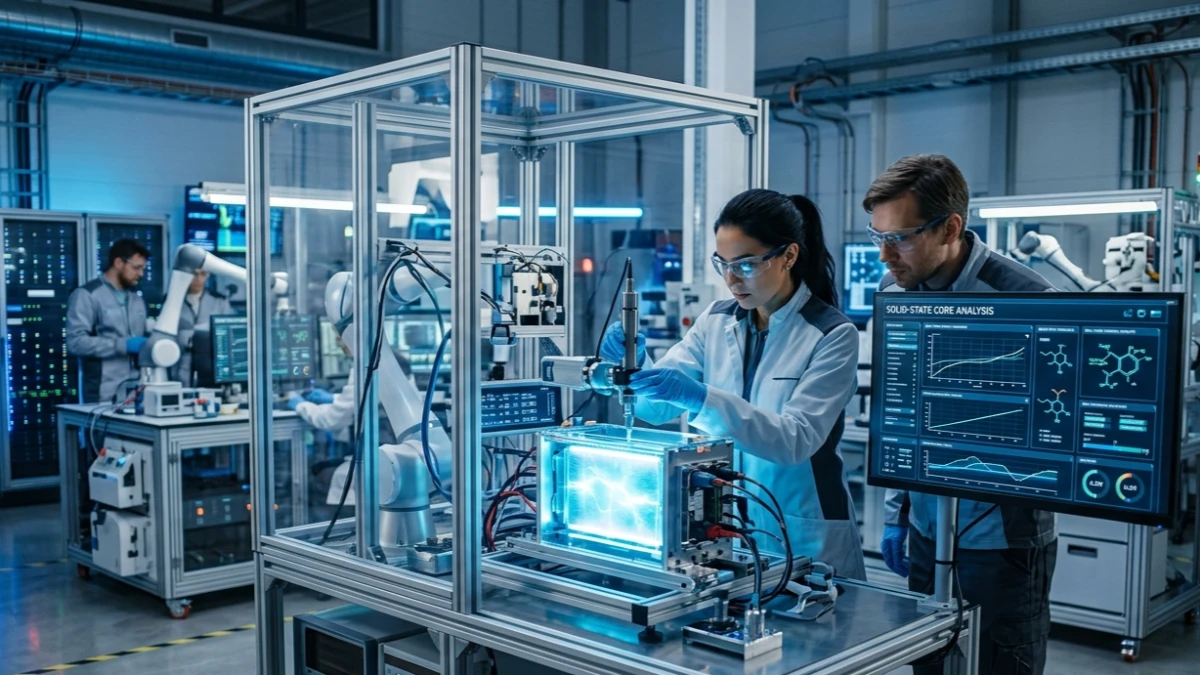
Solid-state batteries represent the most significant leap in energy storage since lithium-ion’s commercialization. By replacing flammable liquid electrolytes with solid ceramic or sulfide materials, these batteries promise double the energy density, 10-minute fast charging, and fundamentally improved safety.
What makes 2026 different from previous years? Solid-state batteries are no longer laboratory curiosities—they’re in production vehicles, undergoing road tests, and achieving manufacturing scale.
Mercedes-Benz: 1,205 Kilometers on a Single Charge
In August 2025, Mercedes-Benz completed a demonstration drive that reset industry expectations. A modified EQS equipped with Factorial Energy’s solid-state battery traveled 1,205 kilometers (748 miles) from Stuttgart, Germany, to Malmö, Sweden—without charging. Upon arrival, the vehicle retained 137 kilometers of remaining range, demonstrating total capability exceeding 1,300 kilometers.
This breakthrough utilized Factorial’s FEST (Factorial Electrolyte System Technology) platform with lithium-metal anodes and proprietary electrolyte systems. Mercedes’ Formula 1 technology center in Brixworth, UK, contributed thermal management and packaging expertise, including patented pneumatic actuators that compensate for cell expansion during charging cycles.
Mercedes-Benz Chief Technology Officer Markus Schäfer has committed to series production before 2030, with some indications pointing to limited production by late 2026 or early 2027.
BMW and Solid Power: The Sulfide Route
BMW has pursued solid-state development through its partnership with Colorado-based Solid Power, focusing on sulfide-based solid electrolytes. In 2025, BMW tested solid-state batteries in modified i7 prototypes, achieving energy densities of 440 Wh/kg and ranges exceeding 800 kilometers.
BMW’s approach emphasizes manufacturing compatibility—the company has constructed prototype production lines in Parsdorf, Germany, to validate scalable production methods. The sulfide route offers high ionic conductivity but requires moisture-free manufacturing environments, adding complexity that BMW and Solid Power are systematically addressing.
Toyota: The 10-Minute, 1,200-Kilometer Promise
Toyota, despite previous delays, has received Japanese government approval for solid-state battery production with an ambitious timeline. The company’s sulfide-based cells achieve 450–500 Wh/kg energy density—more than double current lithium-ion performance.
Toyota’s most striking claim: 10-minute charging for 1,200 kilometers of range. This would effectively eliminate charging anxiety and match gasoline refueling convenience. Mass production is scheduled for 2027, with initial deployment in Lexus flagship models priced at premium levels (800,000–1,000,000 yuan, approximately $110,000–$140,000).
By 2030, Toyota projects cost parity within 1.5x of conventional batteries, enabling broader market penetration. The company holds over 1,000 solid-state battery patents globally, establishing formidable intellectual property barriers.
QuantumScape: The Licensing Model
California-based QuantumScape represents a fundamentally different approach. Rather than manufacturing batteries directly, QuantumScape develops solid-state technology for licensing to established manufacturers—a “fabless” model inspired by semiconductor industry leaders like ARM and Nvidia.
In February 2026, QuantumScape inaugurated its “Eagle Line” pilot production facility in San Jose, California. This automated production line demonstrates scalable manufacturing of ceramic separators and lithium-metal cells, producing samples for automotive partners including Volkswagen Group.
QuantumScape’s technology eliminates traditional anodes entirely—cells are manufactured in a discharged state without host materials, then plated with lithium metal during initial charging. This architecture promises energy density improvements of 50–80% over conventional designs.
The company has expanded beyond automotive applications, targeting drones, defense aerospace, and AI data center power systems where safety and energy density command premium pricing. Full field testing of QuantumScape-powered vehicles is scheduled for 2026, with commercial production targeted for 2027–2028.
Factorial Energy: America’s Solid-State Champion
Boston-based Factorial Energy has emerged as the most commercially advanced American solid-state battery developer. In February 2026, Factorial announced the first U.S. commercial solid-state battery program for passenger vehicles through a partnership with Karma Automotive.
Factorial’s Solstice platform achieves 450 Wh/kg energy density—80% higher than conventional lithium-ion—while maintaining stability at temperatures up to 90°C (194°F). The company’s dry-cathode architecture reduces manufacturing steps and environmental impact compared to wet processes.
Crucially, Factorial’s FEST technology integrates with up to 80% of existing lithium-ion manufacturing equipment, enabling rapid scaling without entirely new factory investments. This compatibility advantage has attracted partnerships with Mercedes-Benz, Stellantis, and Hyundai.
Factorial is proceeding with a $1.1 billion SPAC merger expected to close mid-2026, providing $100 million in growth capital and Nasdaq listing under ticker symbol FAC.
China’s Solid-State Acceleration: CATL, BYD, and the New Standards
While Western companies pursue licensing and partnership models, Chinese manufacturers are driving toward mass production dominance. In 2026, China is preparing its first national standard for solid-state batteries, clarifying terminology for liquid, hybrid, semi-solid, and all-solid-state designs—expected for release in July 2026.
CATL: The Condensed State Battery
CATL, the world’s largest battery manufacturer, has achieved 500 Wh/kg energy density in its “condensed state” solid-state battery technology. The company targets mass production by 2027, with pilot lines already operational.
CATL’s approach combines aspects of semi-solid and solid-state designs, utilizing advanced electrolyte formulations that reduce—rather than eliminate—liquid components. This intermediate step may reach market faster than pure solid-state alternatives while delivering meaningful performance improvements.
BYD: Blade Battery 2.0 and Flash Charging
BYD, the world’s second-largest battery maker, unveiled its Blade Battery 2.0 in early 2026 alongside Flash Charging Technology capable of 1,500 kW power delivery. This enables charging from 10% to 70% in 5 minutes, or 10% to 97% in 9 minutes—approaching gasoline refueling speeds.
BYD’s solid-state roadmap targets small-batch production by 2027, focusing on sulfide electrolyte routes with breakthroughs in battery lifespan and fast-charging capabilities. The company has also developed sodium-ion batteries with 10,000-cycle lifespans—matching energy storage system durability—though commercial timing depends on market demand.
Geely, Chery, and Changan: The Vehicle Manufacturer Push
Chinese automakers are integrating vertically into battery production:
- Geely (Volvo’s parent company) is developing solid-state packs with 400 Wh/kg energy density, targeting prototype vehicle launches by 2026 and 1,000 demonstration vehicles by 2027. Long-term goals include 500+ Wh/kg by 2030 at costs below 0.6 yuan/Wh ($0.08/Wh).
- Chery unveiled its “Rhino” solid-state battery series in early 2026, claiming 600 Wh/kg energy density and 1,500+ km (932 miles) range. The company plans vehicle testing in 2026 with the Exeed ES8 SUV.
- Changan will begin trial installations of its “Golden Bell” solid-state battery by Q3 2026, featuring 400 Wh/kg density and comparable 1,500 km range claims.
- Dongfeng has already begun extreme cold-weather testing of solid-state prototypes, achieving 350 Wh/kg with 1,000 km range, and has completed a 0.2 GWh production line with batteries ready for vehicle use from 2026.
Sodium-Ion Batteries: The Abundant Alternative
While solid-state technology captures headlines, sodium-ion batteries are quietly establishing market presence as a cost-effective, resource-abundant alternative.
Sodium-ion cells currently cost approximately $59 per kWh—slightly above LFP’s $52/kWh but using infinitely more abundant raw materials. Sodium is extracted from seawater and mineral deposits worldwide, eliminating supply chain concentrations in South American lithium triangle regions or African cobalt mines.
In February 2026, BYD announced sodium-ion batteries with 10,000-cycle lifespans—comparable to grid-scale energy storage requirements. CATL and Changan jointly unveiled a passenger vehicle equipped with CATL’s “Naxtra” sodium-ion battery, scheduled for mid-2026 market launch with 175 Wh/kg energy density—competitive with mainstream LFP performance.
The automotive sodium-ion battery market is projected to grow from $193.2 million in 2026 to $599.6 million by 2033, representing an 18.1% compound annual growth rate. Applications will concentrate in entry-level passenger vehicles, electric two-wheelers, and light commercial vehicles where cost sensitivity outweighs maximum range requirements.
India’s market presents particular opportunity—BYD and CATL are targeting the subcontinent’s price-sensitive EV market where lithium import dependence creates economic and strategic vulnerabilities.
Scientific Breakthroughs Reshaping the Industry
Beyond commercial announcements, 2026 has witnessed remarkable laboratory achievements:
KAIST and LG Energy Solution: The 12-Minute Charge
A joint team from Korea’s Advanced Institute of Science and Technology and LG Energy Solution developed a lithium-metal battery achieving 500 miles of range with 12-minute charging capability. The innovation utilizes a “cohesion-inhibiting” liquid electrolyte that suppresses lithium dendrite formation—historically the primary barrier to lithium-metal commercialization.
Durability testing exceeded 186,000 miles of equivalent driving, demonstrating that advanced electrolyte engineering can resolve longevity concerns that have plagued high-energy-density designs.
Fluoride-Ion Batteries: Doubling Range Potential
Researchers have demonstrated all-solid-state fluoride-ion batteries with double the energy density of lithium-ion cells—potentially extending EV ranges from 372 to 745 miles. While commercialization timelines remain uncertain, fluoride-ion chemistry represents a longer-term pathway beyond lithium-based systems.
KAIST’s Low-Cost Solid-State Design
KAIST scientists developed solid-state battery architectures using inexpensive raw materials without costly metal additives, achieving 4x performance improvements through structural redesign rather than exotic materials. This approach addresses the primary barrier to solid-state adoption: manufacturing cost.
Global Market Dynamics: Who’s Winning the Battery Race?
China’s Production Dominance
China’s battery production capacity currently exceeds global demand by five times. CATL alone supplies more than one in three EVs manufactured worldwide. The company’s second European factory—an $8.2 billion facility in Hungary—will supply BMW and Mercedes-Benz Group, extending Chinese influence into European supply chains.
However, policy shifts are reshaping trade flows. China’s reduction of battery export VAT rebates from 9% to 6% (effective April 1, 2026, with full elimination by January 2027) will increase export costs by 6–13%, potentially accelerating price increases in Western markets while incentivizing Chinese manufacturers to establish local production facilities in Europe, North America, and Southeast Asia.
Western Manufacturing Response
The United States and Europe are aggressively building domestic capacity:
- North American sodium-ion production: Natron Energy is constructing a $1.4 billion, 24 GWh gigafactory in North Carolina, projected to reach full capacity by 2028—multiplying current output fortyfold.
- European regulatory leadership: The EU’s New Battery Law imposes the world’s strictest compliance requirements, while Germany’s Moll Batterien has invested $25 million in domestic sodium-ion production with Bavarian government support.
- U.S. startup ecosystem: QuantumScape, Solid Power, and Factorial Energy represent serious technological competition, backed by automotive partnerships and public market capital.
What This Means for EV Buyers: A Practical Decision Framework
Buying in 2026: Today’s Technology Is Mature
Current lithium-ion EVs—whether NMC or LFP—offer 250–400+ miles of real-world range with dramatically improved charging infrastructure. You are no longer an “early adopter”; you’re purchasing mature technology with established resale values and proven reliability.
The charging network has expanded sufficiently that cross-country travel is routine rather than adventurous. Modern EVs include sophisticated route planning that accounts for topography, weather, and charging station availability.
Waiting for Solid-State: The 2027–2030 Window
Industry roadmaps converge on 2027–2028 for initial solid-state vehicle availability, with large-scale commercialization by 2030. Consider waiting if:
- You require 600+ miles of routine range without charging stops
- You prioritize 10-minute charging matching gasoline convenience
- You seek maximum safety with non-flammable battery chemistry
- You’re purchasing in the luxury/performance segment where solid-state will debut
However, solid-state vehicles will command significant premiums initially—likely 50–100% above comparable lithium-ion models. Mass-market affordability awaits 2030+ cost reductions.
Cost Trajectory: Prepare for Short-Term Increases, Long-Term Declines
Battery prices face upward pressure in 2026–2027 due to lithium cost rebounds, Chinese export policy changes, and energy storage demand growth. However, new chemistries (LMR, sodium-ion) and manufacturing scale will resume downward trends by 2028–2030.
The cost parity window—where EVs match gasoline vehicles without subsidies—is closing temporarily but will reopen more definitively by decade’s end.
Chemistry Comparison Table: Making Sense of Your Options
| Chemistry | Current Cost/kWh | Energy Density | Best For | Availability |
|---|---|---|---|---|
| NMC | $80–115 | High (250–300 Wh/kg) | Long-range premium EVs | Now |
| LFP | ~$52 | Moderate (160–180 Wh/kg) | Affordable, long-life EVs | Now |
| LMR | In development | High | Affordable long-range EVs | 2027–2028 |
| Sodium-ion | ~$59 | Moderate (150–175 Wh/kg) | Budget EVs, stationary storage | 2026–2027 |
| Solid-state | Premium pricing | Very High (400–600 Wh/kg) | Next-gen premium EVs | 2027–2030 |
The Road Ahead: Convergence of Multiple Revolutions
The EV battery story of 2026 isn’t a single breakthrough—it’s the convergence of multiple technological and economic transformations:
- Solid-state batteries are transitioning from laboratory demonstrations to production vehicles, with 2027–2028 representing the inflection point for commercial availability.
- Lithium-ion optimization continues through new chemistries (LMR) and manufacturing efficiencies, maintaining competitiveness for mass-market applications.
- Sodium-ion alternatives are establishing market presence, offering supply chain resilience and cost advantages for specific applications.
- Manufacturing localization is accelerating globally, reducing dependence on single-source supply chains.
- Charging infrastructure has achieved critical mass, making EV ownership practical for mainstream consumers regardless of battery chemistry.
EVs captured over 25% of global new vehicle sales in 2025, up from under 5% in 2020. In China, over 50% of new sales are now electrified. Europe saw more pure electric vehicles sold than gasoline cars in December 2025. The transition is no longer theoretical—it’s the dominant market reality.
For battery technology specifically, the most honest assessment is this: today’s lithium-ion batteries are better than they’ve ever been, and tomorrow’s solid-state alternatives are arriving faster than most predicted. The question is no longer whether electric vehicles are viable, but which chemistry dominates which market segment, and how quickly solid-state manufacturing scales to meet pent-up demand.
The internal combustion engine dominated automotive propulsion for over a century. The battery electric drivetrain is achieving comparable dominance in mere decades—and the technology driving this transformation is improving faster than any automotive innovation in history.
Key Takeaways for 2026
- Lithium-ion costs have stabilized after decades of decline, with short-term increases likely before resumed downward trends.
- Solid-state batteries are in real vehicles now—Mercedes, BMW, Toyota, and Chinese manufacturers have functioning prototypes with 600–1,200 km ranges.
- Commercial solid-state availability is targeted for 2027–2028 for luxury segments, 2030 for mass market.
- Sodium-ion batteries are entering the market as viable LFP alternatives with superior supply chain resilience.
- Western manufacturing is scaling rapidly through partnerships (Factorial, QuantumScape, Solid Power) and domestic production investments.
- Chinese manufacturers maintain production dominance but face policy headwinds that may accelerate global supply chain diversification.
Your next step? If you’re EV-curious, test drive current-generation models with latest LFP or NMC packs. The driving experience—instant torque, silent operation, one-pedal driving—makes the technology feel less abstract and more like the inevitable future. For those considering timing, 2026–2027 represents the last optimal window for current-generation purchases before solid-state alternatives begin reshaping premium segments.
The battery revolution isn’t coming. It’s here, it’s charging, and it’s ready to drive.