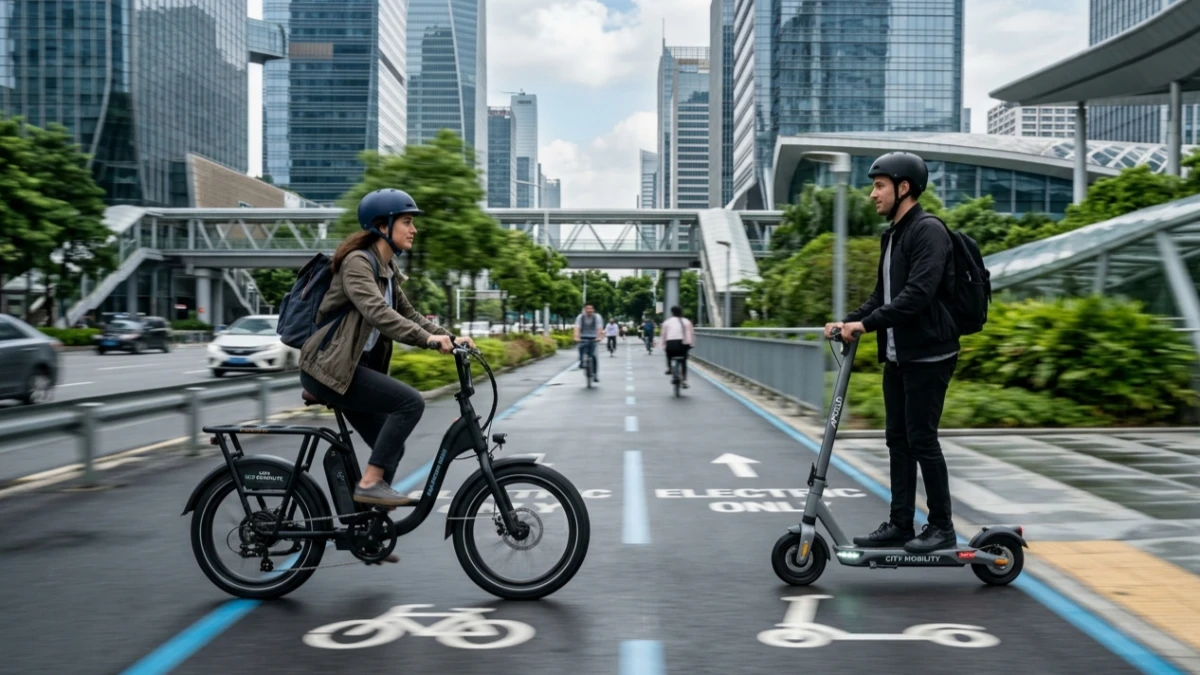
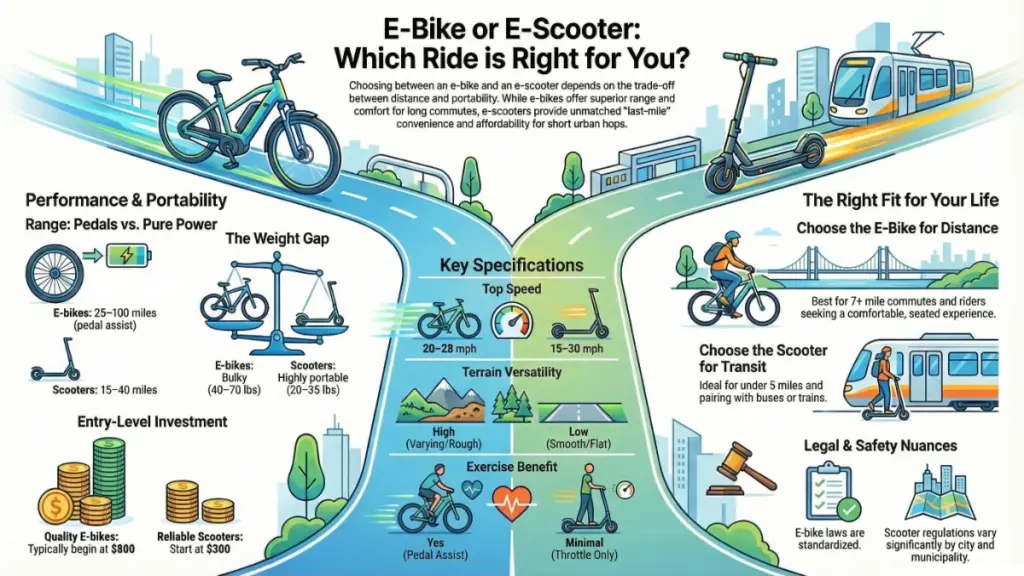
Electric bikes excel for 7+ mile commutes, hills, and exercise with 25-100 mile range but cost $800-$5,000+ and need storage. Scooters win for short urban trips under 5 miles, offering portability and $300-$1,500 pricing, but lack comfort for distance. Choose e-bikes for versatility and long-term value; scooters for budget-friendly, foldable convenience. Both beat traffic—pick based on your commute length and living situation.
Why Electric Micromobility Is Taking Over Cities in 2025
The urban transportation landscape has fundamentally shifted. With the global micromobility market surging to $75.14 billion in 2025 and projected to reach $197.48 billion by 2030
, electric bikes and scooters have moved from niche gadgets to mainstream commuting essentials. Whether you’re looking to slash fuel costs, bypass traffic congestion, or reduce your carbon footprint, choosing between an electric bike (e-bike) and an electric scooter represents one of the most impactful transportation decisions you can make this year.
Here’s the definitive answer: Electric bikes dominate for longer commutes, varied terrain, and riders seeking exercise flexibility, while electric scooters excel at short urban trips, portability, and budget-conscious buyers. But this surface-level comparison barely scratches the surface of what you need to know.
In this comprehensive 2025 guide, you’ll discover data-driven comparisons covering real-world range, total cost of ownership, legal regulations, and emerging technologies like solid-state batteries. By the end, you’ll have the clarity to invest confidently in the right electric vehicle for your lifestyle—and understand why this decision matters more in 2025 than ever before.
What Exactly Is the Difference? Understanding the Fundamentals
Electric Bikes (E-Bikes): The Pedal-Assisted Powerhouse
An electric bike maintains the familiar bicycle architecture—two wheels, pedals, handlebars, and a saddle—but integrates a battery-powered motor that amplifies your pedaling effort. In 2025, e-bikes fall into three federally recognized classes:
- Class 1: Pedal-assist only, motor cuts out at 20 mph
- Class 2: Throttle-assisted, also limited to 20 mph
- Class 3: Pedal-assist up to 28 mph (speed pedelecs)
The key advantage? Dual-power capability. When you pedal, the motor supplements your effort; when the battery dies, you’re still riding a functional bicycle. This hybrid approach fundamentally changes range dynamics and exercise potential.
Electric Scooters: The Stand-Up Solution
Electric scooters feature a motorized platform with handlebars but no pedals. You stand (or occasionally sit on specialty models) and control speed via thumb throttle. Think of them as the evolution of childhood kick scooters—grown up, electrified, and optimized for last-mile connectivity.
The 2025 scooter market has matured significantly, with models like the Segway E3 Pro offering integrated Apple Find My tracking, turn signals, and dual suspension systems previously reserved for premium tiers.
2025 Market Overview: The Numbers Behind the Revolution
Before diving into comparisons, understand the scale of this transportation shift:
| Metric | 2025 Data | Growth Projection |
|---|---|---|
| Global Micromobility Market | $75.14 billion | $197.48B by 2030 (21.5% CAGR) |
| EV Micromobility Segment | $8.73 billion | $22.06B by 2031 (16.71% CAGR) |
| E-Bike Market Share | 85% of micromobility vehicles | Dominant through 2035 |
| Asia-Pacific Market Share | 46-49% globally | North America fastest-growing at 17.72% CAGR |
Key Insight: While e-bikes command the volume market, electric scooters dominate shared mobility fleets and last-mile solutions. Your use case determines which statistic matters most.
Head-to-Head Comparison: 2025 Specs & Real-World Performance
| Feature | Electric Bike 2025 | Electric Scooter 2025 |
|---|---|---|
| Average Range | 25–100+ miles | 15–40 miles |
| Top Speed | 20–28 mph (class-dependent) | 15–28 mph |
| Entry Price | $800–$1,200 (budget) | $300–$600 (budget) |
| Premium Price | $3,500–$8,000+ | $1,200–$2,500 |
| Weight | 40–70 lbs | 20–50 lbs |
| Portability | Low–Moderate | High |
| Exercise Benefit | Significant | Minimal |
| Terrain Versatility | Excellent (hills, gravel, roads) | Limited (smooth urban surfaces) |
| Learning Curve | Low (if you bike) | Very Low |
| Theft Risk | Moderate (can be locked outside) | High (must bring indoors) |
Sources: Bosch eBike Systems 2025, Consumer Reports, Tom’s Guide 2026 , Rad Power Bikes
Range & Battery Technology: The 2025 Reality
E-Bike Range Dominance
The pedal-assist advantage creates a fundamental range gap. A quality 2025 commuter like the Rad Power Bikes RadCity 5 Plus delivers 45+ miles under normal conditions. Premium models with dual-battery configurations—such as the Trek Allant+ 9.9S—push past 100 miles.
Why e-bikes win on range: When you contribute pedaling effort, the motor works less hard. This human-electric synergy extends battery life dramatically. Even at low assist levels, you’re effectively doubling or tripling range compared to throttle-only operation.
Scooter Range Constraints
Top 2025 consumer scooters like the Segway Ninebot Max G3 advertise 50-mile range, but real-world testing shows 17–20 miles under mixed conditions with hills. The Apollo City Pro and Xiaomi Electric Scooter 4 Ultra typically deliver 25–40 miles in practice.
The physics are simple: Scooters rely 100% on battery power. Every mile drains the pack directly, with no human input to offset consumption.
2025 Battery Breakthrough: Solid-State Technology Arrives
The most significant 2025 development is the emergence of solid-state batteries in premium e-bikes. Replacing flammable liquid electrolytes with solid conductive materials delivers:
- 40-50% higher energy density (more range, same weight)
- Faster charging (0-80% in under 30 minutes)
- Enhanced safety (eliminated thermal runaway risk)
- Longer lifespan (8+ years vs. 3-5 for lithium-ion)
While mainstream adoption awaits 2026-2027, early adopters in 2025 can find solid-state options in high-end models from Specialized, Trek, and emerging brands like Spacevelo.
Cost Analysis: Upfront Investment vs. Long-Term Value
Initial Purchase Price (2025 Market)
Electric Scooters:
- Budget tier ($300–$600): NIU KQi 100P, Segway E2 Plus II
- Mid-range ($600–$1,200): Segway E3 Pro ($599), Apollo Air Pro
- Premium ($1,200–$2,500): Segway Ninebot Max G3, Apollo City Pro
Electric Bikes:
- Budget tier ($800–$1,500): Lectric XP 3.0, Aventon Soltera
- Mid-range ($1,500–$3,500): Rad Power Bikes, Ride1Up, Priority Current
- Premium ($3,500–$8,000+): Specialized Turbo series, Trek Allant+, Riese & Müller
Total Cost of Ownership (5-Year Projection)
| Expense Category | E-Bike | E-Scooter |
|---|---|---|
| Initial Purchase | $1,800 (mid-range) | $600 (mid-range) |
| Maintenance (5 years) | $400–$600 | $300–$500 |
| Battery Replacement | $300–$500 (once) | $200–$400 (possibly twice) |
| Insurance | $0–$150/year | $0–$200/year (varies by state) |
| Tax Credits/Rebates | -$150–$750 | $0 |
| Resale Value (Year 5) | -$600 | -$150 |
| Total 5-Year Cost | $2,150–$2,950 | $1,550–$2,350 |
Critical 2025 Update: The federal E-BIKE Act (30% tax credit up to $1,500) remains pending in Congress as of early 2026. However, state-level rebates are expanding aggressively. Minnesota offers 75% of qualifying expenses up to $750, while California, Colorado, and New York maintain robust incentive programs. Always check your state’s current offerings—2025 saw over $50 million in local subsidies distributed across the U.S.
The Hidden Cost: Depreciation & Lifespan
E-bikes typically maintain 40-60% resale value after 3-5 years with proper maintenance. Scooters depreciate faster, often retaining only 20-30% of original value. If you plan to upgrade every 3-4 years, factor this into your calculations.
Portability & Urban Living: Where Scooters Strike Back
This is where electric scooters dominate the conversation.
The Scooter Advantage
The Segway E3 Pro weighs 40 lbs and folds to 46 x 19 x 19 inches—manageable for bus storage, office corners, or apartment closets. Ultra-portable models like the Unagi Model One Voyager hit 26.5 lbs, genuinely feeling like carry-on luggage.
Real-world scenario: You live in a fourth-floor walk-up. You commute via train with a 10-minute walk on each end. A scooter folds in 3 seconds, tucks under your seat, and doesn’t require elevator access.
The E-Bike Challenge
Even “folding” e-bikes like the Lectric XP 3.0 weigh 64 lbs folded. That’s a heavy package to haul up subway stairs or store in compact apartments. Non-folding models require dedicated storage space—ideally ground-floor or elevator-accessible.
Solution: If you choose an e-bike with storage constraints, invest in vertical wall hooks or ceiling hoists. Many urban riders find creative solutions, but acknowledge the spatial commitment.
Comfort & Ride Quality: The Long-Distance Divide
E-Bike Ergonomics
The seated position, larger wheels (20–27.5 inches), and familiar bicycle geometry create inherent comfort advantages. Quality 2025 commuters feature:
- Suspension forks (front shock absorption)
- Wide tires (2.0–2.4 inches for vibration dampening)
- Ergonomic saddles with gel or memory foam
- Adjustable handlebar stems (customize riding posture)
Result? You can ride 20–30 miles without significant fatigue. The Trek Fuel EXe and similar models offer near-silent TQ motors and 140mm suspension travel that rivals traditional mountain bikes.
Scooter Limitations
Standing for extended periods creates fatigue regardless of distance. Small wheels (8–10 inches on most models) transmit every road imperfection directly to your feet and lower back. While 2025 models like the Segway Max G3 feature dual suspension and 10-inch pneumatic tires, they still can’t match e-bike comfort for rides exceeding 5–7 miles.
Exception: Seated scooters like the Razor EcoSmart Metro HD offer alternatives, but sacrifice portability and maneuverability.
Legal Landscape 2025-2026: Know Before You Ride
E-Bike Regulations (Relatively Standardized)
The three-class federal framework covers most states:
- Class 1 & 2: Generally permitted on bike lanes and multi-use paths
- Class 3: Often restricted to roads or designated bike lanes
Helmet requirements vary by state and age. Most jurisdictions treat Class 1-2 e-bikes as bicycles, not motor vehicles.
Electric Scooter Laws (Highly Fragmented)
This is where 2025-2026 gets complicated. Recent updates indicate:
- Insurance requirements: 2026 regulations in several states now require electric scooters to carry liability insurance, while e-bikes remain exempt
- Sidewalk bans: Major cities including New York, San Francisco, and Chicago prohibit scooters on sidewalks entirely
- Registration: Some municipalities classify high-powered scooters as motor vehicles requiring registration and driver’s licenses
- Speed limits: Many jurisdictions cap scooter speeds at 15 mph on shared paths
Action item: Check your state DMV website and local municipal ordinances before purchasing. A scooter legal in one city may require a license plate two towns over.
Which Vehicle Matches Your Lifestyle? 2025 Decision Matrix
Choose an Electric Bike If You:
Commute 7–15 miles each way (range and comfort matter)
Want exercise integration (pedal-assist flexibility)
Navigate hills, gravel, or varied terrain
Prefer seated comfort for 30+ minute rides
Have secure ground-floor storage
Value higher resale value and longer lifespan
Qualify for state tax rebates (offsetting higher upfront cost)
Best 2025 Models: Rad Power Bikes RadCity 5 Plus, Trek Allant+ 9.9S, Specialized Turbo Vado, Ride1Up Prodigy
Choose an Electric Scooter If You:
Commute under 5 miles (last-mile or short-hop)
Live in apartments or need public transit integration
Want the lowest possible entry price
Ride primarily on smooth, flat urban surfaces
Need something learnable in under 5 minutes
Require frequent carrying (stairs, buses, offices)
Prioritize minimal maintenance and storage footprint
Best 2025 Models: Segway E3 Pro ($599), Segway Ninebot Max G3, NIU KQi 100P (budget), Apollo City Pro (premium)
The Hybrid Approach
Growing numbers of 2025 commuters use both: a scooter for quick errands and transit-paired trips, an e-bike for weekend recreation and longer commutes. If budget allows and your lifestyle varies, this dual-vehicle strategy maximizes flexibility.
Emerging Trends: What’s Next for 2025-2026
1. Smart Integration & Connectivity
2025 models increasingly feature:
- GPS anti-theft tracking (Apple Find My integration standard on Segway models)
- Smartphone app control (motor tuning, ride analytics, remote locking)
- Automatic terrain adjustment (sensors modulate power based on incline)
- Digital key sharing (loan your vehicle securely via app)
2. Battery-Swap Infrastructure
Companies like Gogoro and emerging U.S. networks are piloting battery swap stations. Instead of waiting 4-6 hours to charge, swap a depleted battery for a fresh one in 30 seconds. This model eliminates range anxiety entirely for urban riders.
3. Subscription & Rental Evolution
Unagi’s Model One Voyager offers $79/month rental subscriptions, while Lime and Bird continue refining shared fleets. For uncertain buyers, subscription models provide flexibility without depreciation risk.
4. Regulatory Harmonization
Expect 2026 to bring clearer federal guidelines on scooter classification, insurance requirements, and infrastructure access—reducing the current patchwork of local laws.
Final Verdict: Making the 2025 Choice
Neither vehicle is objectively superior—they’re optimized for different transportation ecosystems.
The E-Bike Wins For: Regular commuters covering distance, fitness-conscious riders, those with storage space, and buyers seeking long-term value. The higher upfront investment pays dividends in versatility, comfort, and lifespan.
The Scooter Wins For: Urban apartment dwellers, short-distance commuters, budget-conscious buyers, and anyone prioritizing portability over performance. It won’t do everything, but what it does, it does with elegant simplicity.
Your Action Plan:
- Map your actual commute: Distance, terrain, elevation, weather exposure
- Audit your storage situation: Indoor/outdoor, ground floor/walk-up, secure/insecure
- Verify local laws: State DMV and city ordinances for both vehicle types
- Test ride both: Most dealers offer demos; firsthand experience trumps specs
- Calculate total cost: Include accessories, maintenance, insurance, and potential rebates
The micromobility revolution isn’t coming—it’s here. With $75 billion in global market value and technology advancing monthly , 2025 represents the ideal entry point. Whether you choose pedals or a platform, you’re making a smarter, cleaner, and more enjoyable choice than sitting in traffic.
Welcome to the future of urban transportation.