Government incentives in 2025 make electric vehicles significantly more affordable, offering up to $7,500 for new EVs and $4,000 for used ones. Buyers can stack federal, state, utility, and charger incentives to save thousands. Eligibility depends on income, vehicle specs, and location. With point-of-sale discounts now available, EV savings are immediate, making this one of the best times to switch to electric.
If you’ve been on the fence about buying an electric vehicle, here’s something that might just tip you over: the U.S. government will pay you up to $7,500 to make the switch. That’s not a gimmick or a sweepstakes entry — it’s a federal tax credit that’s been expanded, restructured, and made more accessible than ever under the Inflation Reduction Act (IRA). And the federal government isn’t even the only one offering money. When you stack state rebates, local utility incentives, and tax breaks on top, the savings can be genuinely life-changing for your car-buying budget.
I’ve spent years tracking the electric vehicle market here in Ohio, and nothing surprises first-time EV buyers more than realizing how much financial help is actually available to them. The challenge isn’t that the money doesn’t exist — it’s that the rules are complicated, the eligibility windows can be narrow, and the details change regularly. This guide cuts through all of that.
Here’s what you’ll learn: exactly how the federal EV tax credit works in 2025, which vehicles and buyers qualify, how to combine state and local incentives, and what smart shoppers should do right now to maximize their savings.
How the Federal EV Tax Credit Works in 2025
The centerpiece of U.S. EV incentives is the Clean Vehicle Credit under Section 30D of the Internal Revenue Code, overhauled by the Inflation Reduction Act in 2022 and now fully in effect with its point-of-sale structure.
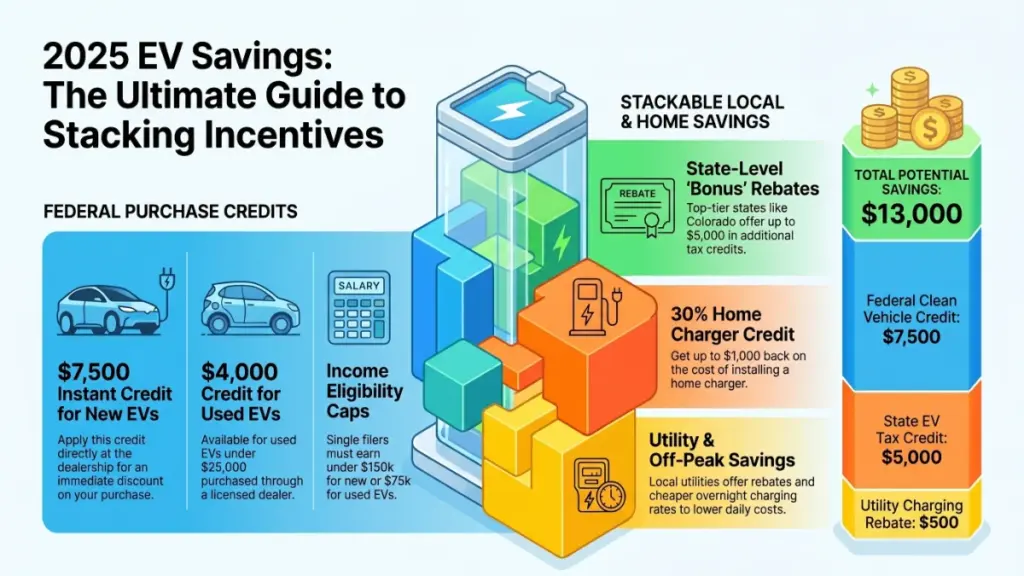
Here’s the headline: qualifying new electric vehicles can earn you a tax credit of up to $7,500. Used EVs can qualify for up to $4,000. And since January 2024, you no longer have to wait until tax season to see that money — you can apply the credit directly at the dealership as a discount off your purchase price.
That last part is a genuinely big deal. Before the point-of-sale option existed, you had to have sufficient tax liability to claim the full credit, meaning people with lower incomes often couldn’t benefit fully. Now, you can transfer the credit to the dealer, who knocks it off your sticker price — no waiting, no complex tax calculations.
Who Qualifies as a Buyer?
Not everyone is eligible, and this is where a lot of people get tripped up. The IRS applies income caps to prevent high earners from claiming credits on luxury purchases:
- Single filers: Modified adjusted gross income (MAGI) must be under $150,000
- Heads of household: Under $225,000
- Married filing jointly: Under $300,000
These limits apply to either the year you buy the vehicle or the prior tax year — whichever is lower. So if you made $145,000 last year but $160,000 this year, you’re still eligible based on your prior year income. That flexibility is helpful for people with variable income.
Which Vehicles Actually Qualify?
This is where it gets more complicated — and where many buyers have been burned by assuming their desired model qualifies. The IRA introduced strict North American assembly requirements along with battery component sourcing rules that change annually.
As of 2025, qualifying vehicles must:
- Be assembled in North America (U.S., Canada, or Mexico)
- Have a battery with a minimum percentage of components sourced from North America or U.S. free-trade partners
- Have an MSRP below $80,000 for SUVs, trucks, and vans, or below $55,000 for sedans and other vehicles
Popular models currently qualifying for the full $7,500 credit include the Chevrolet Equinox EV, Tesla Model 3 (rear-wheel drive and long range), Ford F-150 Lightning, Rivian R1T, and Volkswagen ID.4. Models like the Hyundai Ioniq 6 and Kia EV6, which are built in South Korea, have had limited or no federal credit eligibility — though that is an evolving situation as manufacturers adjust their supply chains.
Pro tip: Always verify eligibility on the IRS’s official vehicle list at fueleconomy.gov before you walk into any dealership. Dealer salespeople sometimes get this wrong.
The Used EV Credit: A Hidden Gem for Budget-Conscious Buyers
The used clean vehicle credit (Section 25E) often flies under the radar, but for many buyers it’s the more impactful incentive. Here’s why.
If you buy a used EV from a licensed dealership for $25,000 or less, you can qualify for a credit of 30% of the sale price, up to $4,000. That’s meaningful money on a $20,000 used Nissan Leaf or a $23,000 Chevy Bolt. And because used EVs have been rapidly depreciating — good for buyers, rough for early adopters — there’s now a solid inventory of capable, relatively recent EVs well within that price cap.
Income limits are tighter here: $75,000 for single filers, $112,500 for heads of household, and $150,000 for joint filers. The vehicle must also be at least two model years old and must not have been previously claimed under this credit. The used credit is also available as a point-of-sale transfer starting in 2024, making it just as accessible as the new vehicle credit.
If you’re shopping on a tighter budget, don’t overlook a 2022 Bolt EUV or a 2021 Nissan Leaf. These are genuinely good cars, and with a $4,000 reduction, they become exceptional value.
State Incentives: Where the Real Stacking Happens
Here’s where EV incentives get exciting — and where a little research can yield dramatically different outcomes depending on where you live.
Many states have layered their own incentive programs on top of the federal credit. A buyer in Colorado, for instance, can currently claim a state tax credit of up to $5,000 on top of the $7,500 federal credit. A California resident might access a Clean Vehicle Rebate of up to $7,500 for lower-income buyers through the CVRP program, plus additional Clean Air Vehicle credits. New York offers up to $2,000 through its Drive Clean Rebate. Illinois, Oregon, Connecticut, and Maryland all have meaningful programs of their own.
Here’s a practical example of what stacking looks like in the real world:
Imagine you’re in Colorado buying a Chevy Equinox EV at $34,995 MSRP:
| Incentive | Amount |
|---|---|
| Federal Clean Vehicle Credit | -$7,500 |
| Colorado State EV Tax Credit | -$5,000 |
| Xcel Energy Charging Rebate (utility) | -$500 |
| Your effective out-of-pocket | ~$21,995 |
That’s a $13,000 reduction from the sticker price through incentives alone, before any dealer negotiation. It transforms an already-affordable vehicle into a genuinely compelling deal.
Not every state is as generous, of course. Some states — particularly in the Southeast and parts of the Midwest — have little or no additional state support. A few states have historically imposed fees on EVs rather than incentives, as a way to offset lost gas tax revenue. Texas, for example, recently moved to charge EV owners higher annual registration fees. This is the messy political reality of EV policy in 2025.
The best single resource for current state incentives is the Alternative Fuels Station & Incentive Locator at afdc.energy.gov/laws, maintained by the U.S. Department of Energy. Filter by your state, vehicle type, and purchase type for a current list.
Utility and Local Incentives: Don’t Leave This Money on the Table
Beyond federal and state programs, a surprisingly rich layer of incentives comes from electric utilities and local governments — and this is the category most buyers overlook entirely.
Many major utility companies offer:
- Rebates for EV purchase or lease (often $500–$2,000)
- Rebates for home charger installation (frequently $500–$1,000 toward a Level 2 EVSE)
- Time-of-use rate plans that dramatically reduce the cost of overnight charging
- Free or discounted charging at public stations they operate
For example, Pacific Gas & Electric (PG&E) in California has offered EV charging rebates and time-of-use rates that can reduce the per-mile energy cost of an EV to well under two cents per mile. Southern California Edison, Duke Energy, and Consumers Energy have run similar programs. Even my local utility in Ohio — AEP Ohio — has offered incentives for EV charger installation in the past.
The time-of-use rate plan alone is worth paying attention to. If you charge your EV overnight during off-peak hours (typically midnight to 6 a.m.), many utilities charge rates 50–70% lower than daytime peak rates. Over a year of driving, this can easily save $500 or more compared to charging opportunistically.
How to find yours: Call your utility company directly, or visit their website and search “electric vehicle” or “EV incentives.” Many utilities are not particularly good at advertising these programs, so you may need to dig a little.
Tax Incentives for EV Charger Installation
If you’re buying an EV, you’ll almost certainly want a home charger — and the government has something for that too.
The Alternative Fuel Vehicle Refueling Property Credit (Section 30C) provides a tax credit of 30% of the cost of installing a home EV charger, up to $1,000 for individuals. A typical Level 2 charger installation runs $800–$1,500 including equipment and electrician costs, so this credit covers a meaningful chunk.
For businesses, the credit is dramatically more generous: up to $100,000 per installation (30% of cost), which has driven rapid expansion of workplace and public charging infrastructure. If your employer is considering adding EV chargers to the parking lot, this credit is a significant financial incentive for them to do so.
The credit has geographic restrictions — it currently applies only to properties in low-income communities or non-urban areas as defined by the census, a change introduced by the IRA. This has frustrated some suburban homeowners who expected to claim it freely. Check your address eligibility using the AFDC’s census tool or consult a tax professional before counting on this one.
Incentives for Businesses and Fleets: A Different Scale Entirely
Individual consumer incentives are just one part of the story. If you own a small business or manage a vehicle fleet, the incentive landscape is dramatically larger.
The Commercial Clean Vehicle Credit (Section 45W) offers up to $7,500 for vehicles under 14,000 lbs and up to $40,000 for larger commercial vehicles like delivery trucks and buses. Unlike the consumer credit, the commercial credit has no MSRP cap — which matters for fleet buyers purchasing expensive cargo vans or medium-duty trucks.
Additionally, businesses can layer this with accelerated depreciation under MACRS or bonus depreciation rules, potentially writing off 100% of a fleet vehicle’s cost in year one. The combination of a $7,500 credit plus immediate full depreciation makes the economics of commercial EV adoption remarkably attractive right now.
Amazon, FedEx, and dozens of smaller regional delivery companies have moved aggressively into EV fleets partly because of these incentives. For small business owners running local delivery or service routes, this is an often-missed opportunity.
What Might Change: The Policy Outlook
It would be irresponsible to write this guide without acknowledging the political uncertainty around these incentives.
The IRA’s EV provisions have faced ongoing criticism and legal challenges, and the current administration has signaled interest in revisiting elements of the clean energy incentive structure. While outright elimination of the Section 30D credit would face significant legislative and procedural hurdles, modifications — particularly to the income thresholds, vehicle sourcing requirements, or point-of-sale transfer mechanism — are not out of the question.
My honest take: the most significant risk isn’t that incentives disappear overnight, but that they may be restructured or phased down in ways that reduce their value. If you’re seriously considering an EV purchase and you’re eligible for current incentives, acting sooner rather than later carries genuine financial logic.
At the same time, even without incentives, the total cost of ownership case for EVs has strengthened considerably. Lower fuel costs, reduced maintenance (no oil changes, simpler drivetrain), and falling battery prices mean the math is increasingly compelling on its own merits.
Key Takeaways and Your Next Steps
Government incentives have never made EV ownership more financially accessible than they are right now in 2025. Here’s what to carry with you:
- The federal Clean Vehicle Credit offers up to $7,500 on new EVs and up to $4,000 on used EVs, now available as an instant point-of-sale discount at participating dealers
- Income limits apply — verify your eligibility before assuming you qualify
- Vehicle eligibility varies by model; always check the official IRS/DOE list before buying
- State incentives can add thousands more — Colorado, California, New York, and others have compelling programs
- Utility rebates and time-of-use rates can add another $500–$2,000 in savings most buyers miss
- Home charger installation earns a federal credit of up to $1,000 in qualifying areas
- Business and fleet buyers can access far larger incentives under Section 45W
Your best next step is to spend 20 minutes on fueleconomy.gov and afdc.energy.gov with your income and zip code in hand. Map out what you’re eligible for before you set foot in a showroom — a well-informed buyer almost always captures more of the available savings than one who relies on the dealer to explain everything.
The transition to electric vehicles is one of the largest shifts in personal transportation in a century. The government has put a remarkable amount of money on the table to help you make that transition. The only question is whether you’re going to take it.