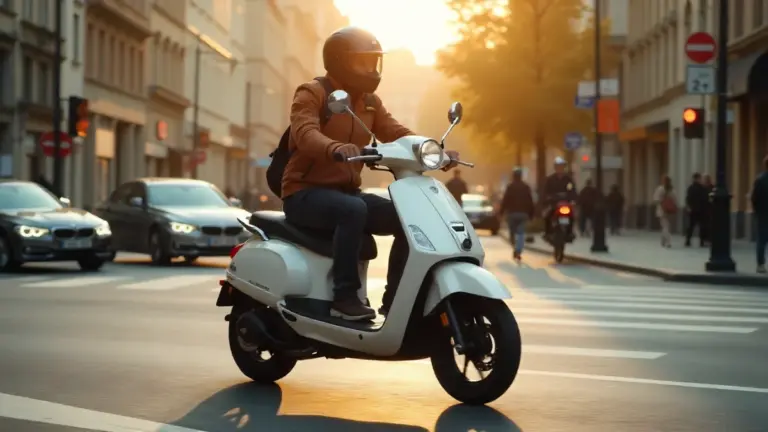
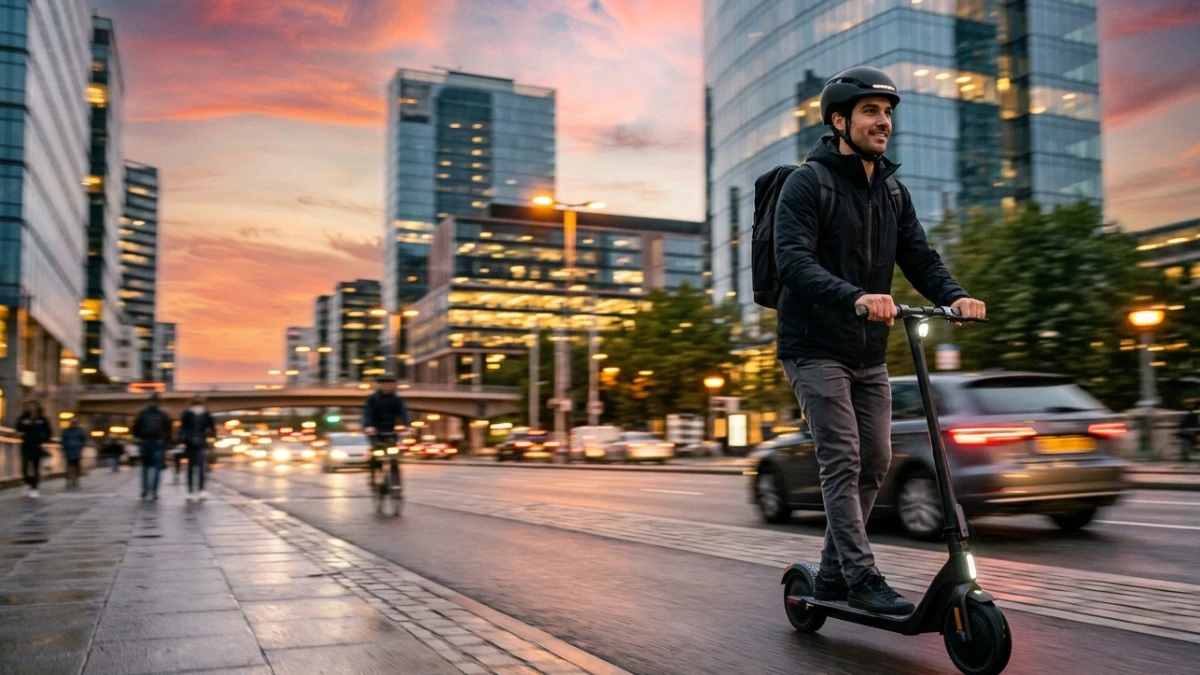
Electric scooters for adults in 2026 offer a smart, affordable alternative to cars for short commutes. With improved range, power, and durability, they handle daily travel with ease while cutting fuel costs and emissions. Choosing the right model depends on motor power, real-world range, and rider needs. From budget to high-performance options, there’s a scooter for every type of adult rider.
Let me ask you something. When was the last time you sat in gridlock traffic and thought, there has to be a smarter way to do this? If you’re nodding right now, you’re not alone—and an electric motorized scooter for adults might be exactly the solution you’ve been overlooking.
Adult electric scooters have exploded in popularity, and for good reason. The global electric scooter market surpassed $41 billion in 2024 and is projected to keep climbing well into the next decade, according to market research from Mordor Intelligence. These aren’t the toys you remember from childhood. Today’s adult e-scooters are powerful, well-engineered machines capable of hitting 30+ mph, carrying riders over 250 lbs, and covering 40 or more miles on a single charge.
In this guide, you’ll learn how to choose the right electric scooter, what specs actually matter for adults, which models are worth your money in 2026, and what real-world ownership looks like day to day. Whether you’re commuting, riding for fun, or just trying to cut down on gas costs, this article has you covered.
Why Adults Are Switching to Electric Motorized Scooters
Let’s be honest: the case for electric scooters has never been stronger than it is right now.
Gas prices remain volatile. Urban parking is a nightmare in most cities. And public transit, while improving in some areas, still leaves a lot of last-mile gaps that frustrate daily commuters. An electric scooter bridges that gap in a way that’s affordable, fast, and surprisingly fun.
Here’s what makes them so appealing to adults specifically:
- Cost savings: Charging a scooter costs pennies compared to fueling a car. Most riders spend less than $1 per charge for 20–40 miles of range.
- Time efficiency: In congested cities, scooters can often outpace cars during rush hour by using bike lanes, side streets, and parking in tighter spaces.
- Low maintenance: No oil changes, no transmission issues, no belts to replace. Electric drivetrains are mechanically simpler than combustion engines.
- Environmental impact: Zero direct emissions make e-scooters one of the cleanest short-distance transport options available today.
- Portability: Many models fold down in seconds and can ride in an elevator, slide under a desk, or fit in the trunk of your car.
Still think scooters are just for college students? The fastest-growing buyer demographic for personal electric scooters is adults between 35 and 55, according to data from the Consumer Technology Association. That tells you everything about how this category has matured.
Understanding the Key Specs: What Actually Matters for Adult Riders
This is where a lot of buyers go wrong. They see a flashy ad, spot a competitive price, and buy a scooter that ends up underpowered, under-ranged, or frankly unsafe for their size and use case. Let me help you avoid that.
Motor Power (Watts)
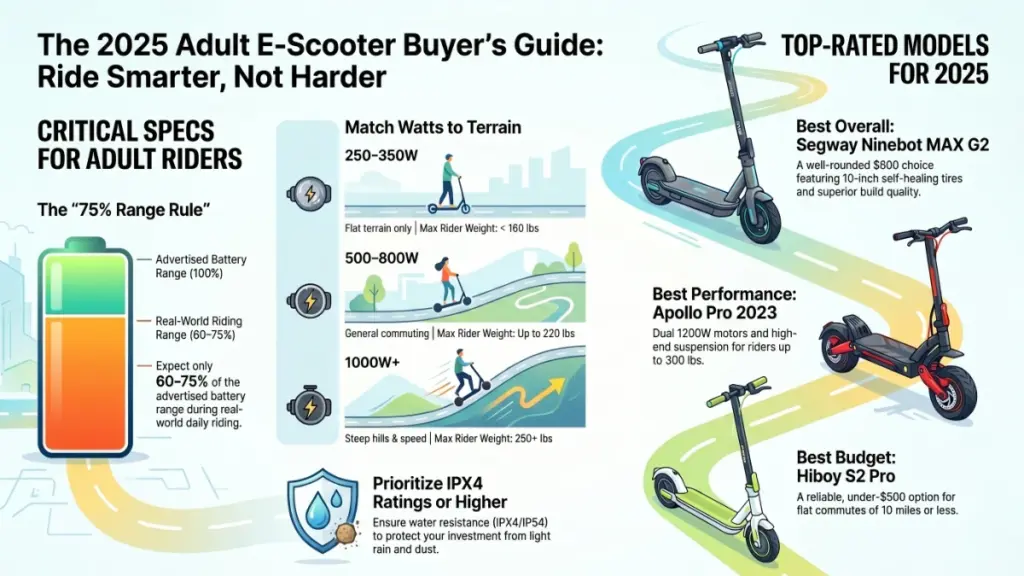
Motor wattage is your starting point. For adult riders, here’s a practical breakdown:
| Motor Power | Best For | Limitations |
|---|---|---|
| 250–350W | Flat urban terrain, lighter riders (<160 lbs) | Struggles on hills |
| 500–800W | General commuting, mild inclines, up to 220 lbs | Not ideal for steep terrain |
| 1000W+ | Hills, heavier riders, faster speeds | Higher cost, heavier scooter |
| Dual motor (2000W+) | Off-road, aggressive riders, max performance | Premium pricing |
If you’re commuting in a hilly city—think San Francisco, Seattle, or Pittsburgh—don’t even look at anything under 800W. You’ll spend every uphill frustrated and arriving late.
Battery Range
Advertised range is always optimistic. Manufacturers test under ideal conditions: flat terrain, mild weather, lighter rider, moderate speed. In the real world, expect to get 60–75% of the advertised range under normal conditions.
So when a brand says “40-mile range,” mentally translate that to about 25–30 miles of real-world riding. That’s still excellent for daily commuting, but it’s important to calibrate expectations before you buy.
Cold weather is another factor. Lithium-ion batteries lose efficiency in low temperatures—sometimes as much as 20–30% in sub-40°F conditions. If you’re riding year-round in a colder climate like I do here in Ohio, that’s something you need to account for.
Weight Capacity
This is non-negotiable. Every adult e-scooter lists a maximum weight capacity. Riding over that limit doesn’t just void your warranty—it stresses the motor, reduces battery efficiency, and can compromise frame integrity over time. Most quality adult scooters support between 220 and 330 lbs. Heavier-duty models go higher.
IP Rating (Water Resistance)
An IP (Ingress Protection) rating tells you how well the scooter handles moisture. For adult commuters who can’t always control the weather, look for at least IPX4 (splash resistant) or ideally IP54 or higher (dust and water resistant from multiple angles).
Don’t confuse water-resistant with waterproof. Even highly rated scooters shouldn’t be submerged or ridden through standing water. But IPX4 and above means light rain won’t kill your ride.
The Best Electric Motorized Scooters for Adults in 2026
After spending considerable time tracking the market, testing specs against real-world reports, and digging through verified owner reviews, here are the standout models right now:
Best Overall: Segway Ninebot MAX G2
The Segway Ninebot MAX G2 has quietly become one of the most well-rounded adult scooters on the market. It features a 450W motor (with 900W peak output), a claimed range of up to 43 miles, 10-inch self-healing tires, and an IPX5 water resistance rating. It folds quickly, supports riders up to 220 lbs, and the build quality is exceptional.
Real-world range lands around 28–32 miles for most riders—still more than enough for typical urban commutes. Street price hovers around $800, which is fair for what you’re getting.
Best Budget Pick: Hiboy S2 Pro
If you want solid adult performance without breaking the bank, the Hiboy S2 Pro deserves serious consideration. It packs a 500W motor, 10-inch pneumatic tires, and a dual braking system at a price point typically under $500. Riders up to 220 lbs are supported, and real-world range is a respectable 17–22 miles.
It’s not a scooter for speed demons or serious hills, but for flat urban commutes of 10 miles or less round-trip, it does the job impressively well at its price.
Best High-Performance: Apollo Pro 2023
For riders who want real performance—fast acceleration, serious hill-climbing ability, and a premium feel—the Apollo Pro is worth every dollar of its ~$1,400 price tag. Dual 1200W motors provide 2400W of peak output, the range extends to 40+ miles under reasonable conditions, and the suspension system genuinely handles rough pavement like it means it.
Riders up to 300 lbs are supported, and top speed hits around 38 mph in sport mode. This is a scooter you won’t outgrow quickly.
Best for Heavier Riders: Dualtron Eagle Pro
Heavier adults often get underserved by the mainstream scooter market. The Dualtron Eagle Pro changes that with a 2000W dual motor setup, a 330 lb weight capacity, hydraulic disc brakes, and a range approaching 60 miles under ideal conditions. It’s heavy (over 60 lbs itself) and expensive (~$2,500+), but for riders who’ve been burned by underpowered options before, this one delivers.
Riding Safety and Legal Considerations Every Adult Should Know
Here’s the part most buyers skip—and then regret skipping.
Electric scooter regulations vary dramatically by location. In some cities, adult e-scooters are legal on bike lanes and streets. In others, they’re restricted to private property or banned from certain roads entirely. Before you buy, spend 15 minutes researching your local laws. The National Conference of State Legislatures (NCSL) maintains regularly updated summaries of e-scooter legislation by state at ncsl.org.
Safety gear is not optional—it’s common sense. At 20–30 mph, a fall without a helmet can be catastrophic. Here’s a simple gear checklist for adult riders:
- Helmet: Look for CPSC-certified or MIPS-equipped options designed for multi-sport or cycling use
- Gloves: Protect your hands in a fall; also improve grip in cold weather
- Bright, reflective clothing: Especially for commuters riding in low-light conditions
- Wrist guards: Particularly useful for new riders
And please—ride defensively. E-scooters are quiet, which means pedestrians and drivers often don’t hear you coming. Use your horn or bell proactively, signal turns with hand gestures, and never assume a driver has seen you.
The True Cost of Owning an Electric Scooter for Adults
Let’s talk money, because the sticker price is only part of the picture.
Purchase price: Entry-level adult scooters start around $300–$500. Mid-range commuter models run $600–$1,200. High-performance scooters range from $1,500 to $3,000+.
Charging costs: Minimal. Most scooter batteries are 36–52V, 10–20Ah. At average U.S. electricity rates (~$0.16/kWh), a full charge typically costs $0.20–$0.50. Even if you charge daily, that’s under $15 per month.
Maintenance: Electric scooters don’t need oil changes or tune-ups, but you will encounter recurring costs:
- Tire replacement (pneumatic tires every 1,500–3,000 miles): $20–$60
- Brake pad replacement (disc brakes): $15–$40
- Inner tube replacement (if not using self-healing tires): $10–$20
- Occasional battery replacement after 3–5 years: $100–$400 depending on model
Insurance and registration: Most personal e-scooters don’t require registration or insurance in the U.S., though this varies by state and is changing in some jurisdictions. Check your local DMV for current requirements.
Compare that total cost of ownership against a car, a monthly transit pass, or even ride-share fees, and the economics of an adult electric scooter become genuinely compelling fast.
What to Expect in Your First 30 Days of Riding
If you’ve never ridden an electric scooter as an adult, there’s a learning curve—though it’s shorter than you might expect.
Week 1 is about building comfort. Start in a quiet parking lot or low-traffic area. Practice starting, stopping, and turning at low speeds before you take it on real streets. The throttle response on higher-powered models can catch you off guard if you’re used to bicycles.
Week 2–3, most riders develop their commute rhythm. You’ll start to feel the braking distance, understand how your scooter handles in wind, and get comfortable reading the road surface ahead of you. Potholes, train tracks, and wet painted lines are things you learn to respect quickly.
By week 4, most adult riders report that the scooter has become second nature—and many tell me they wish they’d made the switch sooner.
One honest tip: give yourself extra time on your commute for the first two weeks. Don’t put yourself in a situation where you feel pressure to ride faster than your skill level allows. Speed will come naturally as confidence builds.
Is an Electric Motorized Scooter Right for You?
Here’s the honest bottom line: electric motorized scooters for adults are one of the most practical, affordable, and genuinely enjoyable transportation tools available in 2026. They’re not perfect for everyone—if you’re commuting 30+ miles each way, riding in heavy snow, or need to carry significant cargo, they’ll fall short. But for urban and suburban adults navigating distances of 5–20 miles, they make an enormous amount of sense.
Key takeaways before you buy:
- Match motor wattage to your terrain—don’t skimp if you face hills
- Discount advertised range by 25–40% for real-world expectations
- Check your local regulations before the scooter arrives at your door
- Invest in a quality helmet; it’s non-negotiable
- Budget beyond the sticker price for accessories, maintenance, and potential repairs
The best scooter isn’t always the most expensive one—it’s the one that matches your specific needs, weight, commute, and terrain. Start with honest answers to those questions, and you’ll find a model that fits.
Ready to take the next step? Start by mapping your typical commute distance, noting any significant hills, and setting a realistic budget. Then use this guide to match those criteria to the right scooter. Your future self—the one gliding past a traffic jam with a grin on their face—will thank you.