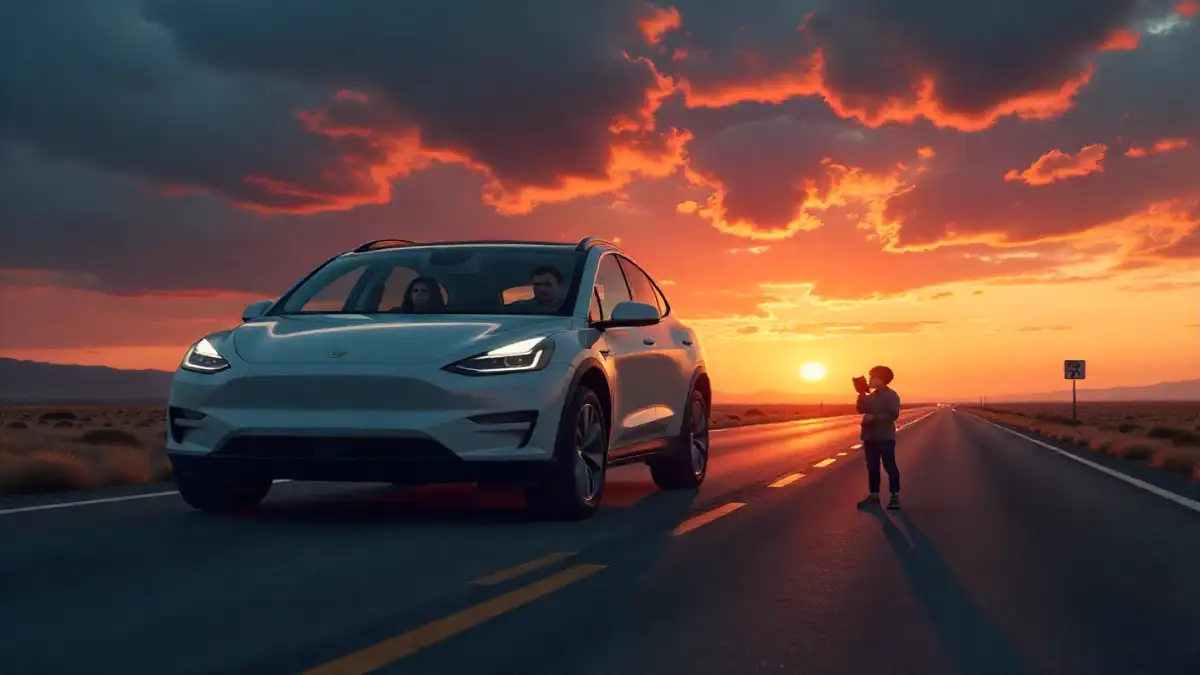
So there’s this family from Sacramento—actually, might’ve been San Diego, details get fuzzy—but anyway, they bought this shiny electric SUV in 2023. The dealer swore up and down it would go 300 miles per charge. Holiday weekend arrives, kids screaming in the backseat (you know the drill), and boom—they’re stranded after 180 miles. Dead. Just… dead.
The dealership? “That’s totally normal, sir.”
Normal. Like watching your dreams evaporate in real-time is just another Tuesday.
This isn’t some isolated horror story, though I wish it were. It’s symptomatic of something far more sinister creeping through the electric vehicle landscape—a web of half-truths, cherry-picked data, and outright manipulation that would make a used car salesman from the ’80s blush. As EVs explode in popularity (and I mean explode—sales jumping like popcorn in a hot pan), marketers are getting increasingly creative with their… let’s call them “interpretations” of reality.
The electric revolution is real, don’t get me wrong. Clean air, silent acceleration, the works. But beneath that gleaming Tesla-wannabe exterior lurks a minefield of marketing BS that could leave you financially and emotionally stranded.
Red Flag #1: The Range Mirage (Or: How Numbers Lie)
Range anxiety—it’s like that friend who always shows up uninvited to parties. And manufacturers know this. They exploit it ruthlessly.
EPA estimates. EPA estimates. These numbers are about as realistic as my New Year’s resolution to hit the gym daily. They’re calculated in laboratory conditions so perfect they’d make a Swiss watchmaker weep: 65°F (not 64°F, not 66°F), no AC blasting, tires inflated to NASA precision, driving at the speed of molasses on a country road.
Real world? Ha. Winter hits and your “300-mile” range becomes 180. Summer heat kicks in, AC cranking, and suddenly you’re looking at 200 if you’re lucky. Hills, headwinds, aggressive driving (because let’s be honest, we all floor it sometimes)—each one chips away at those magical numbers like water eroding stone.
But here’s where it gets truly insidious: they advertise the best configuration. The $80k version with the massive battery pack while their base model—the one you can actually afford—limps along at 60% of that range. Buried in footnote 47, subsection C, probably written in 6-point font.
Trustworthy sources? They’ll show you range in Phoenix summer heat. In Minnesota winter. Up mountains, down valleys. They acknowledge that your Tuesday commute will be different from your Sunday joy ride.
Red Flag #2: The Fast-Charging Fantasy
“20 minutes to 80%!”—screams every EV ad like they’re selling miracle weight loss pills.
Twenty minutes. Sure. If you find one of those mythical 350kW chargers that actually works (spoiler: half are broken), if your battery’s nearly empty (it never is), if the weather’s perfect (it never is), and if you’re one of the lucky few whose car can actually handle those speeds.
I tried this once—pulled up to a “superfast” charger in Nevada. Sign said 150kW. Reality? 47kW on a good day, and that was with the battery at 15%. By 70%? Crawling along at 25kW like a tortoise with arthritis.
The charging curve—that’s the dirty secret they don’t mention. It’s not linear. It’s not even close. You start fast, then it slows… and slows… and slows some more. Like watching paint dry, but more expensive.
And the battery degradation! Every fast charge is like running a marathon—sure, you can do it, but your knees will remember. Most marketers treat this like Voldemort: they don’t speak its name.
Honest evaluations show the whole picture. The 5am charging session when nothing works. The summer road trip when every station has a 30-minute wait. The winter day when charging takes twice as long because physics.
Red Flag #3: Total Cost Math That Would Make Enron Blush
“Save $12,000!” they scream. Compared to what, exactly?
Their math is creative—I’ll give them that. They assume gas costs $6/gallon (it’s been $3.20 in my neighborhood for months), electricity is practically free (tell that to California residents), and you’ll keep the car for 15 years (who does that?). They compare their loaded EV to a base-model Corolla, which is like comparing a Ferrari to a bicycle and claiming superior value.
Insurance? “Minor difference,” they claim. My cousin’s Tesla Model Y costs 40% more to insure than his old Camry. Maintenance? “Nearly zero,” except when the touchscreen dies ($2,800), or the door handles freeze (common in Colorado), or the 12V battery gives up (happened to my neighbor twice).
The real kicker: depreciation. These things lose value faster than crypto in a bear market, but somehow that never makes it into their calculations.
True cost analysis includes everything. Everything. Regional electricity rates, actual insurance quotes, real maintenance schedules, honest depreciation curves. They compare apples to apples—not your EV to a 1995 Honda Civic.
Red Flag #4: The Green Mirage
“Zero emissions!”
Well… technically. If you ignore how the electricity gets made. And the battery mining. And the manufacturing. And the eventual disposal.
I’m not anti-environment—quite the opposite. But this virtue signaling makes my teeth itch. In West Virginia, your “clean” EV might be powered by coal. In Washington State? Hydroelectric paradise. The difference is massive, but marketing treats them identically.
Battery production is an environmental nightmare wrapped in a sustainability bow. Lithium mining devastates landscapes. Cobalt extraction often involves child labor. These aren’t conspiracy theories—they’re documented realities that somehow never make it into the glossy brochures.
Some companies go full greenwashing mode: “Carbon neutral!” (with enough creative accounting to make Arthur Andersen proud), “Recycled materials!” (in the cup holders, not the actual drivetrain), “Sustainable supply chain!” (defined so loosely it’s meaningless).
Legitimate environmental assessments acknowledge complexity. They show lifecycle impacts, regional variations, improvement trajectories. They admit EVs aren’t magic bullets while still highlighting genuine long-term benefits.
Because here’s the thing—and this might surprise you—EVs generally ARE better for the environment over time. Just not in the simplistic, black-and-white way they’re marketed.
Red Flag #5: The Autonomy Oversell (Buckle Up, This Gets Wild)
“Full Self-Driving.”
Those three words have generated more lawsuits than a defective airbag. It’s marketing genius and ethical bankruptcy rolled into one shiny package.
Current “self-driving” is like calling your teenager a professional chef because they can microwave ramen. Sure, there’s some food preparation happening, but let’s not get crazy with the labels.
I’ve driven cars with “Advanced Autopilot,” and let me tell you—advanced is relative. It’s great on straight highways with clear lane markings on sunny days with light traffic. Add construction zones, or weather, or anything remotely complex, and suddenly you’re playing automotive Russian roulette.
But the marketing! Tesla sells “Full Self-Driving” capability for $15,000—for features that don’t exist and may never exist. Other manufacturers use terms like “Super Cruise” and “ProPilot Assist” that sound way more capable than they actually are.
The danger isn’t just financial—it’s literal. People die when they overestimate these systems’ capabilities. They get lulled into complacency by marketing language that promises autonomy while delivering advanced cruise control.
Responsible discussions focus on current reality, not future promises. They emphasize that you’re still the driver, still responsible, still need to pay attention. They treat these as helpful tools, not revolutionary replacements for human judgment.
Red Flag #6: Infrastructure Theater
“Extensive charging network!” sounds impressive until you try to drive from Denver to Salt Lake City.
Sure, there are thousands of charging stations. Most are in California. Or along Interstate 95. Try finding reliable fast charging in Montana, or Wyoming, or basically anywhere that isn’t a major metropolitan corridor.
I learned this the hard way during a work trip to Utah—what should’ve been a simple drive turned into a multi-hour charging odyssey involving three different apps, two broken chargers, and one very expensive towing bill.
Network reliability is all over the map. Some work flawlessly. Others are digital paperweights masquerading as charging stations. Electrify America, EVgo, ChargePoint—each has its own app, payment system, and quirks. It’s like needing different keys for every gas station.
Compatibility adds another layer of complexity. Tesla’s Supercharger network is fantastic—if you drive a Tesla. Everyone else gets to play charging roulette with adapters, payment systems, and compatibility issues that would frustrate a NASA engineer.
Honest infrastructure discussions show real-world availability along your routes. They talk about backup plans when chargers fail. They acknowledge current limitations while highlighting genuine improvements (and there are many—just not evenly distributed).
Red Flag #7: The Software Promise (When Hardware Meets Hopium)
Over-the-air updates! Your car gets better while you sleep!
Except when it doesn’t.
This promise has created a dangerous precedent: selling incomplete cars with IOUs for future functionality. “Don’t worry about those missing features—they’ll arrive in Update 3.2.7!” Which may come next month, next year, or never.
I know someone who bought a luxury EV partly for its promised “enhanced autopilot” features. Eighteen months later, still waiting. The hardware’s there, but the software remains perpetually “in development.”
Some manufacturers use this as a crutch, excusing incomplete products by promising future fixes. Others charge premium prices for hardware that isn’t fully utilized, essentially asking customers to fund R&D disguised as features.
The reality is messier. Some updates genuinely improve the car—more range, better performance, new features. Others introduce bugs, remove functionality, or change interfaces in annoying ways. Your car can literally get worse overnight.
Credible evaluations focus on current capabilities, not future potential. They treat promises as exactly that—promises—and judge vehicles on today’s reality rather than tomorrow’s possibilities.
Taking Back Control (The Plot Twist You Didn’t See Coming)
Here’s what’s wild about all this deception: electric vehicles are genuinely revolutionary. Despite the marketing BS, they represent real progress. Lower operating costs for most drivers, cleaner air in our cities, reduced dependence on oil imports, performance that would make a sports car blush.
The tragedy is that legitimate benefits get overshadowed by huckster marketing.
Your best defense isn’t cynicism—it’s informed skepticism mixed with healthy curiosity. Read independent reviews from people who actually live with these cars. Test drive in conditions that mirror your real life, not the dealer’s perfect loop around suburban streets.
Calculate costs based on your situation. Your local electricity rates, your driving patterns, your actual available incentives. Not some hypothetical scenario designed to maximize savings.
And here’s the biggest secret: unless your current car is actively trying to kill you, waiting often means better options. This market moves faster than a Tesla in Ludicrous mode. New models launch monthly, charging infrastructure expands weekly, prices drop regularly.
The future of transportation is electric—that part’s not marketing hyperbole, it’s physics and economics. But that future should be built on honest information, realistic expectations, and products that deliver on their promises rather than pretty marketing campaigns.
Make your choice based on facts, not feelings. On reality, not rhetoric. On what works for your life, not what some marketing algorithm thinks should work.
Because in the end, the best electric car is the one that actually gets you where you’re going—emotionally, financially, and literally.