Let me ask you something: When was the last time you thought about the invisible trail of carbon dioxide following your daily commute? If you’re like most people, probably not recently. But here’s a reality check that might surprise you—transportation accounts for roughly 27% of total greenhouse gas emissions in the United States alone, making it the single largest contributor to climate change in the country.
The good news? You have more power to change this than you might think.
Whether you’re driving to work, planning a vacation, or just running weekend errands, your transportation choices directly impact the planet’s future. But reducing your carbon footprint doesn’t mean giving up convenience or drastically changing your lifestyle overnight. It’s about making smarter, more informed decisions that benefit both your wallet and the environment.
In this comprehensive guide, I’ll walk you through the most effective strategies to slash your transportation emissions in 2025. You’ll discover practical steps anyone can take—from choosing the right vehicle to optimizing how you use it—along with surprising insights about which changes make the biggest difference. By the end, you’ll have a clear roadmap to cut your transportation carbon footprint significantly, without sacrificing the mobility you need.
Understanding Your Transportation Carbon Footprint
Before you can reduce something, you need to understand what you’re dealing with. Your transportation carbon footprint is the total amount of greenhouse gases—primarily carbon dioxide (CO₂)—generated by your travel activities. Think of it as your personal contribution to climate change through how you get from point A to point B.
The Real Numbers Behind Transportation Emissions
The average American generates about 4.6 metric tons of CO₂ annually just from personal vehicle use. To put that in perspective, that’s equivalent to burning through 500 gallons of gasoline or charging your smartphone 550,000 times. A single gallon of gasoline, when burned, produces approximately 20 pounds of CO₂—and most of us burn through many gallons every week without a second thought.
But here’s what many people don’t realize: it’s not just about what comes out of your tailpipe. The true carbon footprint of transportation includes:
- Direct emissions: What your vehicle produces while driving
- Upstream emissions: Energy used to extract, refine, and transport fuel
- Manufacturing emissions: Carbon produced during vehicle production
- Infrastructure impact: Roads, parking lots, and maintenance operations
When you factor in all these elements, the picture becomes clearer—and more urgent.
Why Transportation Emissions Matter More Than Ever
Global transportation emissions have been rising steadily, increasing by about 1.7% annually over the past decade. Aviation emissions alone have doubled since the mid-1980s, while shipping accounts for nearly 3% of global greenhouse gas emissions. Without significant changes, transportation could become responsible for nearly half of all energy-related CO₂ emissions by 2050.
The challenge is particularly acute because transportation is so deeply woven into modern life. We need to move people and goods efficiently, yet our current systems are predominantly powered by fossil fuels. That’s why understanding your personal contribution is the first step toward meaningful change.
Making the Switch: Electric and Low-Emission Vehicles
The most impactful decision you can make to reduce your transportation carbon footprint is choosing what you drive. And in 2025, the options for cleaner vehicles have never been better or more accessible.
Electric Vehicles: The Game-Changer
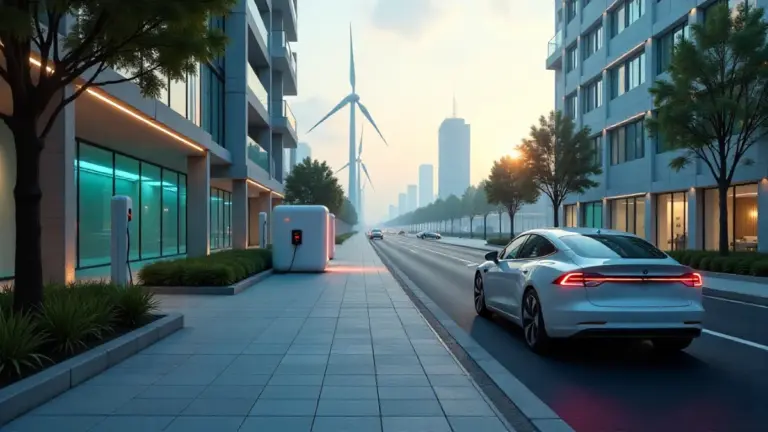
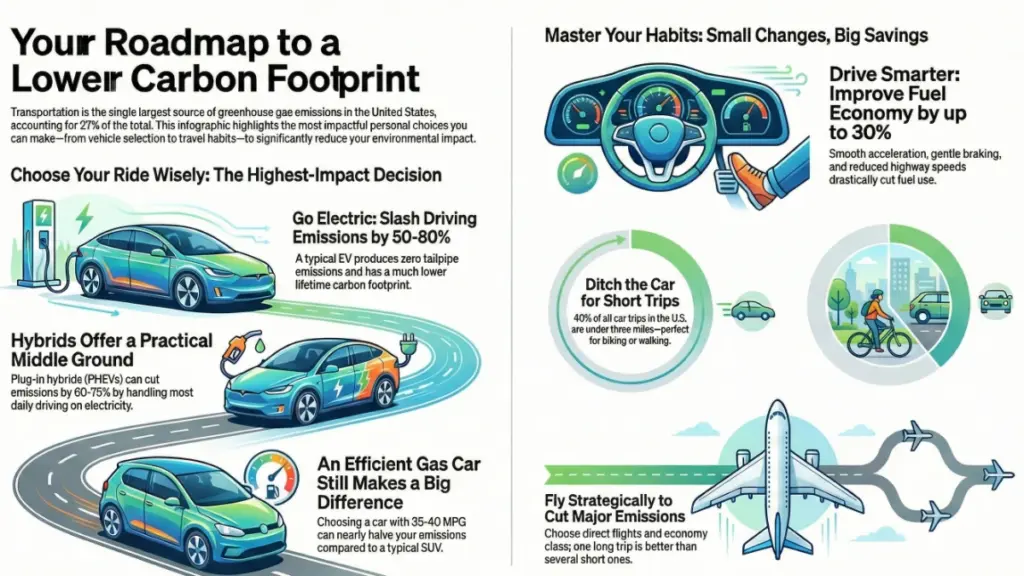
Electric vehicles (EVs) represent the single most effective way to slash your driving emissions. A typical EV produces zero direct emissions and, even when accounting for electricity generation, emits about 50-70% less CO₂ over its lifetime compared to a gasoline-powered car. In regions with cleaner electricity grids—like California or the Pacific Northwest—EVs can reduce emissions by more than 80%.
Key advantages of going electric in 2025:
- Range anxiety is fading: Modern EVs routinely offer 250-350 miles of range, with some premium models exceeding 400 miles
- Charging infrastructure is expanding rapidly: Over 140,000 public charging stations now operate across the U.S., a 40% increase from just two years ago
- Total cost of ownership is competitive: Despite higher upfront costs, EVs save thousands in fuel and maintenance over their lifetime
- Performance rivals or exceeds gas vehicles: Instant torque delivery means responsive acceleration and smooth, quiet operation
Real-world example: Consider the Chevrolet Equinox EV, starting around $35,000 after incentives. With an EPA-estimated range of 319 miles and average electricity costs, you’re looking at the equivalent of paying about $1.20 per gallon of gas. Over five years, you could save $6,000-8,000 compared to driving a comparable gas SUV.
Hybrid Vehicles: The Middle Ground
Not ready for a full EV? Hybrid vehicles offer a practical stepping stone. Modern plug-in hybrids (PHEVs) can run on electricity for your daily commute—typically 30-50 miles—then switch to gasoline for longer trips. This flexibility means you get most of the emissions benefits of an EV for everyday driving, with none of the range concerns for road trips.
A well-utilized PHEV can reduce your emissions by 60-75% compared to a traditional gas vehicle, as most daily driving happens within the electric-only range. The Toyota RAV4 Prime, for instance, offers 42 miles of electric range—enough for 80% of American commutes—plus the security of a gasoline engine for longer journeys.
Efficient Gas Vehicles: If Electric Isn’t Yet Feasible
If you’re not ready to go electric or hybrid, choosing a highly fuel-efficient gas vehicle still makes a substantial difference. Modern compact cars and efficient sedans achieving 35-40 MPG can cut your emissions nearly in half compared to larger SUVs or trucks getting 18-20 MPG.
Smart vehicle selection tips:
- Prioritize fuel economy ratings from the EPA—they’re more accurate than ever
- Consider vehicle size carefully—larger vehicles inherently consume more fuel
- Look for aerodynamic designs and lightweight materials
- Avoid unnecessary features that add weight (oversized wheels, heavy sunroofs)
What About Used Vehicles?
Here’s an important consideration: buying a used efficient vehicle can sometimes be better for the environment than buying new. Manufacturing a new car generates 5-15 tons of CO₂, so extending the life of an existing efficient vehicle avoids those emissions entirely. A three-year-old EV or hybrid represents excellent value and significant environmental benefit without the manufacturing footprint of a new vehicle.
Optimizing How You Drive: Behavioral Changes That Add Up
Even if you can’t change your vehicle today, how you drive makes an enormous difference. I’ve seen people reduce their fuel consumption by 20-30% through driving habit changes alone—without spending a single dollar.
The Art of Eco-Driving
Eco-driving isn’t about crawling along in the slow lane. It’s about driving efficiently while maintaining safety and reasonable speed. Here are the techniques that deliver the biggest impact:
Smooth acceleration and gentle braking: Aggressive driving—rapid acceleration, hard braking—can lower your fuel economy by 15-30% on highways and 10-40% in stop-and-go traffic. Think of the gas pedal as a dimmer switch, not an on-off button. Gradual pressure saves fuel and reduces wear on your brakes.
Maintain steady speeds: Using cruise control on highways maintains consistent speed, which can improve fuel economy by 7-14% on long trips. Every time you unnecessarily speed up and slow down, you’re burning extra fuel.
Reduce highway speeds: At highway speeds, aerodynamic drag increases exponentially. Driving 65 MPH instead of 75 MPH can improve fuel economy by 15-20%. Yes, you’ll arrive slightly later, but you’ll save significant fuel—and emissions—in the process.
Anticipate traffic flow: Look ahead and anticipate stops. Coasting to a stop sign rather than braking hard at the last second maintains momentum and saves fuel. Professional drivers call this “reading the road,” and it’s one of the most effective efficiency techniques.
Vehicle Maintenance Matters
A poorly maintained vehicle can consume 10-20% more fuel than necessary. Keep your carbon footprint in check with these essential maintenance practices:
- Proper tire inflation: Under-inflated tires increase rolling resistance. Keeping tires properly inflated improves fuel economy by up to 3%
- Regular engine maintenance: Clean air filters, fresh oil, and properly functioning spark plugs ensure optimal combustion efficiency
- Wheel alignment: Misaligned wheels create drag and can reduce fuel economy by 10% while causing premature tire wear
- Reduce vehicle weight: Every extra 100 pounds reduces fuel economy by about 1%. Clean out your trunk and remove roof racks when not in use
Strategic Trip Planning
The smartest trip is the one you don’t have to make—or the one that combines multiple errands efficiently:
Combine errands: Multiple short trips taken from a cold start can use twice as much fuel as one longer multi-purpose trip covering the same distance. Plan your route to accomplish several tasks in one outing.
Avoid peak traffic hours: Stop-and-go traffic is incredibly inefficient, sometimes consuming 2-3 times more fuel than smooth highway driving. When possible, adjust your schedule to avoid rush hour.
Telecommute when feasible: Working from home just two days per week eliminates 40% of your commuting emissions. Even one day per week saves 20%—and in 2025, remote work flexibility is more common than ever.
Use traffic apps strategically: Real-time navigation apps like Waze or Google Maps can route you around congestion, saving both time and fuel. But be cautious—sometimes the longer scenic route is actually more efficient than constant acceleration and braking on a shorter, congested route.
Embracing Alternative Transportation: Beyond the Personal Vehicle
Here’s a perspective shift that can dramatically reduce your carbon footprint: your car doesn’t have to be the answer to every transportation need. In fact, for many trips, it’s the least efficient option.
Public Transportation: The Hidden Carbon Champion
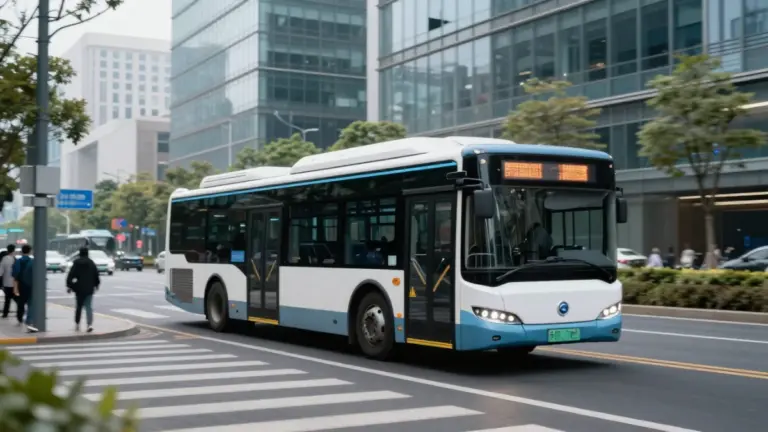
Public transit often gets overlooked, but the numbers are compelling. Taking public transportation produces, on average, 45% less CO₂ per passenger mile than driving alone. A full city bus removes potentially 40 cars from the road, while a commuter train can carry as many passengers as 600 cars.
The surprising benefits of public transit:
- Cost savings: The average American spends over $10,000 annually on vehicle ownership. Switching even part of your driving to public transit can save thousands
- Productivity gains: That commute time becomes reading, working, or relaxation time
- Stress reduction: No traffic navigation, no parking hassles
- Community connection: Regular riders often report feeling more connected to their communities
In 2025, many cities have significantly improved their public transit offerings, with real-time tracking apps, cleaner buses, and expanded routes making transit more convenient than ever.
Biking and Walking: Zero-Emission Champions
For trips under three miles—which account for about 40% of all trips Americans take—biking or walking produces zero emissions while providing health benefits. Think about this: replacing just one four-mile car trip per week with biking prevents about 500 pounds of CO₂ emissions annually.
Making active transportation practical:
- E-bikes expand range: Electric bicycles make 10-15 mile commutes feasible for average fitness levels, arriving without excessive sweat
- Better infrastructure: More cities now offer protected bike lanes and multi-use paths, making cycling safer
- Weather planning: With proper gear, biking works in most weather conditions—and e-bikes make headwinds manageable
- Cargo solutions: Modern bike designs with cargo capacity and trailers can handle grocery shopping and errands
Carpooling and Ride-Sharing Done Right
Sharing rides cuts per-person emissions dramatically. Two people sharing a ride cut individual emissions in half; four people reduce them to 25% per person. The key is optimizing how you share:
Carpooling best practices:
- Regular schedules work best: Daily work commutes with neighbors or coworkers provide consistent emissions reduction
- Apps facilitate connections: Platforms like Scoop and Waze Carpool help find compatible carpooling partners
- Employer incentives: Many companies offer preferred parking, subsidies, or flexible hours for carpoolers
Strategic ride-sharing: When using services like Uber or Lyft, choose shared rides whenever possible. Shared rides generate about 50% less CO₂ per passenger compared to solo rides.
Rethinking Car Ownership: Car-Sharing and Rentals
Do you really need to own a car? For urban dwellers or occasional drivers, car-sharing services like Zipcar or traditional rentals might make more sense—both economically and environmentally.
Consider this scenario: If you drive less than 7,500 miles annually, car-sharing could cost less than ownership while reducing your carbon footprint. You’ll drive more intentionally, choose the right-sized vehicle for each trip, and avoid the manufacturing emissions of personal vehicle ownership.
Air Travel: The Carbon-Heavy Elephant in the Room
Air travel deserves special attention because aviation is one of the most carbon-intensive forms of transportation—and one of the fastest-growing sources of emissions. A round-trip flight from New York to Los Angeles generates approximately 1.5 tons of CO₂ per passenger, roughly equivalent to driving 3,750 miles in an average car.
Understanding Aviation’s True Impact
Flying is complicated from a carbon perspective. Beyond direct CO₂ emissions, aircraft produce water vapor, nitrogen oxides, and contrails at high altitudes, where their warming effect is amplified. Scientists estimate aviation’s total climate impact is 2-3 times its CO₂ emissions alone.
Flight emissions by distance (per passenger):
- Short-haul flight (under 500 miles): 0.25-0.30 tons CO₂
- Medium-haul (500-1,500 miles): 0.40-0.80 tons CO₂
- Long-haul (1,500-3,000 miles): 1.0-2.0 tons CO₂
- Ultra-long-haul (over 3,000 miles): 2.0-4.0 tons CO₂
Practical Strategies to Reduce Flight Emissions
Fly less, but smarter: The most effective strategy is simply to fly less frequently. Instead of multiple short trips, consider fewer, longer vacations. One two-week vacation generates far less emissions than three weekend getaways requiring air travel.
Choose direct flights: Takeoff and landing consume disproportionate amounts of fuel. A direct flight produces 20-30% less emissions than a trip with one connection covering the same total distance. Those “convenient” connecting flights are actually environmental disasters.
Select economy class: Premium cabin seats occupy more space and add aircraft weight, increasing per-passenger emissions. Business class generates roughly 3 times the emissions of economy, while first class can be 4-6 times higher per passenger. If you must fly, economy is significantly more efficient.
Fly newer, more efficient aircraft: When booking, check the aircraft type. Modern planes like the Boeing 787 or Airbus A350 consume 20-25% less fuel per passenger than older models they replace. Some booking platforms now show aircraft types, allowing you to choose more efficient options.
Consider alternative routes: For distances under 500 miles, trains or buses often make more sense—they’re slower but generate 75-90% less CO₂ per passenger mile than flying. The Boston-to-New York corridor, for instance, is far more sustainably traveled by Amtrak than by air.
Carbon Offsets: Helpful Tool or False Solution?
Many airlines now offer carbon offset programs at checkout. These programs fund projects like reforestation or renewable energy to theoretically “neutralize” your flight emissions. While well-intentioned, carbon offsets are controversial.
The reality of offsets:
- Quality varies dramatically: Some projects genuinely sequester carbon; others are questionable or would have happened anyway
- They’re not immediate: Tree planting takes decades to offset emissions you produce today
- They shouldn’t replace reduction: Offsets work best as a supplement to flying less, not a license to fly guilt-free
If you do purchase offsets, choose certified programs through Gold Standard or Verified Carbon Standard, which ensure projects meet rigorous criteria. But remember: the most effective carbon offset is the flight you don’t take.
The Future of Transportation: Emerging Technologies and Trends
As we look ahead, the transportation landscape is changing faster than ever. Understanding these trends helps you make informed decisions and prepare for the opportunities coming in the next few years.
Electric Vehicle Evolution
The EV revolution is accelerating. By 2030, analysts predict EVs will account for 50-60% of new vehicle sales in the U.S., driven by improving technology, expanding infrastructure, and tightening emissions regulations. Battery technology continues advancing, with solid-state batteries promising 500+ mile ranges and 15-minute charging times by 2027-2028.
What this means for you: If you’re considering an EV but hesitant, waiting 1-2 years could deliver better range, faster charging, and lower prices. But don’t wait too long—current federal tax credits of up to $7,500 make EVs more affordable now than they may be in the future.
Sustainable Aviation Fuels
Commercial aviation is exploring sustainable aviation fuels (SAF) made from waste oils, agricultural residues, or even captured CO₂. These fuels can reduce emissions by 50-80% compared to traditional jet fuel. United Airlines and Delta have committed to using 10% SAF by 2030, with some routes already flying partially on these cleaner fuels.
While SAF won’t eliminate aviation emissions entirely, it represents genuine progress. As a passenger, you can support airlines investing in SAF by choosing them when prices are comparable.
Hydrogen and Alternative Fuels
Hydrogen fuel cell vehicles offer another zero-emission pathway, though they remain more expensive and less available than EVs. Heavy-duty transportation—trucks, buses, ships—may benefit most from hydrogen, as batteries become impractically heavy for very large vehicles.
Cities like Los Angeles and London are deploying hydrogen-powered bus fleets, demonstrating the technology’s potential for public transit. While hydrogen passenger vehicles face challenges, the technology continues evolving and may play a role in certain applications.
Micro-Mobility Revolution
E-scooters, e-bikes, and other micro-mobility options are exploding in popularity, particularly for urban “first-mile, last-mile” connections. These vehicles fill the gap between walking and driving, offering zero-emission transportation for short trips. In 2025, micro-mobility ridership has doubled from 2023 levels in many cities.
Why this matters: For many urban trips under five miles, micro-mobility offers the perfect balance of convenience, speed, and sustainability. Rather than driving everywhere, a combination of public transit plus e-scooter can be faster, cheaper, and cleaner.
Creating Your Personal Transportation Carbon Reduction Plan
Now that you understand the strategies, let’s turn knowledge into action. Here’s how to create a realistic plan tailored to your situation.
Step 1: Assess Your Current Transportation Footprint
Start by calculating your baseline. Track your transportation for two typical weeks:
- Daily commute: Miles driven, frequency, current vehicle efficiency
- Other driving: Errands, social activities, children’s activities
- Air travel: Number of flights annually, typical distances
- Alternative transportation: Current use of transit, biking, walking
Online carbon calculators from the EPA or Carbon Footprint can estimate your total transportation emissions. Most Americans will find they generate 3-6 tons of CO₂ annually from transportation alone.
Step 2: Identify Your Highest-Impact Opportunities
Focus on the changes that will make the biggest difference for your specific situation:
If you drive a gas vehicle over 12,000 miles annually: Your top priority is vehicle efficiency. Consider when you’ll next replace your vehicle and seriously evaluate EVs or efficient hybrids.
If you fly frequently: Air travel likely dominates your transportation footprint. Reducing flight frequency or choosing more efficient routes will have the most impact.
If you have a short commute in an urban area: Alternative transportation—biking, transit, walking—could eliminate most of your daily driving emissions.
Step 3: Set Realistic, Measurable Goals
Don’t try to change everything at once. Pick 2-3 high-impact changes and commit to them for three months:
Example goals:
- “I’ll bike to work three days per week, reducing my annual driving emissions by 30%”
- “I’ll combine errands to reduce shopping trips from twice weekly to once weekly”
- “I’ll limit vacation flights to one round-trip annually instead of three”
- “I’ll practice eco-driving techniques and track my fuel consumption monthly”
Make goals specific, measurable, and achievable within your lifestyle constraints.
Step 4: Track Progress and Adjust
Monitor your fuel consumption, track miles driven, and periodically recalculate your carbon footprint. Most people find that once they start paying attention, they naturally discover additional opportunities to reduce emissions.
Use apps like GasBuddy to track fuel economy, or vehicle telematics if your car has them. Celebrate milestones—each ton of CO₂ prevented is meaningful progress.
Step 5: Plan for Major Transitions
Look ahead at major transportation decisions:
- Vehicle replacement: When is your next vehicle purchase? Start researching efficient options now
- Home location: If you’re considering moving, factor in commute distance and access to transit
- Job changes: Remote work options or shorter commutes reduce emissions dramatically
- Lifestyle changes: Major life events offer opportunities to rethink transportation patterns
The most significant emissions reductions often come during these transition points, so plan strategically.
The Bigger Picture: Systemic Change and Advocacy
Individual action matters enormously—but systemic change amplifies your impact. While you’re reducing your personal footprint, consider how you can support broader transportation transformation.
Supporting Better Infrastructure
Contact local representatives to advocate for:
- Protected bike lanes and pedestrian infrastructure: Making active transportation safer encourages more people to choose low-emission options
- Improved public transit: Increased frequency, expanded routes, and cleaner vehicles make transit more competitive with driving
- EV charging infrastructure: Public charging stations at workplaces, apartments, and public spaces make EVs practical for more people
- Transit-oriented development: Building housing near public transit reduces driving necessity from the start
Workplace Transportation Programs
If you’re in a position to influence your employer, advocate for:
- Remote work flexibility
- Transit subsidies or pre-tax transit benefits
- Carpool matching programs and preferred parking
- Bike facilities including showers and secure storage
- EV charging at workplace parking
Many companies find that transportation benefits improve employee satisfaction while reducing corporate carbon footprints—a win-win proposition.
Policy Support
Stay informed about transportation policy and support measures that accelerate the transition to cleaner transportation:
- EV tax incentives and rebate programs
- Fuel economy standards for new vehicles
- Investment in public transit and passenger rail
- Carbon pricing or low-emission zones in cities
- Sustainable aviation fuel mandates
Your voice matters. Elected officials respond to constituent priorities, and transportation policy is increasingly central to climate action.
Conclusion: Your Journey to Lower Transportation Emissions
Reducing your transportation carbon footprint isn’t about perfection—it’s about progress. Every gallon of gasoline you don’t burn, every flight you don’t take, every bike ride you do take adds up to meaningful emissions reductions. And when millions of people make these changes, the collective impact becomes transformative.
Here are your key takeaways:
- Vehicle choice matters most: Switching to an EV or highly efficient hybrid cuts emissions by 50-80%
- How you drive is nearly as important as what you drive: Eco-driving techniques reduce consumption by 15-30%
- Alternative transportation works for more trips than you think: 40% of car trips are under three miles—perfect for biking or walking
- Fly strategically: Choose direct flights in economy class, and fly less frequently
- Small changes compound: Combining errands, carpooling, telecommuting—each reduces your footprint incrementally
Start with the changes that fit your life best. Maybe that’s finally trying your city’s light rail system, or researching EVs for your next vehicle purchase, or simply inflating your tires and slowing down on the highway. Whatever you choose, you’re part of the solution.
The transportation sector is at a pivotal moment. The technologies exist to dramatically reduce emissions; what we need now is widespread adoption. Your choices send market signals, influence others, and prove that lower-emission transportation isn’t just possible—it’s practical, affordable, and often more enjoyable than the status quo.
The road to a sustainable transportation future is being paved right now, one vehicle choice and one trip decision at a time. What will your next trip look like?