Remember when electric cars were those quirky golf cart-looking things your neighbor bought to make a statement? Well, times have changed. As we roll into 2025, EVs aren’t just arriving—they’re reshaping how we think about transportation entirely. But here’s the thing: the conversation has shifted. We’re no longer debating whether electric vehicles have a future. Instead, we’re wrestling with much more interesting questions: How do we make charging as easy as filling up a gas tank? What happens when everyone on your street plugs in at 6 PM? And will your next delivery van be running on batteries or hydrogen?
If you’ve been following the electric mobility space—whether through late-night Reddit rabbit holes or your LinkedIn feed—you know the landscape is evolving faster than most people realize. The next five years won’t just be about more EVs hitting the roads. They’ll be about solving the real-world challenges that determine whether electric mobility becomes truly mainstream or remains a premium option for early adopters.
The Range Anxiety Paradox: Still Here, But Changing Shape
Let’s talk about the elephant in the room—or rather, the anxiety in the driver’s seat. Range anxiety isn’t dead, but it’s transforming into something more nuanced than “Will I make it home?”
Here’s what’s actually happening: Modern EVs are hitting 300-400 miles of range regularly. The Lucid Air tops 500 miles. Tesla’s Model S Long Range cruises past 400. Even more affordable options like the Hyundai Ioniq 6 are pushing 360 miles. So why are people still worried?
Because range anxiety in 2025 isn’t really about distance anymore—it’s about predictability and convenience. You know what I mean if you’ve ever tried planning a road trip with an EV. You’re not just looking for charging stations; you’re calculating: Will that station actually work when I get there? How many stalls will be occupied? Will I be stuck there for 20 minutes or an hour?
The real breakthrough won’t come from bigger batteries alone. It’ll come from three things working together:
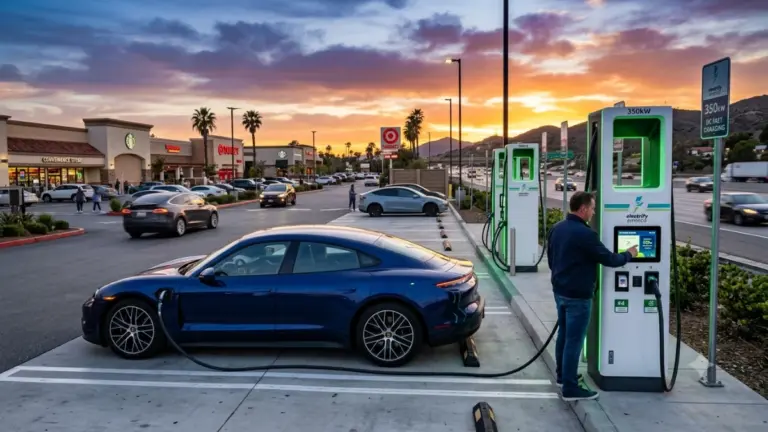
Ultra-fast charging that actually lives up to the hype. We’re talking 10-15 minute top-ups that add 200+ miles. Companies like Electrify America and EVgo are racing to deploy 350kW chargers, but the infrastructure rollout is uneven. You might find cutting-edge charging in California or along major highways, but good luck finding reliable fast charging in rural Montana.
Smarter trip planning integrated into every aspect of your drive. Your car should know your destination, current traffic, weather conditions, and which charging stations are actually functioning—then route you automatically. Some manufacturers are getting there, but the experience remains frustratingly fragmented.
Battery chemistry improvements that maintain range in extreme weather. Cold weather can slash EV range by 30-40%. New lithium iron phosphate (LFP) and solid-state batteries promise better temperature resilience, but widespread adoption is still 2-3 years out.
Battery Swapping: The Comeback Nobody Expected
Here’s a plot twist: battery swapping—the idea that crashed and burned in the US with Better Place back in 2013—is making a serious comeback. But not where you might expect.
China’s NIO has completed over 30 million battery swaps. Their stations swap a depleted battery for a fresh one in under five minutes. That’s faster than most people’s coffee run. Europe is watching closely, with several pilot programs launching across Scandinavia and Germany.
Why now? Because the economics finally make sense for specific use cases. Long-haul trucking, taxi fleets, urban delivery vehicles—these are applications where downtime equals lost money. For a delivery company running 50 vans, battery swapping could mean the difference between needing 50 vehicles or 40 to cover the same routes.
The catch? Standardization. Battery swapping only works if manufacturers agree on universal battery formats and connection standards. Right now, every automaker has their own design. It’s like having different sized gas tanks for every car brand—except way more complicated because batteries are integral to vehicle design.
Will battery swapping go mainstream for personal vehicles? Probably not in the US or most of Europe, where home charging is accessible for many drivers. But for commercial fleets and in dense urban areas where home charging isn’t an option? This could be a game-changer.
Urban Logistics: Where EVs Make the Most Sense Right Now
While we’re all focused on family SUVs and pickup trucks, the real EV revolution is happening in plain sight—literally driving past you every day.
Urban delivery vehicles are going electric fast. Amazon has ordered 100,000 custom electric delivery vans from Rivian. UPS, FedEx, and DHL are all deploying electric fleets. Why? Because the economics are overwhelmingly in favor of EVs for short-range, high-utilization applications.
Think about it: delivery vans drive predictable routes, return to the same depot every night (easy charging), and operate in stop-and-go traffic where EVs excel. No transmission. Less brake wear. Lower fuel costs. Quieter operation (important for early morning deliveries). The total cost of ownership calculations aren’t even close—EVs win decisively.
Garbage trucks are next. Several US cities are testing electric refuse trucks. They’re quieter (big deal for 5 AM pickups), produce zero local emissions, and the regenerative braking from all those stops actually helps extend range.
The lesson here? EV adoption won’t look the same everywhere. We might see 80% of urban commercial vehicles go electric before half of personal vehicles make the switch. And that’s fine—it’s actually smart to deploy EVs where they deliver the most benefit first.
The Infrastructure Problem Nobody Wants to Talk About
Here’s an uncomfortable truth: our electrical grid wasn’t designed for a world where 50 million vehicles suddenly start charging every night.
That doesn’t mean we’re doomed—it means we need to get smarter. Fast.
The issue isn’t total electricity generation capacity (we produce enough). It’s about when and where that power needs to be delivered. If everyone in your neighborhood gets home at 6 PM and plugs in their EV, that local transformer might have a bad day. Utility companies are already seeing demand spikes in EV-heavy areas.
The solutions are emerging, but they require coordination between automakers, utilities, and policymakers:
Smart charging that shifts load to off-peak hours. Your EV should automatically charge when electricity is cheapest and grid demand is lowest—usually between midnight and 6 AM. Some utilities are offering special EV rates to encourage this behavior.
Vehicle-to-grid (V2G) technology that turns your EV into a mobile battery. Imagine your car sending power back to the grid during peak demand, earning you credits on your electric bill. Ford’s F-150 Lightning can already power your house during an outage. The next step is bidirectional grid integration.
Local energy storage and solar integration. Pairing home solar panels with EV charging and a home battery creates a mini microgrid that reduces strain on the utility grid. Tesla’s Powerwall is the most famous example, but competitors are emerging with more affordable options.
The infrastructure build-out will take time and investment—probably $100-200 billion in the US alone over the next decade. But it’s happening. The question is whether deployment can keep pace with EV sales.
What’s Coming: Models and Technology to Watch
The next five years will bring EVs that address current limitations head-on:
Affordable electric trucks and SUVs. The Chevrolet Silverado EV and Ram 1500 EV will test whether American truck buyers are ready to go electric. Early signs are promising—Ford’s F-150 Lightning had 200,000 reservations before it even hit dealerships.
Solid-state batteries moving from lab to road. Toyota, QuantumScape, and Samsung are racing to commercialize solid-state technology that promises 500+ mile range, 10-minute charging, and longer battery life. Expect limited production models by 2027-2028.
Chinese EVs arriving in force. BYD is already the world’s largest EV maker and is expanding aggressively into Europe and South America. Their pricing is competitive, range is solid, and build quality is improving rapidly. US tariffs may slow their entry to North America, but they’re reshaping the global market.
Purpose-built electric platforms. No more EVs that are just modified gas cars. Manufacturers are designing vehicles from the ground up for electric propulsion—with flatter floors, more interior space, and better weight distribution.
Policy and Incentives: The Hidden Driver
Let’s be real: policy matters more than most people want to admit. The Inflation Reduction Act in the US, the EU’s ban on new combustion engine sales by 2035, and China’s aggressive EV quotas aren’t just political posturing—they’re reshaping manufacturer behavior and consumer options.
Tax credits, rebates, HOV lane access, free parking in cities—these incentives are pushing the economics in favor of EVs faster than market forces alone would. Some people hate this; others see it as necessary to overcome the chicken-and-egg problem of infrastructure development.
Your view probably depends on whether you think climate change requires urgent action or whether markets should determine winners naturally. Either way, policy is accelerating the transition. Manufacturers are investing hundreds of billions in EV development because governments have made it clear combustion engines have a deadline.
The Real Question: What Happens at 20% Market Share?
Here’s where it gets interesting. Most technologies follow a predictable adoption curve: slow start, then an inflection point where growth accelerates dramatically. For EVs, many analysts believe that tipping point comes when they reach 15-20% of new vehicle sales.
We’re approaching that threshold now. In 2024, EVs hit about 9% of US new car sales and over 20% in Europe. China is already past 30%. Once EVs become common enough that most people know someone who owns one, perceptions shift. Charging infrastructure becomes more viable. Used EV markets develop. Mechanics learn to service them.
The next five years—2025 to 2030—are when we’ll find out if this transition accelerates or plateaus. Will we hit 30-40% EV sales by 2030, putting us on track for majority-electric transportation by 2035? Or will we stall around 20-25% as we bump up against real infrastructure, cost, and consumer preference limits?
So What Should You Do?
If you’re considering an EV, here’s my honest take:
Wait if: You regularly drive long distances in areas with sparse charging infrastructure, you can’t charge at home or work, or you need your vehicle for heavy towing. Battery and charging technology will improve significantly in the next 2-3 years.
Buy now if: You have home charging, your daily driving is under 200 miles, you have access to a second vehicle for occasional long trips, or you’re buying for urban use. Current EVs already work great for these use cases, and you’ll benefit from available incentives.
Watch closely if: You’re in the market for a commercial vehicle or fleet. The economics are increasingly compelling, and first-movers are seeing real operational savings.
The electric mobility shift isn’t a single event—it’s a transformation that will unfold differently across regions, vehicle types, and use cases. The next five years will tell us whether we’re on the cusp of rapid, widespread adoption or whether EVs will remain a substantial but minority option for another decade.
One thing’s certain: the conversation has evolved. We’re past “if” and deep into “how.” And that’s exactly where the most interesting innovations happen.