You’ve probably wondered what makes an electric vehicle silently glide past you at a stoplight, or how these cars can travel hundreds of miles on a single charge. The answer lies in sophisticated battery technology that’s revolutionizing transportation as we know it. Electric vehicle batteries are essentially giant rechargeable power banks that store electrical energy and release it on demand to power electric motors, but the engineering behind them is far more fascinating than most people realize.
In this article, you’ll discover exactly how EV batteries work, from the chemical reactions happening at the microscopic level to the battery management systems that keep everything running smoothly. We’ll explore why lithium-ion technology dominates the market, how these batteries differ from the one in your phone, and what the future holds for EV energy storage. Whether you’re considering buying an electric car or simply curious about the technology reshaping our roads, you’ll walk away with a solid understanding of the powerhouse behind the electric revolution.
The Basic Architecture: What’s Actually Inside an EV Battery Pack
When you look at an electric vehicle’s battery pack, you’re not seeing a single massive battery—you’re looking at a carefully orchestrated system of thousands of individual cells working together. Think of it like a high-tech LEGO structure where each piece plays a critical role.
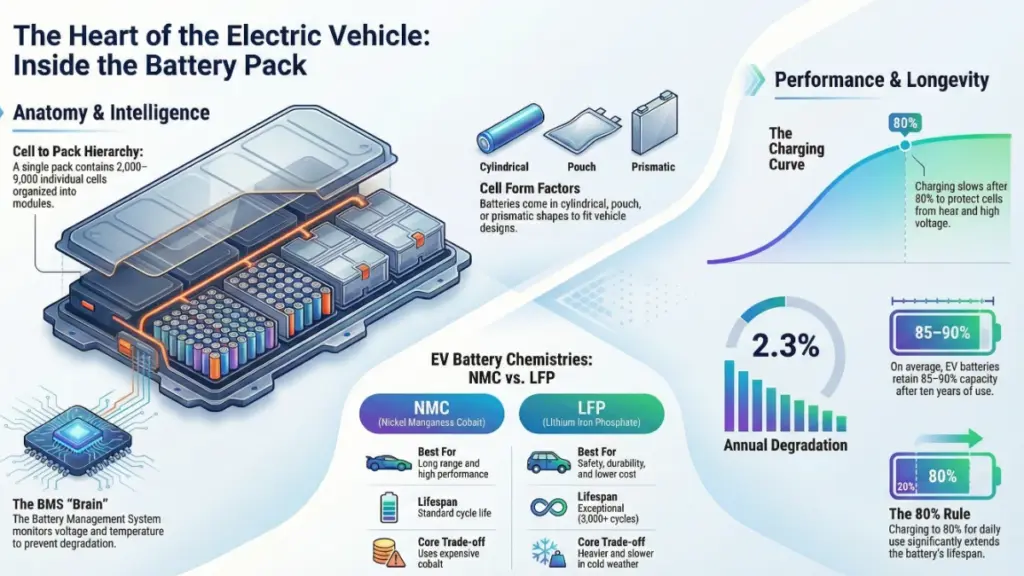
The battery cell is the fundamental building block. These are similar to the cylindrical AA batteries you’d put in a flashlight, except they’re specifically designed for high energy density and longevity. A typical EV might contain anywhere from 2,000 to 9,000 individual cells, depending on the vehicle size and range requirements. For example, Tesla’s Model 3 Long Range uses approximately 4,416 cylindrical 2170-format cells.
These cells are organized into modules—groups of cells packaged together with cooling systems and structural supports. You might have 10-20 modules in a complete battery pack. Finally, all the modules are combined into the battery pack, which includes the outer casing, thermal management system, and battery management system (BMS). The entire assembly typically sits under the vehicle’s floor, creating a low center of gravity that actually improves handling.
The Three Common Cell Formats
Cylindrical cells (like those used by Tesla) offer excellent thermal management and are cost-effective to manufacture since they’ve been produced in massive quantities for years. They look like oversized versions of household batteries.
Pouch cells (favored by Chevrolet and Nissan) are flat, flexible packages that can be stacked efficiently. They’re lighter and can be shaped to fit available space better, but require more robust external structures for protection.
Prismatic cells (used by BMW and others) are rectangular hard-case batteries that offer a nice middle ground—easier to package than cylindrical cells with better structural integrity than pouch cells.
The Chemistry Behind the Power: How Lithium-Ion Batteries Actually Work
Here’s where things get genuinely interesting. The magic of lithium-ion batteries happens through a reversible chemical reaction that shuttles lithium ions back and forth between two electrodes. Let me break this down in a way that doesn’t require a chemistry degree.
Every lithium-ion cell has four main components: the anode (negative electrode), cathode (positive electrode), electrolyte (the medium that allows ions to move), and a separator (a porous membrane that prevents short circuits while allowing ions through).
When you’re driving your EV and discharging the battery, lithium ions flow from the anode through the electrolyte to the cathode. This movement creates a flow of electrons through the external circuit (your car’s electrical system), which powers the motors. The anode is typically made of graphite, while the cathode uses various lithium metal oxides—the specific chemistry here determines many of the battery’s characteristics.
When you plug in to charge, the process reverses. Electrical current forces the lithium ions to move back from the cathode to the anode, storing energy for your next drive. This is why it’s called “rechargeable”—the chemical reaction can go both directions.
Why Lithium? The Element That Changed Everything
You might wonder why lithium became the go-to element for EV batteries. The answer is elegantly simple: lithium is the lightest metal on the periodic table and has exceptional electrochemical properties. This means you can pack a lot of energy into a relatively small, light package—crucial when you’re trying to move a 4,000-pound vehicle efficiently.
Current lithium-ion batteries in EVs achieve energy densities of around 250-300 watt-hours per kilogram (Wh/kg) at the cell level. For context, that’s roughly 100 times more energy-dense than the lead-acid battery in conventional cars. This energy density has been climbing steadily—up from about 200 Wh/kg just five years ago—and is projected to reach 400-500 Wh/kg by 2030 with emerging technologies.
Different Lithium-Ion Chemistries: Not All EV Batteries Are Created Equal
This might surprise you, but “lithium-ion” is actually an umbrella term covering several different battery chemistries. The cathode material makes all the difference in performance, cost, and lifespan. Let’s explore the main types you’ll find in today’s EVs.
NMC (Nickel Manganese Cobalt)
Used in: Tesla Model 3/Y, BMW i4, Audi e-tron, and many others
NMC batteries offer an excellent balance of energy density, power delivery, and cost. The ratio of nickel, manganese, and cobalt can be adjusted—higher nickel content (like NMC 811, meaning 80% nickel, 10% manganese, 10% cobalt) provides greater energy density but can be less stable. These batteries typically deliver 200-250+ miles of range in mid-size EVs and can handle fast charging reasonably well.
The main drawback? Cobalt is expensive and raises ethical concerns due to mining practices in certain regions. The industry is actively working to reduce or eliminate cobalt content.
LFP (Lithium Iron Phosphate)
Used in: Tesla Model 3 Standard Range, Ford Mustang Mach-E Select, many Chinese EVs
LFP batteries are having a major comeback. They’re cobalt-free, extremely safe, and long-lasting—some can handle over 3,000 charge cycles with minimal degradation. They’re also cheaper to produce, which is why you’re seeing them in more affordable EV models.
The trade-off? Lower energy density means either reduced range or a heavier battery pack. LFP batteries also perform poorly in extreme cold. However, for daily commuting in moderate climates, they’re an excellent, cost-effective choice. Tesla’s switch to LFP for their standard-range vehicles signals growing confidence in this chemistry.
NCA (Nickel Cobalt Aluminum)
Used in: Tesla Model S/X (historically)
NCA batteries offer very high energy density and excellent power output, making them ideal for performance vehicles. They’re what helped early Teslas achieve impressive range figures. However, they’re expensive and somewhat less thermally stable than other chemistries, requiring sophisticated cooling systems.
Solid-State (The Future)
While not yet commercially available in EVs, solid-state batteries replace the liquid electrolyte with a solid material. This promises higher energy density (potentially 2x current batteries), faster charging, and improved safety. Companies like Toyota, QuantumScape, and Solid Power are racing to bring these to market, with production targeted for 2027-2030.
The Battery Management System: The Brain Behind the Brawn
Here’s something most people don’t appreciate: the sophistication isn’t just in the battery cells themselves, but in the Battery Management System (BMS) that monitors and controls everything. This is genuinely one of the most impressive pieces of technology in an EV.
The BMS is constantly performing thousands of calculations per second, monitoring:
- Individual cell voltages: Ensuring no cell becomes overcharged or over-discharged
- Temperature: Tracking heat levels throughout the pack and activating cooling when needed
- State of charge (SOC): Calculating how much energy remains (like your fuel gauge)
- State of health (SOH): Assessing overall battery degradation over time
- Current flow: Managing how quickly energy enters or leaves the battery
Cell Balancing: Why It Matters
Imagine you have 4,000 cells in your battery pack. Over time, tiny manufacturing differences and usage patterns mean these cells won’t all have exactly the same charge level. If left unchecked, this imbalance would limit your range and accelerate degradation.
The BMS performs cell balancing, either passively (bleeding excess charge from fuller cells as heat) or actively (redistributing charge between cells). This ensures all cells age together and you get maximum usable capacity. It’s like a conductor keeping thousands of orchestra musicians perfectly in sync.
Thermal Management: Keeping Your Cool
Temperature is the enemy of battery longevity. Operating below 32°F (0°C) or above 95°F (35°C) significantly reduces performance and accelerates degradation. That’s why EVs use sophisticated thermal management systems—typically liquid cooling where a mixture of water and glycol circulates through channels in the battery pack.
When you precondition your EV before a trip (warming or cooling the battery while plugged in), you’re using the BMS to optimize battery temperature for performance and longevity. During fast charging, the BMS might limit charging speed if the battery gets too hot, prioritizing long-term health over immediate convenience.
How Charging Works: From the Plug to Your Battery
When you plug in your EV, you’re not just dumping electricity straight into the battery cells—there’s a carefully choreographed process happening.
AC charging (what you’d use at home or at many public chargers) requires the vehicle’s onboard charger to convert alternating current from the grid into direct current that batteries can store. This conversion limits charging speed—typically 3.3 kW to 19.2 kW depending on your vehicle’s onboard charger capacity. A 60 kWh battery might take 6-12 hours to fully charge on a Level 2 home charger.
DC fast charging bypasses the onboard charger entirely, delivering direct current straight to the battery. This is why it’s so much faster—modern DC fast chargers can deliver 150-350 kW, adding 200 miles of range in 15-30 minutes. The battery’s BMS communicates with the charging station to determine the optimal charging rate based on temperature, state of charge, and battery health.
The Charging Curve: Why Fast Charging Slows Down
You’ve probably noticed that DC fast charging slows significantly after about 80%. This isn’t a flaw—it’s intentional battery protection.
Charging follows a curve: rapid charging from 10-80%, then a significant slowdown. This happens because as cells fill up, the voltage rises and resistance increases, making it harder (and riskier) to push more electrons in. Think of it like filling a water bottle—the last 20% takes much longer as you need to slow down to avoid overflow.
Charging to 100% regularly also accelerates degradation. Most manufacturers recommend charging to 80-90% for daily use, only going to 100% before long trips.
Battery Degradation: The Reality of Aging
Let’s address the elephant in the room: yes, EV batteries degrade over time, just like your smartphone battery. But the reality is far less dramatic than you might fear.
Most modern EV batteries are warranted for 8 years or 100,000-150,000 miles, typically guaranteeing at least 70% capacity retention. Real-world data suggests they often exceed this. A 2023 study by Recurrent analyzing over 15,000 EVs found that battery capacity loss averages around 2.3% per year, meaning a battery might retain 85-90% capacity after 10 years.
Several factors influence degradation rate:
Calendar aging: Simply sitting unused, batteries slowly degrade—about 1-2% per year regardless of use
Cycle aging: Each charge/discharge cycle causes small amounts of wear. Deeper discharge cycles (draining to near 0%) cause more wear than partial cycles
Temperature exposure: Heat is the primary enemy. Consistently operating in hot climates (Arizona, Texas) accelerates degradation by 10-30% compared to moderate climates
Fast charging frequency: Regular DC fast charging (especially to 100%) creates more stress than slower AC charging
Maximizing Battery Life: Practical Tips
Want to extend your EV battery’s lifespan? Here’s what actually works:
- Charge to 80% for daily driving: Only charge to 100% before road trips
- Avoid letting charge drop below 20% regularly: Shallow cycles are gentler
- Minimize exposure to temperature extremes: Park in shade/garage when possible
- Use precondition while plugged in: Warm/cool the battery using grid power
- Limit DC fast charging to when truly needed: Use Level 2 charging for routine charging
- Don’t leave the battery at 100% or 0% for extended periods: Aim for 50% if storing
Follow these practices, and your battery could easily outlast the rest of the vehicle.
Energy Density vs. Power Density: Understanding the Trade-offs
Here’s a concept that helps explain why different EVs feel so different to drive: energy density and power density are related but distinct properties.
Energy density (measured in Wh/kg) determines how much total energy you can store—this translates directly to driving range. A battery with 300 Wh/kg can store more energy in the same weight than one with 250 Wh/kg.
Power density (measured in W/kg) determines how quickly you can discharge that energy—this affects acceleration and performance. High power density enables rapid acceleration and sustained high-speed driving.
There’s an inherent trade-off. Batteries optimized for maximum energy density (like LFP) often can’t deliver power as quickly. Conversely, batteries designed for high power output might sacrifice some energy storage capacity.
This is why a Tesla Model S Plaid with its performance-oriented NCA batteries can accelerate from 0-60 mph in under 2 seconds, while a Tesla Model 3 Standard Range with LFP batteries is quicker off the line but not in the same league. Different battery chemistries and configurations serve different purposes.
Recycling and Second Life: What Happens to Old EV Batteries
One of the most common concerns about EVs is battery disposal. The good news? EV batteries are highly recyclable, and the industry is building robust end-of-life infrastructure.
When an EV battery drops below 70-80% capacity, it’s typically no longer suitable for vehicle use—but it’s still perfectly functional for stationary energy storage. These “second-life” batteries are being repurposed for:
- Home energy storage: Storing solar power or load-shifting grid power
- Grid stabilization: Providing backup power and frequency regulation
- Commercial applications: Powering equipment at lower-demand sites
Companies like Nissan, GM, and Mercedes are already implementing second-life battery programs. A battery might serve 10-15 years in a vehicle, then another 10+ years in stationary storage.
When batteries finally reach true end-of-life, recycling recovers 90-95% of valuable materials—lithium, cobalt, nickel, and manganese. Companies like Redwood Materials, Li-Cycle, and American Battery Technology are scaling up recycling operations. By 2030, recycled materials are expected to supply a significant portion of battery production needs, creating a more circular economy.
This isn’t just environmentally responsible—it’s economically smart. Cobalt and nickel are expensive, and recycled materials cost less than newly mined ones.
The Future: What’s Coming Next in EV Battery Technology
The battery technology in today’s EVs is impressive, but it’s just the beginning. Here’s what’s on the horizon for the next 5-10 years:
Solid-State Batteries (2027-2030)
As mentioned earlier, solid-state batteries could double energy density, enabling 600-800 mile ranges or smaller, lighter battery packs. Toyota has announced plans for solid-state EVs by 2027, though many experts expect mass production closer to 2030. These batteries also promise 10-minute charging times and improved safety since they eliminate flammable liquid electrolytes.
Silicon Anodes (2025-2027)
Current batteries use graphite anodes, but silicon can theoretically store 10x more lithium ions. The challenge is that silicon expands dramatically during charging, causing fractures. Companies like Sila Nanotechnologies and Group14 Technologies are developing silicon-dominant anodes that could increase energy density by 20-40% in the near term.
Lithium-Sulfur Batteries (2028+)
Sulfur is abundant and cheap, and lithium-sulfur batteries could offer energy densities exceeding 500 Wh/kg. The main hurdle is limited cycle life—current versions degrade quickly. Researchers are making progress, but commercial availability is likely a decade away.
Sodium-Ion Batteries (2025-2026)
For budget EVs and grid storage, sodium-ion batteries are emerging as a compelling alternative. Sodium is vastly more abundant than lithium (you can extract it from seawater!), making these batteries potentially much cheaper. Companies like CATL and BYD are already producing sodium-ion cells, though with lower energy density than lithium-ion—suitable for short-range city cars.
Faster Charging Infrastructure
Battery technology isn’t the only thing advancing. Ultra-fast chargers delivering 500+ kW are in development, potentially adding 300 miles of range in under 10 minutes. The bottleneck becomes the battery’s ability to accept charge without overheating—requiring advances in thermal management and cell chemistry.
Conclusion: The Powerhouse Driving the EV Revolution
Electric vehicle batteries represent one of the most sophisticated mass-produced technologies on the planet today. From the chemical reactions happening at the molecular level to the intelligent software managing thousands of cells, every aspect is engineered for efficiency, safety, and longevity.
Here’s what you should remember:
- EV batteries are complex systems of thousands of individual cells organized into modules and packs
- Lithium-ion chemistry dominates because of its exceptional energy density, with variations (NMC, LFP, NCA) optimized for different priorities
- Battery Management Systems are the unsung heroes, constantly monitoring and optimizing performance
- Degradation is real but manageable—expect 85-90% capacity after a decade with proper care
- The technology is rapidly evolving, with solid-state and other next-gen batteries promising even better performance
If you’re considering an EV, understanding how the battery works helps you make informed decisions about which vehicle suits your needs, how to maximize battery life, and what to expect as the technology continues advancing. The batteries powering today’s electric vehicles are already impressive—but the next generation will be even more remarkable.
The future of transportation is electric, and now you know exactly what’s making it possible.