Remember when “The Jetsons” promised us flying cars by the year 2000? Well, we’re fashionably late to that party, but the future is finally arriving – and it’s electric. Urban air mobility isn’t just another tech buzzword or distant sci-fi dream anymore. Companies are actually testing electric flying vehicles right now, airports are building “vertiports,” and regulators are frantically writing the rules for a transportation revolution that could transform your morning commute from a gridlocked nightmare into a smooth glide above the traffic.
But here’s the real question: Is this just expensive toys for the wealthy, or are we genuinely on the cusp of something that could change how millions of us move through cities? Let’s take an honest look at what’s actually happening in the skies above us.
What Exactly Is Urban Air Mobility?
Think of urban air mobility (UAM) as the electric vehicle revolution’s cooler, more adventurous cousin – the one who decided roads were too boring and took to the skies instead. At its core, UAM refers to a new transportation system using electric aircraft to move people and cargo through urban and suburban areas.
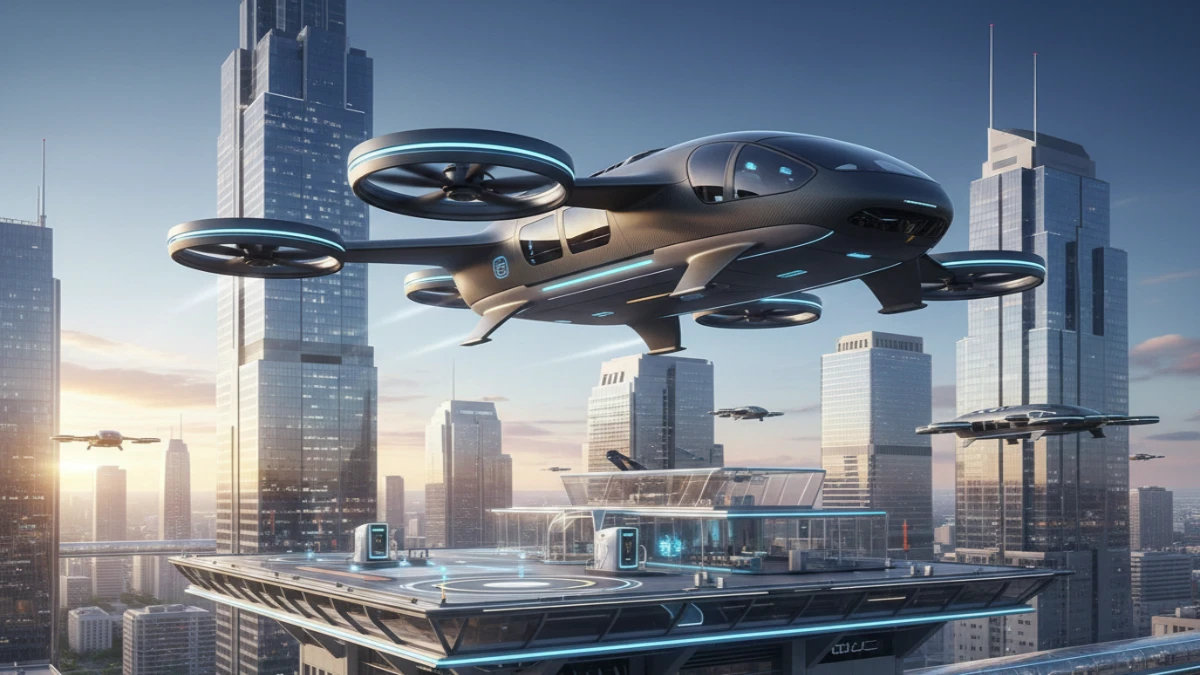
These aren’t your grandfather’s helicopters, though. We’re talking about electric vertical takeoff and landing aircraft – mercifully shortened to eVTOLs – that combine the convenience of a helicopter with the efficiency and quiet operation of an electric vehicle. Picture something that looks like a cross between a drone and a small airplane, powered entirely by batteries, with multiple rotors that let it take off straight up like a helicopter but then tilt forward to fly efficiently like a plane.
The beauty of these machines is their simplicity compared to traditional helicopters. No complex transmission systems, no noisy combustion engines, fewer moving parts to maintain. Just electric motors, batteries, and sophisticated computer systems keeping everything stable. Some models have as many as 18 small rotors working together, which means if one fails, the others can compensate – a safety feature that makes nervous passengers (like me) feel a bit better about the whole “flying through the city” concept.
Companies like Joby Aviation, Archer Aviation, Lilium, and Volocopter aren’t just sketching concepts on whiteboards anymore. They’re building real aircraft, conducting actual test flights, and working with airlines and cities to figure out where these things will land and how much they’ll cost. Joby, for instance, has conducted over 1,500 test flights and recently received FAA certification for their aircraft design – a massive regulatory milestone that moves this from “interesting idea” to “this is really happening.”
Why Electric Power Changes Everything
Here’s where the EV connection becomes crystal clear: urban air mobility only makes sense because of the revolution in electric propulsion and battery technology. Traditional helicopters are loud, expensive to operate, and frankly, terrible for the environment. They’re also complicated mechanical beasts that require constant, costly maintenance.
Electric aircraft flip that equation. The latest lithium-ion and solid-state batteries being developed can power these vehicles for 60 to 150 miles on a single charge – perfect for city-to-city hops or airport transfers. The energy efficiency is remarkable compared to helicopters: some eVTOLs use about one-tenth the energy per passenger mile. And because electric motors are inherently more efficient than combustion engines, more of the energy from the battery actually goes into moving you forward rather than generating heat and noise.
The noise issue is huge, by the way. If you’ve ever had a helicopter fly over your neighborhood, you know that distinctive “whup-whup-whup” sound that rattles windows and stops conversations. eVTOLs produce about one-fifth the noise, often described as a quiet hum rather than a roar. Joby claims their aircraft will be about as loud as a conversation – roughly 65 decibels at 500 feet altitude. That’s the difference between something neighbors would tolerate hundreds of times daily and something that would trigger noise ordinance violations within a week.
And yes, they’re zero-emission vehicles, just like your Tesla or Rivian, but flying. For cities struggling with air quality issues, replacing even a fraction of ground transportation with electric air mobility could make a measurable difference. Not to mention the reduced wear on road infrastructure – those potholes won’t fill themselves, but at least there’d be fewer vehicles creating them.
The Real-World Applications Taking Shape
So who’s actually going to use these things, and when? Let’s get practical, because this is where urban air mobility moves from “cool technology” to “might actually affect your life.”
Airport Transfers: This is the low-hanging fruit everyone’s targeting first. Think about a trip from Manhattan to JFK Airport – that’s about 17 miles that can take anywhere from 40 minutes to two nightmare-inducing hours in traffic. An eVTOL could make that trip in roughly 7 minutes. Companies like Archer Aviation are partnering with United Airlines to offer exactly this service, with plans to launch in places like New York, Los Angeles, and the San Francisco Bay Area as early as 2025-2026.
Inter-City Shuttles: Got a meeting in a neighboring city? Instead of a two-hour drive, imagine a 20-minute flight that lets you skip the interstate entirely. This is particularly attractive in regions with congested corridors – think Los Angeles to Orange County, or Miami to Fort Lauderdale. Lilium is working with regional partners to establish these kinds of routes, essentially creating aerial highways connecting metropolitan areas.
Emergency Services: Here’s where urban air mobility gets genuinely life-saving. Medical evacuations, organ transport, emergency response – these applications justify the technology even if mass transportation never materializes. ADAC, Germany’s largest automobile club, has been testing eVTOL air ambulances. When minutes matter, the ability to bypass traffic entirely could save lives.
Cargo and Delivery: Before we’re all commuting by air, you might see your packages arriving that way. Companies like Wisk Aero are developing autonomous eVTOLs specifically for cargo, which avoids the tricky regulatory issues around passenger safety while still proving the technology works at scale.
Will you be flying to work every day in five years? Probably not. But might you occasionally take an air taxi to catch a flight or make an important meeting across town? That’s genuinely starting to look plausible.
The Honest Challenges We Need to Talk About
Let’s pump the brakes on the hype for a moment and address the elephant in the room – or rather, the extremely complex set of challenges that stand between today’s test flights and tomorrow’s routine air commutes.
Cost: Right now, early projections suggest air taxi rides will cost somewhere between current helicopter service (wildly expensive) and premium rideshare options (merely expensive). Joby estimates around $3 per mile initially, which would make that Manhattan-to-JFK trip about $50. Not terrible compared to a frustrated Uber driver sitting in traffic charging you by the minute, but hardly mass-market transportation. The promise is that costs will drop significantly as operations scale up – think about how Tesla prices have evolved. But “eventually affordable” doesn’t help early adopters.
Infrastructure: Where exactly do these things land? You can’t just set down in a parking lot. Cities need “vertiports” – essentially small airports designed for vertical takeoff aircraft. They need charging infrastructure, passenger facilities, and connection to ground transportation. Billions of dollars in infrastructure investment are required, and cities are notoriously slow at building things. Some are adapting existing heliports, but scaling to meaningful capacity means purpose-built facilities.
Regulation: The FAA and aviation authorities worldwide are essentially writing the rulebook as we go. How do you certify pilots? What air traffic control systems handle potentially thousands of aircraft operating at low altitudes? What happens when something goes wrong? These aren’t trivial questions, and regulators are rightfully cautious about letting electric aircraft carrying passengers operate over dense urban areas.
Battery Limitations: Current battery technology limits range to under 150 miles in most designs, and that assumes ideal conditions. Cold weather, headwinds, the need for reserves – all of these eat into practical range. For urban trips, this is fine, but it constrains the applications significantly. We need the battery equivalent of another Tesla revolution before truly long-distance air mobility becomes practical.
Public Acceptance: Are people actually going to get in these things? Survey data suggests younger, urban populations are surprisingly open to it, but there’s a vast difference between telling a pollster you’d try an air taxi and actually buckling into one for your first flight. One high-profile accident could set the industry back years.
Weather Sensitivity: Unlike commercial jets that fly above most weather, these aircraft operate at low altitudes where wind, fog, and precipitation matter. That afternoon thunderstorm doesn’t just slow down traffic – it grounds the entire air mobility system. Reliability is crucial for transportation, and weather introduces inherent unpredictability.
What the Next Five Years Actually Look Like
Here’s my honest read on what’s coming, based on current developments and regulatory timelines – not the rosy projections in press releases.
2025-2026 will likely see the first commercial operations, but extremely limited in scope. Think a handful of routes in a few cities, primarily airport transfers, operating during good weather conditions only. These will be premium services priced for business travelers and the curious wealthy willing to pay for the novelty. Companies like Joby and Archer seem most likely to launch first in the United States, while Volocopter and Lilium focus on European markets.
The 2028 Olympics in Los Angeles has become an unofficial deadline for the industry, with multiple companies aiming to showcase their services during the games. This could be the “breakout moment” that brings UAM into public consciousness – assuming everything goes smoothly.
By 2030, if things progress well, we might see several dozen operational routes across major metropolitan areas, with prices dropping to make the service accessible to upper-middle-class travelers, not just executives. The infrastructure will still be developing, with perhaps 50-100 vertiports operating in the United States.
Mass adoption? That’s a 2035-2040 conversation, and even then, we’re probably talking about air mobility serving 1-5% of urban transportation needs in cities where it’s available. This isn’t replacing cars or trains – it’s adding a new layer to the transportation mix, much like rideshare services did a decade ago.
The wild card is autonomous operation. Several companies are designing their eVTOLs to eventually fly without pilots, which could dramatically reduce operating costs. But autonomous passenger aviation faces even higher regulatory hurdles than self-driving cars, so don’t expect pilotless air taxis anytime soon, regardless of what the technology enables.
How This Connects to the Broader EV Revolution
Urban air mobility isn’t happening in isolation – it’s part of the same fundamental shift toward electrification that’s transforming ground transportation. The battery technology developed for electric cars directly enables these aircraft. The charging infrastructure being built for EVs can be adapted for eVTOLs. The public acceptance of electric propulsion in vehicles makes the leap to electric aircraft more palatable.
There’s even talent cross-pollination. Engineers and executives from Tesla, Rivian, and traditional automakers are joining UAM companies, bringing expertise in electric powertrains, battery management, and manufacturing scale that the aviation industry traditionally lacked. Joby’s founder, JoeBen Bevirt, talks about applying “Silicon Valley thinking” to aviation – fast iteration, software-first design, and scaling production like a car manufacturer rather than a traditional aircraft company.
The investment community sees it too. Venture capital that flowed into electric vehicle startups a decade ago is now funding urban air mobility. The same investors who backed early-stage Rivian or Lucid are betting on Archer and Lilium. They’re applying lessons learned from the EV revolution to what they hope will be the next transformation in transportation.
And crucially, the environmental argument for UAM only works because it’s electric. Helicopter services have existed for decades, but they’re dirty, loud, and inefficient. Electric propulsion is what makes urban air mobility potentially scalable and sustainable rather than just a niche service for the ultra-wealthy who don’t care about noise complaints or carbon footprints.
Should You Care About Urban Air Mobility?
Here’s the practical takeaway: urban air mobility is coming, but it’s not coming for everybody, everywhere, all at once. If you live in a major metropolitan area, work near an airport, or frequently travel between nearby cities, this technology might actually become relevant to your life within the next five to ten years. If you’re in a smaller city or suburban area without congestion problems, you can safely ignore the UAM hype for now.
The technology is real, the companies are serious, and the investment is flowing. But like the early days of electric vehicles, we’re in for a longer, messier journey than the promotional videos suggest. There will be delays, bankruptcies, regulatory setbacks, and probably a few spectacular failures. That’s how transformative technology works.
What makes me genuinely optimistic is that the fundamentals make sense. Cities are getting more congested, not less. Electric propulsion has proven itself on the ground. The engineering challenges are significant but not insurmountable. And unlike some transportation fantasies (I’m looking at you, hyperloop), urban air mobility is evolutionary rather than revolutionary – it builds on proven concepts like helicopters and electric motors rather than requiring entirely new physics.
So keep an eye on the sky. That quiet hum overhead in five years might not be a drone delivering your package – it might be your neighbor who decided that beating traffic was worth the premium. And a few years after that, it might be you.
The Jetsons were wrong about the timing, but they might have been right about the destination. We’re just taking the scenic route to get there – with a few unexpected stops for regulatory approval along the way.