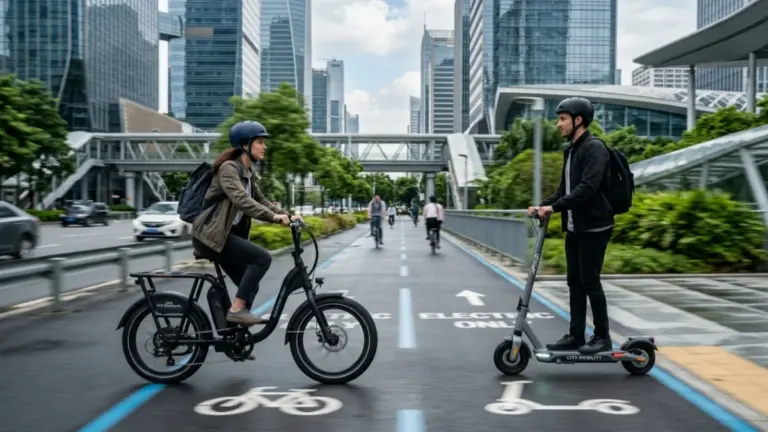

You know that moment when you’re stuck in traffic, watching a cyclist breeze past you on the shoulder, and you think, “That person’s got the right idea”? Well, what if I told you that same cyclist could be hauling a week’s worth of groceries, two kids, and a golden retriever—all without breaking a sweat? Welcome to the world of electric cargo bikes, where pedal power meets electric assistance to create something that might just replace your second car.
I’ve spent the better part of two decades watching the automotive industry transform, and here’s something I didn’t see coming: some of the most exciting innovation in personal transportation isn’t happening in sleek sedans or futuristic SUVs. It’s happening on two wheels, with a motor barely bigger than a toaster and a carrying capacity that would make your trunk jealous.
What Exactly Is an Electric Cargo Bike?
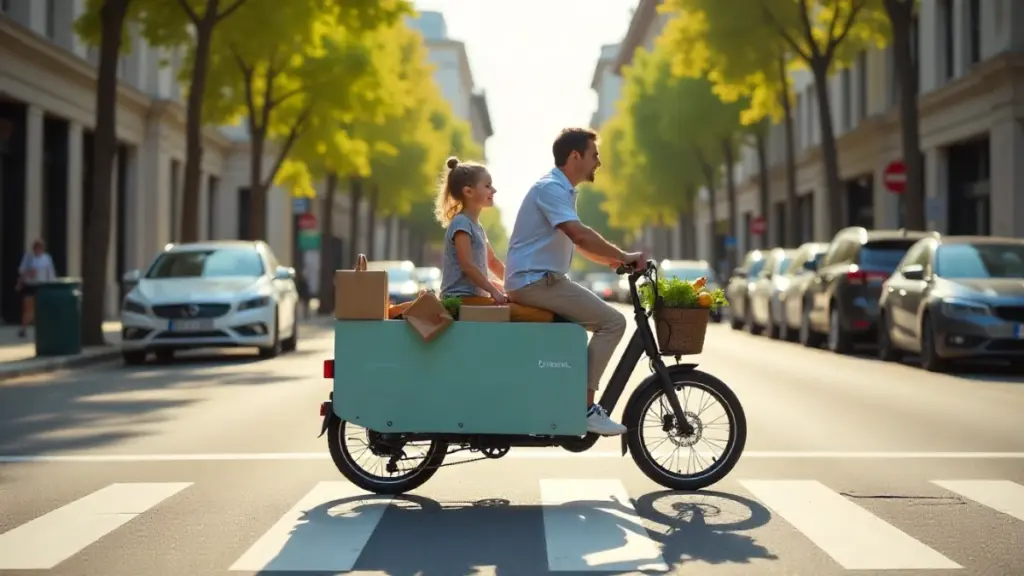
Let’s start with the basics. An electric cargo bike—or e-cargo bike—is essentially a bicycle designed to carry heavy loads, equipped with an electric motor that assists your pedaling. Think of it as the pickup truck of the bicycle world, but with the added benefit of electric assistance that makes hauling 200 pounds feel like you’re riding unladen.
These aren’t your typical beach cruisers with a basket zip-tied to the handlebars. We’re talking about purpose-built machines with reinforced frames, powerful motors (typically 250-750 watts), and cargo capacities ranging from 100 to 400 pounds depending on the model. Some feature a long tail design with extended rear racks, while others sport a front or mid-mounted cargo box called a “bakfiets” (Dutch for “box bike”).
The electric assist system works similarly to what you’d find in an electric car, just scaled down. A rechargeable lithium-ion battery powers the motor, which engages when you pedal. Most systems offer multiple assist levels—think of them like gears, but for effort rather than speed. On the highest setting, you’re contributing maybe 20% of the work while the motor handles the rest. On the lowest setting, you get a gentle boost that makes hills feel flat and headwinds disappear.
The Financial Math That Actually Makes Sense
Here’s where things get interesting for your wallet. The average American family spends about $10,728 annually on their second vehicle—that’s including car payments, insurance, gas, maintenance, and parking. A quality electric cargo bike will run you anywhere from $2,500 to $6,000 upfront. Let’s be generous and say you go high-end at $5,000.
Even if you’re financing it, your monthly payment would be around $140 for three years (with decent credit). No insurance required in most states. No gas—you’re looking at maybe $50 a year in electricity to charge the battery. Maintenance? A tune-up once a year, maybe $150. Suddenly you’re spending roughly $2,000 annually instead of nearly $11,000.
But here’s the catch—and I’m going to be honest with you because that’s what friends do—this only works if you can actually replace car trips with bike trips. If you live in suburban Ohio like I do, with a grocery store two miles away, a school three miles in the other direction, and bike lanes that actually exist, this math works beautifully. If you’re commuting 40 miles on a highway, not so much.
I talked to Maria Rodriguez, a Portland resident who sold her Honda CR-V six months ago and went all-in on an Urban Arrow Family. “I was skeptical at first,” she told me. “But I mapped out my typical week, and 80% of my trips were under five miles. The kids love riding in the front box, I’m getting exercise without trying, and I’m saving about $600 a month. The only time I miss the car is when it’s absolutely pouring rain, and even then, I’ve learned to embrace it.”
The Models Worth Your Attention
The e-cargo bike market has exploded in recent years, and sorting through your options can feel overwhelming. Let me break down a few standout models that cover different needs and price points.
Rad Power RadWagon 4 ($1,999): This is your entry-level workhorse. It features a longtail design with a 750-watt motor and a claimed range of 25-45 miles depending on assist level and cargo weight. It won’t win any beauty contests, but it’s reliable, parts are readily available, and the price point makes it accessible for families testing the waters. I’ve seen these things hauling everything from lumber to laundry, and they just keep going.
Tern GSD S10 ($4,999): If the RadWagon is a pickup truck, the Tern GSD is a luxury SUV. This compact longtail folds down for storage, features a Bosch motor system that’s whisper-quiet and incredibly refined, and has a modular accessory system that lets you configure it for kids, cargo, or both. The integrated lights, built-in lock, and polished fit-and-finish make it feel more like an e-mobility solution than a bike.
Urban Arrow Family ($5,799): This is the Dutch bakfiets taken to its logical conclusion. The cargo box sits low between the rider and the front wheel, giving you a stable platform that can carry up to 275 pounds. Parents love these because you can maintain eye contact with your kids while riding, and the weatherproof canopy option means rain isn’t a dealbreaker. The Bosch Performance Line motor provides smooth, powerful assistance that makes you forget you’re hauling what amounts to a small refrigerator.
Riese & Müller Load 75 ($7,999+): This is the Tesla Model S of cargo bikes—the one you buy when you want the absolute best and money isn’t the primary concern. Dual battery option for 100+ mile range, full suspension, hydraulic disc brakes, and build quality that feels like German engineering should. It’s excessive, it’s expensive, and if you’re planning to truly replace a car, it might actually be worth it.
The Hidden Benefits Nobody Talks About
The financial savings are nice, but here’s what surprised me when I spent a month testing an e-cargo bike: the intangible benefits that don’t show up on a spreadsheet.
First, there’s the exercise factor. Now, I know what you’re thinking—”But Jonathan, it has a motor. How is that exercise?” Fair question. But here’s the thing: even with maximum electric assist, you’re still pedaling. You’re still engaging your legs, core, and cardiovascular system. Studies show that e-bike riders actually get more exercise than traditional cyclists because they ride more often and for longer distances. It turns out that eliminating the “I’m too tired” excuse means people actually use their bikes.
I lost eight pounds during my test month without changing my diet or adding any other exercise. Was it a Tour de France training regimen? Absolutely not. But compared to sitting in a car, it was movement, fresh air, and low-impact cardio disguised as transportation.
Second, there’s the mental health aspect. Your commute stops being dead time spent stressed in traffic and becomes a genuinely enjoyable part of your day. You notice things—a new coffee shop, seasonal changes in the trees, your neighbor’s garden. There’s something meditative about being on a bike, even when you’re hauling 75 pounds of groceries up a hill with electric assistance doing most of the work.
Third—and parents especially appreciate this—it builds community. When you’re driving, you’re isolated in a metal box. On a cargo bike, especially one with kids aboard, you become part of the neighborhood fabric. People wave, kids point, conversations happen at stoplights. It sounds cheesy until you experience it, but it genuinely makes your community feel more connected.
The Practical Realities (The Stuff the Brochures Don’t Tell You)
Now let’s talk about the challenges, because I’d be doing you a disservice if I made this sound like a perfect solution for everyone.
Weather matters. I live in Ohio, where winter means snow, ice, and temperatures that make your face hurt. Can you ride a cargo bike in these conditions? Technically, yes. Will you want to? That’s between you and your pain threshold. Rain gear, studded tires, and pure determination can get you through most conditions, but there will be days when you’re jealous of people in heated cars. Anyone telling you otherwise is selling something.
Infrastructure is everything. If your city has protected bike lanes and shoulders wide enough to not feel like you’re playing chicken with SUVs, you’re golden. If your routes require navigating high-speed stroads (that unfortunate street-road hybrid that’s dangerous for everyone), you’re going to have a much harder time convincing yourself—and especially your spouse—that this is viable for family transportation.
Storage and security. These bikes are big—typically 6 to 8 feet long—and expensive. You need secure storage, ideally covered. A standard bike rack won’t cut it. I’ve seen creative solutions involving modified sheds, garage reorganization, and specialized bike shelters, but this is a real consideration. And yes, they get stolen, so a quality lock (budget $100-150 for a good one) is non-negotiable.
Physical requirements. While the motor does most of the work, you’re still maneuvering a 60-80 pound bike plus cargo. Making tight turns, walking it up steps, or loading it onto a bike rack requires a baseline level of strength and mobility. If you have physical limitations, some models are easier to handle than others—test ride before you buy.
Range anxiety exists here too. Most e-cargo bikes claim 30-60 mile ranges, but that’s under ideal conditions with moderate assist and flat terrain. Real-world range, especially if you’re hauling kids and groceries up hills with maximum assist, might be 20-30 miles. For most urban and suburban uses, this is plenty. But you need to be honest about your typical trip distances and charging opportunities.
Making the Decision: Is It Right for You?
Here’s my framework for figuring out if an electric cargo bike makes sense for your situation. Get out a piece of paper and answer these questions honestly:
Trip Analysis: Log your car trips for a week. How many are under 5 miles? Under 10 miles? If 50% or more fall into these categories, you’re a candidate.
Infrastructure Check: Are there safe routes for most of your regular destinations? Safe doesn’t mean perfect bike lanes everywhere—it means routes where you feel comfortable having your kids on board or where you wouldn’t be white-knuckling the handlebars the whole way.
Weather Tolerance: How many months per year would you realistically ride in your climate? If it’s 8-10 months, great. If it’s 4-5 months, the math gets trickier.
Storage Solutions: Do you have secure, ideally covered storage? A garage, shed, or dedicated bike parking area?
Cargo Needs: What are you actually hauling? Kids to school? Groceries? Work equipment? Make sure the bike type (longtail vs. front-loader vs. mid-tail) matches your primary use case.
If you answered favorably to most of these, an electric cargo bike could legitimately replace or reduce your need for a second vehicle. If not, it might still be a fantastic recreational investment, but don’t expect it to transform your transportation paradigm.
The Future Is Two Wheels (Sometimes)
Here’s what I’ve concluded after diving deep into the electric cargo bike world: this isn’t a niche hobby anymore. Cities from Copenhagen to Portland to—believe it or not—Columbus, Ohio, are seeing explosive growth in cargo bike adoption. UPS and Amazon are testing cargo bike delivery fleets. Parents are forming school bike buses where a dozen families ride together.
The technology is mature, the prices are coming down (relatively speaking), and the infrastructure is slowly improving. We’re at an inflection point similar to where electric cars were around 2015—no longer experimental, not yet mainstream, but clearly pointing toward significant adoption.
Will an electric cargo bike replace your primary vehicle? For most Americans, probably not. Our cities are designed around cars, our distances are too great, and our weather varies too wildly. But as a second vehicle replacement? As a way to reduce car dependency, save money, get exercise, and—dare I say it—actually enjoy parts of your day you currently tolerate? The case is increasingly compelling.
I’ve ordered a Tern GSD for my family. We’re keeping our car—I’m not a zealot—but I genuinely believe we can shift 60-70% of our local trips to the bike. Ask me in six months if I’m right, but for now, I’m optimistic enough to put my money where my mouth is.
The question isn’t whether electric cargo bikes are viable. They clearly are, for the right people in the right circumstances. The question is whether you’re one of those people. Take a test ride, map your trips, do the math, and make an informed decision.
Just don’t be surprised if, six months from now, you’re the one breezing past traffic with a smile on your face and a week’s worth of groceries in tow.