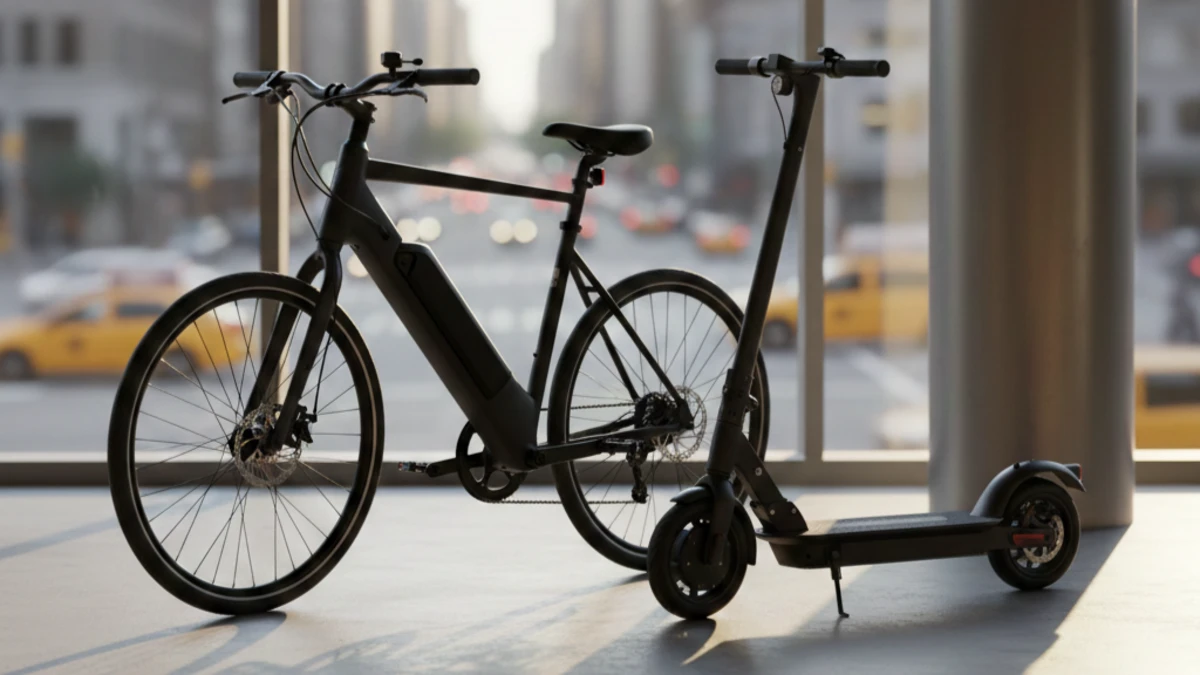
You’re staring at your car keys, thinking about another soul-crushing commute stuck in traffic. Or maybe you’re tired of the sweaty, exhausting bike ride to the office. Whatever your reason, you’ve decided it’s time to go electric for your daily commute—smart move. But here’s where it gets tricky: should you go with an e-bike or an electric scooter?
I’ve spent the last two years testing both options for my own 8-mile commute in Ohio, and I’ve talked to dozens of commuters who’ve made the switch. The answer isn’t as straightforward as “one is better than the other”—it really depends on your specific commute, storage situation, and what you value most. In this article, I’ll break down the real-world differences between e-bikes and electric scooters so you can make the choice that’ll actually work for your daily routine, not just look good on paper.
Here’s what we’ll cover: the practical differences in how they handle real commutes, the hidden costs and benefits of each, how weather and terrain affect your choice, and which one makes sense for different types of commuters.
Understanding the Fundamental Differences
Before we dive into the commuting specifics, let’s clarify what we’re actually comparing here.
Electric bikes are essentially traditional bicycles with an integrated motor and battery that provide pedal assistance. You’re still pedaling, but the motor amplifies your effort, making hills feel flat and longer distances effortless. Most e-bikes sold in the US are Class 1, 2, or 3, with top assisted speeds ranging from 20-28 mph. Think of it as a regular bike that turns you into a superhero cyclist.
Electric scooters (the stand-up kind, not mopeds) are motorized platforms with handlebars where you stand while riding. Modern commuter scooters can reach 15-30 mph depending on the model, and you’re not providing any human power—just balancing and steering. You’re essentially standing on a skateboard with a motor.
The key difference? One requires you to pedal (even with assistance), while the other does all the work. This seemingly simple distinction cascades into everything from how sweaty you’ll arrive at work to where you can legally ride.
The Real-World Commute Experience: What Nobody Tells You
Speed and Travel Time
Here’s where expectations often clash with reality. On paper, many e-bikes and scooters advertise similar top speeds around 20-25 mph. But your actual commute time depends on much more than maximum speed.
E-bikes consistently maintain higher average speeds on real commutes. Why? You can confidently take bike lanes, mixed-use paths, and even some roads where scooters feel sketchy. I average about 18 mph on my e-bike commute, including stops. Class 3 e-bikes (28 mph assisted) can keep pace with city traffic on many roads.
Electric scooters technically hit 20-25 mph on high-end models, but your real-world average drops to 12-15 mph once you factor in rougher surfaces, cautious cornering, and the fact that hitting a pothole at 25 mph on a scooter feels way scarier than on a bike. You’ll instinctively slow down more often.
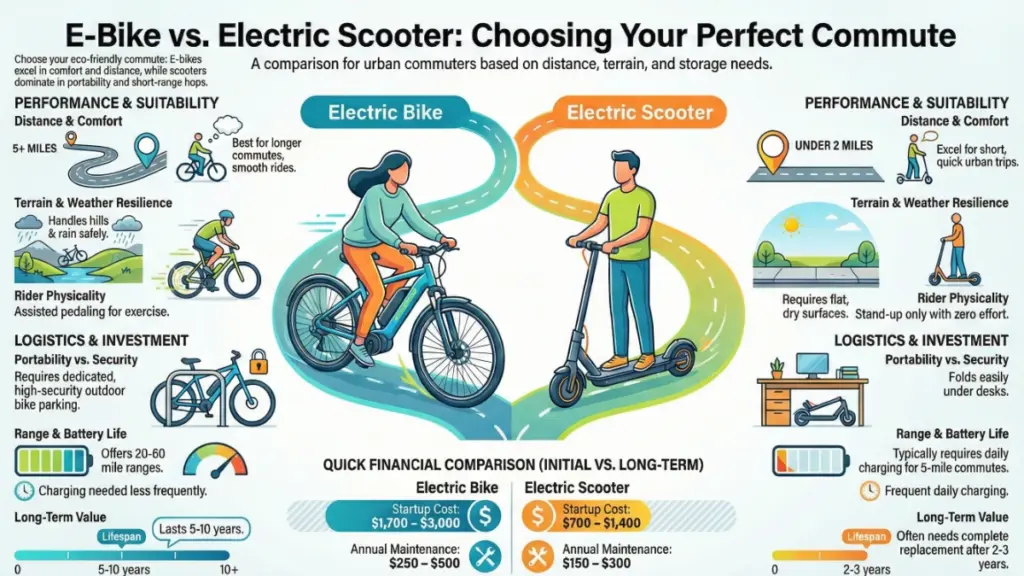
The verdict: For commutes over 3 miles, e-bikes typically save 5-10 minutes compared to scooters, even when top speeds are similar. For shorter urban commutes under 2 miles with lots of stop-and-go, scooters can actually be quicker thanks to their nimble maneuverability.
Comfort and Rider Fatigue
This is huge for your quality of life, yet it’s rarely discussed honestly.
E-bikes let you sit, which matters more than you think for rides over 20 minutes. Your legs share the load with the motor (you’re still pedaling, remember), which actually keeps your muscles engaged without exhausting you. Most people arrive feeling energized rather than drained. The bigger wheels (typically 26-28″) roll over bumps smoothly, and the bike geometry is designed for longer rides. On rough roads or gravel paths, you can stand on the pedals to absorb shock.
Electric scooters require you to stand the entire time. For a 10-minute ride, no problem. For a 30-minute commute? Your feet, calves, and lower back will remind you daily. The smaller wheels (8-10″ typically) transmit every crack, bump, and imperfection directly to your legs. Even scooters with suspension can’t match the comfort of sitting on a bike. I’ve yet to meet someone who commutes 45+ minutes on a scooter and doesn’t complain about fatigue.
Real talk: If your commute exceeds 25 minutes one-way, the comfort advantage of an e-bike becomes substantial. Your body will thank you after week two.
Weather Performance and All-Season Usability
Let’s address the elephant in the room: what happens when it rains?
E-bikes handle wet conditions significantly better. The larger wheels, lower center of gravity (you’re seated), and better weight distribution give you actual control in rain. Most e-bike motors and batteries are rated IPX5 or better—they’re designed to handle wet riding. I’ve ridden my e-bike through Ohio drizzle dozens of times without issue. Snow and ice? Still challenging, but doable with the right tires.
Electric scooters become legitimately dangerous in rain. The small, hard wheels lose traction easily. Your standing position means any slip instantly affects balance. Most scooter batteries are water-resistant, not waterproof—manufacturers explicitly warn against riding in rain. One colleague destroyed a $800 scooter by riding through a single heavy rainstorm.
The reality check: If you live somewhere with frequent rain (Seattle, Portland, much of the East Coast), an e-bike is the only practical year-round option. Scooters work best in dry climates like Southern California or Arizona.
Practical Considerations That Make or Break Your Decision
Portability and Storage
This is where scooters finally get their moment to shine.
Electric scooters are champions of portability. Most commuter models fold in 5-10 seconds and weigh 25-40 lbs—heavy for carrying far, but manageable for short distances. You can roll them into your office, store them under a desk, take them on the subway, or fit them in a car trunk. For urban commuters with no secure outdoor parking or who combine micromobility with public transit, this is game-changing.
E-bikes are, well, bike-sized. Even folding e-bikes weigh 45-70 lbs and don’t collapse as compactly. You need proper bike parking, and you can’t casually bring them into most offices. They also require more secure storage—e-bike theft is a real concern. You’ll need a serious U-lock ($60-100) and ideally an indoor or monitored parking spot.
Storage scenarios:
- Apartment with no bike room: Scooter wins
- Office with bike parking: E-bike is fine
- Need to take it on a bus/train: Scooter is far more practical
- Suburban home with garage: Either works
Range and Battery Anxiety
Both have batteries, but they behave very differently.
E-bikes typically offer 20-60 miles of range depending on assistance level, battery size (measured in watt-hours), terrain, and rider weight. A 500Wh battery on moderate assistance easily covers 30-40 miles. Because you’re pedaling, you can always limp home with a dead battery—you’ll just be on a heavy regular bike. Most commuters charge every 2-3 days for typical urban distances.
Electric scooters offer 15-40 miles on a full charge, but that drops quickly if you’re heavy, riding uphill, or going max speed. Unlike an e-bike, a dead scooter battery leaves you pushing or carrying a 30-lb awkward object. You’ll likely charge daily for commutes over 5 miles each way. Battery degradation is also faster on scooters due to higher discharge rates relative to battery size.
Range comparison for a 10-mile round-trip commute:
- E-bike: Charge every 3-4 days (30+ mile range typical)
- Scooter: Charge every 1-2 days (20-25 mile range typical)
Terrain and Hills: Where Physics Matters
Your commute’s topography might make this decision for you.
E-bikes demolish hills. A mid-drive motor e-bike (motor at the cranks, not the wheel) uses the bike’s gears to multiply torque, climbing 15-20% grades without breaking a sweat. Hub motor e-bikes (motor in the wheel) handle moderate hills well. I barely notice the 400-foot elevation gain on my commute route anymore.
Electric scooters struggle on anything steeper than a 10-15% grade. The motor works against gravity with no gearing advantage, draining battery fast and often slowing to 8-10 mph on climbs. Heavy riders on steep hills sometimes find scooters can’t even maintain speed. If your commute includes a serious hill, test ride a scooter on it before buying.
Terrain suitability:
- Flat urban/suburban: Both work great
- Moderate hills (5-10%): E-bike noticeably easier
- Steep hills (15%+): E-bike is the only practical choice
- Mixed surfaces (pavement + bike paths): E-bike handles variety better
The Money Question: Total Cost of Ownership
Upfront price is just the beginning. Let’s talk about what you’ll actually spend over two years.
Initial Investment
E-bikes range from $1,000 for basic models to $5,000+ for premium brands. A solid commuter e-bike costs $1,500-2,500. You’ll need to add:
- Quality U-lock: $80-120
- Lights (if not included): $40-80
- Fenders: $30-60
- Rear rack or panniers: $50-150
Total realistic startup cost: $1,700-3,000
Electric scooters range from $400 for basic models to $2,500 for premium. A reliable commuter scooter costs $600-1,200. Additional needs:
- Helmet (legally required in many places): $50-100
- Lock (lighter duty works): $30-50
- Visibility lights: $20-40
Total realistic startup cost: $700-1,400
Maintenance and Long-Term Costs
E-bikes require regular bike maintenance:
- Chain, cassette, brake pads: $100-200/year if you DIY, $200-400/year at a shop
- Tires: $60-120/year for regular replacement
- Battery replacement: $400-800 every 3-5 years (500-1,000 charge cycles)
- Annual tune-up: $75-150
Annual cost estimate: $250-500
Electric scooters have lower ongoing costs but higher replacement risk:
- Tire replacement: $40-100/year (more frequent than bikes)
- Brake pads: $30-60/year
- Battery replacement: $150-400 every 2-3 years (degrades faster)
- Miscellaneous parts: $50-100/year
Annual cost estimate: $150-300
The hidden factor: Scooters often need complete replacement after 2-3 years of daily commuting. E-bikes, properly maintained, last 5-10+ years. A $1,500 e-bike that lasts 7 years costs $214/year. A $800 scooter that lasts 2.5 years costs $320/year, plus you need to buy another one.
Savings vs. Driving
Both obliterate car costs. If you’re replacing a 15-mile round-trip car commute:
- Gas savings (at $3.50/gallon, 25 mpg): ~$150/month
- Parking savings (urban): $100-300/month
- Insurance/maintenance reduction: $50-100/month
Either option pays for itself in 6-18 months compared to driving. The e-bike vs scooter cost difference becomes negligible when compared to car savings.
Legal and Safety Realities You Need to Know
Where You Can Actually Ride
This trips people up constantly.
E-bikes (Class 1 and 2, under 20 mph) are legal on most bike lanes, multi-use paths, and roads in the US. Class 3 e-bikes (up to 28 mph) face some restrictions on paths but can use roads. State laws vary, but generally, e-bikes enjoy the same access as regular bikes. You can ride on:
- Bike lanes (all classes in most states)
- Multi-use trails (Class 1 and 2 typically; Class 3 varies)
- Roads (all classes)
- Some sidewalks where bikes are allowed (check local laws)
Electric scooters face a patchwork of confusing regulations. Legal status varies wildly by city and state. Many places classify them differently than bikes:
- Often banned from sidewalks
- Sometimes restricted from bike lanes (yes, really)
- Age restrictions common (16+ or 18+)
- Helmet laws more frequent than for bikes
- Some cities have outright bans
Real example: In New York City, e-bikes are legal and widely accepted. E-scooters were illegal until 2020 and still face restrictions. Know your local laws before buying.
Safety and Accident Risk
The statistics tell a concerning story for scooters.
E-bikes have injury rates similar to regular bikes. You’re seated, stable, have larger wheels, and better braking systems. Most accidents involve cars (emphasizing the importance of defensive riding) rather than solo falls. Serious injuries are relatively rare with proper helmet use and awareness.
Electric scooters show significantly higher injury rates per mile ridden according to multiple studies. Common injuries include:
- Wrist and arm fractures from falls
- Head injuries (even with helmets)
- Facial injuries
- Collarbone breaks
Why? The standing position, small wheels, and less stable platform make you more vulnerable. A 2019 JAMA study found scooter riders had a 40% injury rate during the study period—alarmingly high. The small wheels catch on road imperfections, and there’s no seated position to absorb impacts.
Safety edge: E-bikes, by a significant margin. If personal safety is a top priority, this factor alone might decide for you.
Who Should Choose What: Real Scenarios from Real Commuters
Let me introduce you to some composite profiles based on people I’ve talked to:
Choose an E-Bike If You:
“Sarah” – The Suburban Commuter
- 12-mile round trip with moderate hills
- Has garage storage at home, bike parking at work
- Commutes year-round in a variable climate
- Values comfort and doesn’t mind maintaining equipment
- Occasionally uses it for errands or weekend rides
Result: Sarah bought a $1,800 Class 3 e-bike and hasn’t regretted it once. She arrives un-sweaty, saves 30 minutes vs. driving in traffic, and the comfort means she actually looks forward to her commute. The 45-minute ride feels easy, and she’s using the bike for grocery runs too.
“Marcus” – The Fitness-Conscious Commuter
- Wants exercise but not exhaustion
- 8-mile commute with early morning meetings
- Prefers the engagement of pedaling
- Has storage space and secure parking
Result: Marcus chose an e-bike with adjustable assist levels. He uses higher assistance on the way to work (arriving fresh for meetings) and lower assistance on the way home (getting exercise without exhaustion). He’s lost 15 pounds in six months while never arriving sweaty.
Choose an Electric Scooter If You:
“Jamie” – The Urban Multi-Modal Commuter
- 2-mile scooter ride + 20-minute subway ride
- Lives in a small apartment (no bike storage)
- Works in an office with no bike parking
- Commutes in a dry climate with flat terrain
- Values portability above all else
Result: Jamie’s folding scooter lives under her desk at work and in her apartment closet at home. The portability changed her life—she went from walking 2 miles to the subway (30 minutes) to scooting there in 10 minutes. For her specific use case, an e-bike would have been impractical.
“Alex” – The Short-Distance Commuter
- 1.5-mile flat urban commute
- No secure outdoor parking available
- Wants minimal maintenance
- Quick trips, don’t need comfort for long rides
Result: Alex’s $650 scooter is perfect for quick trips. The short distance means standing isn’t uncomfortable, portability means theft isn’t a concern, and the lower investment made sense for the limited use case. An e-bike would have been overkill.
Making Your Decision: A Framework
Still not sure? Answer these questions honestly:
1. How long is your commute one-way?
- Under 2 miles: Scooter works great
- 2-5 miles: Either could work
- 5+ miles: E-bike strongly recommended
2. What’s your terrain like?
- Flat: Both work
- Moderate hills: E-bike better
- Steep hills: E-bike only
3. Where will you store it?
- Dedicated space at home and work: E-bike fine
- Need to bring it inside, no secure parking: Scooter
4. What’s your climate like?
- Dry and mild: Both work
- Frequent rain/cold: E-bike only practical option
5. Do you combine with public transit?
- Yes, regularly: Scooter’s portability wins
- No: E-bike’s comfort and capability better
6. What’s your budget?
- Under $1,000: Quality scooter easier to find
- $1,500-2,500: Sweet spot for quality e-bike
- $2,500+: Premium options for either
7. How important is comfort on longer rides?
- Very important: E-bike
- Not a priority (short rides): Scooter fine
The Bottom Line: What I’d Tell My Friend
If you forced me to make a blanket recommendation, I’d say this: for most commutes over 3 miles, especially in variable weather or hilly terrain, an e-bike is the better long-term investment. The comfort, safety, weather capability, and longevity advantages add up quickly. Yes, you’ll pay more upfront, but you’re buying something that’ll still work great in five years.
Electric scooters excel in specific scenarios: short urban commutes, multi-modal transit combinations, space-constrained living situations, and dry, flat climates. If your situation checks these boxes, a scooter’s portability and lower cost make perfect sense.
Here’s my honest take after two years of testing both: I use my e-bike for my daily 8-mile commute, and I don’t miss the scooter I tried for three months. The comfort difference on 30-40 minute rides is night-and-day. But my neighbor who scoots 1.5 miles to the train station every morning? His scooter is absolutely the right tool for his job.
The three questions that matter most:
- Is your commute over 4 miles one-way? → E-bike
- Do you desperately need portability? → Scooter
- Do you ride in frequent rain or serious hills? → E-bike
There’s no universally “best” choice—there’s only the best choice for your specific commute, storage situation, and priorities. Think honestly about your real-world needs, not idealized scenarios. Test ride both if possible. And whatever you choose, you’ll be making a smarter, healthier, and more economical choice than sitting in traffic.
Ready to make the switch? Start by measuring your exact commute distance, noting the terrain, and checking local regulations for both e-bikes and scooters. Visit local dealers to test ride options in your price range. And remember—the best electric commuter is the one you’ll actually use every day, not the one that looks coolest in your garage.