
Have you ever wished you could plan, book, and pay for your entire journey—bus, train, bike-share, and rideshare—all in one app? That’s exactly what Mobility as a Service promises to deliver. And if you’re wondering whether this concept is just another tech buzzword or a genuine revolution in how we get around, you’re in the right place.
Mobility as a Service (MaaS) is a digital platform that integrates various transportation options into a single, accessible service. Instead of juggling multiple apps, tickets, and payment methods, MaaS lets you seamlessly combine public transit, ride-hailing, bike rentals, car-sharing, and even electric scooters into one convenient journey—planned and paid for through a single interface.
In this article, you’ll discover what MaaS really means for everyday travelers, how it works in practice, why cities and transportation companies are betting big on it, and what challenges still stand in the way of widespread adoption. Whether you’re a daily commuter, a transportation enthusiast, or simply curious about the future of getting from A to B, understanding MaaS is essential in 2026.
What Exactly Is Mobility as a Service?
At its core, Mobility as a Service transforms transportation from something you own into something you access on demand. Think of it like this: streaming services like Netflix changed how we consume entertainment—we stopped buying individual DVDs and started subscribing to access vast libraries. MaaS does the same thing for transportation.
Instead of owning a car that sits idle 95% of the time (yes, that’s the actual average!), you access exactly the transportation you need, when you need it. Heading to work? Your MaaS app might suggest a combination of bike-share to the metro station, subway across town, then an electric scooter for the last mile. Running late? It’ll reroute you through a rideshare option instead.
The Key Components of MaaS
What makes a platform truly “MaaS”? Here are the essential ingredients:
- Integration: Multiple transportation modes unified in one platform
- Journey Planning: Real-time routing that combines different transport types
- Booking & Payment: Single transaction for multi-modal trips
- Personalization: Tailored options based on your preferences, budget, and schedule
- Subscription Models: Often includes monthly plans, similar to your phone bill
- Real-Time Information: Live updates on delays, availability, and alternatives
The magic happens when these elements work together seamlessly. You shouldn’t need to think about whether the bus accepts cash or if you have the right app for that bike-share system—the platform handles all of it.
How MaaS Works in the Real World
Let’s walk through a typical MaaS experience. Imagine you’re Sarah, living in Helsinki, Finland—one of the pioneering cities for MaaS implementation.
Monday Morning Commute: Sarah opens her Whim app (Finland’s leading MaaS platform) and enters her workplace as the destination. The app instantly shows her three route options:
- Fastest Route (28 minutes): City bike to tram stop → Tram Line 6 → 5-minute walk. Cost: Included in her €499/month unlimited subscription.
- Most Comfortable (35 minutes): Direct bus with guaranteed seating. Cost: Also included.
- Budget-Conscious (32 minutes): Walk to metro → Metro to workplace. Cost: Included.
She selects option one. The app unlocks a nearby city bike with a tap, provides turn-by-turn directions to the optimal tram stop, and even tells her the tram arrives in 4 minutes. When she boards, her subscription automatically validates her ride—no ticket needed.
Evening Plans: Sarah’s meeting runs late, and she’s meeting friends across town for dinner. She checks the app: the last convenient tram departed 3 minutes ago. No problem—the app suggests a rideshare that’ll arrive in 5 minutes. She taps “book,” and the ride is deducted from her monthly mobility budget. One app, one subscription, zero hassle.
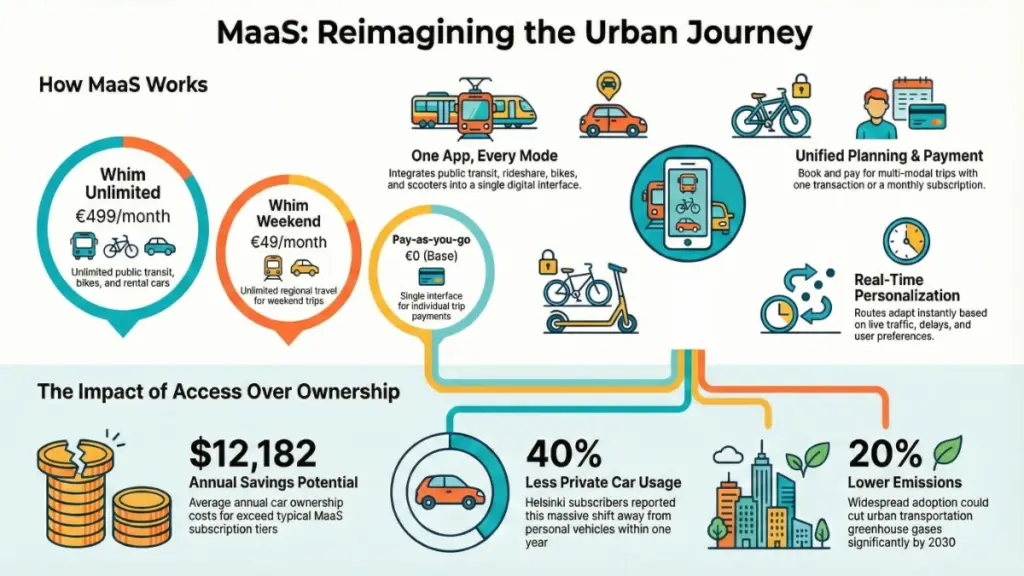
This isn’t science fiction. Helsinki’s Whim app serves over 200,000 users and reports that subscribers reduced their private car usage by 40% within the first year.
Why MaaS Matters: The Benefits
For Individual Users
Convenience That Changes Behavior The friction of using multiple transportation options—different apps, payment systems, timetables—often pushes people back to their cars. MaaS removes that friction entirely. Recent studies from the European MaaS Alliance show that cities with mature MaaS platforms see 20-35% increases in public transportation usage.
Real Cost Savings Consider this: AAA estimates the average cost of owning and operating a vehicle in the United States reached $12,182 per year in 2026. That includes car payments, insurance, fuel, maintenance, and parking. Many MaaS subscription models range from $100-500 monthly, offering unlimited or substantial mobility for a fraction of the cost.
Flexibility and Choice Not every trip requires the same solution. MaaS lets you optimize each journey individually—speed for work commutes, cost-effectiveness for weekend errands, comfort for evenings out. You’re not locked into one mode of transportation.
For Cities and Communities
Reduced Congestion and Emissions When MaaS works well, fewer people drive personal vehicles. Singapore’s MaaS initiatives contributed to a 10% reduction in private car usage in trial areas between 2022-2026, according to the Land Transport Authority. Fewer cars mean less traffic congestion, lower emissions, and cleaner air.
Better Land Use Cities dedicate enormous space to parking—some estimates suggest parking lots occupy 30% of urban land in American cities. Reduced car ownership means this valuable real estate can be repurposed for housing, parks, or businesses.
Inclusive Transportation MaaS platforms can improve access for people who can’t drive due to age, disability, or financial constraints. When designed thoughtfully, they democratize mobility in ways car-centric systems never could.
Data-Driven Planning MaaS platforms generate valuable anonymized data about how people actually move through cities. Transportation planners can use these insights to optimize routes, adjust service frequency, and identify underserved areas—making public transportation more efficient and responsive.
For the Environment
The transportation sector accounts for 27% of greenhouse gas emissions in the United States (EPA, 2026 data). Personal vehicles represent the largest chunk of that. MaaS encourages modal shifts toward:
- Electric public transit: Buses, trams, and trains with far lower per-passenger emissions
- Active transportation: Walking and cycling integrated into multi-modal journeys
- Shared mobility: Carpooling and vehicle sharing that reduce the total number of cars needed
- Optimized routing: AI-driven suggestions that minimize unnecessary trips and distances
A comprehensive study by the International Energy Agency found that widespread MaaS adoption in urban areas could reduce transportation emissions by 15-20% by 2030, assuming continued grid decarbonization.
Current MaaS Platforms and Real-World Examples
Leading MaaS Implementations (2026)
1. Whim (Finland) Launched in Helsinki in 2016, Whim remains the gold standard for MaaS. It offers several subscription tiers:
- Whim Unlimited: €499/month for unlimited access to public transport, city bikes, rental cars, and discounted taxis
- Whim Weekend: €49/month for unlimited weekend travel
- Pay-as-you-go: No subscription, but unified booking and payment
Key Success Factor: Close collaboration with Helsinki’s public transportation authority and regulatory flexibility.
2. Smile (Austria) Vienna’s Smile platform integrates the city’s excellent public transit system with car-sharing (e.g., ShareNow), bike-sharing, taxis, and e-scooters. Users praise its intuitive interface and seamless ticketing across all modes.
3. Citymapper Pass (UK) Available in London and other UK cities, Citymapper evolved from a journey-planning app into a full MaaS platform. It offers weekly mobility subscriptions that include public transport and partnered services.
4. Moovit (Global) While primarily known for transit planning, Moovit has expanded into MaaS territory in select cities, integrating scooters, bikes, and ride-hailing into its journey recommendations.
5. LA Metro Micro + TAP (United States) Los Angeles is testing MaaS approaches by connecting its TAP card system with on-demand micro-transit zones and bike-share networks. It’s early stages, but shows American cities are experimenting with the model.
Emerging Markets and Pilots
Singapore, Tokyo, Stockholm, and Barcelona all have active MaaS trials or deployments. Even smaller cities like Antwerp, Belgium, and Gothenburg, Sweden, are rolling out regional solutions. The global MaaS market is projected to 6).
The Challenges MaaS Still Faces
Despite its promise, MaaS isn’t expanding as quickly as early advocates hoped. Several stubborn barriers remain:
Fragmented Regulation and Governance
Transportation is often managed by multiple authorities—city transit agencies, regional rail operators, private ride-hailing companies, bike-share startups. Getting them all to share data, coordinate pricing, and integrate systems requires unprecedented cooperation. Regulatory frameworks often aren’t designed for multi-modal platforms, creating legal gray areas around liability, service standards, and data privacy.
Data Sharing Resistance
For MaaS to work seamlessly, operators must share real-time data—arrival times, vehicle availability, pricing. Some companies resist, viewing this data as proprietary or competitive advantage. Without comprehensive data integration, MaaS platforms offer incomplete information, undermining their core value proposition.
Business Model Uncertainty
Who pays for MaaS platforms? Subscription fees often don’t cover operational costs, especially in the early years. Do cities subsidize them as public goods? Do transportation operators contribute? Should advertising or data monetization (ethically managed) play a role? Sustainable business models remain elusive for most platforms outside of well-funded pilot programs.
Digital Divide Concerns
MaaS relies heavily on smartphones, internet access, and digital literacy. This can exclude elderly populations, low-income communities, or people without reliable internet. Cities must ensure alternative access methods exist—physical ticket options, customer service centers, simplified interfaces.
Infrastructure Gaps
MaaS only works if the underlying transportation infrastructure is robust. You can’t summon a bus that doesn’t exist. Many cities, particularly in the United States, have weak public transit networks, limited bike infrastructure, and sprawling designs that favor cars. MaaS can’t fix these fundamental gaps overnight.
Behavioral Inertia
Car ownership isn’t purely rational—it’s tied to identity, freedom, status, and habit. Convincing someone to give up their car requires more than just cost savings or convenience. It requires cultural shifts, which take time. Early MaaS adopters tend to be younger, urban, tech-savvy people already predisposed to multi-modal transportation.
The Future of MaaS: What’s Coming Next?
Integration with Autonomous Vehicles
Imagine MaaS platforms that can summon self-driving shuttles on demand, filling gaps in public transit coverage at lower costs than human-driven taxis. Several pilot programs are already testing this—most notably in Phoenix, Arizona, and parts of Singapore. By 2030, analysts predict 15-20% of MaaS journeys in advanced markets could involve autonomous vehicles.
AI-Powered Personalization
Future MaaS platforms will learn your preferences, schedule patterns, and tolerance for cost vs. speed. They’ll proactively suggest optimal routes, alert you to disruptions before you encounter them, and even predict your travel needs based on calendar entries or location history (with consent).
Hyperlocal Micro-Mobility
Electric bikes, scooters, and even personal electric vehicles (like OneWheels or e-skateboards) are becoming integrated into MaaS ecosystems. The “last mile” problem—getting from transit hubs to final destinations—is increasingly solved by these flexible, emissions-free options.
Subscription Bundling with Other Services
Why not bundle your mobility subscription with your streaming services, phone plan, or even grocery delivery? Some companies are exploring these “lifestyle bundles,” making mobility part of a broader subscription economy.
Carbon Tracking and Incentives
Expect MaaS apps to display the carbon footprint of each journey option, rewarding lower-emission choices with discounts or loyalty points. This gamification of sustainable behavior could accelerate adoption among environmentally conscious users.
Rural and Suburban MaaS
Most current MaaS platforms focus on dense urban areas. The next frontier is adapting the model for suburbs and rural communities, where transportation needs differ dramatically. This might involve more on-demand shuttles, carpooling coordination, and integration with traditional car ownership (your car becomes part of the network when you’re not using it).
Is MaaS Right for You?
Consider MaaS if you:
- Live or work in a city with reliable public transportation
- Value convenience and hate juggling multiple apps
- Want to reduce transportation costs
- Don’t need a car daily or are reconsidering car ownership
- Care about reducing your environmental impact
- Enjoy trying new technologies
MaaS might not fit if you:
- Live in a car-dependent suburb with limited transit
- Frequently need to transport large items or multiple passengers
- Require vehicle access at unpredictable hours
- Prioritize privacy and prefer not to share movement data
- Work in areas with poor connectivity or transportation deserts
The beauty of MaaS, though, is that it doesn’t have to be all-or-nothing. Many users maintain car ownership but use MaaS for daily commutes, saving money on parking, wear-and-tear, and stress. Others use it alongside cycling or carpooling.
Key Takeaways: MaaS in 2026
Here’s what you need to remember about Mobility as a Service:
1. MaaS is integration, not invention. It doesn’t create new transportation modes; it makes existing options easier to use together through seamless digital platforms.
2. Real-world examples prove the concept works. Cities like Helsinki, Vienna, and Singapore demonstrate that when regulation, technology, and infrastructure align, MaaS genuinely changes travel behavior.
3. Benefits extend beyond convenience. Cost savings, environmental impact, and improved urban livability are compelling reasons cities and users embrace MaaS.
4. Challenges are substantial but solvable. Regulatory cooperation, data sharing, and business model innovation are evolving, though progress varies dramatically by region.
5. The future is multimodal. Whether or not “MaaS” becomes a household term, the trend toward integrated, on-demand, sustainable transportation is undeniable and accelerating.
Ready to Experience MaaS?
If you live in or near a city with MaaS offerings, I encourage you to try it—even just for a week. Download Whim, Citymapper, Smile, or your local equivalent and plan a few trips. See how it feels to navigate your city without defaulting to your car keys.
For those in areas without mature MaaS platforms yet, stay tuned. The pace of adoption is quickening, and your city might be next. In the meantime, even small steps—using transit apps, trying bike-shares, combining modes manually—help you develop the habits that MaaS will eventually make effortless.
Mobility as a Service isn’t just about transportation—it’s about reimagining urban life with less congestion, cleaner air, and more freedom to move the way you want, when you want. And in 2026, that future is closer than you think.
What’s your experience with multi-modal transportation or MaaS platforms? Have questions about how MaaS might work in your city? The conversation about the future of mobility is just getting started.