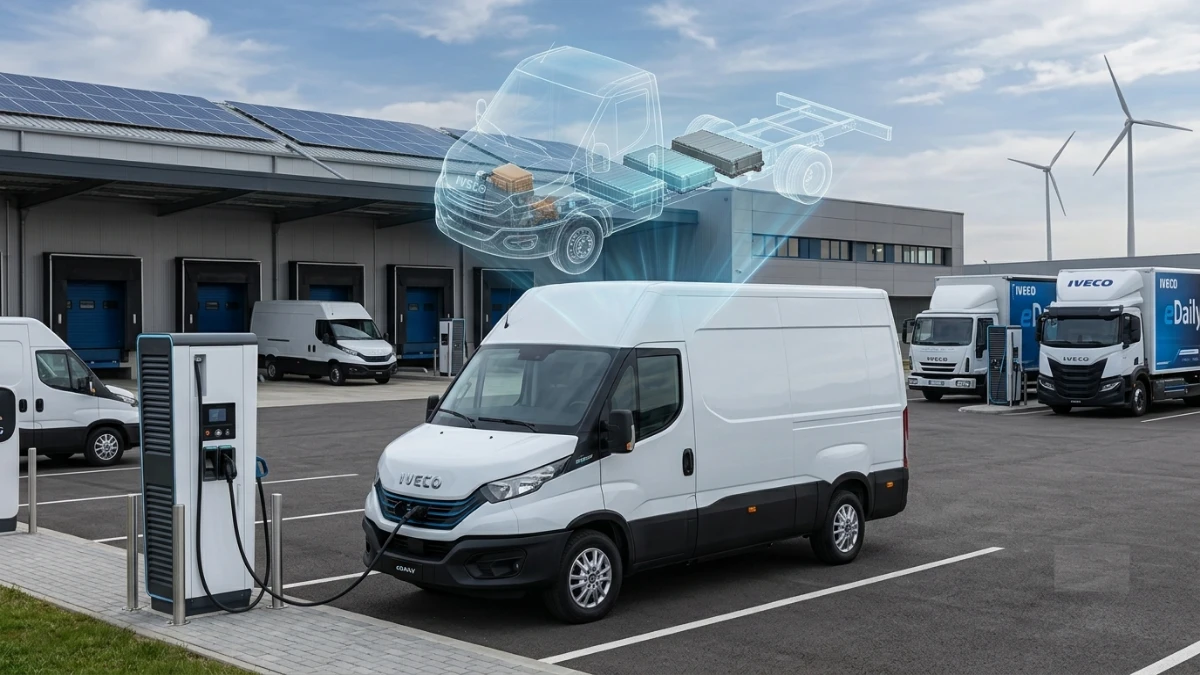
The Iveco Daily Electric (eDaily) stands out with its modular battery system, allowing businesses to add or remove battery packs as operational needs change. Offering up to 148kWh of capacity, strong payload and towing capabilities, and configurations ranging from panel vans to minibuses, it provides unmatched flexibility for commercial fleets. While not the outright range leader, its scalability and versatility make it a compelling choice for growing businesses.
If you run a fleet that needs to haul serious payload without burning diesel all day, you’ve probably already heard whispers about the Iveco Daily Electric — also badged the eDaily. Here’s the short answer: it’s the only large van on the market that lets you literally add or remove battery packs as your range needs change, and it can be built as anything from a compact panel van to a 22-seat minibus or a 7.2-tonne chassis cab.
I’ve spent years tracking electric van rollouts for fleet operators, and the eDaily keeps coming up in conversations because it solves a problem most electric vans ignore: not every route, and not every year of a business’s life, needs the same range. In this guide, I’ll walk you through how the battery system actually works, what range and charging look like in the real world, how it stacks up against rivals like the Ford E-Transit, and whether it’s the right call for your operation.
How the Modular Battery System Actually Works
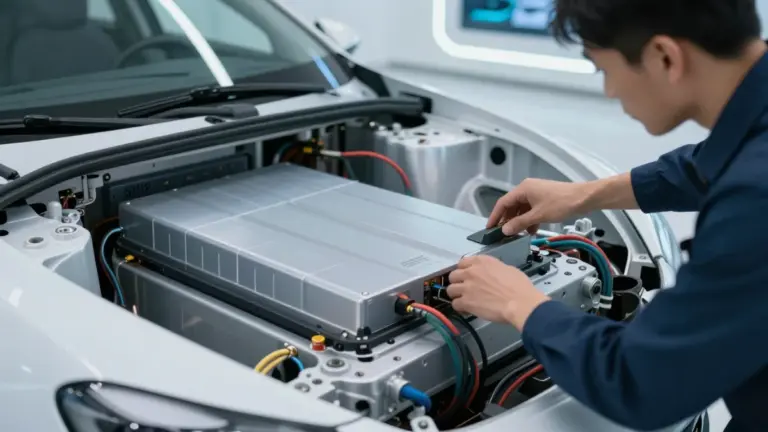
The headline feature of the Daily Electric is its battery architecture. Iveco built the chassis so it can physically accept between one and four battery modules, each rated at 37kWh. That means a dealer can start you off with a single battery for short urban runs, then bolt on additional modules later if your routes grow or your contracts change.
Here’s what that looks like in practice:
- One battery (37kWh): aimed squarely at short, local, multi-drop urban work
- Two batteries (74kWh): a middle-ground option for slightly longer routes
- Three batteries (111kWh): solid daily-use range for regional delivery
- Four batteries (148kWh): the long-range configuration, built for operators who can’t compromise on distance
This isn’t just a marketing gimmick — it changes the economics of buying an electric van. Instead of overpaying for range you’ll rarely use, or underbuying and hitting a wall in six months, you can scale the battery pack to match the job, and add capacity later rather than replacing the whole vehicle.
(Suggested image: a diagram showing the Daily’s chassis with battery modules slotted in different configurations.)
Range, Charging Speed, and Real-World Numbers
Range figures vary quite a bit depending on which source and test cycle you look at, and that’s worth understanding before you make a buying decision.
On the official WLTP urban cycle, Iveco quotes up to roughly 400km (about 249 miles) for the full four-battery, 148kWh configuration. Independent UK reviewers testing the van on the more demanding combined WLTP cycle report a more conservative — but still respectable — 186 miles from a three-battery setup, with the single-battery version limited to around 64–68 miles, which really only suits tight urban loops.
For a specific real-world example: the 14-seat minibus variant, built on a 74kWh pack, is rated at 280km WLTP but tends to deliver closer to 220km in daily operation — useful context for how much of a gap to expect between the sticker figure and what you’ll actually see on the road.
Charging speed is competitive but not class-leading:
- DC fast charging supports up to 115kW on the higher-capacity packs, recovering around 100km of range in about 20 minutes
- Some configurations top out closer to 80kW, adding roughly 62 miles in 30 minutes
- A full overnight charge on a 7.4kW–22kW depot wallbox is the standard approach for most fleet operators
If your routes involve multiple stops during the day, that DC fast-charging option matters more than the headline range number. A van that can top up 100km in 20 minutes while your driver takes a break is often more useful than one with a slightly bigger battery but slower charging.
(Suggested image: charging time comparison chart across battery configurations.)
How It Compares to Rival Electric Vans
Here’s where the eDaily needs to be honest with itself: it isn’t the range king. The Ford E-Transit, for instance, officially manages up to 196 miles — more than the eDaily’s three-battery configuration and within striking distance of its top-spec four-battery van.
| Model | Battery Options | Official Range | Fast Charging | Max GVW |
|---|---|---|---|---|
| Iveco Daily Electric (eDaily) | 37–148 kWh (modular) | Up to ~249 miles (WLTP urban) | Up to 115kW | 7.2 tonnes |
| Ford E-Transit | Fixed | Up to 196 miles | Up to 115kW | 4.25 tonnes |
| Renault Master E-Tech | Fixed | Varies by config | Moderate | 4.25 tonnes |
What the table doesn’t capture is scope. Most rivals cap out around 4.25 tonnes GVW. The Daily Electric goes all the way to 7.2 tonnes, and it’s available in body styles no other electric van maker currently matches — including a minibus with room for up to 22 passengers, tippers, and chassis cabs for specialist conversions. If your business needs something beyond a straightforward panel van, the eDaily is often the only electric option on the table at all.
Payload, Towing, and Practical Business Considerations
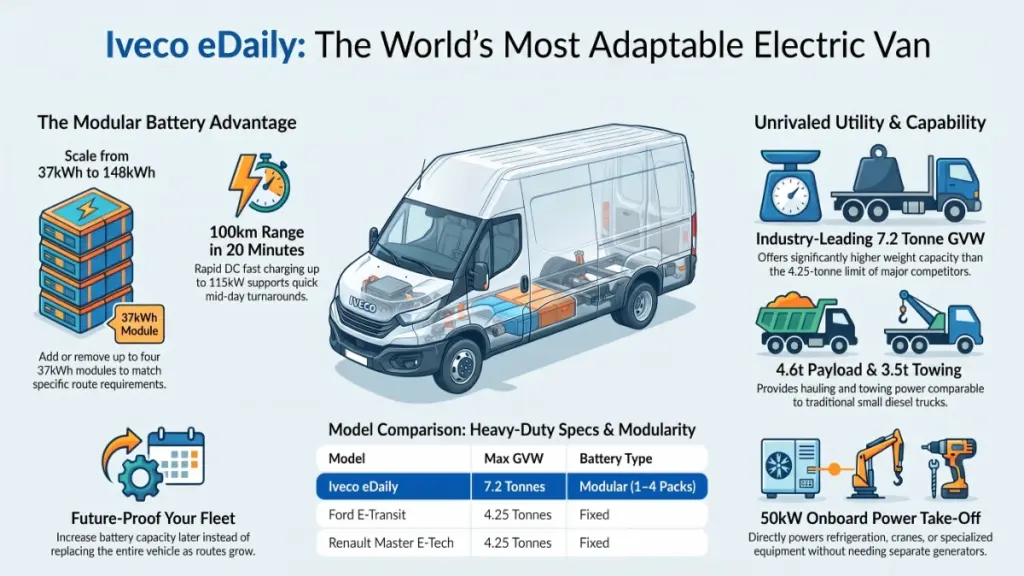
Payload capacity is where the Daily Electric earns its keep. At the top end, it offers up to a 4.6-tonne payload and 3.5-tonne towing capacity — figures that put it closer to a small electric truck than a delivery van.
A few practical points worth knowing before you commit:
- You’ll need a Category C1 licence for any Daily Electric configuration exceeding 4.25 tonnes GVW, which is a step up from the standard car licence that covers most electric vans
- Battery packs can be added or removed by an Iveco dealer rather than requiring a full vehicle swap, which is useful if your contract volumes change seasonally
- Iveco backs the battery with an 8-year or 250,000km warranty, whichever comes first, with replacement guaranteed if degradation passes 20%
- The eDaily also offers up to 50kW of electric power take-off, letting it run refrigeration units, cranes, or other equipment directly from the battery — a genuinely useful feature for specialist bodies that diesel-only rivals can’t easily replicate
If your fleet includes reefer vans, tippers, or crew vans, that power take-off capability alone might tip the decision in the eDaily’s favor, since running auxiliary equipment off a separate generator adds cost and complexity that most competitors haven’t solved as cleanly.
Is the Iveco Daily Electric Right for Your Fleet?
So, should you actually buy one? It depends on what “one van” means for your business, because the Daily Electric isn’t really one van — it’s a platform you configure.
Choose it if:
- You need a body style beyond a standard panel van (minibus, tipper, chassis cab, crew van)
- Your GVW needs exceed 4.25 tonnes
- You want the flexibility to add range later rather than committing to a fixed battery size upfront
- You run auxiliary equipment that benefits from onboard power take-off
Look elsewhere if:
- Maximum range in a single fixed configuration is your top priority (the Ford E-Transit edges it out here)
- You’re running a standard 3.5-tonne panel van fleet where fixed-battery rivals may be simpler and cheaper
- Fast-charging infrastructure near your depot tops out below 80kW, which will blunt the eDaily’s charging advantage
Key Takeaways
- The Daily Electric’s modular battery system (one to four 37kWh packs) is genuinely unique in the large-van segment, letting you scale range to match your routes
- Real-world range runs from roughly 64 miles on a single battery to around 186–249 miles on the full four-battery setup, depending on test cycle and conditions
- DC fast charging up to 115kW can add real-world usable range in under 30 minutes
- It’s the widest-ranging electric van by body style and GVW, stretching to 7.2 tonnes and body types no rival currently offers electrically
- It isn’t the outright range leader, so cross-shop against the Ford E-Transit if raw distance is your only concern
If you’re weighing this against other options, the smartest move is to map out your actual daily routes first, then work backward to the battery configuration that covers them with a comfortable margin — rather than defaulting to the biggest (and most expensive) pack available.
Roy K. Miller is an EV expert focused on electric mobility, green technology, and the future of transportation, helping drivers and fleet operators make smarter, better-informed choices.