Electric vehicles have become a practical option for most drivers in 2025, thanks to improved range, expanding charging networks, and more affordable models. Buyers should focus on real-world range, charging access, ownership costs, and vehicle type. Popular options like the Tesla Model Y, Hyundai Ioniq 5, and Chevy Equinox EV offer strong value, while lower fuel and maintenance costs help offset higher upfront prices.
Everything You Need to Know Before Buying an Electric Vehicle in 2025
The EV market is more crowded, more affordable, and more complicated than ever. Here’s a plain-English breakdown of what actually matters — from range and charging to real-world cost savings.
If you’ve been on the fence about electric vehicles, 2025 is the year the conversation gets serious. Not because of hype — but because the math is finally starting to work for ordinary drivers. You can walk into a dealership today and choose from over 113 EV models across cars, pickups, and SUVs, with a growing number starting below $40,000. That’s a universe away from 2015, when your options were basically a Tesla you couldn’t afford or a Nissan Leaf that made you nervous on anything longer than a grocery run.
So what should you actually know before you buy? In this guide, I’ll walk you through the real state of the EV market — the range improvements, the charging infrastructure, the honest costs, and the models worth your attention. Whether you’re a first-time buyer or someone upgrading from an older EV, there’s something here for you.
Quick Answer
Electric vehicles are now a practical choice for most American drivers. With the average US commute sitting around 16 miles per day, even a modestly priced EV with 220–250 miles of range has more than enough headroom. The bigger questions to answer are: where will you charge, and which body style fits your life?
The State of the EV Market in 2025
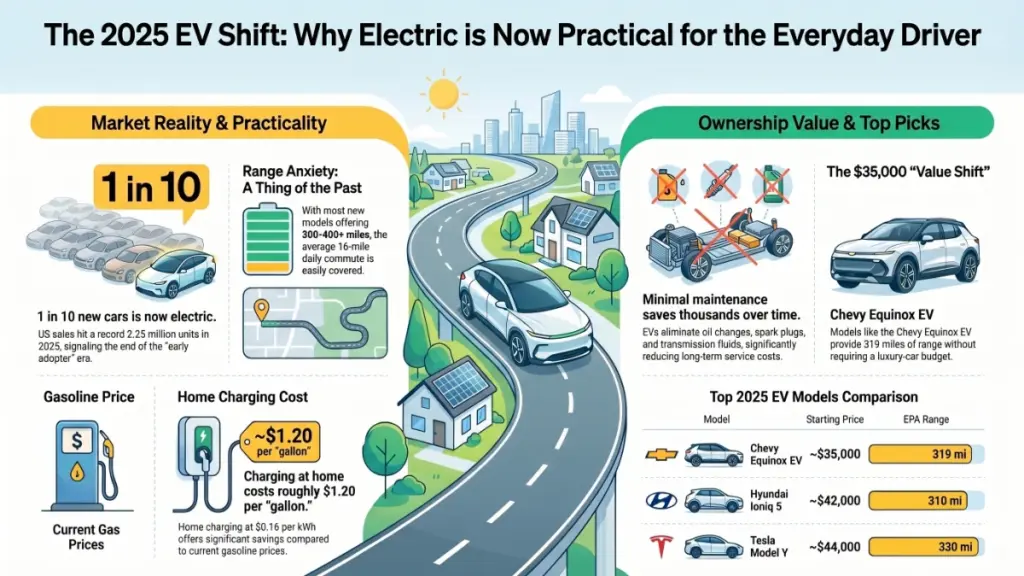
Let’s start with the big picture. The US EV market reached a record 1.52 million vehicles sold in 2024 — about 8% of all new light-duty vehicle sales, up from just 4.6% in 2021. By the end of 2025, projections pointed toward roughly 2.25 million sales, representing around 9% of the market. That’s not a revolution yet, but it’s well past the “early adopter” stage.
What changed? Mostly this: the model selection exploded. Back in 2015, there were 19 car EVs and zero electric pickups on the US market. Today, there are 28 car models, 6 pickup trucks, and 79 electric SUVs. That last number is the real story. American buyers love SUVs, and automakers finally noticed. The result is that compact and midsize electric crossovers now drive the bulk of US EV sales.
That said, 2025 has also brought some turbulence. The federal EV tax credit expired in September 2025, and quarterly sales dipped noticeably in Q4 as a result. It’s a reminder that policy matters — but it also means that if you’re shopping now, you may find better negotiating power on certain models as dealers work through inventory. Every cloud, right?
“Roughly 1 in 10 new vehicles sold in the US is now electric — still a minority, but no longer niche.”— Current market data, mid-2025
Who’s Selling What
Tesla still dominates with about 45–49% of all US EV sales, though that share has been slowly declining as competition heats up. General Motors has surged into a strong second place with brands like Chevy and Cadillac. Hyundai Motor Group — combining Hyundai and Kia — has been a consistent standout for value and technology. Ford, after some stumbles, has pulled back its all-electric ambitions somewhat, but the Mustang Mach-E soldiers on as a solid option.
Real-World Range: What the Numbers Actually Mean
Range anxiety is real, but it’s also a bit overblown in 2025. The EPA range figures you see on a window sticker are a reasonable real-world estimate for mixed city and highway driving at moderate temperatures. The best-performing models today offer 300–400+ miles of range in at least one trim level. For most drivers, that’s more than enough to go a week between charges if you’re plugging in at home each night.
A few things do eat into range, and you deserve a straight answer about them.
Real-World Range Factors
- Cold weather: Battery range can drop in extreme cold — but a 2025 report found even the worst-performing models still retain over 60% of their range. The best only lost about 14%. Improvement is real.
- Highway driving: Unlike gas cars, EVs are often more efficient in stop-and-go city driving (where regenerative braking kicks in) and less efficient at sustained 75+ mph highway speeds.
- Towing: Towing a trailer can cut your range dramatically — sometimes in half. If you tow frequently, factor this in heavily.
- Climate control: Running the heater in winter is harder on range than air conditioning in summer. A heat pump (standard on many 2024–2025 models) helps significantly.
The bottom line: if your daily commute is under 50 miles and you can charge at home, range is almost never going to be your problem. If you regularly drive 200+ miles in a single stretch, you’ll want a car with fast-charging capability and a solid network behind it — more on that in the charging section below.
Top Electric Vehicles Worth Considering in 2025
The market has matured enough that there are genuinely excellent choices at almost every price point. Here’s an honest look at the standouts, organized by what kind of buyer you are.
| Model | Starting Price | EPA Range | Best For | Verdict |
|---|---|---|---|---|
| Tesla Model Y | ~$44,000 | 330 mi | Everyday family SUV | Top Pick |
| Hyundai Ioniq 5 | ~$42,000 | 266–310 mi | Tech-forward buyers | Excellent |
| Kia EV6 | ~$43,000 | 310 mi | Sporty daily driver | Excellent |
| Kia EV9 | ~$55,000 | 304 mi | 3-row family hauler | Best in Class |
| Chevy Equinox EV | ~$35,000 | 319 mi | Value-focused buyers | Best Value |
| Tesla Model 3 | ~$40,000 | 358 mi | Efficiency-first sedan | Top Pick |
| Ford Mustang Mach-E | ~$42,000 | 260–312 mi | Ford loyalists | Solid Choice |
| Nissan Leaf (2025) | ~$29,000 | 212 mi | Urban/budget buyers | City Commuter |
| Lucid Air Pure | ~$70,000 | 410+ mi | Long-haul, luxury | Range King |
A quick note on that Chevy Equinox EV: at around $35,000 with nearly 320 miles of range, it’s reshaping the value equation for mainstream buyers. You no longer have to spend $50,000+ to get a capable, comfortable electric SUV. That’s a real shift from even two years ago.
Charging at Home and on the Road
Here’s what I tell anyone who asks me about EVs: charging at home is the game-changer. If you have a garage or driveway, you can plug in every night and wake up to a “full tank” every morning. That experience — never stopping at a gas station during your normal week — is the thing that converts skeptics into believers faster than any spec sheet.
Home Charging Options
Most EVs ship with a Level 1 charger (standard 120V household outlet). It’s slow — roughly 3–5 miles of range per hour — but perfectly fine if you’re only driving 40–50 miles a day. For faster results, a Level 2 charger (240V, like your dryer outlet) adds 20–30 miles per hour. A typical home installation runs $800–$1,500 including equipment and electrician fees, though many utilities offer rebates.
Public Fast Charging
The public charging story has improved dramatically. DC fast chargers (Level 3) can add 100–200 miles of range in about 20–30 minutes. Tesla’s Supercharger network — long the gold standard — has opened to most non-Tesla EVs through the NACS connector standard. More 2025 models now include NACS from the factory, which matters a lot for road trip reliability.
The federal government committed $7.5 billion to deploy 500,000 public chargers by 2030. That build-out is ongoing, and while rural areas still have gaps, major highway corridors now have dense fast-charging coverage near restaurants and shopping centers. A cross-country drive is genuinely feasible in 2025 — it just requires a little more planning than a gas car.
“DC fast charging at highway corridors typically adds an 80% charge in about 30 minutes — enough time for a coffee stop.”— Coltura EV Range Report, 2025
The True Cost of Owning an Electric Vehicle
Sticker price is only part of the story. EVs typically cost more upfront than comparable gas cars, but they tend to cost less to run and maintain. Over a five-year ownership window, many EV buyers come out ahead — especially if they charge primarily at home.
Fuel Savings
Charging at home at a national average of around $0.16 per kWh, a typical EV driver pays the equivalent of about $1.00–$1.20 per “gallon” of electricity. Compare that to $3.00–$4.00 for gasoline, and the savings add up quickly. Someone driving 15,000 miles per year can reasonably expect to save $1,200–$1,800 annually in fuel costs alone.
Maintenance
This is where EVs quietly shine. No oil changes, no spark plugs, no transmission fluid, no timing belts. Brake pads even last longer thanks to regenerative braking. Consumer Reports data consistently shows EVs have lower maintenance costs than gas vehicles after the first few years. The main wild card is battery health over time — something to evaluate carefully on used models.
The Tax Credit Situation
The federal EV tax credit of up to $7,500 expired in September 2025, which has complicated the buying math for many shoppers. Some states still offer credits — notably California, Colorado, and several Northeast states — and utility companies often have their own incentives for home charger installation. It’s worth doing a zip-code-specific search before you assume you’re getting no help on price.
Advantages
- Lower fuel costs vs. gasoline (often 60–70% less)
- Minimal scheduled maintenance
- Smooth, quiet driving experience
- Instant torque — genuinely fun to drive
- Home charging convenience
- Growing model variety at all price points
Trade-offs to Consider
- Higher upfront purchase price vs. gas equivalents
- Charging time longer than filling a gas tank
- Range can drop in extreme cold
- Public charging network still uneven in rural areas
- Federal tax credit currently expired
- Battery replacement cost if needed out-of-warranty
What’s Coming Next: The Road Ahead for EVs
Even with some headwinds — the expired tax credit, policy uncertainty, a 4% dip in pure BEV sales in 2025 — the trajectory for electric vehicles remains firmly upward. The IEA expects EVs to reach 20% of light-duty vehicle sales by 2030. Battery technology is advancing steadily, and solid-state batteries — lighter, faster-charging, longer-lasting — are moving from labs toward commercial production in the next few years.
One trend worth watching: the convergence on the NACS charging standard. With most major automakers now adopting Tesla’s connector for 2025 and 2026 models, the fragmented charging experience is slowly unifying. That’s huge for cross-brand road trip viability.
Prices are also trending in the right direction. The average new EV transaction price has been falling as competition intensifies and manufacturing scales up. The Chevy Equinox EV at $35,000 and the Nissan Leaf under $30,000 signal where the mainstream market is heading: capable EVs that don’t require luxury-car budgets.
Key Takeaways
If you’ve made it this far, here’s what I’d want you to walk away with:
- Electric vehicles are a practical choice for most US drivers in 2025 — the range, charging infrastructure, and model variety are all at viable points.
- Home charging transforms the experience. If you can charge overnight, range anxiety largely disappears for everyday driving.
- The sweet spot for value right now sits between $35,000 and $50,000 — where models like the Chevy Equinox EV, Hyundai Ioniq 5, and Tesla Model Y offer strong range, reliability, and real-world usability.
- Total cost of ownership often favors EVs over 5+ years, even with higher upfront prices, thanks to fuel and maintenance savings.
- Federal tax credits have expired for now — but state and utility incentives still exist, and used EV prices have created new value opportunities.
The best first step? Figure out your daily driving habits, check whether your home allows a Level 2 charger, and test drive two or three models in your budget. The driving experience tends to close the deal — and it’s hard to go back to a gas car after your first week of waking up to a full charge every morning.