You’re standing in a parking lot, your new electric car’s battery gauge nudging toward empty, and you’re staring at a charging station that won’t accept your payment card. Sound like a nightmare? It shouldn’t be—but if you’ve ever felt confused about which charging networks to trust, you’re not alone. The truth is, picking the right charging network can make the difference between a seamless road trip and a stressful scramble for electrons.
When I first made the switch to electric, I thought all charging stations were created equal. Spoiler alert: they’re not. Some networks blanket the highways like coffee shops, while others are harder to find than a parking spot at the mall on Black Friday. And don’t even get me started on the pricing models—some charge by the minute, others by the kilowatt-hour, and a few throw in membership fees just to keep things interesting.
Let’s cut through the confusion together. In this guide, I’ll walk you through the major electric car charging networks you need to know, what makes each one tick, and how to choose the stations that’ll keep you powered up without draining your wallet. Whether you’re planning your first EV road trip or just tired of playing charging station roulette, this comparison will help you charge smarter.
Understanding the Charging Landscape: What You Need to Know First
Before we dive into specific networks, let’s get one thing straight: not all EV charging is the same speed. You’ve got three main levels to wrap your head around.
Level 2 charging is what you’ll find at most public parking lots, workplaces, and home installations. Think of it like filling your car with a garden hose—it works great overnight or during a long shopping trip, adding about 25-30 miles of range per hour. These are perfect for topping off while you’re doing other things.
DC fast charging (also called Level 3) is the fire hose. These stations can add 100-200 miles of range in just 20-30 minutes, making them ideal for road trips and quick pit stops. This is where network choice really matters, because you’ll be using these when you’re in a hurry and far from home.
Now, here’s where it gets interesting: most charging networks offer both types, but their coverage and reliability vary wildly. Let’s break down your options.
Tesla Supercharger Network: The Gold Standard (With a Catch)
If you drive a Tesla, congratulations—you’ve got access to the most extensive and reliable fast-charging network in North America. The Supercharger network boasts over 50,000 connectors across the continent, strategically placed along major highways and near amenities like restaurants and shopping centers.
What makes Superchargers special? Speed and simplicity. Most stations deliver 150-250 kW of power, meaning you can add 200 miles of range in about 15 minutes. The payment system is seamlessly integrated into your Tesla account—you just plug in and walk away. No fumbling with apps or credit cards.
The pricing varies by location but typically runs between $0.25 to $0.50 per kWh, with some peak-time surcharges. That translates to roughly $10-15 for a typical road trip charging session. Tesla also offers membership plans that can reduce costs for frequent travelers.
But here’s the catch: until recently, Superchargers were Tesla-exclusive. The good news? Tesla began opening select stations to non-Tesla EVs in 2024, though you’ll need an adapter and the Tesla app. Coverage for non-Tesla vehicles is still limited compared to what Tesla owners enjoy, but it’s expanding.
Best for: Tesla owners and (increasingly) non-Tesla drivers willing to use adapters for premium charging experience.
Electrify America: The Fast-Growing Challenger
If you’re driving anything other than a Tesla, Electrify America is probably your best friend. Born from Volkswagen’s emissions scandal settlement (every cloud has a silver lining, right?), this network has grown into the largest open DC fast-charging network in the U.S., with over 950 stations and 4,000+ chargers.
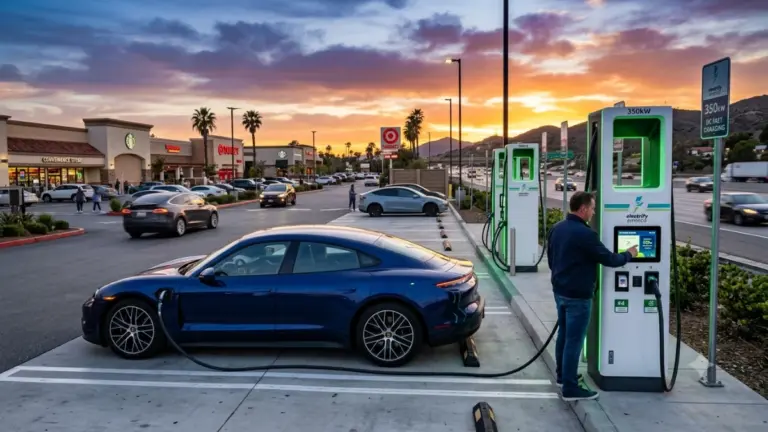
What I appreciate about Electrify America is their commitment to high-powered charging. Most stations offer 150 kW chargers, with many locations featuring ultra-fast 350 kW chargers that can handle the newest EVs capable of accepting that much power. For vehicles like the Hyundai Ioniq 5 or Porsche Taycan, that means seriously quick charging times.
Coverage is solid along major interstates and in urban areas, though you’ll find fewer stations in rural regions. The network has been expanding rapidly, particularly in California, Texas, and along the East Coast corridor.
Pricing structure: Electrify America offers both pay-as-you-go and membership options. Without a membership, you’ll pay around $0.43-$0.48 per kWh (prices vary by state). Sign up for the Pass+ membership ($4/month or $7/month depending on plan), and you’ll get reduced per-kWh rates. Many new EV purchases include complimentary Electrify America charging sessions for the first few years—check if your car qualifies.
The reliability has improved significantly over the past couple years, though some stations still experience occasional downtime. The app is user-friendly and shows real-time station availability, which I’ve found essential for trip planning.
Best for: Non-Tesla EV owners who frequently travel and want access to high-speed charging on major routes.
EVgo: The Urban Champion
EVgo takes a different approach—instead of focusing primarily on highway corridors, they’ve built out an impressive network of over 900 locations concentrated in metropolitan areas. Think grocery stores, shopping malls, and downtown parking garages. If you’re a city dweller who occasionally needs a quick charge, EVgo might be your go-to network.
Most EVgo stations offer 50-100 kW charging speeds, with newer locations featuring 350 kW chargers. That’s fast enough for a meaningful charge while you grab lunch or run errands. The network spans 34 states, with strong coverage in California, Texas, Florida, and the Northeast.
Here’s where EVgo gets interesting for budget-conscious drivers: they offer flexible membership tiers. The basic (free) membership charges around $0.37-$0.40 per minute for fast charging, depending on your location and charger speed. Upgrade to a paid membership ($6.99-$12.99/month), and you’ll unlock lower per-minute rates that can save you money if you charge regularly.
One quirk: EVgo uses per-minute pricing rather than per-kWh in some states due to regulatory requirements. This means your cost depends on how fast your specific vehicle charges, which can make budgeting trickier.
Best for: Urban and suburban drivers who need convenient top-ups during daily activities.
ChargePoint: The Everywhere Network
With over 30,000 charging stations across North America, ChargePoint is the largest overall charging network—though most of these are Level 2 chargers rather than DC fast chargers. Think of ChargePoint as the Swiss Army knife of charging networks: they’re everywhere, they work with virtually every EV, and they’re particularly common at workplaces, hotels, and retail locations.
Here’s what makes ChargePoint unique: they don’t own most of their stations. Instead, they provide the hardware and software platform that businesses and property owners use to install and manage charging stations. This means pricing varies wildly—some ChargePoint stations are completely free (usually at shopping centers trying to attract customers), while others charge competitive rates set by the property owner.
For DC fast charging, ChargePoint has been expanding their Express network, though it’s still smaller than Electrify America or Tesla’s Supercharger network. Charging speeds range from 50 kW to 500 kW at their newest stations.
The ChargePoint app is excellent, offering station availability, pricing information, and the ability to reserve certain chargers in advance. You can start charging sessions right from the app or use an RFID card.
Best for: Drivers who want maximum flexibility and those who primarily charge at destinations rather than on highways.
Smaller Networks Worth Knowing
Don’t sleep on these regional players—they might surprise you:
Blink Charging operates over 3,000 stations, primarily on the East and West coasts. Their pricing tends to be higher ($0.49-$0.59 per kWh), but they often pop up in useful locations like airports and downtown areas where alternatives are scarce.
Francis Energy is making waves in the Midwest and South with a growing network of 150-350 kW chargers. Their per-kWh pricing is competitive, and reliability reports have been positive. If you’re traveling through states like Missouri, Oklahoma, or Kansas, keep them on your radar.
Shell Recharge (formerly Greenlots) is Shell’s entry into EV charging. With a major oil company backing them, expect continued expansion, particularly at existing Shell gas station locations. They’re still building out, but their stations are typically well-maintained and conveniently located.
Making Your Charging Strategy Work: Practical Tips
Here’s what I’ve learned from thousands of miles of electric driving: success comes from using multiple networks strategically, not pledging allegiance to just one.
For road trips, prioritize networks with reliable fast chargers along your route. Tools like A Better Route Planner (ABRP) or PlugShare can show you exactly which networks cover your journey. I typically plan trips using Tesla Superchargers or Electrify America as my primary stops, with ChargePoint or EVgo as backups.
For daily driving, focus on networks with good coverage near places you already spend time. A Level 2 ChargePoint station at your gym or grocery store might be more valuable than the fastest DC charger across town.
Membership math matters. Do the calculation: if you’re spending $40+ per month on charging from a specific network, their paid membership probably pays for itself through reduced rates. But don’t buy memberships to networks you rarely use just because they’re available.
Download multiple apps before you need them. Nothing’s worse than arriving at a station, discovering you need a different app, and watching your phone struggle with a weak signal. I keep ChargePoint, Electrify America, EVgo, and the Tesla app on my phone, even though I don’t use all of them regularly.
The Future of Charging Networks: What’s Coming
The charging landscape is evolving faster than you might think. Tesla’s Supercharger network continues opening to more non-Tesla vehicles, potentially becoming the universal standard. Major automakers like Ford, GM, and Rivian have announced they’re adopting Tesla’s charging connector (called NACS) for future vehicles, which will give their customers native Supercharger access.
Meanwhile, traditional networks are fighting back with upgraded infrastructure and better reliability. Electrify America recently announced a $450 million investment to overhaul older stations and add new sites. ChargePoint is expanding their Express DC fast-charging network aggressively.
The federal government is also stepping in. The National Electric Vehicle Infrastructure (NEVI) program is funding charging stations along designated corridors across all 50 states, with requirements for reliability and uptime. This should help fill coverage gaps in currently underserved regions.
Your Charging Network Game Plan
So, which network should you choose? Honestly, the best approach is choosing multiple networks rather than betting everything on one. Here’s my recommendation for building your charging strategy:
If you drive a Tesla: Use Superchargers as your primary network, but add ChargePoint for destination charging and consider Electrify America as a backup when Superchargers are unavailable or crowded.
If you drive any other EV: Make Electrify America your highway fast-charging backbone, sign up for ChargePoint to access the widest variety of locations, and add EVgo if you live or work in a city where they have strong coverage.
For everyone: Download PlugShare, an app that aggregates stations from all networks and includes user reviews and real-time updates. It’s like Yelp for EV charging and has saved me countless times when my primary network was down or overcrowded.
The bottom line? The “best” charging network depends on where you drive, how often you road trip, and which EVs you own. The good news is that coverage is improving rapidly, prices are stabilizing, and reliability is getting better across the board.
Charging your EV doesn’t have to be complicated. With a little planning and the right apps on your phone, you’ll quickly develop your own favorite spots and backup options. Before long, you’ll be charging as confidently as you used to fill up with gas—maybe even more so, since you can now charge while shopping, eating, or catching up on emails.
Welcome to the electric future. It’s charged with possibilities.