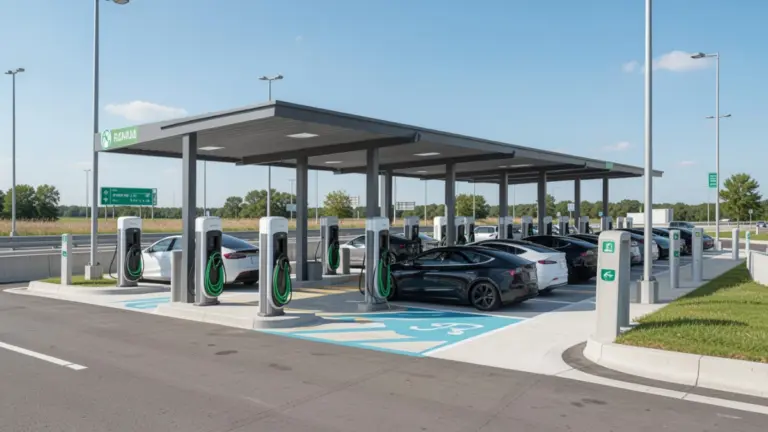

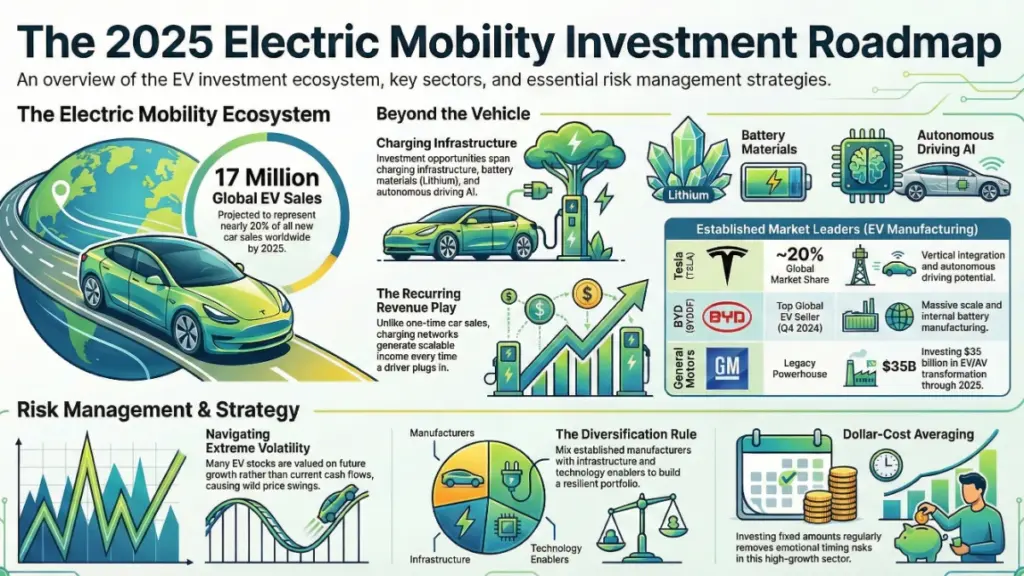
The electric vehicle revolution isn’t just changing how we drive—it’s creating one of the most dynamic investment opportunities of our generation. In 2025, global EV sales are projected to surpass 17 million units, representing nearly 20% of all new car sales worldwide. However, here’s the thing: investing in electric mobility goes far beyond just buying Tesla stock.
If you’re wondering whether electric mobility stocks deserve a place in your portfolio, you’re asking the right question at the right time. This sector offers tremendous growth potential, but it’s also marked by volatility, intense competition, and rapid technological change. Throughout this guide, I’ll walk you through everything you need to know—from understanding the different investment categories to identifying promising opportunities and managing risk effectively.
What you’ll learn:
- The major sectors within electric mobility and their investment potential
- Top stocks and emerging players to watch in 2025
- Key risk factors and how to navigate market volatility
- Practical strategies for building a diversified EV investment portfolio
- Expert insights on timing and long-term trends
Whether you’re a seasoned investor or just starting to explore this space, you’ll come away with a clear understanding of where the opportunities lie and how to approach them strategically.
Understanding the Electric Mobility Investment Landscape
Electric mobility isn’t a single industry—it’s an entire ecosystem of interconnected sectors, each with distinct investment characteristics and growth drivers. Therefore, let’s break down the main categories so you can better understand where to focus your attention.
Electric Vehicle Manufacturers: The Front Line of the Revolution
This is what most people think of first, and for good reason. Consequently, EV manufacturers represent the most visible and often most volatile segment of the market. You’ve got established players like Tesla (TSLA), BYD (BYDDF), and traditional automakers pivoting to electric like Ford (F) and General Motors (GM).
Tesla remains the sector leader with roughly 20% of global EV market share in early 2025, but competition is intensifying. Meanwhile, Chinese manufacturers, particularly BYD, have been gaining ground rapidly—BYD actually outsold Tesla in battery-electric vehicles in Q4 2024. Furthermore, legacy automakers are also getting serious. Ford’s F-150 Lightning and Mustang Mach-E have proven that traditional manufacturers can compete when they commit resources.
Here’s what makes this sector interesting: the total addressable market is enormous. With only about 18% EV penetration globally in 2025, there’s still massive room for growth. In fact, the International Energy Agency projects EVs could reach 45% of new car sales by 2030. That’s not a niche market—that’s a fundamental transformation of transportation.
Investment consideration: Direct EV manufacturer stocks offer high growth potential but come with significant volatility. Specifically, stock prices often reflect future expectations rather than current fundamentals, which means they can swing dramatically based on delivery numbers, new model announcements, or shifting market sentiment.
Charging Infrastructure Companies: Building the Foundation
You can’t have millions of EVs without somewhere to charge them. As a result, this is where charging infrastructure becomes critical—and where smart investors are finding less obvious opportunities.
ChargePoint (CHPT), Blink Charging (BLNK), and EVgo (EVGO) are building out the networks that will power tomorrow’s electric fleet. Additionally, the U.S. alone is investing $7.5 billion through the National Electric Vehicle Infrastructure (NEVI) program to install 500,000 chargers by 2030. Similarly, Europe and China are making comparable commitments.
What I find compelling about this sector: it’s infrastructure, which means recurring revenue models. Unlike selling a car once, charging operators generate income every time someone plugs in. Therefore, as EV adoption grows, usage increases—creating predictable, scalable revenue streams.
Moreover, Tesla’s Supercharger network deserves special mention. In 2024, Tesla began opening its network to other manufacturers, fundamentally changing its business model from a customer amenity to a potential profit center. Consequently, this strategic shift makes Tesla both an EV manufacturer and a charging infrastructure play.
Investment consideration: Charging companies are often earlier-stage and many aren’t yet profitable, but they’re essential infrastructure with strong growth tailwinds. Furthermore, look for companies with government contracts, partnerships with major automakers, or strategic network locations.
Battery Technology and Materials: The Heart of Electric Vehicles
Here’s a perspective that took me years to appreciate: the battery is the EV. Indeed, it represents 30-40% of a vehicle’s cost and determines range, charging speed, and overall performance. Therefore, investing in battery technology and materials companies gives you exposure to electric mobility’s foundation.
Major Battery Manufacturers
Battery manufacturers like Contemporary Amperex Technology Co. Limited (CATL), LG Energy Solution, and Panasonic supply cells to virtually every major automaker. As a result, these companies have become critical partners in the EV supply chain.
Critical Raw Materials
Then there’s the materials side—lithium, cobalt, nickel, and graphite mining and processing companies. Albemarle (ALB), Livent (LTHM), and SQM (SQM) produce the lithium that powers EV batteries. However, this sector has been particularly volatile; lithium prices surged in 2021-2022, then crashed in 2023, and are gradually stabilizing in 2025 as supply and demand rebalance.
Next-Generation Battery Technology
The wild card? Solid-state batteries. Meanwhile, companies like QuantumScape (QS) and Solid Power are developing next-generation battery technology that promises higher energy density, faster charging, and improved safety. Nevertheless, these are high-risk, high-reward investments—the technology could revolutionize the industry, or it could remain perpetually “five years away.”
Investment consideration: Battery and materials stocks offer more diversified exposure since they supply multiple manufacturers. However, commodity price volatility and geopolitical factors (much lithium and cobalt comes from China and the DRC) add complexity.
Autonomous Driving and EV Technology: The Future Converging
Electric mobility and autonomous driving are converging. In fact, most new EV platforms are designed from the ground up to support self-driving capabilities, creating opportunities in software, sensors, and AI.
Leading Autonomous Vehicle Companies
Waymo (owned by Alphabet/GOOGL), Cruise (majority-owned by GM), and Mobileye (MBLY) are leading the autonomous vehicle race. Meanwhile, companies like NVIDIA (NVDA) provide the computing chips that make autonomous driving possible. Impressively, NVIDIA’s automotive segment grew 72% year-over-year in 2024—proof that the AI-powered vehicle future is arriving.
Sensor Technology Leaders
Lidar manufacturers like Luminar (LAZR) and Velodyne supply the sensors that help vehicles “see” their environment. However, this sector has faced headwinds as some manufacturers opt for camera-based systems instead, but high-performance lidar remains crucial for higher levels of autonomy.
Investment consideration: This is a longer-term play. Nevertheless, full autonomous driving remains years away from widespread deployment, making these more speculative investments. On the other hand, the companies that succeed here could become extraordinarily valuable.
Top Electric Mobility Stocks to Watch in 2025
Let me be clear upfront: I’m not a financial advisor, and these aren’t recommendations to buy. Instead, these are the companies I’m watching closely based on their market position, technology, and growth potential.
Established Leaders: Proven Track Records
Tesla (TSLA) – The Industry Pioneer
The elephant in the room. Love it or hate it, Tesla dominates mindshare and has the strongest brand in EVs. Furthermore, beyond vehicles, they’re positioned in energy storage, solar, charging infrastructure, and increasingly, autonomous driving. However, the risk? Much of the future growth is already priced in, and competition is intensifying.
Market cap: ~$800 billion (early 2025) Why watch it: Industry leader with vertical integration, potential breakthrough in autonomous driving
BYD (BYDDF) – China’s Unstoppable Force
China’s EV giant that many Western investors overlook. Indeed, BYD actually sold more EVs than Tesla in late 2024 and is expanding aggressively into Europe and Southeast Asia. Additionally, they manufacture their own batteries, giving them vertical integration similar to Tesla.
Market cap: ~$100 billion Why watch it: Massive scale, strong government support, competitive pricing
General Motors (GM) – Traditional Power Meets Electric Future
The traditional automaker that’s most committed to electric transformation. Specifically, GM plans to invest $35 billion in EVs and autonomous vehicles through 2025, with targets to produce 1 million EVs annually by 2025.
Market cap: ~$55 billion Why watch it: Established manufacturing scale, diverse EV lineup from trucks to luxury
High-Growth Opportunities: Higher Risk, Higher Reward
Rivian (RIVN) – The Electric Adventure Brand
The electric truck and SUV maker that’s targeting the adventure segment. After a rocky 2023, Rivian is hitting production targets and expanding its model lineup. Moreover, the Amazon delivery van partnership provides steady revenue, while the consumer R1T and R1S are winning over buyers.
Current situation: Still burning cash but ramping production Why watch it: First-mover in electric trucks, strong brand loyalty, Amazon backing
Lucid Motors (LCID) – Luxury and Technology Combined
Luxury EV manufacturer with impressive technology but challenging fundamentals. Notably, the Lucid Air sedan offers best-in-class range (over 500 miles), but sales volumes remain low and cash burn is concerning.
Current situation: Struggling with production scale and profitability Why watch it: Superior battery technology, potential acquisition target, Saudi backing provides runway
Nio (NIO) – Innovation from China
Chinese EV maker expanding into Europe with an innovative battery-swap model. Furthermore, Nio’s subscription-based battery program and premium positioning differentiate it from mass-market Chinese competitors.
Why watch it: Unique battery-swap technology, strong brand in China, European expansion
Infrastructure and Supply Chain: The Enablers
ChargePoint (CHPT) – America’s Charging Network Leader
North America’s largest EV charging network operator with over 60,000 charging locations. Additionally, the company is transitioning from selling hardware to a software and services model with higher margins.
Current situation: Growing revenue but not yet profitable Why watch it: Market leader position, NEVI funding tailwinds, recurring revenue model
Albemarle (ALB) – Essential Materials Provider
The world’s largest lithium producer, supplying the critical material for EV batteries. After a wild ride in lithium prices, the market is stabilizing and Albemarle is positioned to benefit from long-term EV growth.
Why watch it: Essential commodity exposure, diversified mining operations, dividend-paying
Panasonic – Diversified Battery Giant
A major Tesla battery partner and leading battery manufacturer. Importantly, Panasonic offers diversified exposure—only part of their business is EV-related, which provides stability.
Why watch it: Established battery technology, Tesla partnership, diversified revenue streams
Technology Enablers: The Intelligence Behind EVs
NVIDIA (NVDA) – The AI Powerhouse
The AI chip giant powering autonomous vehicle development. While primarily known for gaming and data centers, NVIDIA’s automotive segment is growing rapidly and positioning them as essential infrastructure for self-driving vehicles.
Why watch it: Dominant AI chip position, automotive segment growing 70%+, broader market diversification
Mobileye (MBLY) – From Driver Assistance to Autonomy
Intel’s autonomous driving subsidiary that went public in 2022. Meanwhile, Mobileye’s driver-assistance systems are already in millions of vehicles, creating a strong revenue base while they develop full autonomy.
Why watch it: Current revenue from ADAS, relationships with major automakers, path to autonomy
Key Investment Risks You Need to Understand
Let’s talk about what can go wrong—because in electric mobility, plenty can and does. Therefore, understanding these risks upfront will help you make better decisions and avoid costly mistakes.
Market Volatility and Valuation Concerns
Electric mobility stocks are notoriously volatile. Indeed, I’ve watched Tesla swing 50% in a matter of months, and smaller EV companies can move 20% on a single earnings report. Why? Because many of these companies are valued on future growth expectations rather than current cash flows.
Furthermore, when interest rates rose in 2022-2023, growth stocks across the board got hammered—and EV stocks were no exception. Higher rates mean future profits are worth less today, which particularly impacts companies that won’t be profitable for years. Consequently, if you’re investing in this sector, you need to have the stomach for wild swings.
Managing Volatility Risk
How to manage it: Don’t invest money you’ll need in the next 3-5 years. Additionally, consider dollar-cost averaging rather than lump-sum investing. Moreover, maintain appropriate position sizing—even if you’re bullish on EVs, they probably shouldn’t represent 50% of your portfolio.
Intense Competition and Market Consolidation
Here’s an uncomfortable truth: not all of these companies will survive. In fact, the automotive industry has always been brutally competitive with low profit margins, and EVs amplify that challenge. Lower barriers to entry (electric powertrains are simpler than combustion engines) have led to an explosion of new entrants, but scaling manufacturing is incredibly capital-intensive.
For example, look at what happened to Lordstown Motors (bankrupt in 2023) or Fisker (struggling with survival in 2024). Even well-funded startups face existential challenges when they can’t achieve production scale or run out of capital.
Meanwhile, traditional automakers have deep pockets and established dealer networks. Chinese manufacturers have government backing and scale advantages. In contrast, startups often have innovation but lack manufacturing expertise. Therefore, this creates a dynamic where only the strongest will thrive.
Navigating Competition Risk
How to manage it: Diversify across different types of companies—mix established players with high-growth startups. Furthermore, watch cash burn rates carefully. Companies that can’t get to profitability before running out of money won’t make it.
Supply Chain and Geopolitical Risks
The EV supply chain is global and vulnerable to disruption. Specifically, lithium production is concentrated in Australia, Chile, and China. Cobalt comes largely from the Democratic Republic of Congo. Additionally, battery manufacturing is dominated by Chinese, South Korean, and Japanese companies.
Moreover, U.S.-China tensions create real risks. Export controls, tariffs, and supply chain reshoring efforts could increase costs or limit access to critical materials. Although the Inflation Reduction Act attempts to address this by incentivizing North American production, building new supply chains takes years.
Recent Supply Chain Examples
Recent example: Lithium prices surged 700% from 2020 to 2022 as demand outpaced supply, then crashed 80% in 2023 as new mines came online and inventory built up. Consequently, these commodity cycles directly impact EV manufacturer margins and materials company profitability.
How to manage it: Understand where your investments sit in the supply chain. Furthermore, companies with vertical integration (Tesla, BYD) have more control. Look for domestic content and supply chain security when evaluating manufacturers.
Technology Disruption Risks
Battery technology is evolving rapidly, and yesterday’s leader can become tomorrow’s laggard. For instance, solid-state batteries, sodium-ion batteries, and other new chemistries could disrupt current lithium-ion dominance. Therefore, companies heavily invested in legacy technology might face obsolescence.
Similarly, the autonomous driving race could create winners and losers quickly. If Waymo achieves scalable robotaxis before competitors, billions in market value could shift overnight.
Protecting Against Technology Risk
How to manage it: Stay informed about technology developments. Additionally, favor companies investing heavily in R&D. Recognize that earlier-stage technology plays are higher risk but could offer asymmetric returns if they succeed.
Regulatory and Policy Changes
Government policy has been a massive tailwind for EVs—tax credits, emission regulations, infrastructure funding. However, policies can change. Indeed, the $7,500 federal EV tax credit has been modified multiple times. State incentives vary widely. Meanwhile, European regulations continue evolving.
Furthermore, a change in political leadership or priorities could impact growth rates. Even pro-EV policies create uncertainty—frequent changes to tax credit eligibility rules make planning difficult for both consumers and manufacturers.
Managing Policy Risk
How to manage it: Don’t assume current policy support is permanent. Instead, look for companies with products compelling enough to succeed even without subsidies. Diversify geographically to reduce exposure to any single regulatory environment.
Smart Investment Strategies for Electric Mobility
Now that we’ve covered the opportunities and risks, let’s talk strategy. Specifically, how should you actually approach investing in this sector to maximize returns while managing risk?
Diversification is Your Friend
The single biggest mistake I see investors make is concentrating too heavily in one company or sub-sector. Yes, Tesla has been an incredible investment for early believers. However, banking your portfolio on any single company—even the market leader—exposes you to company-specific risks that could derail even the best long-term thesis.
Building a Balanced Portfolio
Consider building exposure across multiple categories:
- 1-2 established EV manufacturers (traditional or EV-pure)
- 1 charging infrastructure company for different revenue model exposure
- 1 battery/materials company for supply chain exposure
- 1 technology enabler (chips, software, sensors)
Consequently, this creates resilience. If one sector underperforms, another might compensate. Therefore, you’re invested in the theme’s success without betting everything on who the ultimate winners will be.
Consider ETFs for Broader Exposure
If picking individual stocks feels overwhelming, electric mobility ETFs offer instant diversification. Specifically, options like the Global X Autonomous & Electric Vehicles ETF (DRIV), KraneShares Electric Vehicles & Future Mobility Index ETF (KARS), or iShares Self-Driving EV and Tech ETF (IDRV) provide exposure to dozens of companies across the ecosystem.
ETF Benefits and Drawbacks
Benefits:
- Professional portfolio management and rebalancing
- Lower individual company risk
- Exposure to companies not easily accessible (foreign stocks)
- Simpler tax reporting
Drawbacks:
- Management fees (typically 0.50-0.70% annually)
- Less control over specific holdings
- May include companies you’d prefer to avoid
- Performance typically matches the sector average, not the best performers
Therefore, ETFs work particularly well as a core holding, which you can supplement with individual stocks if you have specific conviction.
Take a Long-Term Perspective
This cannot be overstated: electric mobility is a long-term transformation, not a quick trade. Indeed, the transition to electric transportation will take decades. The companies that ultimately dominate may not be obvious today. Meanwhile, market volatility will create heart-stopping drawdowns along the way.
Furthermore, if your investment horizon is less than 5 years, you’re essentially speculating on short-term sentiment rather than investing in fundamental transformation. That’s fine if you understand the risk, but don’t confuse the two.
Learning from Successful Long-Term Investors
The investors who’ve made life-changing returns in this sector bought early and held through massive volatility. For example, Tesla dropped more than 60% in 2022-2023 before recovering. Weak hands got shaken out; patient investors who believed in the long-term thesis were rewarded.
Practical application:
- Set it and forget it (mostly)—check quarterly, not daily
- Rebalance annually to maintain target allocations
- Add to positions during market dips when fundamentals remain intact
- Resist the urge to trade around volatility
Dollar-Cost Averaging Reduces Timing Risk
Trying to time the perfect entry point is nearly impossible, especially in volatile sectors. Therefore, dollar-cost averaging—investing a fixed amount regularly regardless of price—removes emotion and timing risk from the equation.
How Dollar-Cost Averaging Works
Example: Rather than investing $10,000 in EV stocks today, invest $1,000 monthly for 10 months. Consequently, you’ll buy more shares when prices are low and fewer when prices are high, averaging out your cost basis over time.
Moreover, this approach is particularly valuable in electric mobility because sentiment swings create frequent buying opportunities. When negative news hits and stocks drop 20%, your next purchase buys more shares—setting you up for stronger returns when prices recover.
Stay Informed but Avoid Noise
There’s a balance between staying informed and drowning in noise. Specifically, you should understand:
- Quarterly earnings and production numbers
- Major product launches and technological breakthroughs
- Significant policy changes or regulatory developments
- Competitive landscape shifts
However, you don’t need to:
- Watch stock prices daily or obsess over minute-to-minute movements
- React to every analyst upgrade/downgrade
- Follow social media hype or FUD (fear, uncertainty, doubt)
- Try to interpret every executive tweet
Creating Your Information Diet
I recommend setting up Google Alerts for your holdings, following 2-3 trusted analysts or journalists covering the sector, and reading quarterly earnings reports. Therefore, that gives you signal without noise.
Know When to Cut Losses
This is the hardest part of investing: recognizing when your thesis was wrong and cutting losses before they become catastrophic. Indeed, not every company will succeed, and holding a failing investment out of stubbornness only compounds the damage.
Warning Signs to Watch
Warning signs that might warrant selling:
- Persistent cash burn with no path to profitability
- Losing market share quarter after quarter
- Frequent executive turnover or governance issues
- Technology being leapfrogged by competitors
- Fundamental thesis change (e.g., regulatory support evaporating)
Furthermore, set mental stop-losses. If a position drops 30-40% and the fundamental reasons you invested have deteriorated (not just price volatility), consider cutting the position or at least reducing it.
Learning from Mistakes
I learned this lesson the hard way holding onto a speculative EV stock that dropped 75%. I kept thinking it would recover, but the company’s fundamentals never improved. Eventually I sold at a massive loss—money I could have redeployed more productively.
The Future of Electric Mobility Investing: 2025-2030
Looking ahead, several trends will shape electric mobility investments over the next five years. Therefore, understanding these trends now will help you position your portfolio strategically.
Consolidation and Maturation
The market will consolidate. Indeed, we’ve already seen smaller players fail or get acquired. This trend will accelerate. Consequently, expect 3-5 major global manufacturers to capture 60-70% of market share, with a tier of regional players and specialists serving niche markets.
What This Means for Investors
For investors, this means: early-stage risk decreases over time, but so does upside potential. The days of 10x returns on established manufacturers are likely behind us. Instead, future outsized gains will come from finding the next category leader before the market recognizes them—or from technology breakthroughs in batteries, autonomy, or adjacent sectors.
Geographic Expansion and Emerging Markets
China, Europe, and North America dominate today’s EV market, but emerging markets represent the next growth frontier. Specifically, India, Southeast Asia, Latin America, and Africa have enormous populations with growing middle classes. As EV costs decline and infrastructure develops, these markets will explode.
Emerging Market Opportunities
Companies with strategies for emerging markets—particularly those developing affordable EVs suited to local conditions—could see extraordinary growth. For instance, BYD’s aggressive international expansion and emergence of new players like India’s Tata Motors reflect this opportunity.
Software and Services Become Differentiators
The hardware—the car itself—is becoming commoditized. Meanwhile, battery costs are falling, manufacturing techniques are standardizing, and multiple companies can build quality electric vehicles. Therefore, the next battleground is software, autonomous features, and connected services.
The Shift to Software-Defined Vehicles
Tesla’s advantage increasingly comes from software updates, autopilot capabilities, and ecosystem integration—not just vehicle quality. Similarly, traditional manufacturers are scrambling to build software competency. Winners will create recurring revenue through subscriptions, updates, and services rather than just one-time vehicle sales.
Investment implication: Look for companies with strong software teams, attractive user interfaces, and credible paths to autonomous capabilities. In contrast, pure hardware plays will face margin compression.
Energy Integration and Grid Services
Here’s a perspective that’s often overlooked: EVs aren’t just transportation—they’re mobile energy storage. Indeed, with bidirectional charging (vehicle-to-grid), millions of EVs could become distributed energy assets, storing excess renewable energy and feeding it back during peak demand.
The Vehicle-to-Grid Opportunity
Companies positioned at this intersection—like ChargePoint, Wallbox, and even traditional utilities developing smart charging solutions—could capture unexpected value as energy markets evolve. Furthermore, Tesla’s energy storage business (Powerwall, Megapack) shows how EV companies can expand into broader energy services.
Autonomous Vehicles Reach Inflection Point
We’re likely 3-7 years from autonomous vehicles reaching meaningful scale in limited domains (geofenced robotaxis in major cities). Consequently, the companies that crack this problem first will capture enormous value—potentially more from robotaxi services than from selling vehicles.
The Autonomy Timeline
This creates both opportunity and risk. Current leaders could be disrupted by breakthrough autonomous technology. Alternatively, autonomous driving could take longer than expected, making current valuations look optimistic.
Watch for: Regulatory approvals expanding beyond pilot programs, safety data demonstrating superiority to human drivers, and unit economics proving robotaxis can be profitable at scale.
Practical Action Steps: Building Your EV Investment Portfolio
You’ve made it this far—here’s how to actually get started or refine your existing exposure. Therefore, let’s turn knowledge into action with concrete steps tailored to your experience level.
For Beginner Investors
Getting Started the Right Way
Start here:
- Allocate 5-10% of your overall portfolio to electric mobility to gain exposure without excessive concentration risk
- Begin with an ETF like DRIV or KARS for instant diversification across 40-50 companies
- Add 1-2 individual stocks if you have strong conviction—maybe one established player (Ford, GM) and one growth stock (Rivian, ChargePoint)
- Invest monthly over 6-12 months rather than all at once to average your entry price
Common Beginner Mistakes to Avoid
What to avoid:
- Don’t invest money you might need in the next 3 years
- Don’t chase stocks after huge run-ups
- Don’t invest based on social media hype
- Don’t let one position exceed 5% of your portfolio initially
For Intermediate Investors
Building a Layered Approach
Build a layered approach:
- Core holding (40-50% of EV allocation): ETF or established manufacturer with proven scale
- Growth positions (30-40%): 2-3 higher-growth companies across different sub-sectors
- Speculation (10-20%): Earlier-stage plays with asymmetric upside (solid-state batteries, emerging manufacturers)
Adding Sophistication to Your Strategy
Add sophistication:
- Research quarterly earnings carefully and adjust positions based on fundamental performance
- Use limit orders to buy during temporary price dips
- Rebalance annually to maintain target allocations
- Consider tax-loss harvesting opportunities in down markets
For Advanced Investors
Maximizing Your Edge
Maximize edge through deeper analysis:
- Develop sub-sector expertise—become truly knowledgeable in one area (batteries, charging, autonomy)
- Monitor supply chain indicators—lithium prices, battery cost curves, semiconductor availability
- Track regulatory developments globally to anticipate policy impacts
- Consider options strategies for hedging or income generation if appropriate for your risk tolerance
Advanced Investment Considerations
Advanced considerations:
- Direct stock purchase plans (DSPPs) for commission-free accumulation
- International exposure through ADRs or foreign brokerage accounts
- Private investments through platforms like StartEngine or Republic (high risk)
- Covered calls for income on core holdings if you don’t expect near-term appreciation
Final Thoughts: Investing with Eyes Wide Open
Electric mobility represents one of the most significant economic transformations of our lifetime. Indeed, the global automotive industry generates $3 trillion annually, and it’s being fundamentally reimagined. Energy, technology, manufacturing, and transportation are converging in ways we’ve never seen before.
The Balanced Perspective
The opportunity is real. Early investors in Tesla, BYD, or even battery materials companies have seen extraordinary returns. Furthermore, the next decade will create new winners as the market expands from millions to tens of millions of EVs annually.
But so are the risks. This is not a guaranteed path to riches. Companies will fail. Technologies will disappoint. Valuations will prove optimistic. Markets will be volatile. Therefore, if you can’t handle watching your positions swing 30-40%, this sector might not be for you.
My Personal Investment Philosophy
My perspective after years of following and investing in this space: electric mobility deserves a place in most growth-oriented portfolios, but appropriate position sizing and diversification are non-negotiable. The transformation is happening, but predicting exactly which companies will dominate is nearly impossible.
Invest with conviction but also humility. Moreover, stay informed but avoid letting noise drive decisions. Think in years, not months. And never invest money you can’t afford to lose in what remains a high-growth, high-volatility sector.
The Road Ahead
The electric future is coming. Therefore, the question isn’t whether to invest, but how to invest intelligently—with a strategy that matches your risk tolerance, time horizon, and financial goals.
What’s your next step? Maybe it’s researching that ETF to build core exposure. Perhaps it’s finally pulling the trigger on a stock you’ve been watching. Alternatively, maybe it’s simply continuing to learn and waiting for the right opportunity.
Whatever you choose, you’re now equipped with the knowledge to make that decision thoughtfully. The electric mobility revolution isn’t waiting—but that doesn’t mean you need to rush. Invest when you’re ready, invest wisely, and invest for the long term.
Disclaimer: This article is for informational and educational purposes only and should not be considered financial advice. Always conduct your own research and consult with a qualified financial advisor before making investment decisions. Electric mobility stocks carry significant risk and may not be suitable for all investors.