Here’s a secret that might surprise you: electric cars need about 40% less maintenance than traditional gas-powered vehicles. But here’s the catch—while EVs are simpler, they’re not maintenance-free, and knowing what to focus on can save you thousands of dollars and extend your vehicle’s lifespan significantly.
Whether you just bought your first electric vehicle or you’re considering making the switch, understanding EV maintenance is crucial. The good news? It’s actually easier than you think. You won’t need oil changes every 3,000 miles or worry about timing belt replacements. Instead, you’ll focus on a different set of priorities—ones that are often overlooked but absolutely essential.
In this guide, you’ll discover the essential maintenance tasks that keep your EV in peak condition, learn when to schedule services, and understand which maintenance myths you can safely ignore. Let’s dive into the practical world of electric vehicle care.
Battery Care: The Heart of Your EV
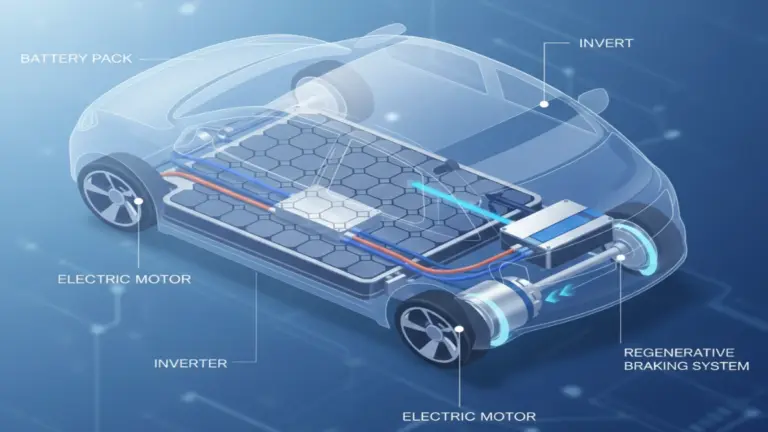
Your battery pack is the single most expensive component in your electric vehicle, often costing between $5,000 and $15,000 to replace. The good news is that with proper care, modern EV batteries can last 10 to 20 years or more. Think of your battery like a smartphone battery, but much more sophisticated and durable.
Optimal Charging Practices
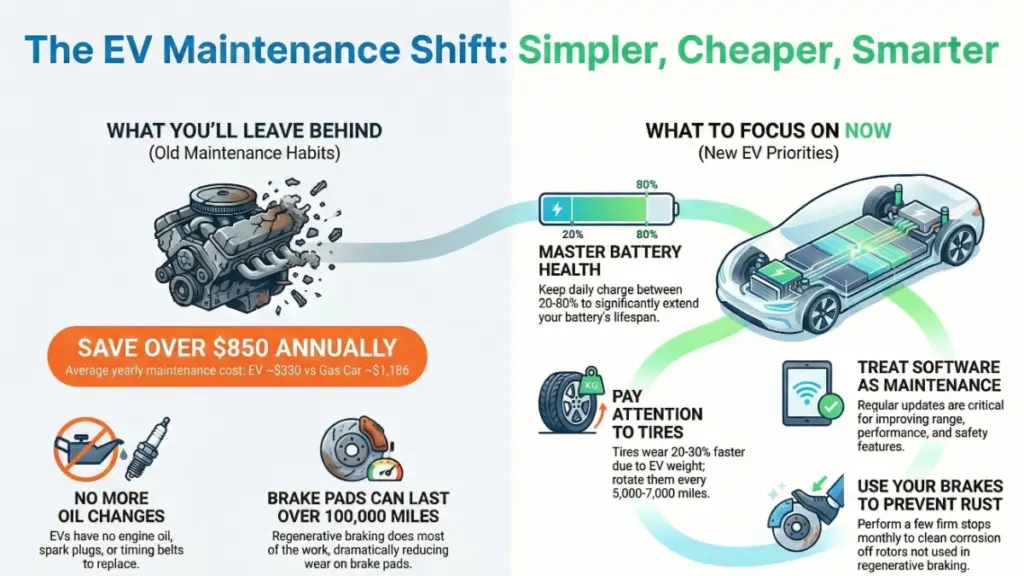
The 20-80 rule is your battery’s best friend. Most manufacturers recommend keeping your battery charge between 20% and 80% for daily driving. Here’s why: charging to 100% regularly puts stress on the battery cells, and letting it drop below 20% can cause deep discharge cycles that reduce capacity over time.
Key charging tips:
- Use Level 2 home charging for daily needs—it’s gentler on the battery than fast charging
- Save DC fast charging for road trips and emergencies—frequent fast charging can accelerate battery degradation
- Charge to 100% only before long trips, and try to use that charge relatively quickly
- If parking for extended periods, aim for 50% charge—this is the sweet spot for battery health during storage
A 2024 study from Recurrent Auto found that EV batteries typically retain about 90% of their original capacity after 10 years. Proper charging habits are the single biggest factor in achieving these results.
Tire Maintenance: Why EVs Wear Tires Differently
Here’s something many new EV owners don’t expect: your tires will wear out about 20-30% faster than on a comparable gas car. Why? Electric vehicles are heavier due to their battery packs, and that instant torque you love? It’s hard on tires during acceleration.
Regular Tire Checks and Rotation
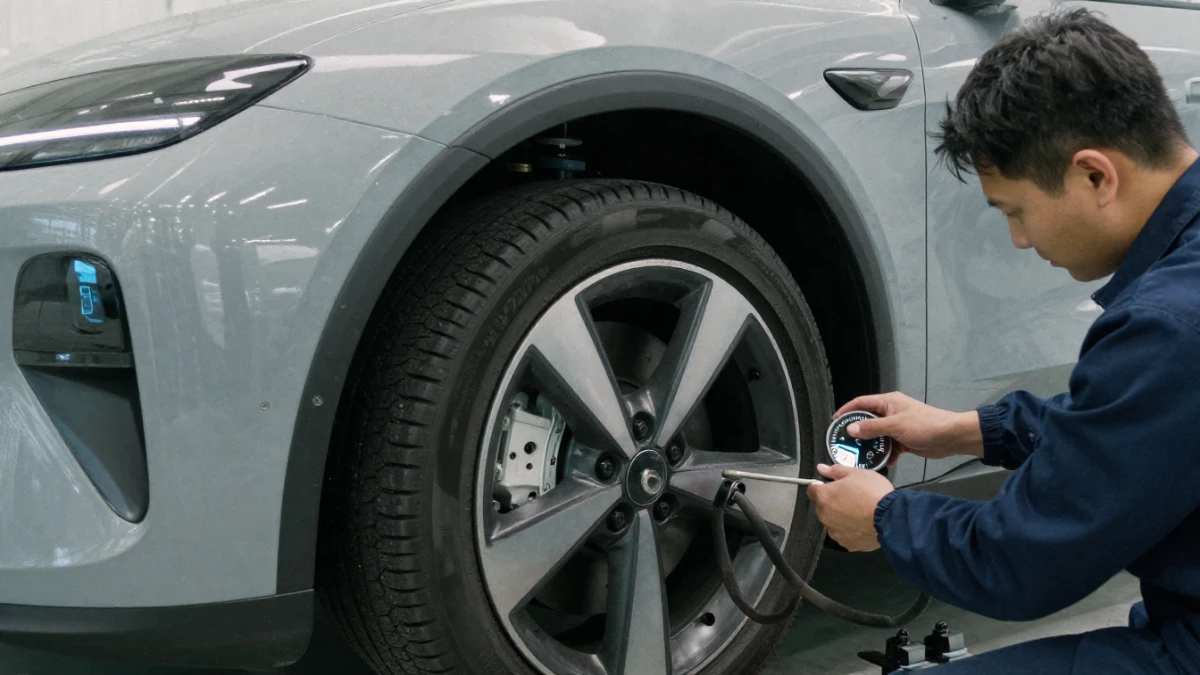
Check your tire pressure monthly, not quarterly. Under-inflated tires reduce your range significantly—we’re talking about 3-5% less range per 10 PSI below the recommended pressure. Your EV’s extra weight makes this even more critical than in traditional cars.
Essential tire maintenance schedule:
- Rotate tires every 5,000-7,000 miles (sooner than gas vehicles)
- Check tread depth every rotation—the penny test still works, but aim for replacing at 4/32 inch rather than waiting for 2/32
- Consider EV-specific tires—they’re designed to handle the extra weight and provide lower rolling resistance for better efficiency
Pro tip: Many EVs come with low-rolling-resistance tires that boost range by 5-10 miles. When replacing them, stick with similar specifications to maintain your vehicle’s efficiency.
Brake System Care: The Regenerative Difference
Here’s one of the best surprises about EV ownership: your brake pads can last 100,000 miles or more—sometimes even the life of the vehicle. That’s because regenerative braking does most of the work, capturing energy to recharge your battery while slowing down.
However, this creates a unique maintenance challenge. Your brake pads might outlast your rotors not from wear, but from corrosion. When your friction brakes aren’t used regularly, rust can develop on the rotors and brake components.
Keeping Your Brakes Healthy
- Once a month, find a safe location and perform a few moderate-to-firm stops from 30-40 mph—this cleans rust off the rotors
- Have your brake fluid inspected annually—it absorbs moisture over time, which can cause problems regardless of pad wear
- Consider brake fluid replacement every 2-3 years, even if the pads look perfect
- Listen for grinding or squealing—these sounds indicate you need immediate inspection, just like in any vehicle
Tesla owners have reported going 100,000-150,000 miles on original brake pads, and this is becoming common across all EV brands. Still, annual brake inspections remain essential for safety.
Cooling System: Your Battery’s Climate Control
Most EVs have sophisticated cooling systems that maintain optimal battery temperature—typically between 60-80°F. Unlike your old car’s radiator that cooled only the engine, your EV’s cooling system manages the battery pack, electric motor, and power electronics.
While you don’t have engine coolant to change as frequently, you do need to maintain this system. Some EVs use liquid cooling, others use air cooling, and some combine both methods.
Cooling System Maintenance
- Check coolant levels every 6 months—most EVs have separate coolant reservoirs for the battery and motor systems
- Follow manufacturer recommendations for coolant replacement—typically every 4-5 years or 50,000 miles
- Keep air intakes and cooling vents clear—leaves, debris, and road grime can block airflow
- Watch for warning lights—temperature management errors can affect battery performance and lifespan
Proper cooling is essential for battery longevity. A study by the National Renewable Energy Laboratory found that batteries in moderate climates with active cooling systems showed 5-10% better capacity retention over time compared to those without.
Software Updates: The Maintenance Task You Can’t Ignore
Here’s something revolutionary about EV ownership: your car can literally improve overnight. Software updates can enhance range, add features, improve performance, and fix bugs—all while you sleep. Think of it like updating your smartphone, except the updates can make your car accelerate faster or charge more efficiently.
In 2024, most major manufacturers now offer over-the-air updates for their EVs. These aren’t just nice-to-have features—they’re critical maintenance items that can affect safety, efficiency, and vehicle performance.
Managing Your EV’s Software
- Enable automatic updates when available—schedule them for overnight when your car is plugged in
- Check for updates monthly if your manufacturer doesn’t push them automatically
- Read release notes—understanding what changed helps you spot issues and take advantage of new features
- Keep your phone app updated—the companion apps are part of your vehicle’s ecosystem
Remember: outdated software can mean missed efficiency improvements, unpatched security vulnerabilities, and even reduced charging speeds. This is genuinely new territory for car ownership, and staying current matters.
Essential Fluid Maintenance: What’s Left to Check?
While you’ve said goodbye to oil changes, EVs still have several fluids that need attention. The difference is that you’ll check them far less frequently than you did with your gas car—but when you do need to service them, it’s just as important.
Your EV Fluid Checklist
Windshield Washer Fluid
Check and refill as needed—EVs use this just like any other car. Consider upgrading to a fluid with water-repellent properties for better visibility.
Brake Fluid
Check annually, replace every 2-3 years. Even though you use the friction brakes less, the fluid still degrades from moisture absorption.
Transmission/Gear Oil
Most EVs have a single-speed transmission with minimal gear oil. Check it around 50,000 miles, replace if manufacturer recommends—many say it’s lifetime fluid, but inspection doesn’t hurt.
Replace every 12,000-15,000 miles or annually. This one’s easy to DIY and makes a huge difference in air quality. Some EVs have HEPA filters that cost more but last longer.
Maintenance Comparison: EV vs. Gas Vehicle
Let’s put this in perspective. Here’s how EV maintenance stacks up against traditional internal combustion engine vehicles:
| Maintenance Item | Electric Vehicle | Gas Vehicle |
| Oil Changes | Not required | Every 5,000-7,500 miles |
| Brake Pad Replacement | 100,000+ miles | 25,000-70,000 miles |
| Transmission Service | Minimal (check at 50K) | Every 30,000-60,000 miles |
| Air Filter | Cabin only (annually) | Engine & cabin (both annually) |
| Spark Plugs | Not applicable | Every 30,000-100,000 miles |
| Coolant System | Check every 50,000 miles | Every 30,000-50,000 miles |
| Tire Rotation | Every 5,000-7,000 miles | Every 5,000-7,500 miles |
According to AAA, the average annual maintenance cost for an EV is approximately $330, compared to $1,186 for a gas vehicle. That’s nearly $850 in savings every single year—and over ten years, you’re looking at $8,500 or more in your pocket.
Common EV Maintenance Myths Debunked
Let’s clear up some widespread misconceptions about electric vehicle maintenance:
Myth 1: EVs are completely maintenance-free
Reality: While EVs need far less maintenance than gas cars, they still require regular care. Battery health monitoring, tire maintenance, brake system checks, and software updates are all essential. The difference is that these tasks are less frequent and often less expensive than traditional car maintenance.
Myth 2: Battery replacement costs make EVs impractical
Reality: Most EV batteries are warrantied for 8 years or 100,000 miles, and real-world data shows they’re lasting much longer. Battery replacement costs have dropped by more than 80% over the past decade. Plus, battery degradation is gradual—not catastrophic—meaning you’ll have plenty of warning if replacement becomes necessary.
Myth 3: You must go to the dealer for all EV service
Reality: While some tasks require specialized equipment, many maintenance items—tire rotations, brake inspections, cabin air filters—can be handled by independent mechanics or even DIY. The key is finding technicians trained on high-voltage systems when needed, but routine maintenance is increasingly accessible.
Myth 4: Cold weather permanently damages EV batteries
Reality: Cold weather temporarily reduces range and charging speed, but it doesn’t cause permanent damage. Modern EVs have sophisticated thermal management systems that protect the battery. Pre-conditioning your battery while plugged in before winter drives helps maintain performance.
Your Simple EV Maintenance Schedule
Let’s make this practical. Here’s a straightforward schedule you can follow:
Monthly Tasks
- Check tire pressure and add air if needed
- Perform a few hard stops to clean brake rotors
- Check for software updates
- Visually inspect tires for damage or unusual wear patterns
Every 5,000-7,000 Miles
- Rotate tires
- Check brake pad thickness and rotor condition
- Inspect suspension and steering components
Annually
- Replace cabin air filter
- Check brake fluid condition
- Inspect coolant levels and system
- Test 12-volt battery (yes, EVs have them too)
- Have a comprehensive vehicle inspection at your service center
Every 2-3 Years
- Replace brake fluid
- Replace 12-volt battery if needed
Every 50,000 Miles or 4-5 Years
- Check transmission/gear oil
- Consider coolant system flush and replacement
The Bottom Line: Simpler, Smarter Maintenance
Electric vehicle maintenance represents a fundamental shift in how we care for our cars. You’re trading complex, frequent maintenance tasks for simpler, less frequent ones. No more oil changes, no more exhaust system repairs, no more transmission overhauls. Instead, you focus on battery health, tire management, and keeping your software current.
The real beauty of EV maintenance is this: it’s designed around prevention and monitoring rather than constant intervention. Your car will tell you what it needs through dashboard alerts and mobile apps. Your job is simply to stay attentive, follow the basic schedule we’ve outlined, and address issues promptly when they arise.
Remember these key takeaways:
- Follow the 20-80 charging rule for optimal battery health
- Check tire pressure monthly and rotate every 5,000-7,000 miles
- Use your friction brakes occasionally to prevent corrosion
- Stay current with software updates
- Monitor cooling system health for long-term battery preservation
Start implementing these practices today, and your EV will reward you with years of reliable, efficient service. The transition to electric isn’t just about zero emissions—it’s about smarter, simpler ownership. And now that you understand what your EV really needs, you’re equipped to make the most of this revolutionary technology.