Electric bike commuting is transforming daily travel in 2025, helping riders save money, skip traffic, and reduce emissions. From choosing the right motor and battery to understanding costs, safety, and incentives, this guide explains everything commuters need before replacing car trips with an e-bike. For many riders, an e-bike becomes cheaper, healthier, and far more enjoyable than driving.
Picture your typical Monday morning: alarm blaring, traffic already backing up on the interstate, and a parking spot that costs you $18 a day. Now picture gliding past all of it on an electric bike, arriving at work without a drop of sweat, spending maybe $0.15 on electricity for the whole trip.
That’s not a fantasy. For millions of commuters worldwide, it’s simply Tuesday.
Electric bike commuting is one of the fastest-growing transportation trends of 2025. Global e-bike sales are on track to exceed 50 million units annually, with urban commuters leading the charge. But before you click “add to cart” on the first e-bike you find, there’s a lot worth understanding — from choosing the right motor to navigating local regulations. This guide covers it all.
$0.10–0.20Avg. cost to charge an e-bike per trip
20–60 miTypical range on a single charge
28 mphMax assisted speed (Class 3 US)
50M+E-bikes sold globally in 2024
What Exactly Is an Electric Bike — and How Does It Work?
An electric bike, or e-bike, looks a lot like a regular bicycle but has three key additions: a battery, an electric motor, and a controller. The motor provides pedal assistance — meaning it helps amplify your pedaling effort rather than replacing it entirely (unless you’re on a throttle-equipped model).
Think of it like having a tailwind on every single ride, no matter which direction you’re going.
The three main motor types
Where the motor sits matters more than most beginners realize:
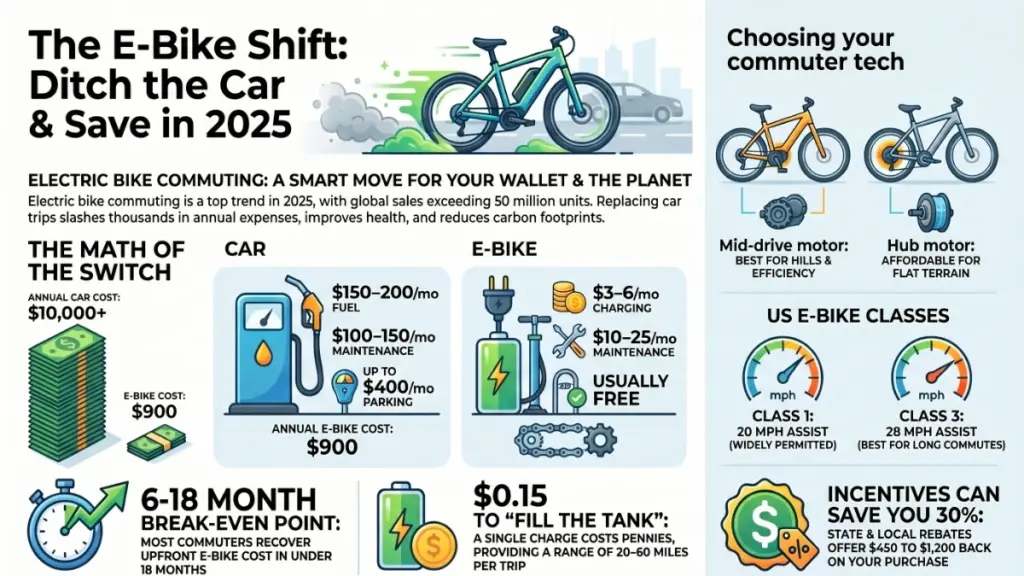
- Hub drive motors (rear or front wheel) — affordable, low-maintenance, great for flat terrain. Most entry-level commuter bikes use these.
- Mid-drive motors (at the crank) — more efficient on hills, better weight distribution, preferred by serious commuters and cyclists. Brands like Bosch, Shimano, and Brose dominate here.
- All-wheel drive — rare, found in high-end cargo e-bikes or performance models; overkill for most commuters.
For typical urban commuting — mixed terrain, occasional hills, stop-and-go traffic — a quality mid-drive motor is almost always worth the extra investment.
Understanding pedal-assist vs. throttle
Pedal-assist (PAS) modes kick in when you’re actively pedaling. The motor senses your pedaling cadence or torque and adds power proportionally. Throttle-only mode, on the other hand, propels the bike without any pedaling — similar to a scooter. Many e-bikes offer both.
In the US, Class 1, 2, and 3 designations govern where and how fast you can ride. Class 1 (pedal-assist to 20 mph) is the most widely permitted on bike paths. Class 3 (pedal-assist to 28 mph) is increasingly popular for longer, faster commutes but may be restricted on some trails.
The Real Cost of E-Bike Commuting (Numbers That Might Surprise You)
Let’s be honest: a decent commuter e-bike costs anywhere from $1,200 to $4,500 upfront. That’s not pocket change. But here’s where the math gets interesting.
The average American spends roughly $10,000–$12,000 per year on a car when you factor in loan payments, insurance, fuel, and maintenance (per AAA’s 2024 annual data). Even if you don’t eliminate your car entirely, replacing just your daily commute with an e-bike can slash hundreds — even thousands — off that annual figure.
| Cost Category | Car Commuting (avg.) | E-Bike Commuting |
|---|---|---|
| Fuel / Charging | ~$150–200/month | $3–6/month |
| Insurance | $150–250/month | $10–20/month |
| Parking | $0–400/month | Free (mostly) |
| Maintenance | $100–150/month avg. | $10–25/month |
| Vehicle depreciation | $300–500/month | Minimal |
| Annual total (rough) | $8,400–$18,000 | $400–900 + upfront cost |
Many commuters break even on their e-bike investment within 6–18 months. After that, it’s largely free riding.
“I bought a Rad Power Bikes RadCity 5 Plus for $1,699. Within eight months of replacing my car commute, I’d saved enough on parking and gas alone to pay for it twice over.” — common sentiment in e-bike owner communities
Don’t overlook hidden savings either: fewer oil changes, no emissions inspections, and dramatically reduced tire wear (e-bikes have much lighter tires than cars). And if you work in a city with a congestion charge or expensive parking structures, those daily costs evaporate completely.
Choosing the Right E-Bike for Your Commute
Walk into any bike shop or browse online in 2025 and you’ll face an overwhelming wall of options. Here’s how to cut through the noise.
First, map your actual commute
Distance and elevation are the two factors that matter most. A flat 8-mile round trip has very different requirements than a hilly 20-miler. Measure both before you shop — Google Maps has a bike routing mode that shows elevation gain.
Rule of thumb: for commutes under 15 miles round-trip on mostly flat terrain, almost any quality e-bike will do. For longer distances or significant hills, you’ll want a bike with at least a 500Wh battery and a mid-drive motor.
Popular e-bike models for commuters in 2025
| Model | Range | Motor | Price (USD) | Best For |
|---|---|---|---|---|
| Rad Power RadCity 5 Plus | ~45 mi | 750W hub | $1,699 | Budget commuters |
| Trek FX+ 2 | ~60 mi | Bosch Active Line | $2,699 | Everyday fitness commuter |
| Specialized Vado SL 4.0 | ~80 mi | SL 1.1 mid-drive | $3,800 | Longer range, lighter feel |
| Tern GSD S10 | ~60 mi | Bosch Cargo Line | $5,299 | Cargo, family hauling |
| Aventon Level.2 | ~60 mi | 500W hub | $1,999 | Speed + value balance |
Roy’s tip: Before buying online, visit a local bike shop and actually ride a few models. The “feel” of an e-bike — how responsive the pedal assist is, how the brakes engage — matters as much as the spec sheet. Most shops will let you test ride before you commit.
Cargo e-bikes: when you need to carry more than a laptop
Got kids? Groceries? A work bag that weighs more than a golden retriever? Cargo e-bikes have matured dramatically. The Tern GSD and Urban Arrow Family are now legitimate car replacements for many families, carrying up to 400 lbs total load. Cities like Amsterdam and Portland have seen cargo e-bike adoption skyrocket as parents replace school-run car trips.
Practical Commuting: Charging, Safety & Sweat
The real-world questions that trip up new e-bike commuters usually aren’t about the bike itself — they’re about logistics. Let’s tackle the most common ones head-on.
Charging: simpler than you think
Most e-bike batteries charge via a standard wall outlet using an included charger — no special installation needed. A full charge typically takes 4–6 hours and costs pennies. Many commuters simply plug in overnight and start every morning with a full battery.
If you can’t bring the bike inside at work, look for removable battery models (Rad Power, Bosch-equipped bikes, most Trek models all have removable batteries). You carry just the battery pack to your desk for charging.
Will you arrive sweaty?
This is the question everyone whispers but nobody wants to ask first. The honest answer: it depends on how hard you push it. With pedal assist, most commuters ride in a comfortable Zone 1–2 heart rate range — enough to feel alive but not enough to drench a work shirt.
A few practical strategies used by experienced e-bike commuters:
- Use a higher assist level on your commute in, lower on the way home (when it matters less)
- Ride slightly slower — 15–18 mph vs. pushing 25 mph — to minimize exertion
- Bring a change of shirt or use facilities at the office
- Allow 5–10 minutes of cool-down time before entering the building
Safety gear and road rules
E-bikes move faster than traditional bicycles, which changes your risk profile. A quality helmet — ideally a MIPS-certified commuter helmet from brands like Giro, Specialized, or Kask — is non-negotiable. Front and rear lights are essential; many quality e-bikes have integrated lighting.
Know your local laws. In most US states, Class 1 e-bikes are treated like regular bicycles. Class 3 bikes may require helmets by law and may be excluded from certain bike paths. In the EU, e-bikes are limited to 250W motors with 15.5 mph (25 km/h) assist — a very different experience from US Class 3 bikes.
Advantages
- Massive cost savings vs. car commuting
- Arrive on time — beat traffic predictably
- Built-in daily exercise without the gym
- Zero parking headaches
- Near-zero emissions
- Mental health boost from fresh air and movement
- Enjoyable — commuting can actually be fun
Considerations
- Upfront cost ($1,200–$4,500+)
- Weather dependency (rain, snow, heat)
- Theft risk in urban areas
- Longer commutes (>15 mi) need careful planning
- Physical limitations for some riders
- Infrastructure gaps in some cities
The Health, Environment & Bigger Picture
Beyond the wallet, there are two more compelling reasons to make the switch: your health and the planet.
The fitness angle (it’s real, even with a motor)
Research published in the International Journal of Environmental Research and Public Health found that regular e-bike commuters get measurably more physical activity than those who commute by car — and only slightly less than traditional cyclists. The key insight: people ride e-bikes more often and farther than they would ride regular bikes. The motor removes the psychological barrier of “I’m too tired today.”
Over a year of daily e-bike commuting, studies suggest riders burn an average of 300–500 additional calories per day compared to car commuters — without ever stepping foot in a gym.
Your carbon footprint
An e-bike produces approximately 2–5 grams of CO₂ per kilometer when accounting for battery charging from the average US grid, compared to roughly 150–200 grams per kilometer for a typical gasoline car. Even an electric car produces significantly more emissions per kilometer than an e-bike due to the weight of the vehicle and the energy required to manufacture it.
If just 10% of urban car commutes globally were replaced by e-bike trips, the emissions reduction would be equivalent to taking tens of millions of cars off the road permanently. That’s not hyperbole — that’s physics.
Infrastructure, Incentives & the Road Ahead
One of the biggest objections to e-bike commuting used to be infrastructure: “My city doesn’t have good bike lanes.” That’s changing rapidly.
US cities have added over 1,500 miles of protected bike infrastructure since 2020, with New York, Chicago, Denver, and Seattle leading the way. The 2021 Infrastructure Investment and Jobs Act allocated $1 billion specifically for active transportation infrastructure. Globally, European cities like Paris, Amsterdam, and Copenhagen have invested billions in cycling networks that make e-bike commuting fast and genuinely safe.
Federal and state incentives
In the US, several states now offer e-bike rebates and tax credits. Colorado’s e-bike tax credit (up to $450), California’s Clean Vehicles Rebate, and Denver’s e-bike rebate program (up to $1,200 for income-qualified residents) are among the most generous. Check your state’s energy office and local utility provider — utility rebates for e-bikes are becoming increasingly common as grid managers recognize that e-bikes are a smarter load than EVs.
Check before you buy: The CARES Act and various state programs may cover 10–30% of your e-bike’s purchase price. A 10-minute search on your state’s energy office website could save you hundreds of dollars.
What’s coming next: e-bike technology in 2025–2026
Battery technology is evolving fast. Solid-state e-bike batteries are entering pilot production, promising lighter weight, faster charging (under 90 minutes for a full charge), and longer lifespan. Smart connectivity — GPS anti-theft, app-based diagnostics, automatic assist adjustment based on real-time terrain data — is becoming standard even on mid-range bikes.
Bosch’s new Performance Line CX Gen5 motor, launched in late 2024, offers a more natural riding feel and improved efficiency on long climbs. Shimano’s EP8 system continues to set the bar for smooth, intuitive pedal assist. The technology gap between e-bikes and traditional bikes is closing — fast.
The Bottom Line: Is E-Bike Commuting Right for You?
If your commute is under 20 miles round-trip, you live somewhere with even basic cycling infrastructure, and the upfront cost is manageable — the answer is almost certainly yes. The savings, health benefits, and sheer enjoyment of bypassing gridlock add up remarkably quickly.
Key takeaways from this guide:
- E-bike commuting costs a fraction of car commuting — most riders break even within 6–18 months
- Mid-drive motors (Bosch, Shimano) are worth the premium for serious or hilly commutes
- Class 1–3 designations govern where and how fast you can ride — know your local rules
- You won’t necessarily arrive sweaty — smart assist use keeps exertion manageable
- Check state and local rebates before purchasing — you may get 10–30% back
- Infrastructure is improving rapidly; now is a better time to start than any point in the past
The commute doesn’t have to be the worst part of your day. With the right e-bike, it might just become your favorite 20 minutes.