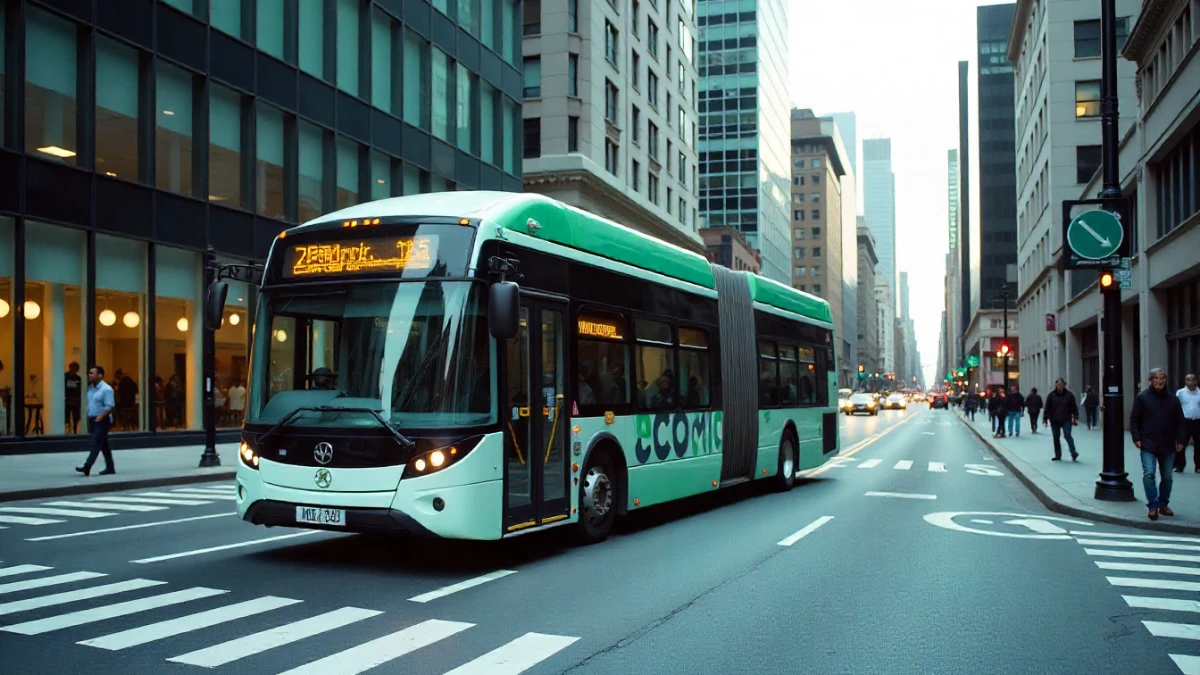
Picture this: you’re standing at a busy city intersection, and a bus glides past you almost silently. No diesel rumble, no cloud of exhaust—just smooth, quiet motion. That’s the electric bus revolution happening right now, and it’s transforming public transportation in ways that go far beyond just being “green.”
If you’re wondering whether electric buses are actually worth the investment or just another environmental trend, you’re asking the right question. Having followed the electric vehicle evolution for years and watched cities across America transition their fleets, I can tell you: electric buses deliver tangible benefits that affect everyone—from city budget directors to the people living next to bus routes.
In this article, you’ll discover: the surprising cost savings cities are realizing, how electric buses are improving air quality in measurable ways, why passengers and drivers prefer them, and what the transition means for your community’s future. Whether you’re a city planner, environmental advocate, or simply curious about where public transit is heading, you’ll find practical insights backed by real-world data from cities already running electric fleets.
The Financial Case: Electric Buses Save Money (Yes, Really)
Let’s address the elephant in the room first: electric buses cost more upfront. A diesel bus runs around $500,000, while an electric bus typically costs between $750,000 and $1 million. So how can I claim they save money?
The answer lies in total cost of ownership, and the numbers are compelling.
Operating Costs Tell the Real Story
Electric buses slash the expenses that drain transit budgets year after year:
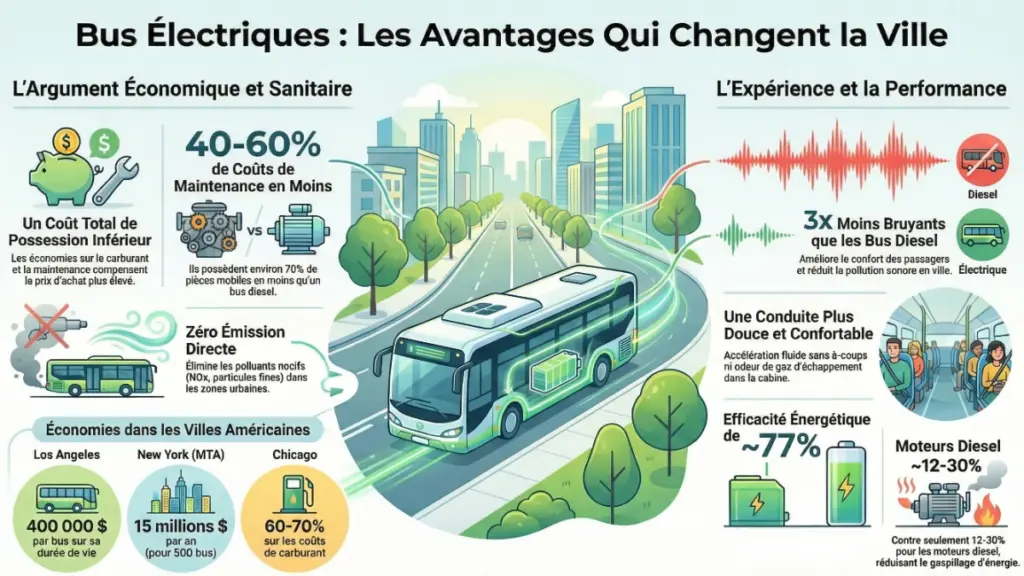
Fuel costs drop dramatically. Electricity costs roughly $0.15-0.30 per mile to operate an electric bus, compared to $0.50-0.80 per mile for diesel. Over a 12-year lifespan (the typical bus lifetime), that’s a savings of $200,000-$400,000 per bus. When you’re running a fleet of 50, 100, or 500 buses, those savings add up fast.
Maintenance costs plummet. This is where electric buses really shine. They have about 70% fewer moving parts than diesel buses. No oil changes, no transmission repairs, no exhaust system replacements, no cooling system overhauls. Transit agencies like King County Metro in Seattle report maintenance cost reductions of 40-60% compared to their diesel fleet.
Consider what you’re eliminating: a diesel bus requires regular oil changes (every 6,000-10,000 miles), air filter replacements, fuel filter changes, and eventually major engine overhauls costing $35,000-$50,000. An electric bus? You’re primarily maintaining brakes (which last longer thanks to regenerative braking), tires, and the occasional suspension component.
The brake advantage is particularly impressive. Regenerative braking—where the electric motor helps slow the bus while capturing energy—means brake pads and rotors can last 2-3 times longer than on diesel buses. In stop-and-go city driving where buses might brake hundreds of times per route, this makes a significant difference.
Real-World Savings Examples
- Los Angeles Metro projects lifetime savings of $400,000 per electric bus compared to natural gas buses
- Chicago Transit Authority reports fuel cost savings of 60-70% on their electric routes
- New York’s MTA estimates their transition to 500 electric buses by 2025 will save $15 million annually in fuel and maintenance
Cities typically reach break-even on the higher purchase price within 6-8 years, then enjoy cost savings for the remainder of the bus’s operational life. Factor in the federal and state incentives available (more on this shortly), and many agencies see positive returns even sooner.
Breathing Easier: The Public Health Benefits Are Measurable
Here’s something that affects you whether or not you ride the bus: diesel buses emit harmful pollutants directly into the communities they serve. And those communities are disproportionately low-income neighborhoods where transit routes are concentrated.
What’s Actually in Diesel Exhaust?
Diesel particulate matter—the tiny particles you can sometimes see in exhaust plumes—includes compounds classified as carcinogenic by the World Health Organization. A single diesel bus emits:
- Nitrogen oxides (NOx): Contributes to smog and respiratory problems
- Particulate matter (PM2.5): Penetrates deep into lungs and even bloodstreams
- Carbon monoxide: Reduces oxygen delivery in the body
- Volatile organic compounds: Can cause short and long-term health effects
Children, elderly residents, and people with respiratory conditions are particularly vulnerable. Schools along bus routes, bus stops where people wait, and neighborhoods with bus depots face concentrated exposure.
The Zero-Emission Difference
Electric buses produce zero tailpipe emissions. Period. This isn’t about reducing emissions by a percentage—it’s about eliminating them entirely at the point of use.
Research from Columbia University found that switching New York City’s bus fleet to electric would prevent approximately 50-150 premature deaths annually from improved air quality. They also estimated benefits worth $150-$500 million per year in reduced healthcare costs and improved productivity.
Real impact in communities:
- A study in California found that neighborhoods near bus depots with electric fleets showed measurable improvements in air quality within the first year
- Indio, California reported that children at schools along their electric bus routes experienced fewer asthma-related absences
- London’s transition to electric buses has contributed to their 20% reduction in roadside nitrogen dioxide since 2016
Even accounting for the emissions from electricity generation, electric buses produce 50-70% fewer greenhouse gas emissions than diesel buses over their lifetime—and that number improves as the electrical grid incorporates more renewable energy.
The Passenger Experience: Why Riders Prefer Electric Buses
If you’ve ever ridden an electric bus, you probably noticed the difference immediately. If you haven’t, you’re in for a pleasant surprise.
It’s Quieter Than You’d Expect
Electric buses operate at 70-75 decibels during normal operation, compared to 85-90 decibels for diesel buses. That might not sound like much, but decibels are logarithmic—electric buses are roughly one-third as loud as diesel buses.
What does this mean in practice?
- Conversations are easier. You don’t have to raise your voice to talk to the person next to you
- Phone calls actually work. Try making a call on a diesel bus—enough said
- Less fatigue. Constant exposure to engine noise is surprisingly draining
Drivers consistently report that the quiet operation reduces stress over long shifts. Transit agencies in Seattle and Los Angeles note that driver retention has improved on electric routes.
For communities, the benefits extend beyond the bus interior. Neighborhoods along bus routes experience less noise pollution—particularly important during early morning and late evening service when diesel buses can wake residents.
Smoother, More Comfortable Rides
Electric motors deliver power differently than diesel engines. The acceleration is smooth and immediate, without the lurching that comes from gear changes in diesel transmissions. Torque is available instantly, which means:
- Smoother starts from stops (passengers can actually stay balanced standing up)
- Better hill climbing without the engine strain and noise
- No exhaust smell seeping into the cabin
The climate control is also notably better. Electric buses can run heating and air conditioning without idling the engine, maintaining comfortable temperatures more consistently.
Environmental Benefits Beyond Zero Emissions
Yes, electric buses eliminate tailpipe emissions—but the environmental advantages don’t stop there.
Energy Efficiency Is Dramatically Better
Electric drivetrains convert about 77% of electrical energy into motion, compared to just 12-30% efficiency for diesel engines. That means electric buses use far less total energy to move the same number of passengers the same distance.
Even when you account for power plant emissions (if electricity comes from fossil fuels), electric buses produce significantly fewer greenhouse gases over their lifetime. As the electrical grid continues shifting toward renewable sources—solar, wind, hydroelectric—electric buses automatically become cleaner without any hardware changes.
Regenerative Braking Recaptures Energy
Here’s something clever: when an electric bus brakes, the motor runs in reverse, functioning as a generator that converts the bus’s momentum back into electricity stored in the battery. This regenerative braking can recapture 15-25% of the energy used, extending the bus’s range and reducing wear on mechanical brakes.
Think of it like a hybrid car on steroids—except the energy savings happen hundreds of times per route, all day, every day.
Lower Lifetime Carbon Footprint
From manufacturing through disposal, electric buses have a smaller total carbon footprint than diesel buses—even when charged from grids still using fossil fuels. Studies show:
- Electric buses produce 50-70% fewer lifecycle greenhouse gas emissions
- As grids incorporate more renewables, this advantage grows automatically
- Battery recycling programs are capturing 90-95% of materials for reuse
Cities serious about climate commitments recognize that transit represents a significant portion of municipal emissions. Los Angeles estimates their electric bus transition will reduce transportation emissions by 230,000 metric tons of CO2 annually—equivalent to removing 50,000 cars from the road.
Grid Flexibility and Smart Charging: The Technical Advantages
Modern electric buses aren’t just vehicles—they’re part of an increasingly sophisticated energy ecosystem.
Overnight Charging Works Perfectly for Transit
Bus routes are predictable. Most buses return to the depot each night, making overnight charging ideal. This aligns perfectly with:
- Lower electricity rates during off-peak hours
- Reduced strain on the grid during high-demand periods
- Opportunity for renewable energy (wind power is often most abundant at night)
A typical 40-foot electric bus with a 350-400 kWh battery can be fully charged in 3-6 hours using depot charging infrastructure. For routes requiring longer range, fast-charging systems at route endpoints can add significant charge during driver breaks.
Vehicle-to-Grid (V2G) Potential
Here’s where it gets interesting: electric bus batteries can potentially serve as mobile energy storage for the electrical grid. During peak demand or grid emergencies, parked buses could feed electricity back into the system.
While this technology is still emerging, pilot programs in California and Europe are demonstrating that bus fleets could:
- Provide grid stabilization services
- Generate revenue for transit agencies during non-service hours
- Support renewable energy integration by storing excess solar/wind power
The Antelope Valley Transit Authority in California is already testing this concept, with their electric buses providing backup power during Public Safety Power Shutoffs.
Smart Charging Optimizes Operations
Modern charging systems use software to:
- Schedule charging when electricity is cheapest
- Load balance across multiple buses to avoid demand charges
- Optimize battery health by managing charge rates and depth of discharge
- Predict range based on route requirements and battery condition
This level of optimization is impossible with diesel refueling—you fill the tank when it’s empty, regardless of timing or cost.
Job Creation and Economic Development
The electric bus transition is creating new industries and employment opportunities across the country.
Manufacturing Jobs Are Coming Home
Major electric bus manufacturers have established or expanded U.S. facilities:
- Proterra (before its recent challenges) had facilities in California and South Carolina
- New Flyer manufactures electric buses in Minnesota
- BYD operates a factory in Lancaster, California employing over 800 workers
- Nova Bus produces electric buses in New York
These facilities employ engineers, technicians, assembly workers, and support staff—often in communities that need economic development.
New Workforce Skills
The maintenance workforce is evolving. Technicians who previously worked on diesel engines are retraining to service electric drivetrains, battery systems, and high-voltage electrical components. These positions often command higher wages due to the specialized skills required.
Transit agencies partnering with community colleges and technical schools are developing training programs, creating career pathways for the next generation of transit workers.
Infrastructure Development
The transition requires charging infrastructure, electrical upgrades, and facility modifications—all creating construction and engineering work. Cities investing in electric buses typically invest $150,000-$400,000 per bus in infrastructure, much of which goes to local contractors and electrical workers.
Overcoming the Challenges: What You Should Know
I’d be doing you a disservice if I didn’t address the legitimate challenges cities face when transitioning to electric buses.
Range Anxiety Is Overblown (Mostly)
Early electric buses had range limitations that concerned transit agencies. Modern electric buses typically offer 150-250 miles per charge—more than sufficient for most urban transit routes, which average 120-150 miles daily.
However, range is affected by:
- Climate: Heating in extreme cold can reduce range by 30-40%
- Topology: Hilly routes consume more energy
- Route characteristics: Frequent stops and high passenger loads require more energy
Cities address this through careful route planning, opportunity charging, or hybrid-electric options for particularly demanding routes. Many agencies start electric bus deployment on moderate routes, expanding as they gain experience.
Upfront Costs Require Planning
The higher purchase price remains a barrier for some agencies, particularly smaller systems without access to federal funding. However:
- Federal funding through the Low or No Emission Vehicle Program and Infrastructure Investment and Jobs Act provides billions in support
- State incentives in California, New York, and other states can cover 50-80% of incremental costs
- Utility partnerships sometimes subsidize charging infrastructure
- Lease and financing options spread costs over time
The key is viewing electric buses as long-term investments rather than comparing only purchase prices.
Cold Weather Performance Has Improved
Early concerns about battery performance in cold climates were legitimate. Modern buses incorporate:
- Battery thermal management systems that maintain optimal temperatures
- Heat pump technology that’s more efficient than resistive heating
- Pre-conditioning that warms the bus while still plugged in
Cities like Chicago, Minneapolis, and Edmonton, Canada are successfully operating electric buses year-round, though some still report modest range reductions during extreme cold.
Charging Infrastructure Requires Investment
Depot charging infrastructure represents a significant upfront investment—typically $150,000-$400,000 per charging position, depending on power levels and site requirements. Electrical service upgrades at depots can add substantially to costs if the existing infrastructure is inadequate.
However, these are one-time capital expenses that support the entire fleet over decades. Many utilities offer special rates or infrastructure incentives for transit agencies making the transition.
The Policy Landscape: Government Support Is Strong
If you’re wondering whether electric buses will remain a niche or become the standard, current policy trends provide a clear answer.
Federal Commitment
The Infrastructure Investment and Jobs Act allocated $5.5 billion for low- and zero-emission transit buses, the largest investment in bus electrification in U.S. history. The EPA’s Clean School Bus Program is investing another $5 billion in electric school buses, demonstrating federal commitment across transit sectors.
State and Local Action
- California requires all new transit buses purchased by state agencies to be zero-emission starting in 2029
- New York has committed to converting NYC Transit’s entire 5,800-bus fleet to electric by 2040
- Washington state has set a goal for all transit agencies to transition by 2035
- Cities like Los Angeles, Seattle, Atlanta, and Denver have aggressive electrification targets
This isn’t hypothetical anymore—these are binding commitments with funding and timelines attached.
Global Leadership Matters
The U.S. is actually behind China and Europe in electric bus adoption:
- China operates over 600,000 electric buses (about 98% of the world’s fleet)
- Europe is rapidly electrifying, with cities like London and Amsterdam leading
- Latin America has seen significant adoption in cities like Santiago and Bogotá
This global market maturity means the technology is proven, manufacturers have economies of scale, and best practices are well-established.
What This Means for Your Community
Whether you live in a major city or a smaller community, the electric bus transition will likely affect you sooner than you think.
For Transit Riders
Expect a better experience: quieter, smoother, and more comfortable rides. Improved air quality at bus stops and along routes benefits everyone, but particularly children, elderly residents, and people with respiratory conditions.
For Taxpayers
Long-term cost savings mean transit agencies can stretch budgets further—potentially maintaining service levels better during budget constraints or even expanding service. Every dollar saved on fuel and maintenance is a dollar that can go toward more frequent service, longer hours, or better facilities.
For Residents Near Bus Routes
Reduced noise and air pollution particularly benefits neighborhoods with heavy bus traffic. Communities along busy transit corridors will notice the difference in ambient noise levels and air quality.
For Climate-Conscious Citizens
Electric buses represent tangible climate action with measurable results. Unlike many climate initiatives that show results over decades, the emissions reductions from electric buses are immediate and quantifiable.
Looking Ahead: The Future of Electric Transit
The technology continues improving rapidly, and what’s coming next is exciting.
Longer Range, Faster Charging
Battery technology advances 5-8% annually. Next-generation buses will offer:
- 300+ mile ranges becoming standard
- Faster charging reducing infrastructure requirements
- Longer battery life extending bus operational lifetime
- Lower costs as battery prices continue declining
Wireless and Automated Charging
Inductive charging systems—where buses charge wirelessly when parked at specific locations—are already being tested. This eliminates plugging and unplugging, reducing labor and enabling automated charging operations.
Integration with Renewable Energy
Transit agencies are increasingly pairing electric bus adoption with solar installations at depots, creating truly zero-emission transit systems. Battery storage at facilities can store excess solar energy for overnight charging.
Full Fleet Electrification
The question is no longer “if” but “when.” Industry experts predict:
- Major U.S. cities will have primarily electric fleets by 2035
- New bus purchases will be predominantly electric by 2030
- Cost parity with diesel buses likely by 2026-2027 as production scales
Key Takeaways: Why Electric Buses Are Worth It
Let me bring this all together for you:
Financially, electric buses deliver substantial long-term savings despite higher purchase prices. Reduced fuel costs, dramatically lower maintenance expenses, and available incentives create a compelling economic case—particularly for agencies planning beyond short-term budgets.
Environmentally, the benefits are clear and immediate: zero tailpipe emissions, significantly reduced greenhouse gases over the vehicle’s lifetime, and automatic improvement as the electrical grid becomes cleaner. This isn’t greenwashing—it’s measurable impact.
For health, eliminating diesel exhaust from communities improves air quality where people live, work, and go to school. The public health benefits alone may justify the transition in many communities, with reduced asthma, fewer respiratory illnesses, and lower healthcare costs.
Operationally, electric buses provide a better experience for passengers and drivers alike—quieter, smoother, and more comfortable. They also offer technical advantages through smart charging, grid integration, and simplified maintenance.
The challenges—upfront costs, infrastructure requirements, range considerations in extreme climates—are real but solvable. Agencies across diverse climates and circumstances are successfully making the transition, and their experiences provide roadmaps for others to follow.
The momentum is undeniable. Federal support, state mandates, local commitments, and global market development all point in the same direction. Within the next decade, electric buses will likely become the standard for new transit purchases, with diesel buses gradually becoming the exception rather than the rule.
If your community hasn’t yet made the transition, it’s worth asking your transit agency about their electrification plans. The benefits—financial, environmental, and social—make this one of the most impactful investments cities can make in sustainable, equitable transportation.
The future of public transit isn’t just about getting from point A to point B—it’s about getting there cleanly, quietly, affordably, and sustainably. Electric buses deliver on all counts, and the revolution is already well underway.
Want to learn more? Check your local transit agency’s website for their fleet transition plans, or contact them to ask about electric bus pilot programs in your area. Many agencies offer opportunities to tour electric buses or facilities—seeing (and hearing) the difference firsthand is the best way to understand why cities are making the switch.