Think about your daily commute for a moment. Whether you’re driving an electric car, taking public transit, or cycling to work, your transportation choices ripple through society in ways you might not realize. They affect air quality, economic opportunity, climate change, and even gender equality.
The United Nations recognized this interconnectedness when they created the 17 Sustainable Development Goals (SDGs) in 2015. While only one goal explicitly mentions transportation—SDG 11 on sustainable cities—the truth is that how we move people and goods influences nearly every single goal on the list.
In this article, you’ll discover how transportation systems serve as the backbone of sustainable development, which specific goals depend most heavily on mobility solutions, and what innovative approaches countries and cities are taking in 2025 to create transportation that works for everyone—without destroying our planet in the process.
Understanding the UN Sustainable Development Goals
Before diving into transportation’s role, let’s clarify what we’re talking about. The Sustainable Development Goals are 17 interconnected objectives adopted by all United Nations member states in 2015 as part of the 2030 Agenda for Sustainable Development. Think of them as humanity’s to-do list for creating a better world by 2030.
These goals range from ending poverty and hunger to ensuring quality education, achieving gender equality, and taking urgent action on climate change. Each goal has specific targets—169 in total—that provide measurable outcomes.
Here’s what makes the SDGs different from previous global initiatives: they’re universal, meaning they apply to all countries (not just developing nations), and they’re integrated, recognizing that action in one area affects outcomes in others. Transportation perfectly illustrates this integration. When you improve transportation infrastructure, you’re not just making it easier to get from point A to point B—you’re potentially reducing poverty, improving health outcomes, and fighting climate change all at once.
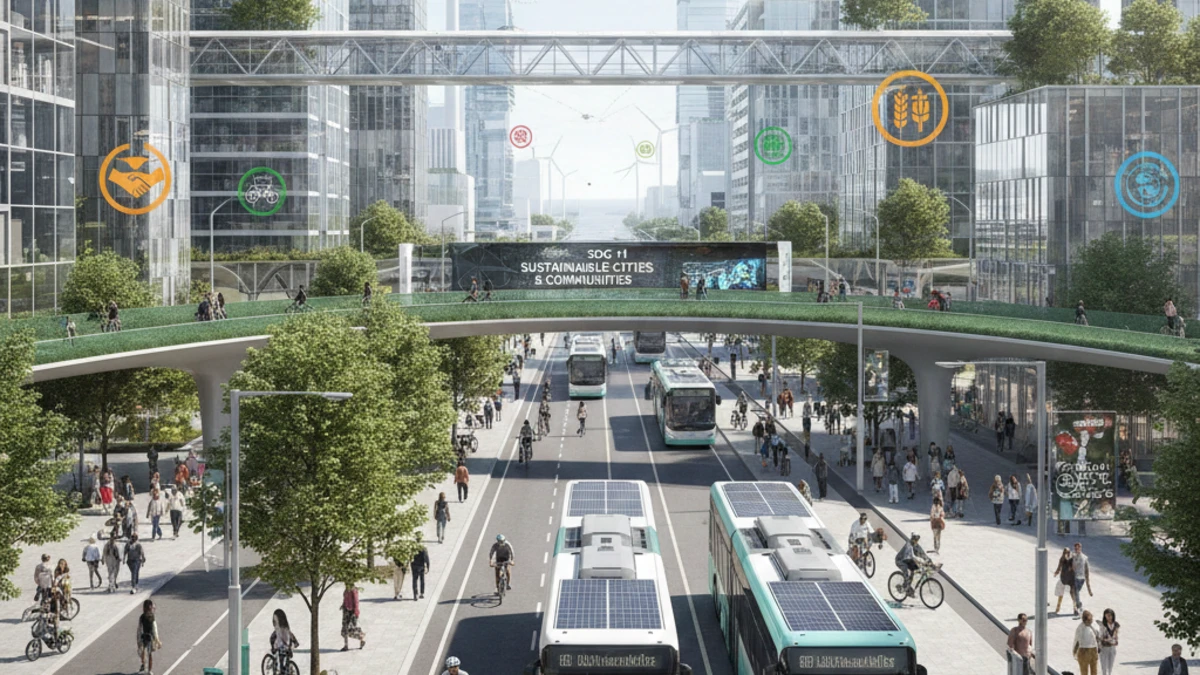
SDG 11: Sustainable Cities and Communities—Where Transportation Takes Center Stage
SDG 11 aims to “make cities and human settlements inclusive, safe, resilient and sustainable.” This is where transportation gets explicit recognition in the SDG framework, particularly through Target 11.2: “By 2030, provide access to safe, affordable, accessible and sustainable transport systems for all, improving road safety, notably by expanding public transport, with special attention to the needs of those in vulnerable situations, women, children, persons with disabilities and older persons.”
Let’s break down what this means in practice:
Safe Transportation Systems
Road traffic accidents kill approximately 1.3 million people annually worldwide, according to the World Health Organization. It’s the leading cause of death for children and young adults aged 5-29. Creating safer transportation isn’t just about better cars—it requires:
- Infrastructure design that separates different types of traffic (pedestrians, cyclists, vehicles)
- Speed management in urban areas (many cities have adopted 30 km/h zones near schools and residential areas)
- Vehicle safety standards that mandate features like automatic emergency braking
- Driver education and enforcement of traffic laws
Cities like Oslo, Norway, and Helsinki, Finland, have achieved remarkable results. Oslo recorded zero pedestrian or cyclist deaths in 2019 by prioritizing walking and cycling infrastructure, reducing speed limits, and restricting car access in the city center.
Affordable and Accessible Transportation
In many cities, low-income residents spend 20-30% of their household income on transportation—a burden that limits their access to jobs, education, and healthcare. Affordable transportation requires:
- Subsidized public transit for low-income residents, students, and seniors
- Payment flexibility including monthly passes, pay-as-you-go options, and mobile payment systems
- Universal design that makes systems usable by people with disabilities (elevators, low-floor buses, audio announcements)
- Geographic equity ensuring that underserved neighborhoods receive adequate service
Bogotá, Colombia’s TransMilenio rapid bus transit system serves as an excellent example. The system moves over 2.4 million passengers daily and costs significantly less than subway systems while providing similar capacity on dedicated lanes.
Sustainable Transportation Options
This is where the electric vehicle revolution, improved public transit, and active mobility (walking and cycling) converge. Sustainable transportation means:
- Electrification of public and private vehicle fleets to reduce emissions
- Integrated multimodal systems that make it easy to combine walking, cycling, transit, and ride-sharing
- Transit-oriented development that places housing, jobs, and services within walking distance of transit stations
- Micro-mobility solutions like e-bikes and e-scooters that provide first-mile/last-mile connectivity
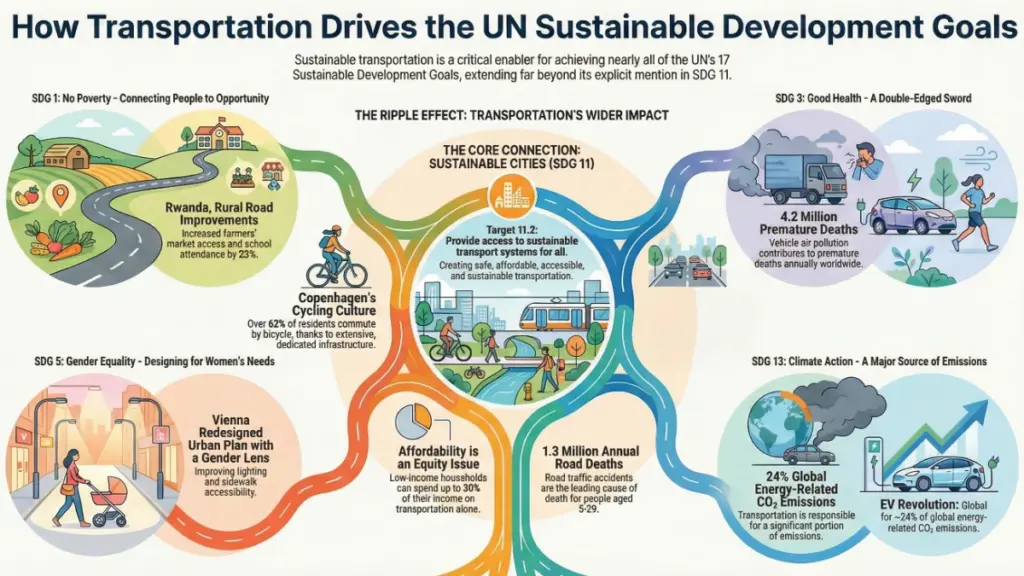
Copenhagen, Denmark, exemplifies sustainable urban transportation. Over 62% of residents commute by bicycle, supported by 385 kilometers of dedicated bike lanes, traffic signals timed for cycling speeds, and integrated bike-transit connections.
Transportation’s Impact Across All 17 SDGs
Here’s where transportation’s influence gets truly fascinating. While SDG 11 explicitly addresses transportation, nearly every other SDG depends on mobility solutions to achieve its targets. Let’s explore these connections:
SDG 1: No Poverty
Transportation determines whether people can access economic opportunities. Rural residents in developing countries often live more than 2 kilometers from the nearest all-season road, limiting their ability to reach markets, schools, and healthcare facilities.
Real-world impact: In Rwanda, the government’s rural road improvement program reduced travel time to health facilities by 64% and increased school attendance by 23%. When farmers can reliably reach markets, their incomes rise by an average of 30-50%.
SDG 2: Zero Hunger
Agricultural products need efficient transportation to reach markets before spoiling. Poor road infrastructure in Sub-Saharan Africa causes post-harvest losses of 30-40% for perishable goods.
Innovation highlight: Cold chain logistics powered by electric refrigerated trucks are expanding in India, allowing dairy farmers to access urban markets 300 kilometers away without product spoilage. This technology simultaneously reduces emissions and food waste.
SDG 3: Good Health and Well-Being
Transportation affects health in multiple ways—both positive and negative. On one hand, air pollution from vehicles contributes to 4.2 million premature deaths annually from respiratory and cardiovascular diseases. On the other, reliable transportation ensures access to healthcare facilities and emergency services.
The dual challenge: Cities must reduce vehicle emissions while ensuring ambulances can quickly reach patients. Electric buses in Shenzhen, China (the world’s first city to fully electrify its bus fleet of 16,000+ vehicles) have eliminated 1.35 million tons of CO2 emissions annually while improving air quality for 12 million residents.
SDG 4: Quality Education
Students’ ability to attend school regularly depends on safe, affordable transportation. In many developing countries, girls face particular barriers—long walking distances expose them to safety risks, and cultural norms may prevent them from using certain transportation modes.
Case study: Ethiopia’s school bus programs in rural areas increased girls’ secondary school enrollment by 35%. The programs prioritized routes where girls previously walked 2+ hours each way, facing harassment and safety threats.
SDG 5: Gender Equality
Transportation systems often reflect and reinforce gender inequalities. Women face distinct mobility challenges:
- Safety concerns: Harassment and assault on public transit disproportionately affect women
- Care responsibilities: Women make more complex trip chains (work-daycare-grocery-home) requiring flexible transportation
- Economic barriers: Women typically earn less and spend more time on unpaid care work, limiting transportation budgets
- Cultural restrictions: In some societies, women face restrictions on driving or traveling alone
Progressive solutions: Vienna, Austria, redesigned its urban planning with a gender lens, adding lighting to pedestrian paths, widening sidewalks for strollers, and creating bus stops closer to residential areas. These changes benefited all residents but particularly supported women’s mobility.
SDG 7: Affordable and Clean Energy
Transportation accounts for about 27% of global energy consumption and 23% of energy-related greenhouse gas emissions. The shift to electric vehicles represents more than just cleaner cars—it’s about transforming the entire energy-transportation system.
2025 perspective: Battery electric vehicle sales reached 18% of global vehicle sales in 2024, up from just 4% in 2020. China leads with 60% of global EV sales, followed by Europe (25%) and North America (11%). However, the real game-changer is vehicle-to-grid (V2G) technology, where electric vehicles serve as distributed energy storage, helping balance renewable energy supply and demand.
SDG 8: Decent Work and Economic Growth
Efficient transportation infrastructure creates jobs directly (construction, operations, maintenance) and indirectly (by improving access to employment centers and reducing commute times). The World Bank estimates that a 1% increase in infrastructure stock generates a 1% increase in GDP.
Employment access: Studies show that workers with 60-minute access to job centers via public transit have 30% more job opportunities than those with only automobile access. This matters most for low-income workers who may not own cars.
SDG 9: Industry, Innovation, and Infrastructure
Transportation infrastructure forms the physical backbone of economic development. Without reliable roads, railways, ports, and airports, industries cannot efficiently move raw materials and finished goods.
Infrastructure gap: The Asian Development Bank estimates that developing Asia needs $26 trillion in infrastructure investment through 2030, with transportation accounting for roughly half. However, simply building more infrastructure isn’t enough—it must be smart, sustainable, and inclusive.
SDG 10: Reduced Inequalities
Transportation can either reduce or reinforce social inequalities. When wealthy neighborhoods receive excellent transit service while poor neighborhoods are neglected, inequality deepens. When transportation systems are designed inclusively, they promote social equity.
Spatial inequality: In many cities, low-income residents live farther from job centers and spend 2-3 hours daily commuting—time that could be used for education, family, or rest. Los Angeles, for example, is addressing this through targeted transit investment in underserved communities.
SDG 11: Sustainable Cities (Already Covered Above)
SDG 12: Responsible Consumption and Production
The transportation sector must transition from linear “take-make-waste” models to circular economy approaches:
- Vehicle lifecycle management: Designing vehicles for disassembly and recycling
- Sharing economy models: Car-sharing and ride-sharing reduce the total number of vehicles needed
- Sustainable materials: Using recycled and bio-based materials in vehicle manufacturing
- Remanufacturing: Giving second lives to components through professional rebuilding
Industry shift: Major automakers are committing to circular economy principles. Renault’s Re-Factory aims to recondition 120,000 vehicle parts annually by 2030, reducing resource consumption by up to 90% compared to new part manufacturing.
SDG 13: Climate Action
Transportation’s contribution to climate change cannot be overstated. The sector produces about 8 billion tons of CO2 equivalent annually—roughly 24% of global energy-related emissions. Meeting Paris Agreement targets requires dramatic transportation sector transformation.
Decarbonization pathways include:
- Electrification: Battery electric and hydrogen fuel cell vehicles for light and heavy-duty transport
- Modal shift: Moving freight from trucks to rail and passengers from cars to public transit
- Efficiency improvements: Lighter vehicles, better aerodynamics, optimized logistics
- Alternative fuels: Sustainable aviation fuels for planes, bio-methane for shipping
Progress check: Transportation emissions actually increased 1.7% in 2023, highlighting the challenge ahead. However, accelerating EV adoption and policy commitments from 140+ countries could bend the curve downward by 2027.
SDG 14: Life Below Water
Ocean ecosystems face threats from maritime shipping, including:
- Ballast water transferring invasive species between regions
- Oil spills causing catastrophic environmental damage
- Plastic pollution with 80% originating from land-based sources transported by rivers
- Underwater noise from ship engines disrupting marine life
- Air pollution from ships affecting coastal communities
Solutions emerging: The International Maritime Organization’s 2023 strategy targets net-zero greenhouse gas emissions from shipping by around 2050, with check-points in 2030 and 2040. Technologies include hydrogen fuel cells, ammonia propulsion, and wind-assisted propulsion using modern sail designs.
SDG 15: Life on Land
Road and rail infrastructure fragments habitats, creating barriers for wildlife movement and increasing roadkill. Every year, vehicles kill millions of large mammals globally.
Wildlife-friendly infrastructure: Countries are building wildlife crossings—overpasses and underpasses that allow animals to safely cross roads. Banff National Park in Canada has 44 wildlife crossings that have enabled over 200,000 safe animal crossings since 1996, reducing wildlife-vehicle collisions by 80%.
SDG 16: Peace, Justice, and Strong Institutions
Transportation affects governance and justice in several ways:
- Transparent procurement: Large infrastructure projects are vulnerable to corruption, requiring robust oversight
- Equitable decision-making: Transportation planning must include diverse community voices
- Access to justice: Rural residents need transportation to reach courts and legal services
- Conflict and displacement: Poor transportation planning can displace communities and cause social conflict
Participatory planning: Cities like Medellín, Colombia, transformed their transportation systems through inclusive community engagement, ensuring that infrastructure investments served the most marginalized neighborhoods first, rather than last.
SDG 17: Partnerships for the Goals
Achieving sustainable transportation requires unprecedented collaboration between governments, private sector, civil society, and international organizations. No single entity can solve these challenges alone.
Innovative partnerships:
- Public-private partnerships (PPPs) financing infrastructure while sharing risks
- Technology transfer helping developing countries leapfrog to cleaner transportation
- City networks like C40 Cities sharing best practices on sustainable mobility
- Development bank coordination aligning financing with sustainable development principles
Key Challenges in Achieving Sustainable Transportation
Despite progress, significant barriers remain:
Financing Gap
The International Transport Forum estimates that achieving SDG-aligned transportation requires $2.5 trillion annually in infrastructure investment—significantly more than current spending levels. Developing countries face particular challenges accessing affordable financing.
Technology Transition Costs
While electric vehicles are becoming cost-competitive with internal combustion engines in some markets, upfront costs remain higher. Charging infrastructure requires massive investment. Heavy-duty vehicles (trucks, ships, planes) still lack commercially viable zero-emission alternatives at scale.
Political Economy Challenges
Powerful interests benefit from the status quo. Oil companies, automobile manufacturers, and construction firms have historically resisted changes that threaten their business models. Overcoming this requires political will and smart policy design.
Behavioral Change
People’s transportation choices are shaped by decades of habit, cultural norms, and built environment. Even when sustainable options exist, convincing people to change their behavior remains difficult.
Just Transition Concerns
The shift to sustainable transportation will displace workers in fossil fuel industries and traditional automotive manufacturing. Ensuring these workers have pathways to new opportunities is both an economic and ethical imperative.
Innovative Solutions and Best Practices from Around the World
Despite challenges, innovation is accelerating. Here are some of the most promising developments in 2025:
Integrated Mobility-as-a-Service (MaaS)
Helsinki’s Whim app pioneered this concept, allowing users to plan, book, and pay for all transportation modes—public transit, bike-sharing, car-sharing, taxis—through a single interface with subscription options. Over 400,000 users now rely on the service, with many giving up private car ownership.
The concept is spreading globally, with similar systems launching in cities across Europe, Asia, and North America. These platforms make sustainable transportation more convenient than car ownership for urban residents.
Autonomous and Shared Mobility
Self-driving vehicles could dramatically reduce the number of cars needed in cities. Shared autonomous electric vehicles could provide on-demand mobility at lower cost and environmental impact than private car ownership.
However, experts caution that autonomous vehicles could also increase vehicle miles traveled if not properly regulated, potentially worsening congestion and emissions. The technology’s sustainability depends on how it’s deployed—prioritizing shared rides over private ownership.
Hydrogen for Heavy Transport
While batteries work well for passenger vehicles, long-haul trucks, ships, and aircraft need energy-dense fuels. Green hydrogen (produced using renewable electricity) offers a zero-emission solution for these difficult-to-decarbonize sectors.
Europe and Asia are investing billions in hydrogen infrastructure. Germany plans 400 hydrogen refueling stations by 2025, while Japan and South Korea are building hydrogen ship refueling capabilities at major ports.
Active Mobility Revolution
E-bikes are transforming urban transportation, making cycling accessible to older adults, those with limited fitness, and people facing hilly terrain. Global e-bike sales exceeded 40 million units in 2024, surpassing electric car sales.
Cities are responding with expanded cycling infrastructure. Paris aims to become 100% cyclable by 2026, adding hundreds of kilometers of protected bike lanes. Barcelona’s “superblocks” restrict car traffic in residential areas, prioritizing walking and cycling.
Transit-Oriented Development (TOD)
This planning approach concentrates housing, offices, and services around transit stations, reducing the need for vehicle trips. Hong Kong exemplifies this model—90% of residents live within 500 meters of public transit, and the system generates revenue from property development around stations.
New TOD projects are emerging globally. Denver, Colorado, transformed 170 acres of former industrial land into transit-oriented neighborhoods expected to house 30,000 residents with direct light rail access.
Freight Logistics Innovation
The movement of goods generates 40% of transportation emissions in many countries. Innovations include:
- Electric delivery vehicles for last-mile deliveries (UPS has ordered 10,000 electric delivery vans)
- Cargo bikes for urban deliveries (reducing truck trips by 50% in pilot programs)
- Port electrification allowing ships to plug into shore power instead of running diesel engines while docked
- Platooning technology where trucks travel in close formation, reducing aerodynamic drag by 10-15%
What You Can Do: Individual and Community Action
Feeling overwhelmed? You don’t need to wait for governments and corporations to act. Here’s how you can contribute:
Personal Transportation Choices
- Consider your next vehicle purchase carefully: If an electric vehicle fits your needs and budget, it typically has lower lifetime costs and emissions than comparable gasoline vehicles
- Try multimodal commuting: Combine cycling, transit, and ride-sharing instead of driving alone
- Advocate for workplace flexibility: Remote work and flexible hours reduce commute-related emissions
- Support car-sharing: Services like Zipcar and Turo allow occasional car access without ownership burdens
Community Engagement
- Attend local transportation planning meetings: Your voice matters in shaping community infrastructure priorities
- Support “Complete Streets” policies: These require roads to safely accommodate pedestrians, cyclists, transit, and vehicles
- Advocate for transit investment: Contact elected officials about improving public transportation funding and service
- Join or support transportation advocacy organizations: Groups like your local bicycle coalition or transit riders union need members and resources
Influence Through Consumption
- Choose businesses with sustainable transportation policies: Companies that encourage employee transit use or offer EV charging
- Support last-mile electric delivery: Choose retailers that offer low-carbon delivery options
- Consider product transportation impact: Locally-produced goods often have lower transportation footprints
Educational and Professional Contributions
- Educate others: Share information about sustainable transportation benefits with friends, family, and colleagues
- Incorporate sustainability into your work: Regardless of your profession, consider how transportation affects your industry and advocate for improvements
- Support research and innovation: Whether through donations, participation in studies, or career choices, support sustainable transportation advancement
The Road Ahead: Transportation and SDGs by 2030
We’re now past the halfway point to the 2030 target date for achieving the Sustainable Development Goals. Progress on transportation-related targets is mixed:
Promising trends:
- Electric vehicle adoption is accelerating faster than most experts predicted even five years ago
- Cities worldwide are prioritizing sustainable mobility investments
- Digital technologies are enabling more efficient, multimodal transportation systems
- Social awareness of transportation’s climate impact is growing
Concerning gaps:
- Transportation emissions continue rising globally, despite local successes
- Infrastructure investment in developing countries remains far below needs
- Traffic fatalities aren’t declining fast enough to meet SDG targets
- Access gaps between urban and rural areas, and between developed and developing countries, are widening
Critical decade ahead: The next five years will likely determine whether we can achieve SDG-aligned transportation by 2030. This requires:
- Accelerated policy implementation: Countries must move from commitments to concrete actions
- Scaled investment: Public and private sectors must dramatically increase sustainable transportation financing
- Technology maturation: Emerging solutions like hydrogen and sustainable aviation fuels need to reach commercial viability
- Behavioral transformation: People must embrace new transportation patterns and reject car-dependent lifestyles
- Just transition planning: We must ensure that transformation benefits everyone, not just wealthy urbanites
Conclusion: Transportation as a Catalyst for Sustainable Development
Transportation isn’t just about getting from one place to another—it’s about creating societies where everyone can access opportunities, live healthily, and thrive without destroying the planet. The connections between transportation and the UN Sustainable Development Goals demonstrate that mobility is fundamental to nearly every aspect of human development.
The good news? We have the technologies, knowledge, and resources to create sustainable transportation systems. Electric vehicles, high-quality public transit, safe cycling infrastructure, and smart urban planning are proven solutions, not distant possibilities.
The challenge? Implementing these solutions at the necessary scale and speed requires political courage, significant investment, and societal commitment to change. It means prioritizing long-term sustainability over short-term convenience, and collective benefit over individual preference.
As we navigate toward 2030, every transportation decision matters—from the infrastructure projects cities approve, to the vehicles companies manufacture, to the commute choices individuals make. The question isn’t whether sustainable transportation is possible, but whether we’ll summon the collective will to make it reality.
Your transportation choices today shape the world we’ll inhabit tomorrow. What role will you play in this transformation?
About the Author: Jonathan M. Jordan is a technology writer and automotive expert based in Bloomingburg, Ohio, specializing in electric vehicles, smart transportation technologies, and sustainable mobility trends. With extensive experience covering automotive innovation, he helps readers understand how transportation is evolving to meet global sustainability challenges.
Additional Resources
For further reading on SDG transportation:
- UN Department of Economic and Social Affairs: Sustainable Transport (sustainabledevelopment.un.org)
- International Transport Forum: SDG Transport Data (www.itf-oecd.org)
- World Resources Institute: Sustainable Cities Mobility (www.wri.org/sustainable-cities-mobility)
- C40 Cities Climate Leadership Group: Transportation initiatives (www.c40.org)
Recommended tools:
- Your city’s transportation planning department website
- Local transit authority service updates and planning documents
- Your country’s EV incentive programs
- Community transportation advocacy groups