If you’re considering an electric vehicle, you’ve probably wondered: do EVs really reduce carbon emissions, or is it just clever marketing? It’s a fair question, especially when critics point to electricity generation and battery production as potential environmental concerns.
Here’s the straightforward answer: Yes, electric vehicles significantly reduce carbon emissions compared to gas-powered cars—typically by 50-70% over their lifetime, even when accounting for electricity generation and battery manufacturing. The exact reduction depends on where you live and how your local power grid generates electricity, but EVs come out ahead in virtually every scenario analyzed by researchers.
In this article, you’ll discover exactly how EVs slash carbon emissions, why they’re getting cleaner every year, and what the science actually says about their total environmental impact. We’ll look at real-world data from 2024-2025, address common myths about “dirty electricity,” and help you understand the complete picture—from manufacturing through end-of-life recycling.
The Full Carbon Picture: Understanding Lifecycle Emissions
When we talk about an EV’s carbon footprint, we need to look at the complete lifecycle—not just what comes out of the tailpipe (or lack thereof). This comprehensive view is called a “lifecycle assessment,” and it includes three major phases:
Manufacturing emissions involve everything from mining raw materials to assembling the final vehicle. Operational emissions cover all the pollution generated while actually driving the car over its lifetime. End-of-life emissions account for recycling, disposal, and material recovery when the vehicle reaches the end of its useful life.
The battery is where EVs face their biggest upfront carbon challenge. Producing a typical 75 kWh battery pack generates roughly 5-10 metric tons of CO2 equivalent, depending on the manufacturing location and energy sources used. That’s significant—it means an EV starts its life with a larger carbon “debt” than a conventional car.
But here’s what changes the equation: operational emissions. A gasoline car continuously burns fossil fuels, emitting roughly 4.6 metric tons of CO2 per year for an average driver covering 12,000 miles. An EV, meanwhile, only generates emissions indirectly through the electricity it uses—and that number keeps dropping as power grids get cleaner.
According to a comprehensive 2024 study by the International Energy Agency, EVs in the United States produce about 50% fewer lifecycle emissions than comparable gas vehicles. In countries with cleaner grids like Norway or France, that figure jumps to 70-80% lower emissions. Even in regions heavily dependent on coal power, EVs still achieve 25-35% emission reductions compared to their gasoline counterparts.
Why EVs Win on Emissions: The Engineering Advantage
Electric motors are fundamentally more efficient than internal combustion engines, and this efficiency translates directly into lower emissions. Let’s break down why:
Energy conversion efficiency reveals the stark difference between these technologies. A typical gasoline engine converts only about 20-30% of the fuel’s energy into actual movement—the rest disappears as heat. Electric motors, by contrast, convert 85-90% of electrical energy into motion. Think of it like this: for every dollar you spend on gasoline, roughly 75 cents literally goes up in smoke and heat. With an EV, 85-90 cents of every dollar actually moves your car forward.
Regenerative braking adds another efficiency layer that gas cars simply can’t match. When you slow down in an EV, the motor runs in reverse, acting as a generator that captures kinetic energy and feeds it back into the battery. This can recover 15-25% of the energy used during city driving. In a gas car, all that energy is wasted as heat in your brake pads.
The electricity grid advantage becomes clearer when you examine the numbers. The U.S. power grid in 2024 generates electricity at approximately 0.85 pounds of CO2 per kilowatt-hour (and dropping annually). An EV might use 30 kWh to drive 100 miles, producing about 25 pounds of CO2 indirectly. A comparable gas car burning 3 gallons of gasoline to cover the same distance directly emits about 60 pounds of CO2—more than double.
Here’s what makes this even more compelling: the grid keeps getting cleaner. Renewable energy sources—solar, wind, and hydroelectric—now account for over 40% of new electricity generation capacity in the U.S., and that percentage rises every year. Your EV automatically becomes cleaner over time without any changes to the vehicle itself. A gas car, however, remains locked into its emissions profile for its entire lifetime.
Breaking Down the Numbers: Real-World Emission Comparisons
Let’s get specific with actual data from popular vehicles. These comparisons are based on 2024-2025 EPA ratings and lifecycle analysis from the Argonne National Laboratory’s GREET model:
Compact Cars:
- Honda Civic: 4.7 metric tons CO2 per year (operational only)
- Nissan Leaf: 2.1 metric tons CO2 per year (operational, U.S. average grid)
- Reduction: 55% lower annual emissions
Mid-Size SUVs:
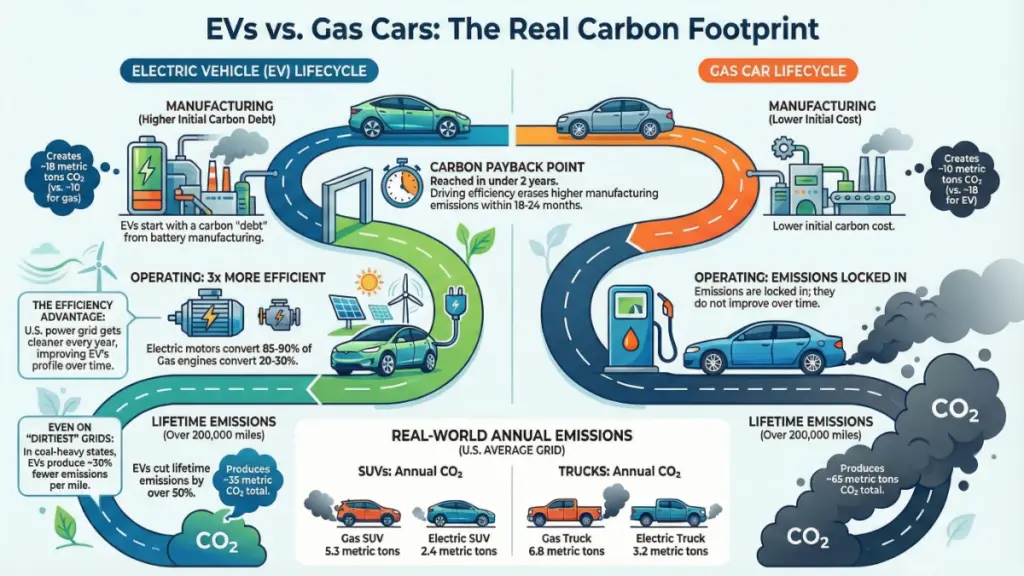
- Toyota RAV4 (gas): 5.3 metric tons CO2 per year
- Tesla Model Y: 2.4 metric tons CO2 per year (U.S. average grid)
- Reduction: 55% lower annual emissions
Full-Size Trucks:
- Ford F-150 (gas, 2.7L EcoBoost): 6.8 metric tons CO2 per year
- Ford F-150 Lightning: 3.2 metric tons CO2 per year (U.S. average grid)
- Reduction: 53% lower annual emissions
These operational emissions tell only part of the story. When we include manufacturing, the picture looks like this over a typical 200,000-mile vehicle lifetime:
A gas-powered mid-size sedan generates approximately 65 metric tons of CO2 equivalent over its complete lifecycle—about 10 tons from manufacturing and 55 tons from 15 years of driving. A comparable EV produces roughly 35 metric tons—18 tons from manufacturing (including that battery) and 17 tons from charging over the same period.
The “carbon payback period”—the point where an EV’s lower operational emissions offset its higher manufacturing footprint—typically occurs within 18-24 months of driving. After that, every mile driven in the EV represents pure carbon savings compared to a gas alternative.
The Grid Reality: Does “Dirty Electricity” Negate EV Benefits?
You’ve probably heard the criticism: “EVs just move pollution from the tailpipe to the power plant.” Let’s examine whether this holds up against the data.
The coal power argument often comes up in these discussions. It’s true that some regions still rely heavily on coal—West Virginia, for example, generates about 90% of its electricity from coal. Even there, however, EVs produce fewer emissions than gas cars. Here’s why:
Modern coal plants, despite being the dirtiest electricity source, are still more efficient at converting fuel to energy than millions of individual car engines. A coal plant operates at 33-40% efficiency, compared to that 20-30% for gasoline engines. Plus, power plants use emission control technologies—scrubbers, filters, catalytic systems—that capture pollutants before they enter the atmosphere. Your car’s engine, even with a catalytic converter, can’t match that level of emission control.
Regional electricity mixes vary dramatically, and this affects EV emissions significantly. In California, where 60% of electricity comes from renewables and natural gas, an EV produces about 80 pounds of CO2 per 100 miles. In West Virginia’s coal-heavy grid, that figure rises to about 140 pounds per 100 miles. But here’s the key comparison: a gas car produces 200 pounds per 100 miles regardless of location.
The grid is rapidly decarbonizing—faster than most people realize. In 2024, renewable energy sources generated 25% of U.S. electricity, up from just 15% a decade earlier. Natural gas, which produces 50-60% less CO2 than coal, has largely replaced coal plants across most of the country. Coal’s share of U.S. electricity generation has plummeted from 50% in 2005 to just 16% in 2024.
This trend means your EV gets cleaner every year without you doing anything. If you bought an EV in 2020, it’s already producing roughly 15% fewer emissions today than when you first drove it home, simply because the grid has shifted toward cleaner sources. A 2015 gas car, meanwhile, emits exactly the same amount today as it did nine years ago.
Charging Choices: How Your Power Source Matters
Where and when you charge your EV can significantly impact your carbon footprint. Understanding these variables gives you additional control over your environmental impact.
Home charging on standard grid electricity represents the baseline for most EV owners. If you charge overnight from your local utility, you’re using whatever mix of energy sources your region provides. In 2024, this averages to about 0.85 pounds of CO2 per kWh nationally, though it varies from 0.3 pounds in Washington State (heavy hydroelectric) to 1.5 pounds in coal-dependent regions.
Time-of-use optimization can reduce your carbon footprint further. Many utilities now offer time-of-use rates that encourage overnight charging when demand is lower. Interestingly, nighttime charging often means cleaner electricity—not because the grid is greener at night, but because industrial facilities wind down and base-load power (often nuclear, hydro, or wind) makes up a larger percentage of the mix. Some utilities report that overnight charging can reduce emissions by 10-20% compared to peak-hour charging.
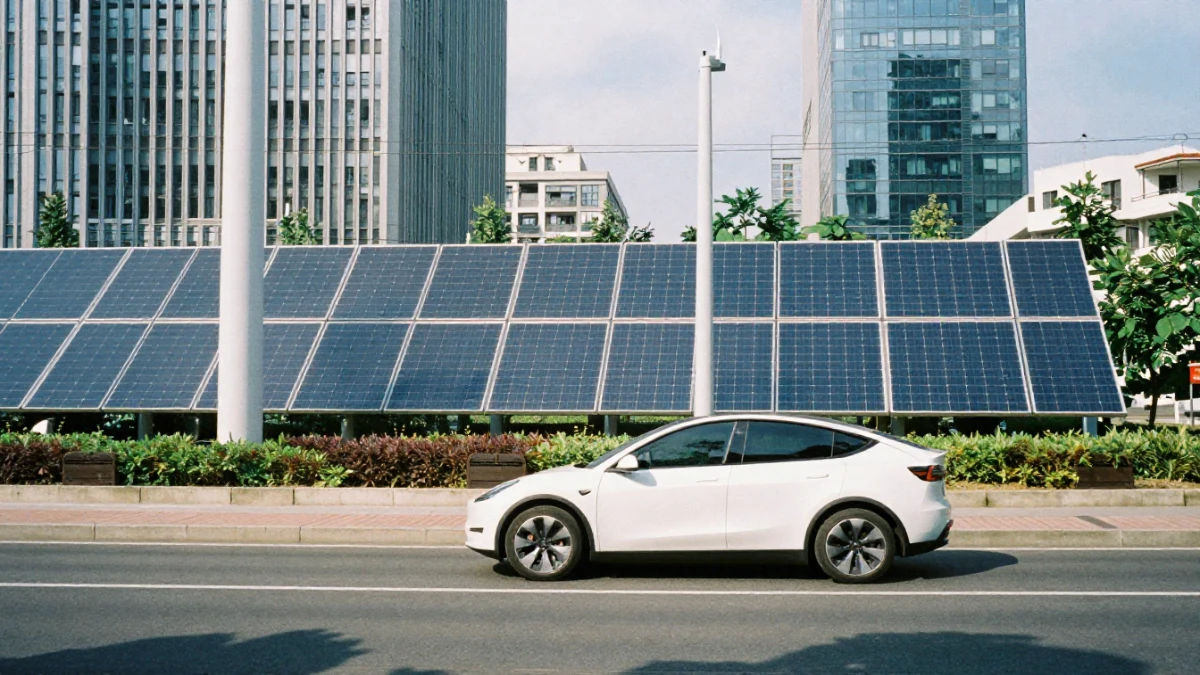
Solar charging represents the cleanest option available. If you install home solar panels, you can charge your EV with effectively zero direct emissions. A typical 6 kW solar array in a sunny location generates enough electricity to power an EV for 12,000-15,000 miles annually. Even accounting for the manufacturing emissions of the solar panels, this setup reduces lifetime EV emissions by an additional 30-40% beyond grid charging.
The numbers are compelling: an EV charged entirely from home solar produces roughly 8-10 metric tons of CO2 equivalent over its complete 200,000-mile lifecycle—about 85% lower than a comparable gas vehicle. This includes manufacturing emissions for both the car and the solar system.
Public charging stations vary in their energy sources. Some networks, like Electrify America, have committed to sourcing 100% renewable energy for their charging infrastructure. Others simply draw from the local grid. If environmental impact is a priority, apps like PlugShare now often indicate which networks prioritize clean energy.
Battery Manufacturing: The Elephant in the Room
Let’s address the biggest criticism head-on: battery production does generate substantial emissions, and pretending otherwise doesn’t serve anyone. But context matters enormously here.
The manufacturing footprint of a lithium-ion battery has been extensively studied. Current estimates place production emissions at 60-80 kg of CO2 equivalent per kWh of battery capacity. For a 75 kWh pack (common in mid-range EVs), that translates to 4.5-6 metric tons of CO2—roughly equivalent to 1-1.5 years of driving a gasoline car.
This seems significant until you consider the full picture. Over a 15-year vehicle lifetime, that upfront carbon debt is more than offset by operational savings within the first two years. After 200,000 miles, the EV still comes out ahead by 30-35 metric tons of avoided emissions.
Manufacturing is getting cleaner rapidly. Battery production in 2024 generates roughly 30% fewer emissions than it did in 2018, thanks to several factors. Many battery factories now source renewable energy—Tesla’s Nevada Gigafactory runs on solar power, and several Chinese manufacturers have shifted to renewable-powered facilities. Production processes have become more efficient, requiring less energy per kWh of capacity. Additionally, more recycled materials are entering the supply chain, reducing the need for energy-intensive mining and refining.
The comparison with gasoline requires honest accounting. Critics who point to battery manufacturing emissions rarely mention that producing gasoline is itself extremely carbon-intensive. Extracting crude oil, transporting it to refineries, refining it into gasoline, and distributing it to gas stations generates about 25-30% additional emissions beyond what comes out of your tailpipe. This “upstream” fossil fuel production adds roughly 1.3 metric tons of CO2 per year for an average driver—emissions that EVs avoid entirely.
Recycling programs are developing rapidly, creating a circular economy for batteries. Companies like Redwood Materials and Li-Cycle now recover 95% of valuable materials from spent EV batteries. By 2030, recycled materials are expected to supply 20-30% of new battery production, further reducing manufacturing emissions and environmental impact.
The Future Gets Cleaner: What’s Coming in 2025-2030
The carbon advantage of EVs isn’t static—it’s improving faster than most projections anticipated. Several converging trends will make electric vehicles even cleaner over the next five years.
Grid decarbonization continues accelerating. The U.S. Energy Information Administration projects that renewable energy will account for 35% of electricity generation by 2030, up from 25% in 2024. Coal’s contribution is expected to drop below 10%. This means an EV purchased in 2025 will produce roughly 30% fewer emissions over its lifetime compared to an identical EV purchased in 2020, simply due to grid improvements.
Battery technology improvements are reducing both manufacturing emissions and resource requirements. New lithium-iron-phosphate (LFP) batteries use no cobalt and produce 15-20% fewer manufacturing emissions than conventional lithium-ion batteries. Solid-state batteries, expected in commercial vehicles by 2027-2028, promise higher energy density with potentially lower manufacturing footprints.
Vehicle-to-grid technology will transform EVs from simple consumers to active grid participants. V2G systems allow parked EVs to discharge power back to the grid during peak demand, helping integrate more renewable energy and reducing the need for fossil fuel “peaker plants.” California and several other states are actively deploying V2G infrastructure, with Ford, GM, and others offering bidirectional charging in new models.
Manufacturing continues shifting toward renewable energy. Major automakers have committed to carbon-neutral manufacturing: GM pledges 100% renewable energy by 2030, Volkswagen by 2035, and Ford by 2035. Battery manufacturers are making similar commitments. These changes will reduce the upfront carbon debt of new EVs by 40-50% compared to today’s vehicles.
Policy support is driving improvements across the board. The Inflation Reduction Act provides incentives for domestic battery production, clean manufacturing, and renewable energy—all of which further reduce EV lifecycle emissions. The EPA’s strengthened vehicle emission standards will effectively require automakers to produce more EVs, accelerating the transition and associated environmental benefits.
Making Your Personal Impact Count
Understanding the big picture is valuable, but what about your individual situation? Here’s how to maximize your carbon reduction through EV ownership:
Location matters significantly for your potential impact. If you live in a state with a clean grid—Washington, Oregon, California, Vermont, or New York—switching to an EV can reduce your transportation carbon footprint by 70-80%. In coal-heavy regions, you’ll still achieve 35-45% reductions. Use the EPA’s Power Profiler tool to check your specific region’s grid mix and estimate your personal emissions reduction.
Driving patterns influence your carbon savings too. EVs excel in city driving where regenerative braking recovers energy. If you mostly drive short trips in urban or suburban areas, you’ll see the maximum efficiency benefit. Highway driving at high speeds reduces the efficiency advantage somewhat, though EVs still beat gas cars on emissions even at 75 mph steady-state cruising.
Consider additional lifestyle changes that compound your impact. If you’re installing a home charger, adding solar panels creates a multiplier effect—your EV becomes a zero-emission vehicle for daily driving. Time your charging during off-peak hours to potentially use cleaner electricity. Combine trips to maximize the efficiency of each charge.
Vehicle choice affects your carbon impact too. A smaller, more efficient EV like a Chevy Bolt produces fewer lifetime emissions than a large electric SUV, though both dramatically beat their gas equivalents. Consider whether you need 300+ miles of range or if 200-250 miles would suffice—smaller batteries mean lower manufacturing emissions.
The second-hand market offers an interesting opportunity. Buying a used EV means you’re not responsible for manufacturing emissions (they’ve already been accounted for), and you still gain all the operational emission benefits. A three-year-old Nissan Leaf or Chevy Bolt can provide most of the environmental benefits of a new EV at a fraction of the cost and carbon impact.
Common Myths and Misconceptions Debunked
Despite overwhelming scientific evidence, several persistent myths about EV emissions continue circulating. Let’s address the most common ones with actual data:
“EVs are just as polluting as gas cars when you factor in the electricity.” This claim ignores both current data and basic physics. As we’ve covered, even in the coal-heaviest grid regions, EVs produce 25-35% fewer lifecycle emissions than gas vehicles. In most of the U.S., that figure exceeds 50%. The efficiency advantages of electric motors over combustion engines are fundamental and insurmountable.
“Battery production emits so much that EVs never make up the difference.” The carbon payback period is well-documented: 18-24 months in most cases, after which every mile driven represents pure carbon savings. Over a 200,000-mile lifetime, EVs avoid 25-35 metric tons of CO2 equivalent compared to similar gas vehicles, even after accounting for battery manufacturing.
“EVs just move pollution from one place to another.” While EVs do shift some emissions from distributed tailpipes to centralized power plants, this is actually an advantage. Centralized pollution sources can be controlled more effectively, use more efficient emission control technology, and are increasingly shifting to renewable sources. Your car’s engine will never get cleaner, but the grid powering your EV already is.
“Most electricity comes from coal, so EVs aren’t clean.” This was more accurate 15 years ago, but it’s outdated today. Coal provided just 16% of U.S. electricity in 2024, down from 50% in 2005. Natural gas (38%), renewables (25%), and nuclear (19%) make up the vast majority. The trend continues toward cleaner sources every year.
“Battery recycling doesn’t work, so EVs create waste problems.” Current EV battery recycling programs recover 95% of materials, and this technology is improving. Unlike gasoline (which can only be burned once), battery materials are repeatedly recyclable. The industry is developing robust circular economy practices that will further reduce the environmental impact of future batteries.
The Bottom Line: Real Impact, Real Numbers
After examining the complete picture—from manufacturing through disposal—the evidence is unambiguous: electric vehicles substantially reduce carbon emissions compared to gasoline-powered alternatives.
Here’s what the science tells us: An average EV in the United States produces 50-60% fewer lifecycle emissions than a comparable gas car. This advantage exists in every U.S. state and improves each year as the grid becomes cleaner. The carbon payback period for the battery’s manufacturing footprint occurs within two years of typical driving, after which EVs provide pure environmental benefits.
The reduction isn’t theoretical—it’s measurable and significant. Switching from a gas car to an EV eliminates approximately 3-4 metric tons of CO2 annually for an average driver. Over a 15-year vehicle lifetime, that’s 45-60 tons of avoided emissions per vehicle. With over 4 million EVs now on U.S. roads, they’re already preventing roughly 12-15 million metric tons of CO2 emissions annually compared to if those vehicles were gas-powered.
Your individual impact matters. While systemic change requires broad policy and industry transformation, personal choices drive demand and accelerate the transition. Every EV purchased sends market signals that shape future investment, technology development, and infrastructure deployment.
The environmental case for EVs strengthens every year as grids decarbonize, manufacturing improves, and recycling programs mature. An EV purchased in 2025 will produce fewer lifetime emissions than an identical model bought in 2020—not because the car changed, but because the electricity powering it is cleaner.
Taking Action: Your Next Steps
If you’re seriously considering an EV purchase, here’s how to make an informed decision that maximizes your environmental impact:
Research your local grid mix using the EPA’s Power Profiler to understand your specific emission reduction potential. This will give you a personalized estimate based on where you actually live and charge. Check whether your utility offers time-of-use rates or green energy programs that could further reduce your carbon footprint.
Calculate your personal driving patterns to determine the appropriate vehicle and range for your needs. Most American drivers cover fewer than 40 miles daily—well within the capability of even entry-level EVs. Right-sizing your vehicle choice reduces both cost and environmental impact.
Explore incentive programs at federal, state, and local levels. The federal tax credit (up to $7,500), state rebates, utility incentives, and potential HOV lane access can significantly offset costs while encouraging cleaner transportation. These incentives exist precisely because society recognizes the environmental benefits of accelerating EV adoption.
Consider starting with a plug-in hybrid if you’re not ready for full electric. PHEVs allow you to drive electrically for daily trips while providing gas backup for longer journeys. While not as environmentally beneficial as full EVs, they still reduce emissions by 30-50% compared to conventional vehicles and offer a transitional step.
Test drive multiple options to find what works for your lifestyle. The EV market in 2025 offers unprecedented variety—from compact cars to SUVs to pickup trucks. Find a vehicle that meets your practical needs so you’ll actually enjoy driving it, because the environmental benefits only materialize if you’re happy with your choice.
The transition to electric transportation represents one of the most significant levers individuals have to reduce their personal carbon footprint. The data is clear, the technology is proven, and the infrastructure is rapidly expanding. Whether you make the switch today or in a few years, you’ll be participating in a transformation that reduces emissions, improves air quality, and helps address climate change—one electric mile at a time.