TL;DR : Here’s a question most EV owners never think to ask: Could the way I drive be quietly shortening my car’s life — or saving me thousands in maintenance costs?
Here’s a question most EV owners never think to ask: Could the way I drive be quietly shortening my car’s life — or saving me thousands in maintenance costs?
The short answer is yes. Absolutely yes.
Electric vehicles are mechanically simpler than gas-powered cars. No oil changes, no timing belts, no exhaust systems. But that doesn’t mean your driving habits are irrelevant. In fact, with EVs, how you drive and charge has a surprisingly direct impact on battery health, brake longevity, tire wear, and overall reliability.
In this article, I’ll break down the key driving behaviors that affect EV maintenance — the good, the bad, and the surprisingly impactful. Whether you’re a new EV owner or have been driving electric for years, you’ll walk away with concrete habits that can extend your vehicle’s life and keep costs low.
1. How Charging Habits Make or Break Battery Health
The battery pack is the single most expensive component in any electric vehicle — often representing 30–40% of the car’s total cost. That makes battery health the cornerstone of EV maintenance, and your charging habits are the biggest variable in the equation.
The 20–80% Rule: Your Battery’s Best Friend
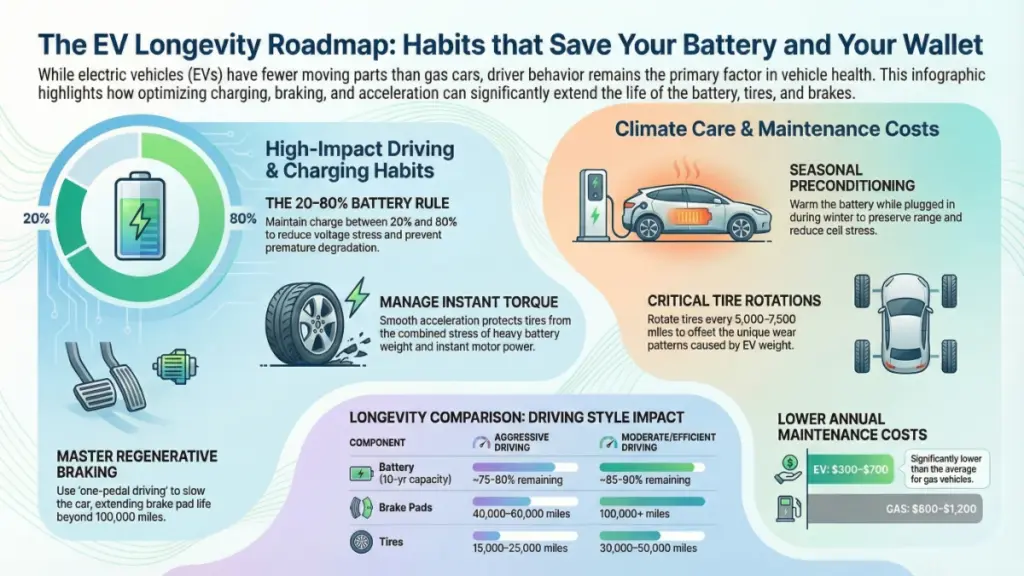
Most EV manufacturers and battery experts recommend keeping your state of charge (SoC) between 20% and 80% for everyday driving. Think of it like a phone battery — constantly charging to 100% and draining to 0% accelerates cell degradation faster than keeping it in the comfortable middle range.
Tesla, for example, explicitly recommends setting your daily charge limit to 80–90% in its owner’s manual. The same guidance appears from Rivian, GM, and most major manufacturers. Why? Because lithium-ion cells experience higher voltage stress at the extremes, which degrades the cathode material over time.
Real-world impact: Studies from Recurrent, an EV data analytics company, show that EVs consistently charged to 100% show measurably faster battery degradation compared to those regularly charged to 80%. Over five years, that difference can translate to 10–15% less usable range.
DC Fast Charging: Convenient but Costly if Overused
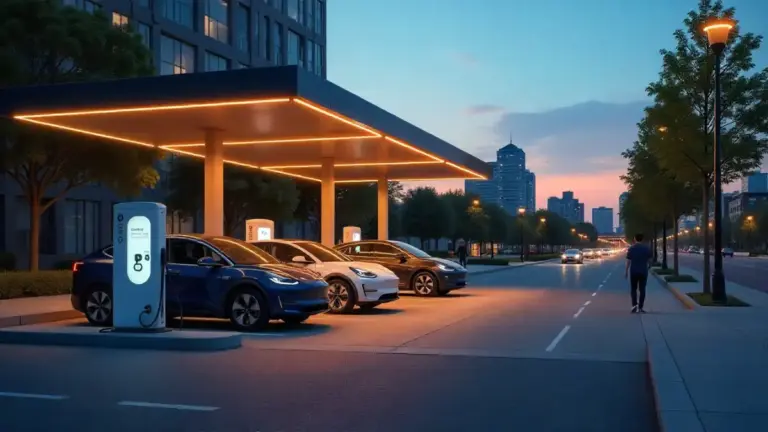
DC fast chargers (like Tesla Superchargers or Electrify America stations) are incredible for road trips — pushing 150–350 kW into your battery in 20–30 minutes. But using them as your primary daily charging method is hard on battery chemistry.
The high current involved in fast charging generates heat, and heat is the enemy of lithium-ion cells. Most modern EVs have thermal management systems to mitigate this, but frequent fast charging still accelerates capacity loss over time. Aim to use Level 2 home charging (7–11 kW) for your daily top-ups, and save the fast chargers for when you genuinely need them on longer drives.
Charging Habit Impact Summary
| Charging Habit | Battery Impact | Recommendation |
| Charge to 100% daily | Accelerates cell degradation | Set limit to 80% for daily use |
| Drain to 0% regularly | High stress on cells | Avoid below 15–20% |
| Daily DC fast charging | Heat buildup, faster aging | Use Level 2 as primary charger |
| Charging to 80% daily | Minimal degradation | Ideal for daily driving |
| Overnight Level 2 charging | Gentle, low-heat charging | Best long-term strategy |
2. Regenerative Braking: The Habit That Saves Your Brakes
One of the most underappreciated advantages of driving an electric vehicle is regenerative braking. When you lift your foot off the accelerator, the motor acts as a generator — slowing the car while converting kinetic energy back into electricity. It’s genuinely clever engineering, and it has a massive impact on brake maintenance.
EV owners who learn to use regenerative braking effectively can extend the life of their brake pads dramatically. In traditional cars, brake pads need replacing every 30,000–70,000 miles depending on driving style. Many EV owners report going well over 100,000 miles on their original brake pads — some even longer.
One-Pedal Driving: Master It, Love It
Most modern EVs — including the Chevy Bolt, Hyundai IONIQ 6, and all Tesla models — offer a “one-pedal driving” mode where regeneration is strong enough to bring the car to a complete stop without touching the brake pedal. Once you get used to it, it feels completely natural and keeps your friction brakes in near-pristine condition.
The flip side? If you rarely use regenerative braking and instead rely heavily on friction brakes (a common habit for drivers transitioning from gas cars), you’re leaving one of the EV’s greatest maintenance advantages on the table.
Watch for Brake Rotor Corrosion
Here’s a counterintuitive problem: because EV owners use their friction brakes so rarely, rotors can develop surface rust — not from overuse, but from underuse. Light surface rust is normal and gets cleared off during occasional hard braking, but in very wet climates, rotors left unused for extended periods can develop more significant corrosion.
The fix is easy: a few deliberate hard stops periodically (safely, of course) will keep your rotors clean and healthy. Think of it as scheduled maintenance that takes about ten seconds.
3. Acceleration Style and Its Hidden Costs
Let’s be real: driving an electric car and not occasionally flooring it is like buying a sports car and staying in third gear. EVs are genuinely fast — the instant torque delivery is addictive. But aggressive acceleration habits do carry maintenance implications worth understanding.
Tire Wear: The Quiet Casualty of Hard Launches
Because electric motors deliver 100% of their torque instantly, aggressive starts put significant stress on tires. EVs are also heavier than comparable gas cars due to battery weight — the average EV weighs 10–30% more than its gas equivalent. That extra mass, combined with instant torque, means tires wear faster under aggressive driving.
EV-specific tires (like the Michelin Pilot Sport EV or Continental EcoContact 6) are designed to handle higher loads and torque demands. They’re not cheap — typically $150–$300 per tire — but they perform noticeably better than standard tires on EVs. Most EV owners should expect to rotate tires every 5,000–7,500 miles, and replace them every 25,000–40,000 miles depending on driving style.
Motor and Drivetrain: More Durable Than You Think
The good news about aggressive driving? Electric motors are remarkably robust. Unlike internal combustion engines, there’s no valve train to stress, no pistons hammering at thousands of RPM, and no transmission clutch packs to wear out. The motor and single-speed reduction gear are engineered to handle the full torque output without flinching.
That said, repeatedly hitting very high speeds (above 90 mph for sustained periods) does generate significant heat in the motor and power electronics. Most EVs will thermally limit performance if temperatures climb too high — a safety feature, not a flaw. If you’re regularly doing track days or high-speed highway driving, keep an eye on thermal management.
EV Maintenance Comparison: Aggressive vs. Moderate Driving
| Component | Aggressive Driving | Moderate/Efficient Driving |
| Battery (10-yr capacity) | ~75–80% remaining | ~85–90% remaining |
| Brake pads | 40,000–60,000 miles | 100,000+ miles possible |
| Tires | 15,000–25,000 miles | 30,000–50,000 miles |
| Motor/drivetrain | Minimal impact | Minimal impact |
| Annual energy cost* | ~$2,000–$2,500 | ~$700–$1,200 |
*Based on U.S. average electricity rate of $0.16/kWh and 12,000 miles/year
4. Temperature Management: Driving Smart in Extreme Weather
Temperature is one of the most powerful — and most overlooked — variables in EV maintenance. Both extreme heat and extreme cold affect battery performance and longevity, and how you manage your vehicle in these conditions matters enormously.
Cold Weather: Precondition Before You Drive
In cold weather, lithium-ion battery performance drops noticeably. Range can decrease 20–40% in temperatures below 20°F (-7°C), and charging speeds slow down as the battery management system works to warm cells before accepting high current. Driving a cold battery hard — especially demanding fast acceleration right after a cold start — adds unnecessary stress.
The solution is preconditioning: most EVs let you schedule cabin and battery warming while the car is still plugged in. This draws power from the grid rather than the battery, preserving range and reducing stress on cold cells. Make this habit a part of your morning routine in winter and you’ll see both better range and slower battery degradation.
Heat: Park in Shade and Use Scheduled Charging
Sustained heat above 95°F (35°C) accelerates battery aging, particularly when the battery is at a high state of charge. Leaving an EV parked in direct sunlight at 100% charge in a hot Arizona summer is genuinely hard on the cells. Whenever possible, park in shade or a garage, and use scheduled charging so the battery reaches its target level just before you depart — rather than sitting at high charge in the heat for hours.
Some EVs (like the Tesla Model 3 and Y) actively run the thermal management system even while parked to protect the battery in extreme heat — a feature called “cabin overheat protection” that also keeps the battery from thermal soak. It’s worth knowing whether your vehicle has this capability and keeping the car on a charger when parked in extreme heat so the system doesn’t drain your battery to cool itself.
5. Efficient Driving Techniques That Reduce Long-Term Wear
There’s a virtuous cycle in EV driving: habits that save energy also tend to reduce wear and maintenance costs. Smooth, efficient driving extends range, reduces tire and brake wear, and places gentler demands on battery and thermal systems simultaneously.
Hypermiling: The Art of Efficient EV Driving
Here are the key efficient driving habits that directly reduce maintenance costs:
- Anticipate stops early: Lifting off the accelerator well ahead of a red light lets regenerative braking do the work, harvesting energy rather than wasting it as heat in the friction brakes.
- Smooth acceleration: Gradual, progressive acceleration from stops reduces tire wear and thermal stress on the battery compared to jack-rabbit starts.
- Maintain consistent speeds on highways: Cruise control at 65–70 mph uses dramatically less energy (and creates less drivetrain stress) than frequent speed changes between 70–85 mph.
- Use Eco or Range mode in the city: These modes soften throttle response and maximize regeneration, reducing energy consumption and mechanical wear simultaneously.
- Minimize climate control use when possible: Heating, in particular, is the biggest range drain in winter EVs. Pre-conditioning while plugged in, using seat heaters instead of cabin heat when appropriate, and dressing warmly all reduce the load on the battery.
Highway vs. City Driving: Which is Better for EVs?
Unlike gas cars (which get terrible city mileage due to idling), EVs actually perform well in both environments — though for different reasons. City driving benefits from frequent regenerative braking opportunities. Highway driving is more consistent and thermally stable but uses more energy at sustained high speeds.
From a pure maintenance perspective, city driving with frequent smooth stops and regeneration is gentler on brakes and tires, while highway driving places more consistent thermal load on the battery. Neither is dramatically worse — but highly aggressive urban driving (frequent hard launches and hard stops) is the worst combination for tire and brake wear.
6. The Maintenance Tasks That Still Matter for EVs
I’ve met plenty of EV owners who assume their car needs almost zero maintenance. That’s mostly true compared to gas vehicles — but “mostly” is doing a lot of work in that sentence. Here’s what actually still requires attention:
- Tire rotations (every 5,000–7,500 miles): Due to EV weight and torque, this is actually more critical than for gas cars. Skipping rotations leads to uneven wear and early replacement.
- Brake fluid (every 2 years): Even with minimal brake pad use, brake fluid absorbs moisture over time and needs periodic replacement to maintain performance and prevent corrosion.
- Cabin air filter (every 15,000–25,000 miles): Filters out pollen, dust, and particulates. Easy DIY task on most models.
- Coolant system check: EVs use liquid cooling for the battery and power electronics. Coolant should be inspected annually and replaced per manufacturer schedule (typically every 5 years or 150,000 miles).
- Windshield wipers and washer fluid: The same boring maintenance as any car.
- Software updates: Modern EVs receive OTA (over-the-air) updates that improve battery management, charging behavior, and efficiency. Keeping software current is genuinely important maintenance.
The total annual maintenance cost for an EV typically runs $300–$700 per year according to Consumer Reports — compared to $800–$1,200 for the average gas vehicle. Drive efficiently and charge smartly, and you’ll stay toward the lower end of that range.
Final Thoughts: Small Habits, Big Savings
Electric vehicles are already low-maintenance machines — but the gap between a well-driven EV and a poorly driven one is larger than most owners realize. The good news? The habits that protect your car are also the ones that save you money on energy costs and make for a more pleasant, smooth driving experience. It’s a rare case where doing the right thing is also the more enjoyable thing.
Here are the five most impactful takeaways from everything we’ve covered:
- Keep your battery between 20–80% for daily use and use Level 2 charging at home whenever possible.
- Master regenerative braking and one-pedal driving — your brake pads will thank you for the next 100,000 miles.
- Precondition in cold weather and park in shade in hot weather to protect battery chemistry.
- Rotate your tires every 5,000–7,500 miles and consider EV-specific tires for better performance and longevity.
- Stay current on software updates — modern EVs improve their own battery management through over-the-air patches.
Your electric car is a long-term investment. Treat it like one — and it will reward you with years of reliable, low-cost, genuinely enjoyable driving.