TL;DR
Elektro-Trucks/SUVs 2025 bereit: 300+ Meilen Reichweite, 14.000 lbs Zugkraft. Top: Ford F-150 Lightning, Rivian R1T, Kia EV9. Aber: Kälte -20-40% Reichweite, Zug -40-60%. Heimladung essentiell, DC-Schnellladung für Langstrecke. Höherer Kaufpreis, aber $1.600-2.100/Jahr Kraftstoff-Ersparnis. Ideal für Pendler, Hausbesitzer, Outdoor-Fans mit realistischen Erwartungen. Noch nicht für Langstrecken-Zug oder Mieter ohne Ladestation.
The automotive landscape is undergoing its most dramatic transformation in over a century, and nowhere is this change more exciting—or more practical—than in the world of electric trucks and SUVs. If you’ve been watching from the sidelines, wondering whether an electric pickup or SUV could actually handle your weekend camping trips, daily commutes, or work demands, you’re asking exactly the right questions.
Here’s the quick answer: Yes, electric trucks and SUVs are ready for real-world use, and they’re becoming more capable every year. The 2025 lineup offers impressive towing capacities (up to 14,000 pounds), practical ranges exceeding 300 miles, and features that often surpass their gas-powered counterparts. But like any major purchase, understanding what’s available and what fits your specific needs makes all the difference.
In this comprehensive guide, I’ll walk you through everything you need to know about electric utility vehicles—from the heavy-hitters currently dominating the market to the practical considerations of ownership. Whether you’re a contractor evaluating work vehicles, an outdoor enthusiast concerned about range, or simply someone who needs more cargo space than a sedan provides, you’ll find the insights to make an informed decision.
The Electric Truck and SUV Revolution: Why Now?
The timing of this electric utility vehicle boom isn’t accidental—it’s the convergence of technology, infrastructure, and consumer demand finally reaching a tipping point.
Technology Has Caught Up to Expectations
Remember when electric vehicles meant compromising on power and capability? Those days are definitively over. Modern electric trucks and SUVs utilize battery packs ranging from 100 kWh to over 200 kWh, delivering the kind of torque and power that actually exceeds traditional internal combustion engines. The Ford F-150 Lightning, for instance, generates 563 horsepower and 775 lb-ft of torque in its Extended Range configuration—numbers that would have seemed like science fiction just five years ago.
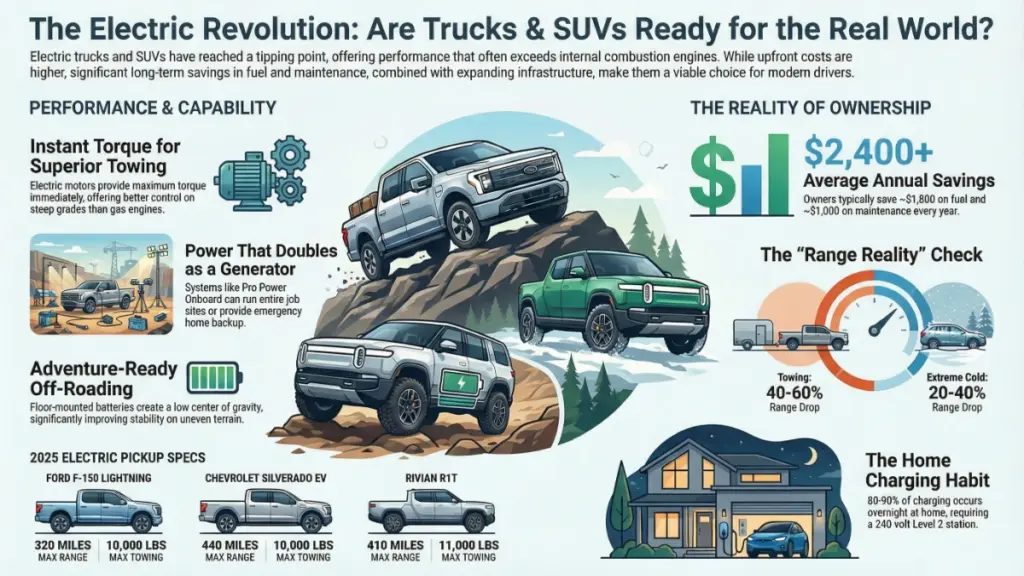
What’s particularly impressive is how electric drivetrains handle weight and towing. Unlike gas engines that struggle at low RPMs, electric motors deliver maximum torque instantly. This means smoother acceleration when pulling a trailer, better control on steep grades, and less strain on the powertrain overall.
Infrastructure Is Expanding Rapidly
One of the biggest concerns I hear about electric trucks centers on charging infrastructure, especially for those who venture beyond city limits. The landscape has changed dramatically in just the past two years. As of early 2025, North America has over 160,000 public charging ports, with DC fast-charging stations (the ones that matter most for trucks and SUVs) growing at approximately 30% annually.
Major automakers are also collaborating on charging networks specifically designed for larger vehicles. The Tesla Supercharger network is opening to non-Tesla EVs, and Ford, GM, and other manufacturers are building charging stations with pull-through bays that accommodate vehicles with trailers attached—a game-changing development for anyone who actually uses their truck for towing.
Market Demand Is Driving Innovation
Here’s an interesting fact that surprised even me: pickup trucks and SUVs represent approximately 70% of new vehicle sales in the United States. Automakers recognize that electrifying this segment isn’t optional—it’s essential for meeting both regulatory requirements and consumer preferences. This has triggered an unprecedented investment in electric utility vehicle development, with over $500 billion committed globally to EV technology through 2030.
The result? Competition that benefits consumers through better vehicles, lower prices, and more diverse options than ever before.
Current Market Leaders: What’s Available in 2025
The electric truck and SUV market has evolved from a handful of experimental models to a robust lineup that covers nearly every use case and price point. Let’s explore what’s actually available today.
Full-Size Electric Pickup Trucks
Ford F-150 Lightning remains the benchmark against which all electric pickups are measured, and for good reason. With two battery options—Standard Range (98 kWh) offering 240 miles and Extended Range (131 kWh) providing up to 320 miles—it delivers genuine truck capability. The payload capacity reaches 2,000 pounds, and it can tow up to 10,000 pounds when properly equipped.
What sets the Lightning apart isn’t just capability—it’s practicality. The front trunk (or “frunk”) offers 14.1 cubic feet of weatherproof, lockable storage with built-in power outlets. The Pro Power Onboard system can power your entire job site or serve as emergency home backup power. I’ve spoken with contractors who’ve eliminated their generators entirely, using their Lightning to run power tools all day without touching a gas can.
Chevrolet Silverado EV entered the market with ambitious specifications: up to 440 miles of range in certain configurations, 10,000-pound towing capacity, and a remarkable 1,300-pound payload in the base Work Truck variant. The Silverado’s “Multiflex” mid-gate system allows you to fold down the rear seats and expand the bed length to accommodate longer cargo—think lumber, kayaks, or building materials that typically require a heavy-duty truck.
Rivian R1T takes a different approach, targeting adventure-seekers and outdoor enthusiasts rather than traditional truck buyers. With quad motors (one per wheel), it offers exceptional off-road capability, including a “Tank Turn” feature that pivots the vehicle in place. The range tops out around 410 miles in the Max Pack configuration, and the R1T’s innovative “Gear Tunnel” provides additional storage that runs the width of the vehicle between the cab and bed.
Electric SUVs Across Multiple Segments
Rivian R1S essentially takes the R1T’s platform and applies it to a three-row SUV format. With seating for up to seven passengers and similar off-road prowess to its pickup sibling, the R1S offers 335-410 miles of range depending on battery configuration. It’s particularly impressive when you consider it can tow 7,700 pounds while maintaining its luxury SUV comfort—ideal for families who need to haul a boat or camper.
Kia EV9 represents the most compelling value proposition in the three-row electric SUV segment. Starting around $55,000, it offers up to 304 miles of range, spacious interior accommodations, and Kia’s excellent warranty coverage. The EV9 demonstrates that electric utility vehicles don’t need to carry premium price tags to deliver genuine capability and quality.
BMW iX targets luxury buyers seeking an electric SUV that doesn’t compromise on premium features or driving dynamics. While its 324-mile range isn’t class-leading, the iX’s interior quality, advanced driver assistance systems, and refined driving experience justify its higher price point for buyers prioritizing comfort over maximum utility.
Tesla Model X continues to offer unique features like falcon-wing doors and impressive performance (0-60 mph in 2.5 seconds in Plaid trim), though its third row remains more suitable for children than adults. The Model X’s access to Tesla’s extensive Supercharger network remains a significant advantage for long-distance travel.
Mid-Size and Compact Electric SUVs
Tesla Model Y has become America’s best-selling electric vehicle overall, offering practical utility in a compact crossover package. With up to 330 miles of range and available third-row seating (though cramped), it strikes an excellent balance between efficiency, capability, and price.
Hyundai Ioniq 5 brings bold styling and impressive technology to the compact SUV segment. Its 800-volt architecture enables 10-80% charging in approximately 18 minutes at compatible fast-chargers—currently the quickest charging time in its class. The available all-wheel-drive system and 256-mile range make it suitable for diverse climates and driving conditions.
Volkswagen ID.4 offers European engineering in an affordable package, with pricing starting around $39,000 before incentives. Its 275-mile range and spacious interior make it a practical choice for families transitioning from compact gas-powered SUVs.
Understanding Range, Towing, and Real-World Capability
Let’s address the elephant in the room: how do electric trucks and SUVs perform when you actually use them as intended—for hauling, towing, and venturing beyond paved roads?
Range Reality: What to Actually Expect
EPA range estimates provide a helpful baseline, but real-world driving introduces variables that significantly impact your actual range. Here’s what you need to know:
Temperature effects are real. Cold weather reduces battery efficiency by approximately 20-40%, meaning that 300-mile range estimate might drop to 180-240 miles in winter conditions. Conversely, extreme heat (above 95°F) can also decrease range by 10-15%, though the impact is less severe than cold.
Highway driving consumes more energy than city driving—the opposite of gas vehicles. Electric motors are most efficient at lower speeds with frequent regenerative braking opportunities. Cruising at 70-75 mph on the interstate typically reduces range by 15-25% compared to EPA estimates based on mixed driving cycles.
Towing cuts range dramatically. This is perhaps the biggest adjustment for truck buyers accustomed to gas-powered vehicles. Towing 5,000-8,000 pounds can reduce range by 40-60%, depending on trailer aerodynamics, weight, and terrain. That 300-mile Lightning suddenly becomes a 150-180-mile truck when pulling a camper. This doesn’t make electric trucks impractical for towing—it just requires different trip planning than you might be used to.
Towing Capabilities: Impressive But Different
Electric trucks excel at towing in some ways and require adaptation in others. The instant torque delivery provides exceptional control and confidence when pulling heavy loads up steep grades. You’ll experience none of the gear-hunting or power lag that plagues many gas engines under strain.
However, the range reduction when towing necessitates strategic charging planning. For local or regional towing (within 100-150 miles of home), electric trucks work beautifully. For cross-country trailer hauling, you’ll need to plan charging stops more carefully than you would fuel stops, and accept that your travel time will increase.
The good news: charging infrastructure specifically designed for towing scenarios continues expanding. Electrify America, EVgo, and other networks are installing pull-through charging bays that allow you to charge without disconnecting your trailer—a massive convenience improvement over earlier installations.
Off-Road Performance: Surprising Advantages
Electric trucks and SUVs offer several advantages for off-road enthusiasts that might not be immediately obvious:
Precise torque control through individual wheel motors (in vehicles like the Rivian R1T/R1S) provides exceptional traction in challenging conditions. The computer can adjust power to each wheel milliseconds faster than any mechanical differential.
Low center of gravity thanks to floor-mounted battery packs improves stability on uneven terrain and steep side slopes. Most electric trucks and SUVs handle better on technical trails than comparably-sized gas vehicles.
Silent operation enhances the outdoor experience—you can enjoy nature without constant engine noise. Plus, wildlife is less likely to be disturbed during your adventures.
Onboard power means you can run campsite equipment, power tools, or emergency devices without carrying a separate generator. The F-150 Lightning’s 9.6 kW Pro Power Onboard system can run a full campsite setup for days without depleting the battery beyond usability for driving.
Charging Infrastructure and Home Charging Considerations
Successfully owning an electric truck or SUV requires understanding charging—both at home and on the road. Let’s break down what you actually need to know.
Home Charging: Your Primary “Fuel Station”
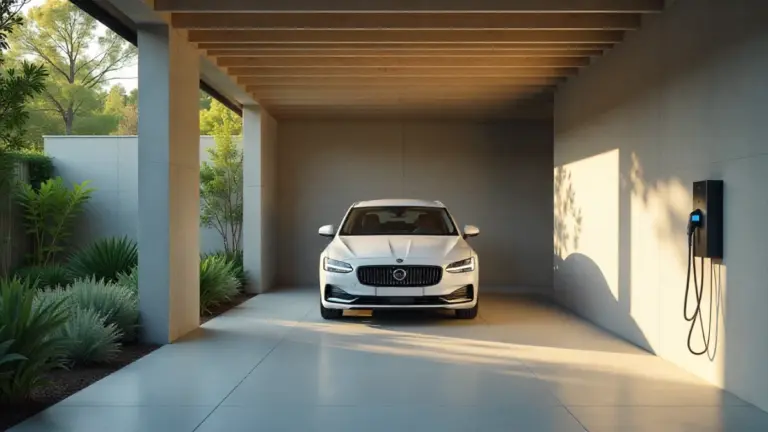
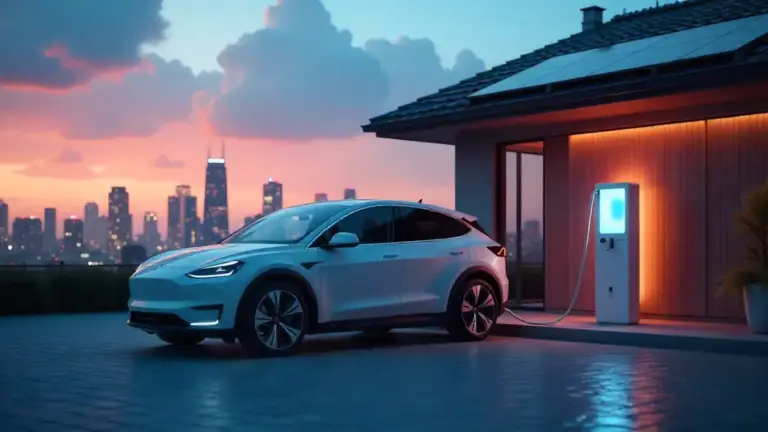
For most owners, 80-90% of charging happens at home overnight. This represents one of the biggest practical advantages of electric vehicles: you start each day with a “full tank” without ever visiting a gas station.
Level 2 home charging (240-volt) is essentially mandatory for trucks and SUVs with large battery packs. A 40-amp Level 2 charger adds approximately 25-30 miles of range per hour, meaning you can fully recharge a depleted battery overnight. Installation costs typically range from $500-$2,000, depending on your electrical panel location and capacity.
Electrical panel capacity becomes a consideration if your home’s electrical service is older or already near capacity. Most electric trucks recommend a 60-80 amp dedicated circuit, which may require a panel upgrade in homes with 100-amp or smaller main service. Factor this potential cost ($1,500-$3,000) into your purchase decision.
Utility rate optimization can significantly reduce charging costs. Many electric companies offer time-of-use rates with substantially lower pricing during off-peak hours (typically 11 PM – 7 AM). Programming your truck to charge during these windows can cut your electricity costs by 40-60%.
Public Charging Networks: Road Trip Capability
DC fast-charging networks have expanded dramatically, but they’re not all created equal. Here’s what matters for truck and SUV owners:
Charging speed varies based on both the vehicle’s maximum acceptance rate and the charger’s output capacity. Most current electric trucks can accept 150-180 kW, allowing 10-80% charges in 30-40 minutes at compatible stations. Newer vehicles with 800-volt architecture (like the Hyundai Ioniq 5) can charge even faster when paired with appropriate infrastructure.
Network availability differs by region. Tesla’s Supercharger network remains the most extensive and reliable, with over 40,000 stalls in North America. However, most non-Tesla electric trucks can’t yet access these stations (though this is changing in 2025 as Tesla opens its network). For now, networks like Electrify America, EVgo, and ChargePoint serve the majority of electric trucks and SUVs.
Charging costs at public stations typically range from $0.30-$0.55 per kWh, varying by network, location, and time of day. For perspective, charging a 130 kWh battery from 10-80% might cost $25-$40 at public fast-chargers, compared to $5-$15 for the same charge at home.
Route Planning Apps Are Essential
Apps like A Better Route Planner (ABRP), PlugShare, and vehicle manufacturer apps help identify charging locations, plan multi-stop journeys, and avoid range anxiety. These tools factor in your vehicle’s specific characteristics, current weather, terrain, and even whether you’re towing to provide accurate arrival estimates and charging recommendations.
The first few road trips require more planning than you’re probably accustomed to with gas vehicles. However, most owners report that this becomes second nature within a few weeks, and the convenience of home charging more than compensates for the occasional need to plan longer journeys more carefully.
Cost Analysis: Purchase Price vs. Long-Term Ownership
Electric trucks and SUVs carry higher upfront costs than their gas counterparts, but the total cost of ownership tells a more favorable story. Let’s examine the real numbers.
Purchase Price Considerations
Base prices for electric trucks and SUVs typically start $10,000-$20,000 higher than comparable gas models. The Ford F-150 Lightning starts around $55,000, while a similarly-equipped gas F-150 might cost $42,000-$48,000. Luxury electric SUVs like the BMW iX or Mercedes EQS SUV command premium prices exceeding $80,000.
Federal tax credits of up to $7,500 can significantly offset initial costs for qualifying vehicles. However, eligibility depends on where vehicles are assembled, battery component sourcing, and buyer income limits (under the Inflation Reduction Act requirements). As of 2025, several popular models qualify for the full credit, while others receive partial credits or none at all.
State and local incentives vary widely. California offers up to $7,500 in additional rebates, while states like Oregon, Colorado, and New York provide $2,500-$5,000. Some utilities also offer purchase incentives or reduced charging rates. Combining federal, state, and utility incentives can reduce effective purchase prices by $10,000-$15,000.
Operating Cost Advantages
Here’s where electric trucks and SUVs shine financially:
Fuel savings are substantial. Charging at home costs approximately $0.12-$0.15 per kWh on average (lower with time-of-use rates). Driving 15,000 miles annually in an electric truck consuming 2.5 miles/kWh costs about $900-$1,100 in electricity. A comparable gas truck averaging 18 mpg would cost $2,500-$3,000 in fuel at current prices—a savings of roughly $1,600-$2,100 per year.
Maintenance costs are dramatically lower. Electric drivetrains have far fewer moving parts: no oil changes, transmission services, spark plug replacements, or exhaust system repairs. Most electric trucks require only tire rotations, cabin air filter changes, and occasional brake service (which is needed less frequently thanks to regenerative braking). Expect to save $800-$1,200 annually compared to gas truck maintenance.
Brake longevity benefits from regenerative braking, which uses the electric motor to slow the vehicle and recapture energy rather than relying solely on friction brakes. Many electric vehicle owners report brake pads lasting 100,000+ miles—three to four times longer than traditional vehicles.
Insurance costs can be 10-20% higher for electric vehicles due to higher replacement values and repair costs. However, some insurers offer discounts for EVs recognizing their advanced safety features.
Break-Even Analysis
Combining purchase price premiums with operating cost savings, most electric truck owners reach break-even within 5-7 years of ownership. If you drive more miles annually, tow frequently (using home charging), or live in areas with especially high gas prices, this timeline shortens to 3-5 years.
Beyond break-even, continuing operating cost savings accumulate as pure financial benefit. Over a typical 10-year ownership period, many owners save $15,000-$25,000 compared to owning a gas truck—even accounting for the higher initial purchase price.
Who Are Electric Trucks and SUVs Really For?
After spending time researching and evaluating these vehicles, I’ve identified several distinct buyer profiles that benefit most from electric utility vehicles.
The Daily Commuter Who Needs Utility
If you drive 30-60 miles daily for work but also need truck or SUV capability for weekend projects, family activities, or hobbies, you’re an ideal electric truck candidate. Home charging handles your daily needs effortlessly, and the occasional longer trip is easily manageable with minimal planning. The fuel savings alone can be substantial—we’re talking $150-$200 monthly for many drivers.
The Homeowner and DIY Enthusiast
Electric trucks excel for homeowners who frequently haul supplies, equipment, or tools but rarely travel long distances while loaded. The combination of ample cargo space, onboard power for tools (eliminating generator needs), and low operating costs makes vehicles like the F-150 Lightning particularly compelling. Several contractors I’ve interviewed report that the Pro Power Onboard feature alone justifies the switch—they’ve eliminated fuel costs for generators and reduced noise complaints from neighbors in residential areas.
The Outdoor Adventurer (With Realistic Expectations)
If your adventures typically fall within 150-200 miles of home—weekend camping trips, mountain biking excursions, ski outings—electric SUVs and trucks work beautifully. The Rivian R1T and R1S are specifically designed for this use case, offering exceptional off-road capability plus the convenience of silent running and built-in power for camping equipment. The key is managing expectations about towing range and planning charging stops for longer journeys.
The Environmentally-Conscious Family
Families prioritizing sustainability but needing the space and utility of an SUV find compelling options in vehicles like the Kia EV9, Rivian R1S, or Tesla Model Y. These vehicles offer seating for 5-7 passengers, substantial cargo capacity, and significantly lower carbon footprints than gas SUVs—especially when charged using renewable energy sources.
Who Should Wait (For Now)
Electric trucks and SUVs aren’t quite ready for everyone yet:
- Long-distance towers who regularly haul trailers 300+ miles should probably wait for next-generation vehicles with larger batteries and faster charging, or consider plug-in hybrid alternatives
- Apartment dwellers without charging access face challenges without guaranteed home charging—though this is improving as landlords and property managers install chargers
- Budget-conscious buyers may find the upfront costs prohibitive even with incentives, especially if annual mileage is low (reducing fuel savings benefits)
- Those in extreme climates might want to see further cold-weather battery improvements, though current vehicles are certainly usable in winter with range adjustments
Looking Forward: What’s Coming in 2026-2027
The electric truck and SUV market is evolving rapidly, with several developments worth watching:
Next-Generation Battery Technology
Solid-state batteries promise energy densities 40-50% higher than current lithium-ion packs, potentially enabling 400-500+ mile ranges in large vehicles while reducing charging times. Toyota, Ford, and others have announced solid-state battery vehicles for 2026-2027 production, though industry observers expect meaningful volume in 2027-2028.
Expanded Model Availability
Over 30 new electric truck and SUV models are scheduled for North American launch between now and early 2027. This includes:
- Electric versions of popular models like the Toyota 4Runner and Jeep Wrangler
- Heavy-duty electric pickups from Ram and Chevrolet (2500/3500 class)
- Mid-size electric trucks from Toyota (Tacoma EV) and others
- Additional luxury electric SUVs from Mercedes, Audi, and BMW
Charging Infrastructure Growth
The National Electric Vehicle Infrastructure (NEVI) program is deploying charging stations along highway corridors nationwide, with particular focus on accommodating larger vehicles and towing scenarios. By 2027, experts project DC fast-charging stations every 50 miles on major interstates.
Vehicle-to-Home (V2H) and Bidirectional Charging
Next-generation electric trucks will increasingly support bidirectional charging, allowing your vehicle to power your home during outages or peak-rate periods. The F-150 Lightning already offers this capability (with compatible equipment), and other manufacturers are following suit. This transforms your truck from simple transportation into a mobile energy storage system—a compelling value proposition in areas prone to power outages.
Key Takeaways: Making Your Decision
As we’ve explored throughout this guide, electric trucks and SUVs have evolved from experimental concepts into genuinely capable vehicles suitable for diverse use cases. Here’s what you should remember:
Electric trucks and SUVs are ready for mainstream adoption if your use case aligns with their strengths: daily driving with home charging, regional towing, and weekend adventures. They’re not yet ideal for every scenario, but they’re far more capable than most people realize.
Total cost of ownership matters more than sticker price. While initial costs are higher, fuel and maintenance savings accumulate significantly over time. Run the numbers for your specific situation—many buyers are pleasantly surprised by the long-term value proposition.
Charging infrastructure continues improving rapidly. Range anxiety remains the most common concern, but it’s becoming less justified with each passing month as networks expand and vehicle ranges increase. The key is understanding your actual needs rather than planning for theoretical worst-case scenarios.
The technology will continue improving, but waiting indefinitely means missing out on current benefits. Today’s electric trucks and SUVs are already impressive; tomorrow’s will be better. Only you can decide whether current capabilities meet your needs.
My recommendation? If you’re seriously considering an electric truck or SUV, take multiple test drives in real-world conditions. Rent one for a weekend if possible. Evaluate your actual driving patterns honestly—most people discover their range needs are far lower than they initially assumed. Talk to current owners about their experiences (online forums are excellent resources). And remember: the transition to electric utility vehicles isn’t about sacrifice—it’s about embracing a different, often better, way of driving.
The future of trucks and SUVs is electric. The only question is when you’ll join it.