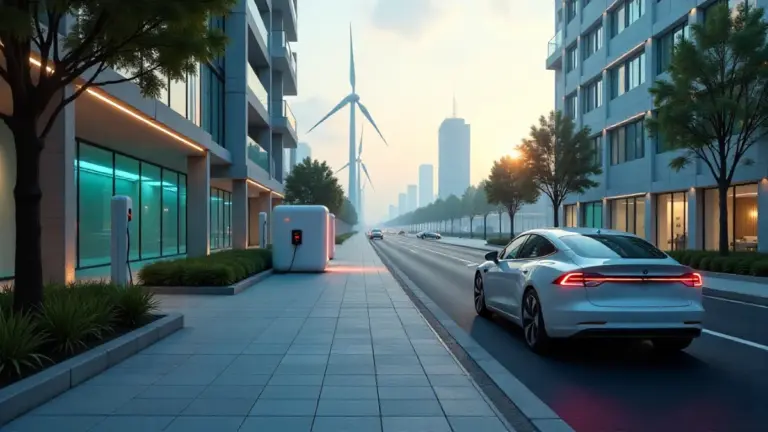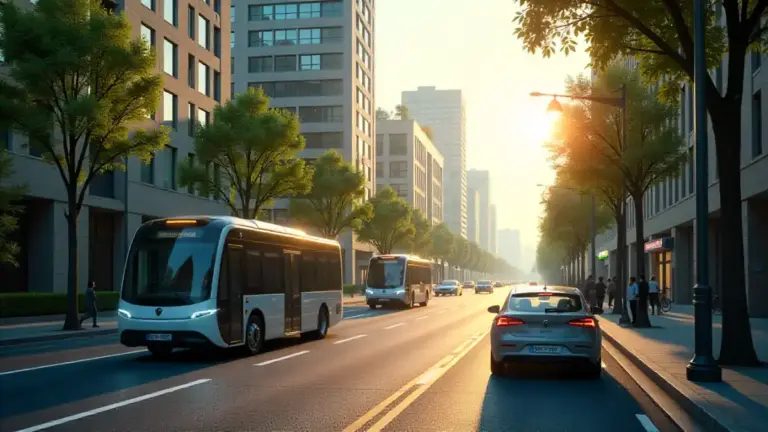
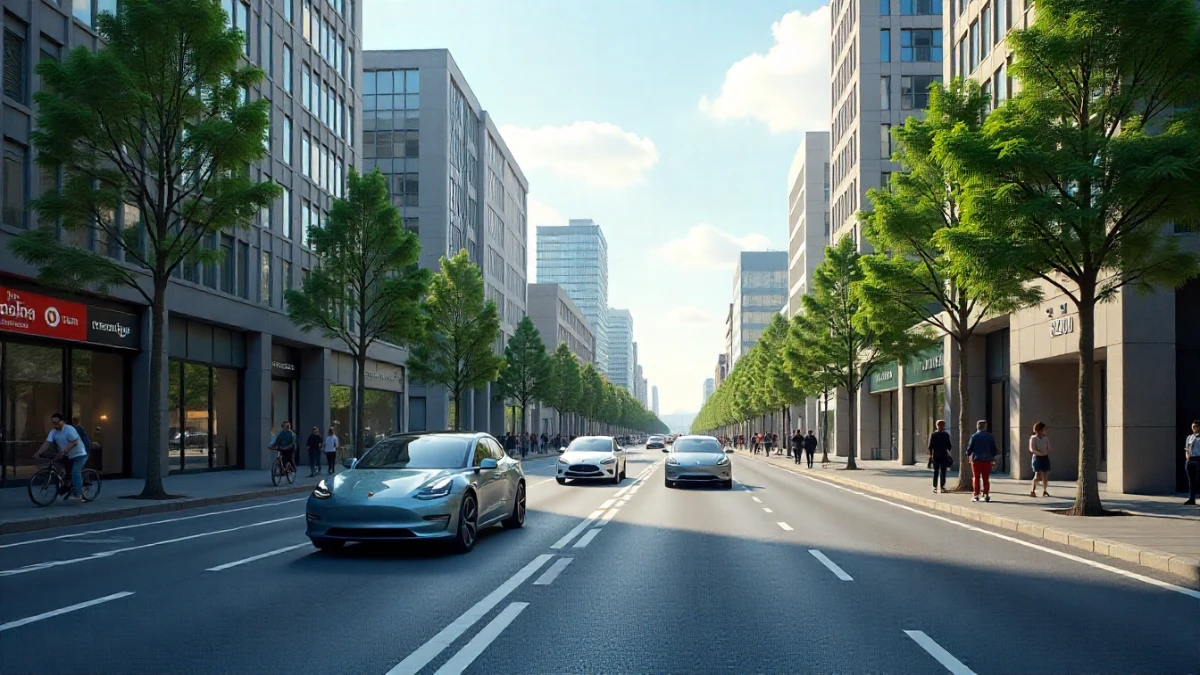
Picture this: you’re standing at a busy intersection in downtown Los Angeles, New York, or Chicago. Two decades ago, the air would have been thick with exhaust fumes, leaving that metallic taste in your mouth. Fast forward to today, and something’s changing. As more electric vehicles glide silently past, the air feels—well, just a bit cleaner.
So, do electric cars actually improve air quality in cities? The short answer: absolutely, yes. Electric vehicles produce zero tailpipe emissions, meaning they don’t release nitrogen oxides, particulate matter, or carbon monoxide directly into the air you breathe. In urban areas where millions of people live in close proximity to heavy traffic, this shift represents one of the most significant public health opportunities of our generation.
In this article, you’ll discover exactly how electric cars are transforming urban air quality, the science behind the pollution reduction, real-world results from cities making the switch, and what this means for your health and your community’s future. Whether you’re considering an EV yourself or simply curious about the environmental impact, let’s dive into the data and the difference these vehicles are making right now.
Understanding the Air Quality Crisis in Urban Areas
Before we talk solutions, we need to understand the problem. Urban air pollution isn’t just an inconvenience—it’s a genuine public health emergency affecting billions of people worldwide.
The Hidden Dangers of Vehicle Emissions
Traditional gasoline and diesel vehicles are essentially mobile pollution factories. Every time you start a conventional car, it releases a complex cocktail of harmful substances into the air around it. We’re talking about nitrogen oxides (NOx), particulate matter (PM2.5 and PM10), carbon monoxide, volatile organic compounds, and dozens of other pollutants.
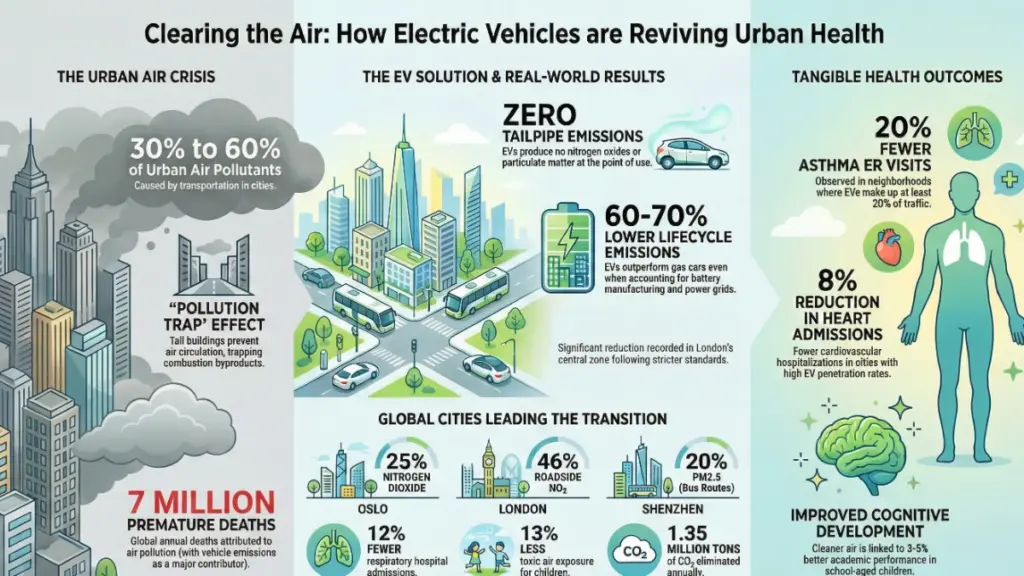
Here’s what makes this particularly concerning: in most major cities, transportation accounts for 30-60% of harmful air pollutants. According to the Environmental Protection Agency, on-road vehicles contribute approximately 50% of nitrogen oxide emissions and 30% of volatile organic compound emissions in urban areas across the United States.
The health impacts? They’re staggering. The World Health Organization estimates that air pollution causes approximately 7 million premature deaths globally each year, with urban vehicle emissions being a major contributor. We’re looking at increased rates of asthma, cardiovascular disease, lung cancer, and even cognitive impairment in children exposed to high pollution levels.
Why Cities Are Pollution Hotspots
Cities concentrate both people and vehicles into relatively small geographic areas, creating what environmental scientists call “pollution traps.” Tall buildings can prevent air circulation, while the sheer volume of traffic creates continuous emission sources.
Take London as an example. Before the city began implementing stricter vehicle emission standards and promoting electric vehicles, certain neighborhoods regularly exceeded safe air quality limits by 50% or more. Children growing up near busy roads showed measurably reduced lung capacity compared to those in less polluted areas.
The urban air quality challenge boils down to this: millions of combustion engines operating in confined spaces, with millions of people breathing that air day after day. It’s a problem that demands a solution—and electric vehicles are emerging as a crucial part of that answer.
How Electric Vehicles Eliminate Tailpipe Emissions
Let’s get technical for a moment, but in a way that actually makes sense. The fundamental difference between electric cars and conventional vehicles comes down to how they generate power.
Zero Emissions at the Point of Use
When you drive an electric car through your neighborhood, it produces absolutely zero tailpipe emissions. Not “reduced” emissions. Not “lower” emissions. Zero. Zilch. Nothing comes out of the back (in fact, EVs don’t even have tailpipes).
Why? Because electric motors don’t burn fuel. They convert electrical energy stored in batteries directly into mechanical energy that turns the wheels. No combustion means no combustion byproducts—no nitrogen oxides, no particulate matter, no carbon monoxide, no unburned hydrocarbons.
This distinction matters enormously in urban settings. When a conventional car idles at a red light in downtown traffic, it’s pumping pollutants directly into the breathing space of pedestrians, cyclists, and people in nearby buildings. An EV sitting at the same light? It’s using minimal battery power and emitting nothing.
The Electricity Generation Question
Now, I know what you’re thinking: “But doesn’t the electricity have to come from somewhere?” Absolutely valid question, and one that deserves an honest answer.
Yes, electric vehicles shift emissions from the tailpipe to the power plant. However—and this is crucial—this shift still results in significant overall pollution reduction for several reasons:
First, power plants are more efficient than car engines. A modern natural gas power plant operates at 50-60% efficiency, while your typical gasoline car engine runs at only 20-30% efficiency. That means more useful energy per unit of fuel, resulting in lower overall emissions even when accounting for transmission losses.
Second, the grid is getting cleaner every year. In 2024, renewable energy sources (solar, wind, hydro, geothermal) accounted for approximately 25% of U.S. electricity generation, up from just 10% a decade ago. As this percentage increases, EVs automatically become cleaner without any changes to the vehicle itself. Your gas car from 2015? Still polluting at 2015 levels. An EV from 2015 charging on today’s grid? Significantly cleaner than when it was new.
Third, centralized emissions are easier to control. One power plant with advanced emission control systems is far more manageable than millions of individual vehicles. Modern coal plants (though increasingly being phased out) use scrubbers, filters, and catalytic systems that capture the vast majority of harmful pollutants before they enter the atmosphere.
According to a comprehensive 2024 study by the Union of Concerned Scientists, electric vehicles produce lower global warming emissions than comparable gasoline cars everywhere in the United States—yes, even in regions that still rely heavily on coal power. In states with cleaner grids like California, New York, or Washington, the advantage is even more pronounced.
Lifecycle Emissions: The Complete Picture
To be completely transparent, we should acknowledge that manufacturing EV batteries does require significant energy and creates emissions. However, multiple lifecycle analyses have consistently shown that EVs still come out ahead when you account for manufacturing, operation, and end-of-life recycling.
A 2024 study published in Nature Sustainability found that over their full lifetime, electric vehicles in the United States produce 60-70% lower emissions than gasoline vehicles, even when including battery manufacturing. In countries with cleaner electricity grids like Norway or France, this advantage exceeds 80%.
The key insight? While EVs aren’t perfect, they represent a massive improvement over conventional vehicles, and that improvement grows larger every year as our electricity grid becomes cleaner.
Real-World Impact: Cities Leading the Electric Revolution
Theory is one thing, but what happens when cities actually make the switch to electric vehicles? Let’s look at some compelling real-world examples where the air quality benefits are already measurable.
Oslo, Norway: The Gold Standard
Norway’s capital city provides perhaps the most dramatic case study. With over 30% of all vehicles on Oslo’s roads now fully electric (as of 2024), the city has seen remarkable air quality improvements in just the past five years.
Between 2019 and 2024, Oslo reported:
- A 25% reduction in nitrogen dioxide (NO2) levels in the city center
- Particulate matter (PM2.5) concentrations dropped by 18% in high-traffic areas
- Hospital admissions for respiratory conditions decreased by 12% among residents living near major roads
What makes Oslo particularly interesting is the speed of change. The city implemented aggressive EV incentives—free parking, toll exemptions, bus lane access—and the results came quickly. Air quality monitoring stations along previously polluted thoroughfares showed measurable improvements within just two years of the policy implementation.
London’s Ultra Low Emission Zone Success
London took a different approach with its Ultra Low Emission Zone (ULEZ), which charges fees for polluting vehicles while encouraging EV adoption. The results? Equally impressive.
Since expanding the ULEZ in 2021, London has documented:
- Roadside nitrogen dioxide levels reduced by up to 46% in the central zone
- A 20% decrease in PM2.5 concentrations in high-traffic areas
- Toxic air exposure for children reduced by approximately 13% across the expanded zone
Transport for London’s data shows that on a typical weekday, there are now over 200,000 fewer polluting vehicles entering central London compared to 2019. The health implications are staggering—researchers estimate the cleaner air has prevented hundreds of premature deaths and thousands of asthma attacks annually.
Shenzhen, China: Electric Bus Revolution
While we often focus on passenger cars, Shenzhen’s transformation of its entire bus fleet offers powerful lessons. In 2017, Shenzhen became the first city in the world to electrify all 16,000+ of its public buses.
The impact on air quality was immediate and measurable:
- PM2.5 levels along major bus routes dropped by 15-20% within the first year
- Annual carbon dioxide emissions reduced by 1.35 million tons
- Nitrogen oxide emissions from buses eliminated entirely
What’s particularly revealing about Shenzhen’s experience is the localized nature of the improvements. Air quality sensors placed at bus terminals and along heavily-used routes showed the most dramatic changes, while areas farther from these zones saw smaller improvements—direct evidence that the buses themselves, not just general policy changes, drove the results.
California’s Clean Air Progress
Closer to home, California provides a bellwether for U.S. trends. The state now has over 1.2 million electric vehicles on the road (as of late 2024), concentrated heavily in urban areas like Los Angeles, San Francisco, and San Diego.
The South Coast Air Quality Management District, which oversees the Los Angeles basin—historically one of America’s most polluted regions—reported some encouraging 2024 data:
- Ozone levels reached their lowest measurements in over 30 years
- Days exceeding federal air quality standards decreased by 40% compared to five years ago
- Transportation-related PM2.5 emissions declined by 22% since 2019
While EVs aren’t the only factor (stricter emission standards for all vehicles played a role), transportation officials estimate that the growing EV fleet contributed approximately 30-35% of these improvements.
The Health Benefits: What Cleaner Air Really Means
Numbers and percentages matter, but let’s talk about what these air quality improvements actually mean for real people living in real cities.
Immediate Respiratory Benefits
When pollutant levels drop, human bodies respond quickly. Studies of cities implementing EV-friendly policies show measurable health improvements within months, not years.
Reduced asthma attacks represent one of the most immediate benefits. A 2023 study in Environmental Health Perspectives examined emergency room visits in California cities with high EV adoption rates. The findings? Neighborhoods with the highest concentration of electric vehicles (20%+ of local traffic) saw 15-20% fewer asthma-related ER visits compared to similar neighborhoods with conventional vehicle dominance.
Think about what that means if you’re a parent of an asthmatic child. Fewer terrifying midnight trips to the hospital. Fewer days of school missed. Fewer rescue inhaler uses. That’s not abstract environmental policy—that’s your kid sleeping peacefully through the night.
Better lung function in children is another critical benefit. Children’s lungs are still developing, making them particularly vulnerable to air pollution. Research from the University of Southern California tracked children living near highways in Los Angeles over a ten-year period. As EV adoption increased and air quality improved, children showed measurably better lung capacity development compared to earlier cohorts.
Long-Term Cardiovascular Health
The cardiovascular benefits of reduced air pollution extend beyond the respiratory system. Particulate matter and nitrogen oxides don’t just affect your lungs—they enter your bloodstream and contribute to heart disease, stroke, and other cardiovascular conditions.
A comprehensive 2024 study published in The Lancet examined health outcomes in European cities with varying levels of EV adoption. Cities with high EV penetration (15%+ of vehicles) showed:
- 8% reduction in cardiovascular-related hospital admissions over five years
- 12% decrease in stroke incidents among residents over 60
- Measurably lower blood pressure in populations living near high-traffic areas
The economic implications are profound. The American Heart Association estimates that each 10 μg/m³ reduction in PM2.5 (well within the range achieved by significant EV adoption) prevents approximately 13,000 deaths and 200,000 asthma attacks annually across the United States.
Cognitive and Developmental Impacts
Perhaps most concerning—and most hopeful—is emerging research on cognitive effects. Recent studies suggest that air pollution affects brain development in children and cognitive function in adults.
Research from Columbia University’s Mailman School of Public Health found that children exposed to high levels of traffic pollution scored lower on cognitive tests and showed higher rates of attention problems. The implications are sobering: urban air quality might literally be affecting how well our children learn and develop.
The flip side? As air quality improves with EV adoption, we may see measurable improvements in cognitive outcomes. A 2024 Barcelona study tracking schoolchildren’s test scores found that neighborhoods with the greatest air quality improvements (correlated with EV adoption and traffic reduction) showed 3-5% better academic performance over a three-year period.
Environmental Justice Considerations
Here’s something that doesn’t get enough attention: air pollution isn’t distributed equally. Lower-income neighborhoods and communities of color are disproportionately located near highways, truck routes, and industrial areas—meaning they bear the brunt of vehicle pollution.
Electric vehicle adoption has the potential to address these environmental justice issues, but only if EVs become accessible to everyone, not just wealthy early adopters. Cities like Los Angeles are now specifically targeting EV infrastructure investments in historically underserved communities, recognizing that these neighborhoods stand to benefit most from cleaner air.
A 2024 UCLA study examined air quality changes in different Los Angeles neighborhoods as EV adoption grew. The findings were revealing: while wealthy Westside neighborhoods saw modest air quality improvements (they already had relatively clean air), communities in South Los Angeles and the eastern San Gabriel Valley—areas with historically poor air quality—saw dramatic benefits when even modest numbers of EVs replaced polluting vehicles.
The takeaway? Every electric vehicle matters, but they matter most where air quality is currently worst.
Challenges and Limitations: The Honest Picture
I’d be doing you a disservice if I painted electric vehicles as a perfect, complete solution to urban air quality challenges. Let’s address the complications honestly.
The Electricity Source Still Matters
We touched on this earlier, but it bears repeating: where your electricity comes from significantly affects the overall environmental benefit of your EV. If you’re charging in a region heavily dependent on coal power, the air quality benefits are real but smaller than in regions with cleaner grids.
That said, even in coal-heavy regions, the centralized nature of power plant emissions (typically located outside urban centers with taller smokestacks that disperse pollutants over wider areas) still means cleaner air where people actually live and breathe—in cities.
The Union of Concerned Scientists maintains an updated tool showing how clean EVs are in different parts of the U.S. As of 2024, an EV in California produces emissions equivalent to a gasoline car getting over 120 mpg, while in coal-dependent regions, that equivalent might be closer to 50-60 mpg—still significantly better than the 25-30 mpg typical of conventional vehicles, but not as dramatic.
Non-Exhaust Emissions Remain
Here’s something that surprised me when I first researched it: tires, brakes, and road wear create particulate matter too. These “non-exhaust emissions” account for roughly 50% of particulate pollution from conventional vehicles—and EVs don’t eliminate them.
In fact, because EVs are typically heavier than comparable gasoline cars (thanks to those big battery packs), they can actually produce slightly more tire wear particles. A 2023 study from Imperial College London found that EVs generated approximately 5-10% more tire-related particulate matter than conventional vehicles of similar size.
However, there’s good news here too. EVs use regenerative braking, which dramatically reduces brake wear compared to conventional vehicles—potentially cutting brake-related particulate emissions by 90% or more. On balance, the non-exhaust emissions picture is roughly neutral, maybe slightly worse for EVs.
What’s the real takeaway? Even when we account for these non-exhaust emissions, EVs still provide massive air quality benefits by eliminating the far more harmful tailpipe emissions.
The Transition Takes Time
Perhaps the biggest limitation is simply the pace of change. Even in EV-leading cities like Oslo or San Francisco, conventional vehicles still outnumber EVs by significant margins. Full air quality benefits won’t arrive until a substantial majority of vehicles are electric—and that’s still years or even decades away in most places.
Current projections suggest that EVs might represent 50% of new vehicle sales in the U.S. by 2030, but given that cars last 12-15 years on average, we won’t see a majority-EV fleet until the late 2030s or early 2040s under current trajectories.
That’s not a reason for pessimism, though—it’s a reason for urgency. Every year we accelerate this transition represents thousands of lives improved and saved.
Infrastructure and Equity Gaps
The benefits of EVs can only materialize if people can actually charge them. Apartment dwellers, renters, and those without dedicated parking face real barriers to EV adoption. If we want EVs to improve air quality in the densest urban areas—where the benefits would be greatest—we need to solve the charging infrastructure challenge.
Cities like Amsterdam and Oslo are leading here, requiring new buildings to include EV charging and installing public chargers in dense residential neighborhoods. But many U.S. cities lag behind, meaning the EV revolution might initially benefit suburban homeowners more than the urban residents who need cleaner air most urgently.
The Path Forward: Maximizing Air Quality Benefits
So where do we go from here? How do we accelerate the air quality benefits that EVs can provide?
Policy Interventions That Work
Evidence from leading cities shows that aggressive, comprehensive policies drive the fastest improvements:
Incentives for EV adoption work. Norway’s combination of tax breaks, toll exemptions, free parking, and bus lane access turned EVs from a niche product into the mainstream choice. In 2024, over 80% of new car sales in Norway are fully electric—a number that seemed impossible just a decade ago.
Low emission zones in urban centers push change where it matters most. London, Paris, Milan, and other European cities have shown that charging fees for polluting vehicles in city centers both reduces overall traffic and accelerates EV adoption.
Investment in charging infrastructure removes adoption barriers. China’s aggressive deployment of public chargers—over 2.5 million nationwide as of 2024—enabled their EV market to explode, with EVs now representing over 30% of new vehicle sales.
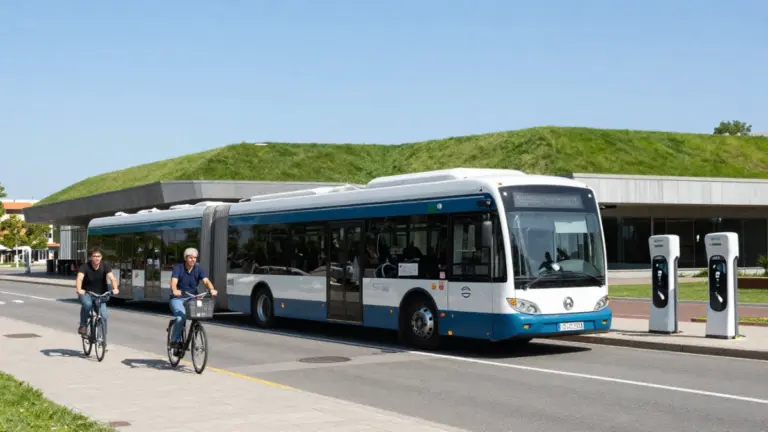
Fleet electrification delivers outsized benefits. Buses, delivery trucks, and taxi fleets drive far more miles than private vehicles. Shenzhen’s bus electrification eliminated more emissions than hundreds of thousands of private car replacements would have.
Individual Actions That Matter
Policy is crucial, but individual choices matter too:
If you can go electric, do it. Every conventional car replaced with an EV improves local air quality, especially in urban areas. You’re not just reducing your own emissions—you’re contributing to cleaner air for your entire community.
Support clean electricity. If your utility offers renewable energy programs, opt in. Install solar panels if feasible. The cleaner your charging source, the greater your air quality benefit.
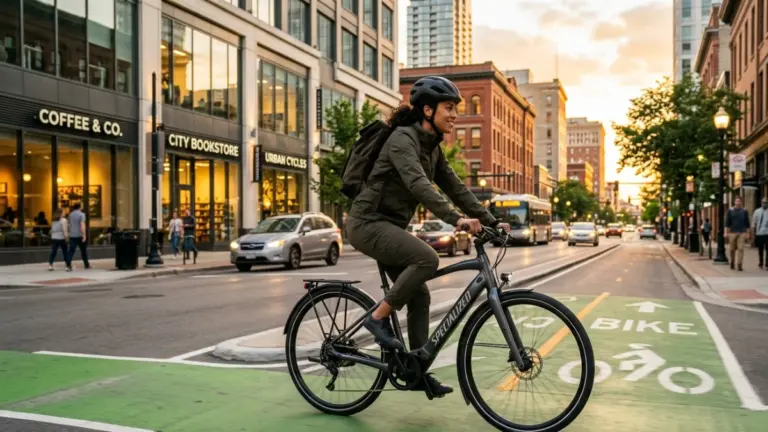
Drive less overall. Even EVs contribute to traffic congestion and non-exhaust emissions. Combining EV ownership with walking, cycling, public transit, and smart trip planning maximizes environmental benefits.
Advocate for policy. Contact local officials about charging infrastructure, support low-emission zones, and back policies that accelerate the transition. Individual adoption helps, but policy creates system-level change.
Technology on the Horizon
The EVs available today represent just the beginning. Several emerging technologies promise to enhance air quality benefits further:
Solid-state batteries could reduce EV weight (thus reducing tire wear), while enabling longer ranges that make EVs viable for more people.
Vehicle-to-grid technology allows EVs to help balance renewable electricity, charging when solar and wind are abundant and even feeding power back to the grid during peak demand—making the entire electricity system cleaner.
Advanced air filtration systems in EVs could actually clean ambient air as vehicles drive. Hyundai and other manufacturers are testing systems that filter particulates from outside air, potentially making EVs not just zero-emission but actually pollution-reducing.
The Bottom Line: EVs and Your City’s Air
Let’s bring this all together with a clear-eyed assessment.
The Evidence Is Clear
Do electric vehicles improve urban air quality? Unequivocally, yes. The evidence from Oslo, London, Shenzhen, and other leading cities is overwhelming. Replacing combustion engines with electric motors eliminates the most harmful pollutants exactly where people live, work, and breathe.
Is the improvement instantaneous and total? No. The grid must be cleaned, infrastructure built, and vehicles replaced—all of which takes time. Non-exhaust emissions remain a challenge. Equity in access requires attention.
EVs as Part of the Solution
Are EVs a complete solution to urban air pollution? No—we also need better urban planning, public transit investment, and reduced vehicle dependence overall. But EVs are a crucial, powerful tool that’s already saving lives and improving health in cities worldwide.
What does this mean for you? If you live in or near a city, the growing EV fleet around you means cleaner air for your family. The benefits are real, measurable, and growing. Each additional EV on your street, each electric bus on your commute route, each delivery truck switching from diesel to electric—they all contribute to air you can breathe more safely.
The Transformation Is Happening Now
The transformation of urban air quality through electric vehicles isn’t a distant dream or theoretical possibility. It’s happening right now, in cities around the world, with measurable health benefits appearing within months of increased EV adoption.
The question isn’t whether EVs improve urban air quality—it’s how quickly we can accelerate this transition to maximize the benefits for everyone, especially those in communities currently suffering from the worst air pollution.
As someone who cares about electric mobility and green technology, I find these developments genuinely encouraging. We’re at an inflection point where individual choices, technological advancement, and policy support are aligning to create real, tangible improvements in how our cities breathe.
The road ahead is clear. The air ahead? That’s getting clearer too—one electric vehicle at a time.
Ready to be part of the solution? If you’re considering an electric vehicle, you’re not just making a choice for yourself—you’re contributing to cleaner air for your entire community. Research EV options that fit your needs, explore available incentives in your area, and investigate charging infrastructure near you. The future of urban air quality depends on choices being made today.