You’re eyeing that sleek electric vehicle at the dealership, but there’s that nagging voice in the back of your mind: “What if I run out of charge in the middle of nowhere?” If this sounds familiar, you’re not alone. Range anxiety—the fear of your EV’s battery dying before you reach a charging station—is one of the biggest hurdles keeping drivers from making the switch to electric.
Here’s the good news: range anxiety is largely a perception problem that’s rapidly becoming outdated. With modern EVs offering 250-400+ miles per charge, a growing charging network, and smarter technology, the “will I make it?” worry is more psychological than practical for most drivers. In this article, I’ll walk you through proven solutions to eliminate range anxiety, from understanding your real-world driving needs to leveraging cutting-edge tools that make EV ownership as stress-free as filling up at a gas station—maybe even easier.
Whether you’re a prospective EV buyer or a current owner looking to maximize your confidence on the road, you’ll discover actionable strategies that transform range anxiety from a dealbreaker into a non-issue.
Understanding the Reality Behind Range Anxiety
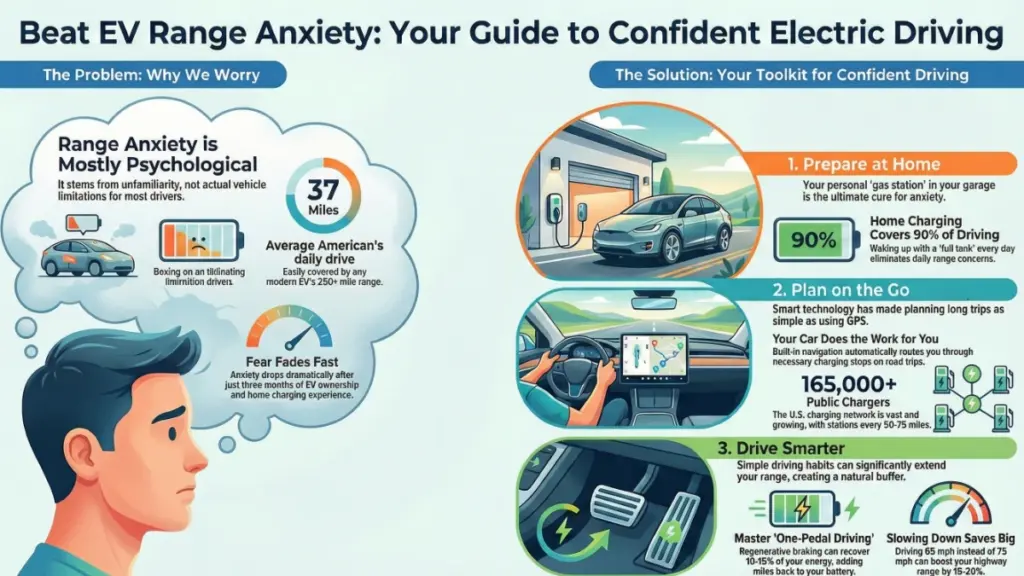
Let’s start with some perspective. The average American drives just 37 miles per day, according to the Federal Highway Administration. Even the most affordable EVs in 2025, like the Chevrolet Equinox EV or Nissan Ariya, offer over 250 miles of range. That means most drivers could go nearly a week without charging. So why does range anxiety persist?
The psychological factor is real. We’re conditioned by decades of gas car ownership to think about fuel differently. With gas stations on every corner, we rarely worry about running out. But here’s what many people don’t realize: EV owners typically start each day with a “full tank” by charging at home overnight. Unlike gas cars, where you’re always driving toward empty, EVs keep you constantly topped up for your daily routine.
Recent data from the 2024 J.D. Power U.S. Electric Vehicle Experience Study shows that range anxiety decreases dramatically after just three months of EV ownership. Once drivers experience the convenience of home charging and realize how rarely they actually need public charging, the fear largely evaporates.
Common misconceptions worth addressing:
- “EVs can’t handle road trips”: Modern EVs with 300+ mile ranges can easily travel between charging stops, which are strategically placed along major highways
- “Cold weather kills your range”: Yes, range decreases in extreme cold (typically 20-40%), but planning tools account for this automatically
- “Charging takes forever”: DC fast chargers can add 200+ miles in just 20-30 minutes—about the time you’d spend grabbing lunch on a road trip
The truth is, range anxiety often stems from unfamiliarity rather than actual limitations. Let’s explore the practical solutions that make this worry a thing of the past.
Solution 1: Choose the Right EV Range for Your Lifestyle
The most effective way to eliminate range anxiety is to start with the right vehicle for your needs. You wouldn’t buy a massive pickup truck if you only commute in the city, right? The same logic applies to EV range.
Matching Range to Daily Driving
Take an honest look at your typical driving patterns. Track your mileage for a week or check your car’s odometer history. For most people, the answer is surprisingly consistent:
- Urban/suburban commuters: 30-50 miles daily (nearly any EV works, even 150-200 mile range models)
- Long commuters: 80-100 miles daily (250+ mile range recommended)
- Frequent road trippers: Consider 300-400+ mile range EVs for maximum flexibility
Popular 2025 EV ranges by category:
| Vehicle Class | Example Models | EPA Range |
|---|---|---|
| Affordable Compact | Chevy Equinox EV, Nissan Ariya | 250-300 miles |
| Mid-Range Sedan/SUV | Tesla Model 3/Y, Ford Mustang Mach-E | 270-330 miles |
| Long-Range Premium | Tesla Model S/X, BMW iX, Mercedes EQS | 350-400+ miles |
| Electric Trucks | Ford F-150 Lightning, Rivian R1T | 230-410 miles |
The “Bigger Isn’t Always Better” Principle
While it’s tempting to max out range, bigger batteries add weight, increase cost, and take longer to charge. If you’re primarily a city driver who rarely ventures beyond 100 miles, paying an extra $8,000-$10,000 for extended range might not make financial sense. Instead, that money could go toward a home charging installation or cover years of charging costs.
I’ve found that most people overestimate their range needs by about 30-40%. When you factor in home charging (which covers 90% of typical driving), a 250-mile range EV becomes incredibly practical for the vast majority of drivers.
Pro tip: If you occasionally need extra range for road trips, consider that renting a gas car once or twice a year might be more economical than paying for maximum range you’ll rarely use. Many EV owners find this hybrid approach works perfectly.
Solution 2: Master Home Charging Setup and Strategy
Home charging is the secret weapon against range anxiety. Think of it as having a personal gas station in your garage that fills your tank while you sleep. Once you experience this convenience, you’ll wonder why you ever drove to gas stations at all.
Installing Your Home Charging Station
Level 2 home chargers (240-volt) are the sweet spot for most EV owners:
- Add 25-40 miles of range per hour of charging
- Fully charge most EVs overnight (6-10 hours)
- Cost $500-$2,000 for equipment and installation
- Eligible for federal tax credits (up to $1,000 as of 2025)
Popular home charger brands include ChargePoint Home Flex, JuiceBox, and Tesla Wall Connector. Many utility companies offer rebates or discounted installation, potentially saving you $500-$1,000. Check with your local provider—I’ve seen rebates cover nearly half the installation cost in some regions.
Installation considerations:
- Requires a dedicated 240-volt circuit (similar to an electric dryer)
- Typical installation takes 2-4 hours with a licensed electrician
- Some older homes may need electrical panel upgrades (adds $500-$2,000)
- Position the charger within cable reach of your parking spot (most cables are 18-25 feet)
Optimizing Your Charging Routine
Here’s where home charging becomes a game-changer for eliminating anxiety:
Set it and forget it. Modern EVs and smart chargers let you schedule charging during off-peak hours when electricity rates are lowest. Many utilities offer time-of-use plans where nighttime charging costs 50-70% less than daytime rates. Your car automatically starts charging at the optimal time while you’re asleep.
The 20-80% rule. You don’t need to charge to 100% daily—in fact, keeping your battery between 20-80% for daily use extends battery life. Save full charges for road trips. This means you’re working with plenty of buffer, reducing any stress about running low.
Monitor remotely. Smartphone apps let you check your charge level from anywhere, start/stop charging, and even precondition your car’s cabin temperature. Forgot to plug in? You’ll get a notification and can often still top up before morning.
For renters or apartment dwellers, solutions are expanding rapidly. Many newer apartment complexes are installing EV charging stations, and some landlords will install chargers if you cover equipment costs. Workplace charging is another option, with over 42,000 workplaces offering EV charging as of 2024, according to the Department of Energy.
Solution 3: Leverage Advanced Trip Planning Technology
Remember when people worried about GPS replacing paper maps? The same technological leap has happened for EV charging. Modern trip planning tools have become so sophisticated that range anxiety is largely eliminated through smart navigation.
Built-In Vehicle Navigation Systems
Today’s EVs come with intelligent navigation that considers your battery level, driving style, weather conditions, and real-time charger availability:
Tesla’s navigation system automatically routes you through Supercharger stations, preconditions the battery for optimal charging speed, and updates in real-time if chargers are busy. You simply enter your destination, and the car handles the rest.
Ford, GM, Rivian, and others have implemented similar systems with integration to multiple charging networks (not just proprietary ones). The Ford Mustang Mach-E, for example, routes you through Electrify America stations and shows real-time charger availability before you arrive.
What these systems do automatically:
- Calculate if you’ll reach your destination with current charge
- Route you through necessary charging stops with optimal timing
- Factor in elevation changes (hills drain more battery)
- Adjust for temperature effects on range
- Show real-time charger availability and pricing
- Precondition battery for faster charging at stops
Third-Party Apps That Enhance Confidence
While built-in navigation is excellent, supplementary apps provide additional peace of mind:
A Better Route Planner (ABRP): The gold standard for EV trip planning. Input your specific vehicle model, and it provides hyper-accurate range predictions based on real-world data from thousands of users. You can adjust for speed, weather, and payload weight. Many experienced EV owners call this app essential for long trips.
PlugShare: Think of it as Yelp for charging stations. See real user reviews, photos, check-in reports, and real-time status updates. Particularly valuable for finding reliable chargers in unfamiliar areas and avoiding broken stations.
ChargePoint, Electrify America, and EVgo apps: Access network-specific chargers, see real-time availability, reserve spots, and pay seamlessly. Many offer subscription plans for reduced charging costs.
Real-World Trip Planning Example
Let me walk you through a typical road trip scenario. Say you’re driving from Los Angeles to San Francisco (380 miles) in a Tesla Model 3 Long Range (330 miles EPA range):
- Pre-trip: Leave home with 100% charge (330 miles)
- First leg: Drive 180 miles to Harris Ranch Supercharger
- Charging stop: 25-minute charge while grabbing lunch adds 180 miles
- Final leg: Drive remaining 200 miles to San Francisco with 130 miles buffer
Total trip time: ~6 hours driving + 25 minutes charging. Compare this to a gas car that would stop once for 10 minutes to refuel—you’re adding just 15 minutes to the journey, much of which overlaps with meals or restroom breaks you’d take anyway.
The key insight: with proper planning, charging stops integrate naturally into travel breaks rather than feeling like inconvenient delays. Many EV owners report that forced 20-30 minute breaks actually make road trips less stressful and more enjoyable.
Solution 4: Understand and Utilize the Growing Charging Infrastructure
The charging network has exploded in recent years, yet many people still operate on outdated perceptions from 2018-2020. The landscape has dramatically improved, and understanding what’s available today is crucial for eliminating range anxiety.
Public Charging Network Growth
As of early 2025, the U.S. has over 165,000 public charging outlets at approximately 61,000 stations, according to the Department of Energy. That’s a 60% increase from just three years ago, and the growth is accelerating thanks to federal infrastructure investments.
Key networks to know:
- Tesla Supercharger Network: 2,100+ stations with 23,000+ chargers across North America. Starting in 2024, Tesla opened this network to non-Tesla vehicles through adapters, massively expanding access for all EVs.
- Electrify America: 950+ stations with 4,000+ ultra-fast chargers (up to 350 kW), concentrated along highways and in metro areas. Built as part of VW’s emissions settlement.
- EVgo: 1,000+ fast-charging locations, often in convenient urban and suburban spots like grocery stores and shopping centers.
- ChargePoint: The largest network with 30,000+ charging spots, though many are Level 2 (slower) chargers at workplaces, hotels, and parking facilities.
Coverage where it matters most: Highway corridors now have charging stations every 50-75 miles on average along major interstates. The National Electric Vehicle Infrastructure (NEVI) program is specifically funding chargers to eliminate any remaining gaps, with a goal of stations every 50 miles on major highways by 2026.
DC Fast Charging: The Game-Changer
Understanding charging speeds eliminates a lot of anxiety. Here’s what you need to know:
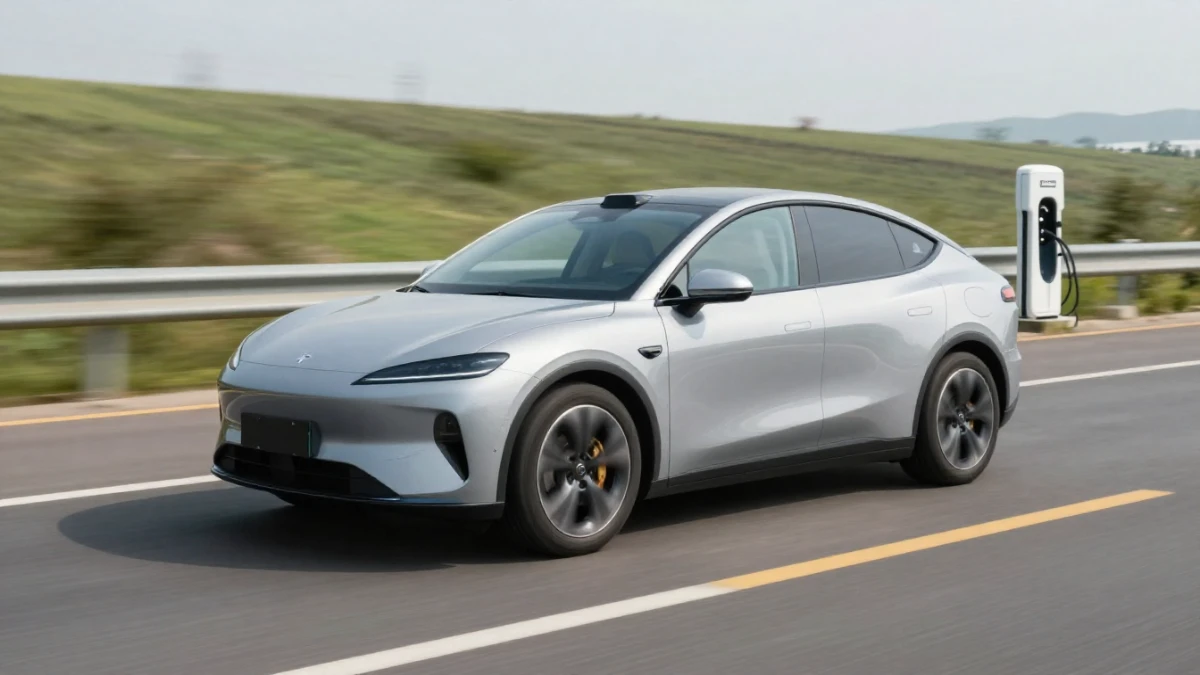
Level 1 (120V household outlet): 3-5 miles per hour – Emergency backup only Level 2 (240V): 25-40 miles per hour – Home and destination charging DC Fast Charging (Level 3): 150-300+ miles in 30 minutes – Road trip essential
Modern EVs can accept 150-350 kW DC fast charging, which means during a road trip lunch break, you’re adding enough range to continue 200+ miles. The Ford F-150 Lightning, for example, can charge from 15% to 80% in about 41 minutes at a 150 kW charger.
The 80% rule in practice: DC fast charging slows significantly after 80% to protect battery health. This means you typically charge from 20-80% at fast chargers (the “sweet spot”), then move on. You’re rarely waiting for a full charge, which keeps stops short.
Charging Costs: The Pleasant Surprise
Many new EV owners are shocked by how affordable charging is compared to gas:
- Home charging: $0.12-$0.15 per kWh on average (varies by state) = $6-$9 to add 200 miles
- Public Level 2: $0.20-$0.30 per kWh = $12-$18 for 200 miles
- DC fast charging: $0.35-$0.50 per kWh = $21-$30 for 200 miles
Compare this to a gas car averaging 30 mpg with gas at $3.50/gallon: $23 for 200 miles. Even expensive fast charging is competitive, and home charging costs about a third of gas expenses. Over a year, typical drivers save $800-$1,500 in fuel costs alone.
Solution 5: Adopt Range-Maximizing Driving Techniques
Your driving style significantly impacts range—sometimes as much as 30-40%. Learning a few simple techniques can squeeze considerably more miles from each charge, providing a built-in buffer against anxiety.
Regenerative Braking Mastery
EVs capture energy when you slow down, converting it back into battery charge. Unlike gas cars where braking wastes energy as heat, EVs turn deceleration into range recovery.
How to maximize regenerative braking:
- Use “one-pedal driving” mode: When you lift your foot off the accelerator, the car slows significantly while regenerating energy. Many EVs let you drive 80% of the time without touching the brake pedal.
- Anticipate traffic flow: Look ahead and coast early rather than braking hard. Smooth, gradual deceleration regenerates more energy than sudden stops.
- Adjust regeneration levels: Most EVs offer adjustable regen strength. Higher settings capture more energy but feel more aggressive; find your comfort balance.
I’ve seen skilled EV drivers add 10-15% more range simply through excellent regen management. It becomes second nature after a few weeks, and you’ll start to appreciate how clunky traditional braking feels in comparison.
Speed Management and Efficiency
Aerodynamics and rolling resistance increase exponentially with speed. Here’s the practical impact:
- Highway speeds: Driving 75 mph versus 65 mph can reduce range by 15-20%
- Cruise control: Maintains consistent speed, avoiding the energy waste of constant acceleration/deceleration
- Draft awareness: Following large vehicles at safe distances (not tailgating) can slightly improve efficiency through reduced air resistance
Real-world strategy: On road trips where you’re stopping to charge anyway, driving 65-70 mph instead of 80 mph might add 15 minutes to a 3-hour leg but could eliminate an entire charging stop. That’s a net time savings plus reduced charging costs.
Climate Control Efficiency
Heating and cooling your EV cabin draws directly from the battery, affecting range more than most drivers expect:
Winter strategies:
- Precondition while plugged in: Heat the cabin before unplugging so you’re not drawing battery power
- Use seat and steering wheel heaters: These are far more efficient than heating the entire cabin (about 1/10th the power draw)
- Dress appropriately: Sounds obvious, but keeping the cabin a few degrees cooler saves significant range
Summer strategies:
- Park in shade: Reduces the energy needed to cool down initially
- Vent before AC: Let hot air escape before turning on AC at full blast
- Moderate temperature settings: Every degree counts; 72°F uses less power than 68°F
In extreme weather, climate control can impact range by 20-40%. Planning for this—either through preconditioning or moderating use—ensures you’re never caught off guard.
Additional Efficiency Tips
- Reduce cargo weight: Every 100 pounds reduces range by roughly 1-2%. Clean out unnecessary items.
- Check tire pressure: Under-inflated tires increase rolling resistance. Maintain manufacturer-recommended pressure.
- Remove roof racks: External cargo carriers significantly increase drag. Remove when not in use.
- Combine trips: Like any vehicle, multiple short trips with cold starts are less efficient than one longer journey.
These techniques aren’t about obsessing over every mile—they’re about building habits that provide a natural buffer zone, eliminating the worry that you’ll cut things too close.
Solution 6: Build Your Personal Charging Network Knowledge
Confidence grows from familiarity. Creating your personal “charging map” of trusted stations along frequent routes eliminates uncertainty and builds genuine comfort with EV ownership.
Mapping Your Frequent Routes
Start by identifying the routes you drive most often:
Daily commute routes: Note any charging options within 5 minutes of your regular path. Workplace chargers, gym parking lots, shopping centers—these become your convenient top-off options if you ever need them.
Weekend destinations: If you regularly visit family, friends, or vacation spots within 150-250 miles, plan these routes once using ABRP or your vehicle’s navigation. Save preferred charging stops. After 2-3 trips, these become as familiar as gas stations you’ve always used.
Emergency backup spots: Identify at least 2-3 charging locations within 10 miles of home as backup options if you can’t charge at home for any reason.
Test Charging Before You Need It
Many new EV owners experience unnecessary anxiety on their first public charging experience. Eliminate this by practicing:
Your first DC fast charge trial run: On a weekend when you’re not in a hurry, drive to a nearby fast charger and practice the entire process:
- Locate the station using your app
- Verify charger compatibility with your vehicle
- Follow the connection and payment process
- Monitor charging speed and battery percentage
- Disconnect properly when finished
Takes 30 minutes total, and you’ll feel dramatically more confident knowing exactly how everything works. It’s like practicing parallel parking before your driver’s test—the skill becomes automatic.
Join EV Owner Communities
Local and online EV communities provide invaluable insider knowledge:
- Local Facebook EV groups: Members share favorite charging spots, report broken chargers, and organize meetups
- Reddit communities (r/electricvehicles, model-specific subreddits): Troubleshooting, tips, and real-world experiences
- PlugShare comments: Users report real-time charger status, access issues, and location tips
I’ve found that asking experienced local EV owners about their go-to charging spots reveals hidden gems that apps don’t highlight—like the reliably available charger behind the library or the fast charger that’s always empty on Sunday mornings.
Develop a “Charging Personality”
Every EV owner develops their own style:
The “Always Topped Off” type: Plugs in every night and rarely lets battery drop below 60%. Prefers frequent, short charging sessions.
The “Weekly Charger” type: Charges once or twice per week when battery hits 30-40%. Maximizes home charging convenience.
The “Opportunistic Charger” type: Tops off during errands when convenient, treating charging like parking at the grocery store.
None of these approaches is “correct”—find what matches your psychology and lifestyle. The key is developing a routine that feels natural rather than stressful.
Solution 7: Embrace the Mental Shift and Long-Term Benefits
Ultimately, overcoming range anxiety requires a perspective shift about what vehicle ownership means in 2025. EVs aren’t just different in power source—they represent a fundamentally new ownership experience that’s often better once you adjust.
Reframing “Refueling” Entirely
With gas cars, you drive until empty, then fill up—it’s reactive. With EVs, you’re almost always maintaining a charge—it’s proactive. This shift actually reduces stress once you embrace it:
Gas car ownership:
- Monitor fuel gauge, worry when low
- Detour to gas stations when needed
- Stand outside pumping in weather
- Regular trips solely for refueling
EV ownership:
- Start each day “full” from home charging
- Rarely think about charging during normal weeks
- Charge during activities you’d do anyway (shopping, dining, working)
- Pay attention only for longer trips
Ask EV owners about their biggest surprise, and many mention never thinking about charging after the first month. The convenience of home charging overwhelms any inconvenience from occasional public charging needs.
The Financial and Lifestyle Benefits
Focusing solely on range misses the broader ownership advantages:
Lower operating costs:
- Fuel savings: $800-$1,500 annually for typical drivers
- Maintenance savings: No oil changes, fewer brake replacements (thanks to regen), fewer moving parts
- Incentives: Federal tax credits up to $7,500, plus state/local incentives
Improved daily experience:
- Instant torque makes driving more enjoyable
- Quiet, smooth operation reduces fatigue
- Preconditioning creates perfect cabin temperature before entering
- Lower center of gravity improves handling
Environmental alignment: For drivers concerned about climate impact, EVs offer tangible emissions reductions even accounting for electricity generation sources.
Building Confidence Through Experience
Every EV owner I’ve spoken with reports the same pattern: anxiety highest before purchase, moderate during first month, nearly zero after three months. The learning curve is real but short.
Month 1: Learning charging habits, testing public chargers, adjusting to new routine Month 2-3: Developing personal system, building familiarity with local infrastructure Month 4+: Rarely thinking about range unless planning unusual trips
The confidence comes from proving to yourself, through lived experience, that the infrastructure works and your range is sufficient. No article can substitute for that personal verification, but understanding that this progression is normal helps you push through initial uncertainty.
When Range Anxiety Is Valid (And Solutions)
There are legitimate scenarios where range concerns require planning:
Rural areas with sparse charging: If you live far from civilization with limited home charging access, EVs remain challenging. However, this applies to less than 5% of the U.S. population.
Extreme cold climates without garaged parking: If you regularly experience -10°F to -20°F temperatures without sheltered parking, range impacts of 30-40% are real. Solutions include longer-range models or plug-in hybrid alternatives.
Frequent towing heavy loads: Towing can cut range by 50% or more. Electric trucks work for towing, but you’ll need to plan more frequent charging stops.
No home or workplace charging access: If you’re relying solely on public charging, EV ownership is significantly less convenient (though still workable in dense urban areas with ample charging infrastructure).
For these specific situations, be honest about whether an EV fits your lifestyle today, or wait 2-3 years as infrastructure and technology continue improving rapidly.
Your Path to Range Anxiety-Free EV Ownership
Conquering range anxiety isn’t about eliminating all concerns—it’s about replacing irrational fears with informed confidence. The solutions we’ve covered work together synergistically:
Start with the right foundation: Choose an EV with appropriate range for your needs, install home charging, and understand your actual driving patterns.
Leverage technology: Use trip planning tools, stay informed about charging infrastructure, and let your vehicle’s intelligence guide you.
Build practical skills: Master efficient driving techniques, familiarize yourself with local charging spots, and practice public charging before you need it urgently.
Shift your mindset: Recognize that EV ownership is different, not inferior. The convenience of daily home charging outweighs the occasional planning needed for longer trips.
The electric vehicle revolution is happening whether range anxiety exists or not. As of 2025, EVs represent over 14% of new car sales in the U.S., up from just 3% in 2020. Millions of drivers have successfully made the transition, and infrastructure continues expanding at an accelerating pace.
Your anxiety is understandable—it’s human nature to worry about the unfamiliar. But remember: the drivers who worried most before buying are often the ones who laugh about their concerns a few months later, wondering why they waited so long to switch.
Ready to take the next step? Test drive an EV and specifically ask to see the charging features, navigation system, and range estimation tools. Talk to current owners about their experience. You’ll likely discover that range anxiety is the last real obstacle between you and a better driving experience—and it’s an obstacle that dissolves faster than you expect once you’re behind the wheel.
The road ahead is electric, and it’s longer than you think.