Picture this: you’re cruising down the highway in complete silence, your car accelerating smoothly past gas stations while you spend a fraction on “fuel.” Sounds futuristic? It’s actually the everyday reality for millions of EV owners worldwide. As someone who’s spent years analyzing the automotive industry’s transformation, I can tell you that electric vehicles have evolved from eco-warrior experiments into genuinely practical, cost-effective transportation options that offer surprising advantages most people don’t realize until they make the switch.
The question isn’t really whether EVs offer benefits anymore—it’s whether those benefits align with your specific needs and lifestyle. Electric vehicles deliver measurable advantages in cost savings, performance, environmental impact, and convenience, but they also come with considerations you’ll want to understand before making the jump. In this article, I’ll walk you through the real-world benefits backed by current data, owner experiences, and honest perspectives on where EVs excel and where they still have room to grow.
Whether you’re casually EV-curious or seriously considering your next vehicle purchase, you’ll discover how electric driving could reshape your daily commute, your monthly budget, and maybe even your relationship with your car.
Lower Operating Costs: The Financial Case Gets Stronger Every Year
Let’s talk money first, because this is where EVs make their most compelling argument.
Electricity vs. Gasoline: The Math That Matters
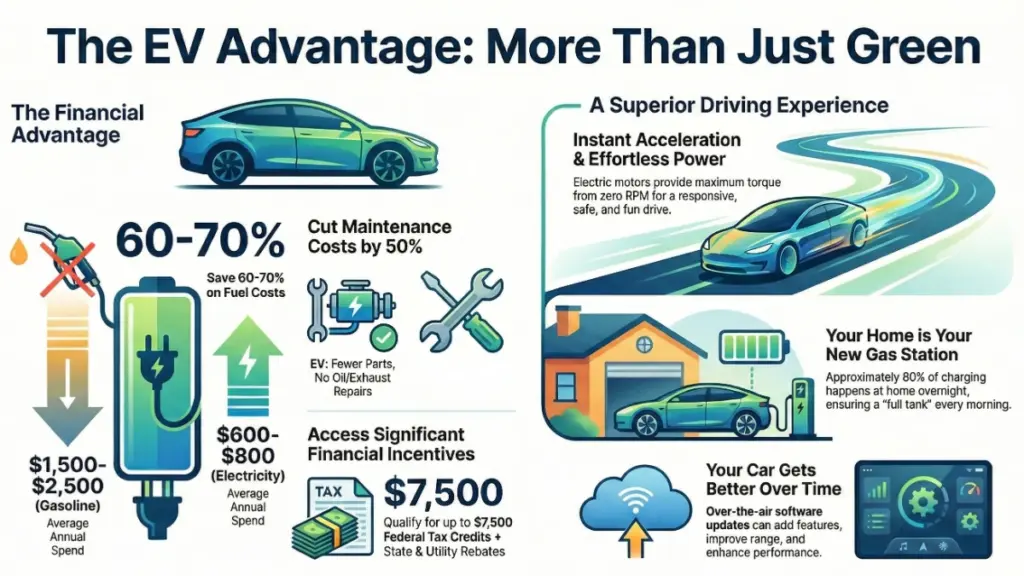
The average EV owner spends about $600-800 annually on electricity for typical driving (around 12,000-15,000 miles per year), compared to $1,500-2,500 for gasoline in a comparable vehicle. That’s roughly 60-70% less spent on “fuel.” Even in states with higher electricity rates, the savings remain substantial.
Here’s the breakdown: electricity costs average around $0.15 per kilowatt-hour (kWh) nationally, though this varies by state. Most EVs consume about 3-4 miles per kWh, meaning you’re traveling roughly 100 miles for $4-5. Compare that to a 30-mpg gas car at $3.50 per gallon—100 miles costs about $11.67. The difference adds up quickly, especially if you charge at home overnight during off-peak hours when rates can drop below $0.10 per kWh.
And if you have solar panels? You’re essentially driving on sunshine at near-zero marginal cost after your initial solar investment. I’ve talked to EV owners with home solar who calculate their “fuel” cost at literally pennies per day.
Maintenance: The Advantage of Simplicity
This is where EVs truly shine, and it’s a benefit many first-time buyers underestimate. Electric motors have about 20 moving parts compared to over 2,000 in internal combustion engines. Fewer parts mean fewer things that can break, wear out, or need servicing.
What you’ll never pay for again:
- Oil changes (typically $50-100 every 5,000-7,500 miles)
- Transmission service (EVs use single-speed transmissions with minimal maintenance)
- Spark plugs, timing belts, or air filters
- Exhaust system repairs (there is no exhaust system)
- Coolant flushes for engine cooling (though EVs do have battery cooling systems)
According to 2024 Consumer Reports data, EV owners spend roughly 50% less on maintenance and repairs over the first five years of ownership compared to gas-powered vehicles. The main maintenance items? Tire rotations, cabin air filters, windshield washer fluid, and brake fluid changes every few years.
Regenerative Braking: Brakes That Last Forever (Almost)
Here’s something that surprises new EV drivers: your brake pads might outlast the car itself. Regenerative braking captures energy during deceleration and feeds it back to the battery, which means you’re barely using your mechanical brakes for normal driving. Many EV owners report their original brake pads lasting 100,000+ miles—sometimes the full lifetime of the vehicle.
This isn’t just about cost savings (though replacing brakes every 80,000 miles instead of every 30,000 miles adds up). It’s also about the driving experience. Once you get used to “one-pedal driving,” where lifting off the accelerator slows the car significantly, you’ll find city driving becomes smoother and more intuitive.
Performance Perks: Electric Power Delivers Instant Gratification
If you think EVs are just about being eco-friendly, prepare to have your assumptions challenged. Electric powertrains deliver performance characteristics that even luxury sports cars struggle to match.
Instant Torque: Physics on Your Side
Electric motors produce maximum torque from zero RPM, which translates to immediate, seamless acceleration the moment you press the pedal. There’s no waiting for the engine to rev up, no transmission hunting for the right gear—just pure, linear power delivery.
Even affordable EVs like the Chevrolet Bolt EUV or Hyundai Ioniq 5 accelerate with a responsiveness that feels closer to performance cars than economy vehicles. The Tesla Model 3 Performance can hit 60 mph in around 3.1 seconds—supercar territory—while mid-range options like the Ford Mustang Mach-E or Volkswagen ID.4 still offer spirited acceleration that makes merging onto highways and overtaking traffic effortless.
This isn’t about drag racing (though EV acceleration is addictively fun). It’s about confident, safe driving when you need power immediately—entering a highway, navigating busy intersections, or making quick passing maneuvers.
The Silence Factor: Noise Pollution You Didn’t Know You Hated
Close your eyes and imagine sitting in your car with the “engine” running. Now imagine… nothing. No rumble, no vibration, just silence. That’s the EV experience, and once you adjust to it, combustion engines feel almost primitive.
The quiet isn’t just pleasant—it fundamentally changes your driving environment. Conversations happen naturally without raising your voice. Phone calls are crystal clear. You actually notice the quality of your car’s audio system. Highway driving becomes far less fatiguing because you’re not fighting constant noise and vibration.
Plus, your neighbors will appreciate the 6 AM departures and 11 PM arrivals a lot more when your car glides silently past their bedroom windows instead of announcing itself with engine noise.
Lower Center of Gravity: Physics That Improves Handling
Battery packs mounted low in the floor give EVs an inherently lower center of gravity than traditional vehicles. This translates to more planted, confident handling through corners with reduced body roll. Even larger EVs like the Rivian R1S or BMW iX feel surprisingly agile and stable for their size.
This isn’t just a performance enthusiast benefit—it’s a safety advantage. Better weight distribution and lower center of gravity reduce rollover risk and improve overall vehicle stability, especially in emergency maneuvers or adverse weather conditions.
Environmental Impact: Beyond the Obvious “Zero Emissions” Message
Yes, EVs produce no tailpipe emissions—that’s the headline benefit everyone knows. But the environmental story is more nuanced and, in many ways, more compelling than the simplified narrative suggests.
The Full Lifecycle Picture
Let’s be honest about the complete environmental impact, because transparency builds trust. EV manufacturing, particularly battery production, is energy-intensive and has a larger initial carbon footprint than building a conventional car. Mining lithium, cobalt, and other battery materials raises legitimate environmental and ethical concerns that the industry continues addressing through improved sourcing practices and recycling programs.
However, here’s the crucial context: EVs make up for that initial deficit through operational efficiency. Studies by organizations like the Union of Concerned Scientists and the International Energy Agency consistently show that even when accounting for battery manufacturing and electricity generation, EVs produce significantly fewer lifetime emissions than comparable gas vehicles—typically 50-70% less over their lifespan, depending on the regional electricity grid.
And this advantage keeps growing. As electricity grids incorporate more renewable energy (solar, wind, hydro), the carbon intensity of charging drops further. An EV you buy today gets “cleaner” every year as your local grid improves, while a gas car’s emissions remain constant throughout its lifetime.
Grid Reality Check: Where Your Electricity Comes From Matters
The environmental benefit of your EV depends heavily on your region’s electricity mix. In states like Washington (mostly hydro), California (increasingly solar and wind), or Vermont (nuclear and renewables), EVs are dramatically cleaner than gas vehicles from day one. In coal-heavy regions, the advantage is smaller but still significant—and improving rapidly.
The U.S. electricity grid is rapidly transitioning toward cleaner sources. In 2024, renewables accounted for over 25% of U.S. electricity generation, up from just 11% in 2010. Coal continues declining while natural gas (which produces roughly half the CO2 of coal) and renewables expand. This trend means every EV gets cleaner over time without the owner doing anything.
Local Air Quality: The Health Benefit You Can’t See
Here’s an often-overlooked advantage: EVs eliminate local air pollution entirely. No particulates, no nitrogen oxides, no volatile organic compounds from your tailpipe—because there is no tailpipe.
This matters enormously in urban areas where air quality affects public health. Studies link traffic-related air pollution to asthma, cardiovascular disease, and reduced life expectancy. Cities like London, Paris, and Oslo are implementing low-emission zones specifically because reducing local vehicle emissions saves lives and reduces healthcare costs.
If you live in a city or suburban area, choosing an EV means you’re no longer contributing to the air pollution your family, neighbors, and community breathe every day. That’s a tangible health benefit beyond climate considerations.
Charging Convenience: The Home Fueling Advantage
This is where perspectives flip dramatically between EV owners and skeptics. Non-owners worry about “finding charging stations.” EV owners wonder why they’d ever want to visit gas stations again.
Your Home Becomes Your Gas Station
About 80% of EV charging happens at home, and this fundamentally changes your relationship with refueling. Instead of detouring to gas stations and standing around pumping fuel, you simply plug in when you park—usually in your own garage or driveway overnight.
Think of it like charging your smartphone. You don’t worry about finding “phone charging stations” because you charge overnight at home. EVs work the same way. You wake up every morning with a “full tank” without ever thinking about it.
Installing a Level 2 home charger (240V, similar to a dryer outlet) costs $500-1,500 depending on your electrical setup and typically adds 25-40 miles of range per hour of charging. For most people driving 30-50 miles daily, even a few hours of overnight charging provides more than enough range for daily needs.
Public Charging: Better Than You Think, Still Improving
For road trips and longer journeys, public charging infrastructure has improved dramatically. As of early 2025, the U.S. has over 160,000 public charging ports, including approximately 30,000 DC fast chargers that can add 150-200 miles of range in 20-30 minutes.
Networks like Tesla’s Supercharger system (now opening to non-Tesla EVs), Electrify America, EVgo, and ChargePoint blanket major highways and urban areas. Modern trip planning apps and built-in vehicle navigation seamlessly route you through charging stops, factoring in current charger availability and your battery level.
Is it exactly like gas station convenience? Not yet—charging takes longer than pumping gas, and you’ll want to plan ahead for long trips. But it’s far more convenient than it was even three years ago, and infrastructure expansion continues accelerating.
Destination Charging: An Unexpected Perk
Hotels, restaurants, shopping centers, and workplaces increasingly offer EV charging as an amenity. This means you often charge while doing something else—eating lunch, grocery shopping, or working—rather than making dedicated refueling stops.
I know EV owners who rarely use public fast charging because their workplace offers free charging and they plug in at home each night. Their “fueling” happens passively during activities they’d do anyway.
Technology and Features: Future-Forward Driving Experience
EVs aren’t just different powertrains—they’re fundamentally modern vehicles built around software and connectivity in ways traditional automakers are still catching up to.
Over-the-Air Updates: Your Car Gets Better With Age
Many EVs receive over-the-air software updates that add features, improve performance, extend range, or enhance safety systems without visiting a dealership. Tesla pioneered this approach, but manufacturers like Ford, Rivian, Polestar, and BMW now offer similar capabilities.
This means your EV can literally improve after you buy it. Updates have added faster charging speeds, new driver assistance features, improved battery conditioning, entertainment options, and more. It’s the opposite of traditional vehicles that are frozen in time at purchase and only decline from there.
Advanced Driver Assistance: Safety Features Standard
Most modern EVs come equipped with comprehensive driver assistance systems—adaptive cruise control, lane keeping, automatic emergency braking, blind spot monitoring—often as standard equipment. Many offer advanced semi-autonomous driving features that handle highway driving, traffic jams, and parking with minimal driver input.
While these features aren’t exclusive to EVs, the centralized, software-driven architecture of electric vehicles makes implementing and updating these systems easier and more sophisticated.
Smartphone Integration and Connectivity
EVs typically offer seamless smartphone integration that lets you:
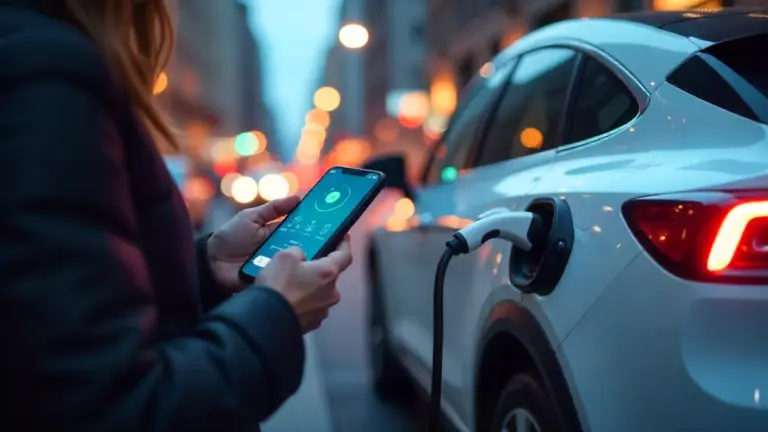
- Monitor and control charging remotely (start, stop, schedule)
- Pre-condition the cabin (heat or cool before you get in)
- Check range and battery status from anywhere
- Locate your vehicle and lock/unlock doors
- Review driving efficiency and charging history
This connectivity transforms your vehicle from a standalone machine into an integrated part of your digital life.
The Incentives: Financial Support That Sweetens the Deal
Government incentives make EVs more affordable than sticker prices suggest, though navigating the programs requires some attention to detail.
Federal Tax Credits
The federal EV tax credit offers up to $7,500 for new EVs meeting specific criteria related to assembly location, battery sourcing, and price caps. As of 2025, the program has evolved with stricter requirements, but many popular models still qualify.
Additionally, used EVs may qualify for up to $4,000 in federal credits, making pre-owned electric vehicles more accessible. Income limits apply to both new and used vehicle credits, so check current IRS guidelines to see if you qualify.
State and Local Incentives
Many states offer additional rebates, tax credits, or incentives that stack with federal programs:
- California: Up to $7,500 in combined state and local rebates
- Colorado: $5,000 state tax credit
- New Jersey: $4,000 rebate
- New York: $2,000 rebate
Some states also offer perks like HOV lane access for EVs (even with a single occupant), reduced registration fees, or free public charging access. These benefits vary widely by location, so research your state’s current programs.
Utility Company Incentives
Electric utilities increasingly offer incentives to encourage EV adoption and smart charging:
- Rebates on home charger installation ($250-$1,000)
- Special EV electricity rates (super off-peak rates as low as $0.05-0.08 per kWh)
- Time-of-use rate plans that reward overnight charging
- Managed charging programs that offer credits for flexible charging times
Check with your local utility—these programs can significantly reduce your charging costs.
Real Owner Perspectives: What Changes After You Go Electric
The best insights come from people who’ve actually made the switch. Here’s what consistently surprises new EV owners:
“I Didn’t Expect to Love the Driving Experience This Much”
Nearly every EV owner mentions enjoying the drive itself more than they anticipated. The instant acceleration, smooth operation, and quiet cabin transform commuting from a chore into something genuinely pleasant. One owner described it as “the difference between a flip phone and a smartphone—you don’t realize what you were missing until you experience it.”
“Range Anxiety Was a Mental Hurdle I Overcame Quickly”
The fear of running out of charge dominates pre-purchase concerns, but experienced owners report this anxiety fades within weeks. Once you establish charging routines and recognize that 90% of your driving happens well within your vehicle’s range, the concern evaporates. As one owner put it: “I never worried about my gas car’s range around town, and my EV has more than twice the range I need daily.”
“The Savings Are Real and Noticeable”
Multiple owners emphasize that the fuel and maintenance savings genuinely impact their monthly budgets. One calculated saving $180 monthly on gas alone, which helped offset their slightly higher car payment. Another mentioned avoiding a $1,200 brake job at 70,000 miles thanks to regenerative braking.
“Charging on Road Trips Requires Adjustment”
Honest feedback: long-distance travel requires more planning and patience initially. However, many owners note that forced 20-30 minute breaks every 2-3 hours actually make road trips less exhausting. Kids get bathroom breaks, everyone stretches, and you grab snacks—things you’d probably do anyway, just more intentionally timed.
The Honest Limitations: Where EVs Still Have Room to Grow
Balanced perspectives acknowledge areas where electric vehicles aren’t yet perfect:
Upfront Purchase Price
Despite incentives, many EVs still carry higher purchase prices than comparable gas vehicles—though this gap is narrowing rapidly. The total cost of ownership often favors EVs over 5-7 years when factoring in fuel and maintenance savings, but that higher initial price remains a barrier for many buyers.
Charging Infrastructure Gaps
While urban and suburban charging networks are robust, rural areas and certain regions still have limited public charging options. If you live in an apartment without charging access or regularly drive through remote areas, EV ownership requires more planning.
Cold Weather Range Reduction
Battery performance decreases in cold temperatures, with range typically dropping 20-30% in winter conditions below freezing. Pre-conditioning the cabin while plugged in helps, but cold-weather drivers need to account for reduced range during winter months.
Longer Refueling Times
Even the fastest DC fast chargers require 20-40 minutes for substantial recharging, compared to 5 minutes pumping gas. For people who value maximum flexibility and minimal trip planning, this remains a legitimate trade-off.
The Bottom Line: Are the Benefits Worth It for You?
Electric vehicles deliver measurable advantages in operating costs, performance, environmental impact, and daily convenience—but they require adapting to a different refueling model and making peace with current infrastructure limitations.
EVs make the most sense if you:
- Have home charging access (garage, driveway, or reliable workplace charging)
- Drive predictable daily distances under 200 miles
- Value lower operating costs and minimal maintenance
- Appreciate modern technology and software integration
- Want to reduce your environmental footprint meaningfully
You might want to wait or consider alternatives if:
- You have no access to home or workplace charging
- You regularly drive 300+ miles daily with limited charging time
- You frequently tow heavy loads long distances
- You live in extremely cold climates without a garage
- The upfront cost difference strains your budget even with incentives
The honest truth? The benefits of electric vehicles have reached a tipping point where they now make practical sense for a much broader audience than just early adopters or environmental enthusiasts. The combination of falling prices, expanding charging networks, improving technology, and genuine cost savings means 2025 is arguably the best time yet to consider going electric.
Your next vehicle might not be an EV—everyone’s situation is different. But ignoring the benefits entirely means potentially overlooking a vehicle type that could save you money, reduce your environmental impact, and deliver a more enjoyable driving experience than you expected.
The electric vehicle revolution isn’t coming—it’s here. The question now is whether the benefits align with your specific needs, priorities, and driving patterns. Only you can answer that, but hopefully you now have the complete picture to make an informed decision.
Ready to explore specific models? Research current EV offerings in your preferred vehicle class, check available incentives in your state, and schedule test drives with local dealerships. The difference between reading about EVs and experiencing one firsthand is night and day—and that test drive might just convince you more than any article ever could.