
Think electric vehicles are just a trend? Think again. In 2025, we’re witnessing a historic transformation that’s reshaping the global automotive industry faster than anyone predicted. With over 20 million EVs sold worldwide this year, electric vehicles aren’t just gaining traction—they’re becoming the new normal in markets from Beijing to Berlin.
If you’ve been following the EV market, you know that 2024 was already impressive. But 2025? It’s absolutely explosive. Global EV sales have surged by 21-25% year-over-year, with total sales reaching between 18.5-20 million units. To put that in perspective, the additional EVs sold in 2024 alone exceeded the entire global EV market of 2020. We’re not just seeing incremental growth—we’re watching a fundamental shift in how the world moves.
The Numbers That Tell the Story
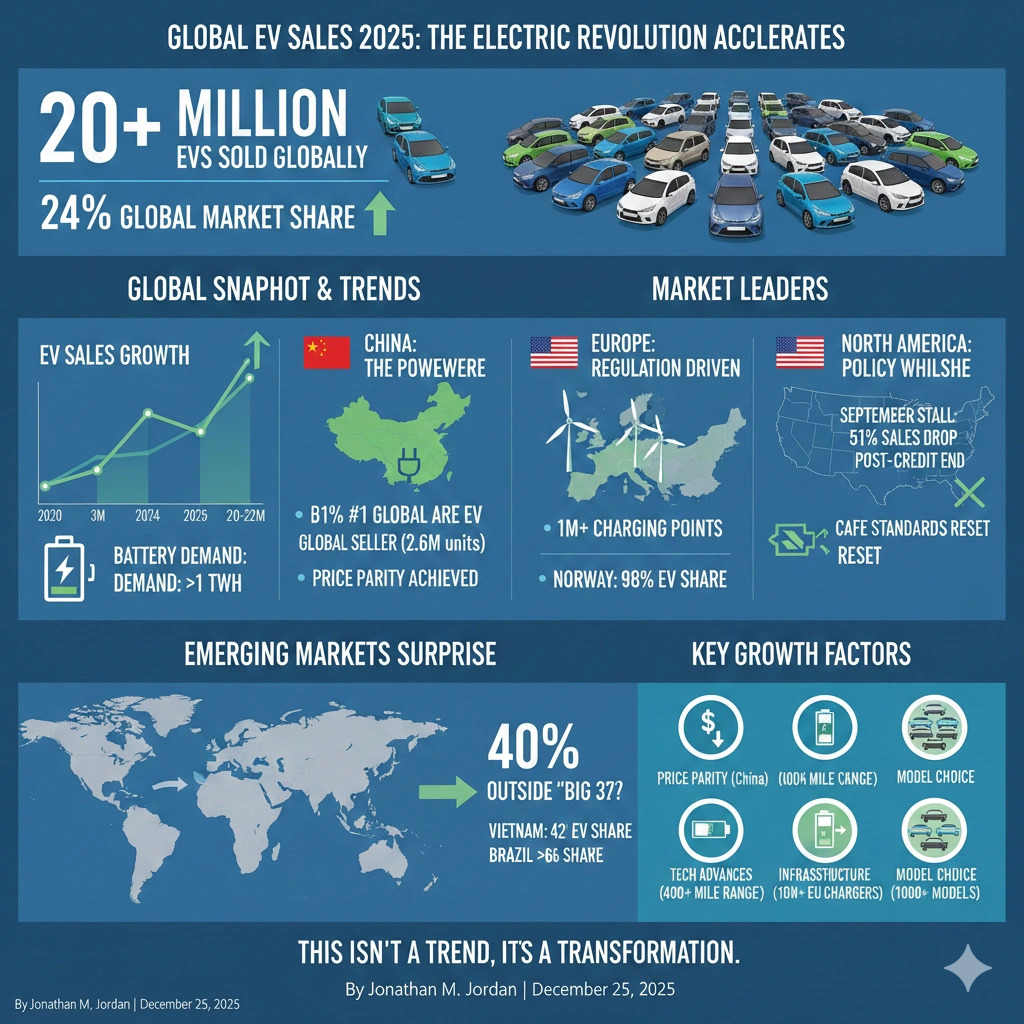
Let’s start with the headline figures. According to the International Energy Agency’s Global EV Outlook 2025, electric vehicle sales topped 17 million units in 2024, representing a stunning 25% increase from the previous year. But 2025 has taken things even further. By November 2025, global sales had already reached 18.5 million units, with projections suggesting we’ll end the year somewhere between 20-22 million EVs sold worldwide.
What makes these numbers even more remarkable is the market share. EVs now account for nearly 20% of all new vehicle sales globally, up from just 3% in 2019. Industry forecasts predict this will climb to 24% in 2025 and potentially 42% by 2030. We’re not talking about a niche market anymore—electric vehicles are rapidly becoming mainstream.
China: The Undisputed EV Powerhouse
When it comes to electric vehicles, all roads lead to China. The country has maintained its commanding position as the world’s largest EV market, and the gap is widening. In 2024, China sold more than 11 million electric vehicles—more than the entire world sold just two years earlier. Through November 2025, Chinese EV sales reached 11.6 million units, representing a 19% year-over-year increase.
But here’s what’s truly staggering: EVs now account for over 51% of all new car sales in China. That’s right—more than half of every new vehicle sold in China is electric. Industry analysts project this could reach 73% by 2030. China isn’t just leading the EV transition; it’s racing ahead at a pace that’s leaving the rest of the world scrambling to keep up.
The BYD Phenomenon
If there’s one company that embodies China’s EV dominance, it’s BYD. The Shenzhen-based manufacturer has not only overtaken Tesla as the world’s top EV seller but has established a commanding lead. In the first half of 2025, BYD sold nearly 1.9 million electric vehicles, capturing a 19.9% global market share. To put this in context, BYD alone sold more EVs than the next four companies combined.
What’s driving BYD’s success? It’s a combination of factors that other manufacturers are struggling to replicate:
- Vertical integration: BYD controls everything from battery production to semiconductor manufacturing, giving them unprecedented cost control and supply chain resilience
- Competitive pricing: Many BYD models are now cheaper than comparable gasoline vehicles, with the popular Seagull starting at just $9,900
- Advanced technology: Features like BYD’s ‘God’s Eye’ driver-assistance system are now available even on entry-level models
- Rapid development: BYD can bring a new car from concept to market in just 20 months, compared to 40 months for traditional automakers
BYD’s dominance extends beyond China. The company reported record exports of 131,935 units in November 2025, with sales in Europe increasing fourfold, doubling in Southeast Asia, and growing by over 50% in South America. This global expansion is reshaping competitive dynamics across every major automotive market.

Europe: Strong Growth Despite Economic Headwinds
Europe has emerged as one of the brightest spots in the global EV market during 2025. Despite weaker macroeconomic conditions and trade uncertainty, European EV sales jumped 33-36% year-over-year through November, reaching approximately 3.8 million units. This growth has pushed EVs to capture between 26-27% of the European market, making the continent one of the most electrified automotive markets in the world.
What’s driving this impressive growth? Several factors are combining to accelerate Europe’s EV adoption:
- Stricter CO₂ targets: New emissions regulations taking effect in 2025 are forcing automakers to push EV sales more aggressively
- Expanding model range: Over 785 electric models were available in 2024, with projections of 1,000 models by 2026, giving consumers unprecedented choice
- Charging infrastructure: Europe exceeded 1 million public charging points in 2024, with fast chargers available every 50 km on over 75% of highways
- More affordable options: New entry-level models and competitive leasing programs have made EVs accessible to mainstream buyers
Country Spotlight: European Leaders
The European EV market isn’t uniform—some countries are racing far ahead of others. Here’s how the top performers stack up:
| Country | EV Market Share | Key Insight |
| Norway | 93.7% | 15 of 16 cars sold are electric |
| Denmark | 63.9% | Jumped 18.8% in just one year |
| Sweden | 35.2% | One in three new cars is electric |
| UK | 30% | Up from 24% in 2023 |
| Germany | 17.7% | Rebounding after subsidy cuts |
Interestingly, colder climates are leading adoption—debunking the myth that EVs don’t work well in winter. Norwegian drivers have proven that with proper infrastructure and vehicle technology, electric vehicles can thrive even in the harshest conditions.
North America: Policy Whiplash and Market Uncertainty
The North American EV market—particularly the United States—tells a more complicated story in 2025. While the US led EV sales growth in early 2025, momentum stalled dramatically after the expiration of federal EV tax credits on September 30, 2025.
Before the credit expired, American consumers rushed to purchase EVs, with sales peaking at 192,000 units in September. But October saw sales plummet to just 94,000 units—a massive 51% drop in a single month. By November, sales recovered slightly but remained well below pre-expiration levels.
The policy reversal didn’t stop there. In December, the Trump administration formally ‘reset’ Corporate Average Fuel Economy standards, lowering the required fleetwide average to approximately 34.5 mpg by 2031—down from the roughly 50.4 mpg target under the previous rule. This dramatic rollback, combined with fines for missing CAFE targets being set to $0, significantly reduces pressure on automakers to prioritize EV production.
The Tesla Dilemma
Tesla’s 2025 performance has been mixed, to say the least. While the company maintained its leadership position in the US market, it faces significant challenges globally:
- Global deliveries declined 13.1% in the first half of 2025 to 719,325 units
- Market share dropped from 11.7% to 7.5% globally
- In China, Tesla’s share fell to just 4.9% year-to-date, with October sales hitting the lowest level since November 2022
- European sales weakened, though Model Y remains the continent’s best-selling EV
CEO Elon Musk’s political activities have reportedly alienated some potential buyers, while intense competition from Chinese manufacturers—particularly BYD—has eroded Tesla’s technological advantage. Many analysts suggest Tesla may have seen its best days in key markets like China, where local competitors now offer more features at lower prices.
The Emerging Market Surprise: EV Adoption Accelerates
Perhaps the most exciting development in 2025 is the rapid EV adoption happening in emerging markets. Countries that were largely overlooked in EV discussions just a few years ago are now experiencing explosive growth:
Outside the traditional ‘Big Three’ markets (China, Europe, US), EV sales surged nearly 40% to reach 1.3 million units. By 2025, EVs account for 6% of all car sales in these markets, up from 5% in 2024, with projections suggesting this could reach 6.7% by year-end.
Regional Highlights
Southeast Asia:
- Vietnam has doubled its EV sales share to nearly 40%, overtaking both the UK and EU in EV penetration
- Thailand exceeded 20% EV market share for the first time, up from just 1% in 2019
- Indonesia’s EV share reached 15%, now surpassing the United States in EV penetration
Latin America:
- Brazil and Mexico now have higher EV sales shares than Japan
- Combined sales in Southeast Asia and Brazil are expected to exceed 500,000 units by year-end
India:
- While three-wheelers dominate the EV landscape, passenger car adoption is accelerating
- Policy support and affordable models are driving growth
“In 2025, the center of gravity has moved. Emerging markets are no longer catching up, they are leading the shift to electric mobility. These countries see the strategic advantages of EVs, from cleaner air to reduced fossil fuel imports.” – Ember Energy Report
What’s Driving This Explosive Growth?
Understanding why EV sales are exploding requires looking at several converging factors that are creating the perfect storm for electric vehicle adoption:
1. Price Parity is Here (In Some Markets)
The cost barrier is crumbling faster than anyone predicted. In China, electric vehicles are now, on average, cheaper than comparable gasoline vehicles—a milestone no other major market has achieved yet. Models like the BYD Seagull start at just $9,900, making EVs accessible to budget-conscious buyers.
Even in Western markets, competitive leasing programs are bringing costs down dramatically. The Hyundai IONIQ 5 now leases for under $20,000 annually in some programs, while premium options like the Lucid Gravity SUV offer 440+ mile range starting under $80,000.
2. Battery Technology Breakthroughs
Battery efficiency is improving faster than anticipated. Global battery demand surpassed 1 terawatt-hour in 2025, driven by innovations that are addressing both range anxiety and cost concerns:
- 99.99% lithium recovery rates in recycling processes are reducing resource scarcity concerns
- Battery costs have fallen dramatically, with projections suggesting battery demand will double to 2.3 TWh by 2030
- Range capabilities are improving across all vehicle segments, with many models now exceeding 400 miles per charge
3. Charging Infrastructure Expansion
Range anxiety is rapidly becoming a thing of the past. Europe exceeded 1 million public charging points in 2024, representing 35% growth. Fast chargers are now available every 50 km on over 75% of European highways. Even in emerging markets, countries are rapidly building out charging networks as part of their EV transition strategies.
China is taking infrastructure innovation even further, installing 5,000 bidirectional charging stations that allow parked EVs to send power back to the grid, turning vehicles into mobile energy storage units.
4. Unprecedented Model Choice
Remember when buying an EV meant choosing between a handful of options? Those days are long gone. There were 785 electric models available in 2024—a 15% increase—with projections of 1,000 models by 2026. Whether you’re looking for a budget-friendly compact, a family SUV, a luxury sedan, or a performance sports car, there’s now an electric option that fits your needs.
5. Real-World Economics
The economic case for EVs is becoming irresistible. One UK driver reported saving £200 ($259) monthly on fuel, with electricity adding just £22 ($29) to their bill—a net savings of £178 ($231) per month or £2,136 ($2,772) annually. With volatile gas prices and rising fuel costs, these savings are resonating strongly with budget-conscious buyers worldwide.
Looking Ahead: What 2026 and Beyond Hold
If you think 2025’s numbers are impressive, industry forecasts paint a picture of accelerating adoption that will reshape global transportation within the next decade. Here’s what the data suggests:
Near-Term Projections (2025-2026)
- 2025 will close with 20-22 million EV sales globally, representing a 24% market share
- By 2026, one in four new cars globally will be electric
- China’s EV share could exceed 55% of all new vehicle sales
- Europe is forecast to maintain strong growth with a 26% market share
- Emerging markets will continue their rapid acceleration, driven by policy support and falling prices
Medium-Term Transformation (2030)
Industry analysts project that by 2030:
- Global EV sales will reach 40.7 million units annually, representing a 42% market share
- China’s EV penetration could hit 73% of new vehicle sales
- Battery demand will double from current levels to 2.3 TWh
- Price parity will be achieved in most major markets
- Global peak gasoline car sales (2017) will be far in the rearview mirror
Wild Cards and Uncertainties
Of course, forecasts are just that—forecasts. Several factors could accelerate or slow the transition:
Potential Accelerators:
- Breakthrough battery technologies (solid-state batteries, faster charging)
- Aggressive climate policies in response to environmental concerns
- Continued manufacturing innovations driving costs down faster than expected
- Chinese manufacturers successfully expanding into Western markets despite tariff barriers
Potential Headwinds:
- Policy reversals in key markets (as seen in the US)
- Raw material supply constraints (lithium, cobalt, rare earths)
- Economic recession reducing overall vehicle purchases
- Trade tensions and tariff barriers limiting competition and keeping prices higher
The Bottom Line: This Isn’t a Trend, It’s a Transformation
The 2025 EV sales statistics tell a clear story: the electric vehicle revolution is accelerating at a pace that has exceeded even the most optimistic predictions from just a few years ago. With over 20 million EVs sold globally, representing nearly one-quarter of all new vehicle sales, we’ve reached a tipping point.
China continues to dominate with over 50% EV market share and rapidly expanding global exports. Europe is experiencing strong growth despite economic challenges, with several countries already approaching majority-electric vehicle sales. Emerging markets are surprising everyone by adopting EVs faster than many advanced economies. And while North America faces policy uncertainty, the underlying economics and technology trends suggest the EV transition is inevitable.
The assumptions that underpinned high oil demand forecasts are already proving wrong. The International Energy Agency’s Current Policy Scenario, which envisaged continued high oil demand, hinged on the assumption that EV sales shares outside China and Europe would remain at 2024 levels. That assumption has been invalidated in less than a year.
Whether you’re a potential EV buyer, an investor, a policymaker, or simply someone interested in the future of transportation, the message is clear: electric vehicles aren’t the future anymore—they’re the present. The question isn’t whether the transition will happen, but how quickly different markets will adapt to this new reality.
For those considering making the switch, 2026 looks to be an even better year than 2025. With more models, better infrastructure, falling prices, and improving technology, there’s never been a better time to go electric. The numbers don’t lie—the electric revolution is here, and it’s accelerating faster than anyone imagined.
Sources and Further Reading
This article is based on data from the following authoritative sources:
- International Energy Agency (IEA) – Global EV Outlook 2025
- EV Volumes – 2025 EV Statistics, Sales & Market Forecasts
- Benchmark Mineral Intelligence (Rho Motion) – Monthly EV Sales Reports
- European Automobile Manufacturers’ Association (ACEA)
- China Passenger Car Association (CPCA)
- Ember Energy – The EV Leapfrog Report
- CnEVPost – China EV Market Analysis