Table of Contents
- Why E-Bikes Are Perfect for Commuting
- Choosing the Right E-Bike
- Practical Commuting Logistics
- Cost Comparison Analysis
- Common Questions Answered
- Getting Started: Your First 30 Days
- The Future of E-Bike Commuting
Quick Answer
Can an electric bicycle work for your commute? Yes, if your round-trip is under 20 miles and you have reasonably safe routes. E-bikes combine exercise with electric assistance, letting you arrive at work energized—not exhausted. Most commuters save $2,000-4,000 annually compared to driving, with typical commute times 15-30% faster than cars in urban areas.
Have you ever sat in bumper-to-bumper traffic, watching your gas gauge drop and thinking there has to be a better way? If you’re tired of expensive commutes or packed public transit, an electric bicycle might be the solution you’ve been looking for.
Electric bicycles have revolutionized urban commuting. They combine health benefits and environmental friendliness with enough electric assistance to make longer distances, hills, and headwinds manageable for riders of all fitness levels.
What you’ll learn in this guide:
- How to choose the right e-bike for your specific commute
- Real cost savings and time comparisons
- Practical solutions for weather, security, and logistics
- A realistic 30-day transition plan
Why Electric Bicycles Are Perfect for Commuting
Let’s address the key question: why not just ride a regular bicycle? The reality most commuters face is that hills are exhausting, headwinds are demoralizing, and showing up to work drenched in sweat isn’t exactly professional.
E-bikes remove these barriers without eliminating exercise entirely. Think of the motor as an equalizer—it doesn’t do all the work, but it smooths out the hard parts that make cycling prohibitive for many people.
The Real-World Benefits You’ll Actually Notice
Time Savings That Add Up
In congested urban areas, e-bikes often beat cars door-to-door. According to a 2024 study by the European Cyclists’ Federation, e-bike commuters in cities with populations over 500,000 saved an average of 18 minutes per trip compared to driving during rush hour.
Key advantages:
- Skip traffic jams entirely
- Parking takes seconds instead of circling blocks
- Predictable arrival times regardless of traffic
Cost Savings That Shock Most People
Let’s look at real numbers. The average American commuter spends roughly $2,000 to $5,000 annually on:
- Gas and fuel
- Parking fees
- Vehicle insurance
- Maintenance and repairs
An e-bike requires:
- Electricity: $20-30 per year
- Maintenance: $100-200 annually
- No insurance or parking fees (in most areas)
Even with a $2,000-3,000 upfront investment, most commuters see complete payback within the first year.
Mental Health Benefits You Can’t Put a Price On
Multiple studies, including research from the University of East Anglia, show that active commuters report better mood and lower stress levels. You’re outdoors, getting gentle exercise, and experiencing your city differently than from behind a windshield.
[IMAGE SUGGESTION: Infographic showing “4 Key Benefits of E-Bike Commuting” with icons for Time, Money, Health, and Environment]
Choosing the Right E-Bike for Your Commute
Not all electric bicycles are created equal. Here’s what you need to consider based on your specific situation.
Understanding E-Bike Classes
The United States classifies e-bikes into three categories:
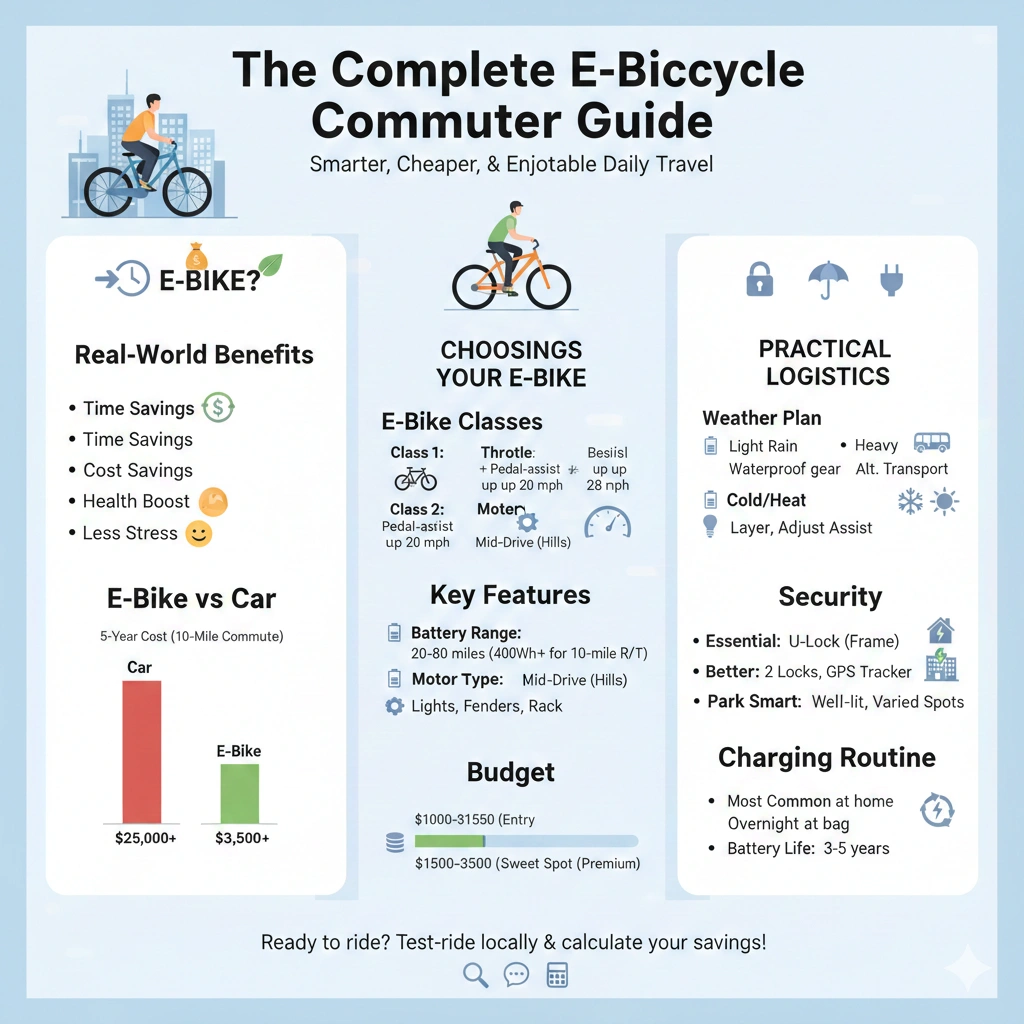
| Class | Type | Speed Limit | Where Allowed | Best For |
|---|---|---|---|---|
| Class 1 | Pedal-assist only | 20 mph | Most bike paths/trails | Urban commuters wanting maximum route options |
| Class 2 | Throttle-assisted | 20 mph | Some restrictions | Riders with physical limitations |
| Class 3 | Pedal-assist | 28 mph | Restricted from many paths | Longer commutes, faster travel |
My recommendation for most commuters: Start with Class 1 unless you have a specific reason to go faster. The 20 mph limit sounds slow until you realize how rarely you’ll max out that speed in urban environments.
[IMAGE SUGGESTION: Side-by-side comparison diagram of the three e-bike classes with visual representations]
Key Features That Actually Matter
Battery Range: How Far Is Far Enough?
E-bike batteries typically range from 300Wh to 700Wh, translating to roughly 20-80 miles of range depending on:
- Terrain (flat vs. hilly)
- Rider weight
- Assist level used
- Weather conditions
Practical calculation: Take your round-trip commute distance and multiply by 1.5 to account for detours and battery degradation over time.
Examples:
- 10-mile round-trip commute → 400Wh battery (30-40 mile range) works well
- 20-mile round-trip commute → 500-600Wh battery recommended
- 30+ mile round-trip → Consider removable batteries to charge at work
Motor Placement: Mid-Drive vs. Hub Motors
Hub Motors (in the wheel):
- Simpler, cheaper
- Less maintenance required
- Great for flat-to-moderate terrain
- Less efficient on steep hills
Mid-Drive Motors (at the cranks):
- Better weight distribution
- More efficient on hills
- Works with bike’s gears
- Higher cost
- More complex maintenance
For most urban commuters, a quality hub motor saves money without sacrificing performance. Save mid-drive for hillier regions.
[IMAGE SUGGESTION: Technical diagram showing hub motor vs. mid-drive motor placement on e-bikes]
Must-Have Practical Features
Don’t overlook these essentials:
- Integrated lights – Powered by main battery (non-negotiable for safety)
- Fenders – Protect work clothes from road spray ($40 investment that proves invaluable)
- Rear rack or pannier compatibility – Carrying a backpack daily gets old fast
- Chain guard – Prevents grease stains on pants
- Kickstand – Surprisingly important for daily use
Budget Considerations: What Should You Actually Spend?
The e-bike market spans from $600 budget models to $10,000+ performance machines. Here’s the honest breakdown:
Under $1,500:
- Approach with caution
- Many budget brands use low-quality components
- Exception: Reputable brands like Ride1Up or Lectric eBikes offer solid entry options
$1,500 – $3,000: Sweet Spot for Most Commuters
- Brands: Rad Power Bikes, Aventon, Trek entry models
- Reliable performance with decent warranties
- Quality components for several years of daily use
$3,000 – $5,000:
- Premium commuter territory
- Better motors (Bosch, Shimano)
- Longer-lasting batteries
- Worth it for year-round commuting or challenging terrain
Over $5,000:
- Enthusiast-grade bikes
- Marginal returns for pure commuting purposes
My advice: Budget $2,500-3,500 for your first serious commuter e-bike.
Practical Commuting Logistics: What Nobody Tells You
The romantic vision of e-bike commuting hits reality pretty quickly. Here are the practical considerations that separate successful e-bike commuters from those whose bike sits unused.
Weather: The Real Test of Commitment
Let’s be honest—riding in rain isn’t pleasant. But it’s also not as bad as you imagine.
Most commuters develop this pragmatic strategy:
Light rain or drizzle:
- Waterproof jacket + fenders = You’re fine
- You’ll be surprised how quickly you adapt
Heavy rain:
- Keep a bus pass or ride-share app handy
- Most e-bike commuters ride 70-80% of days, not 100%
Cold weather:
- More manageable than expected
- Layer properly: base layer → insulating mid-layer → windproof outer
- Moving keeps you warmer than standing at a bus stop
- Bar mitts and good gloves are game-changers
Heat:
- Actually easier than traditional cycling
- Dial back your effort with higher assist settings
- Arrive less sweaty than pedaling a regular bike
Key insight: Perfection is the enemy of progress. Even using your e-bike 3-4 days per week delivers substantial financial and health benefits.
Security: Protecting Your Investment
E-bikes are theft targets—there’s no sugarcoating this. But proper security makes theft difficult enough that thieves move on to easier targets.
Minimum Security Setup (cost: $100-150):
- U-lock for frame and one wheel to immovable object
- Cable lock for second wheel and seat
- Remove or lock the battery (many are removable with a key)
Gold Standard (cost: $150-250):
- Two U-locks (different brands require thieves to carry multiple tools)
- Locking wheel skewers
- GPS tracker hidden in frame ($30-50)
- Register serial number with local police and BikeIndex.org
Where you park matters more than your lock:
- Choose well-lit, high-traffic areas with security cameras
- Vary your parking location slightly each day
- Ask about indoor parking at work—many employers are accommodating
The Charging Routine: Easier Than You Think
Range anxiety is real, but usually overblown. Most e-bike batteries charge fully in 3-5 hours.
Most Common Approach:
- Charge overnight at home
- 2-3 times per week depending on commute length
- Modern batteries have no “memory effect”—partial charging is fine
Battery Longevity Tips:
- Store between 20-80% charge when not using for extended periods
- Avoid extreme heat or cold during storage
- Expect 500-1,000 charge cycles (roughly 3-5 years of daily commuting)
- Budget $400-700 for eventual battery replacement
What to Do About Sweat and Professional Appearance
This concern stops many potential commuters, but it’s surprisingly solvable.
The E-Bike Advantage: With pedal assist, most riders arrive with minimal perspiration. Dial up the assist level on hot days.
Three Clothing Strategies:
- Change at work: Commute in athletic clothes, keep work clothes in desk drawer
- Wear work clothes: If commute is under 30 minutes with high assist levels (wrinkle-resistant fabrics work best)
- Technical fabrics: Designed for cycling but look professional and wick moisture
[IMAGE SUGGESTION: Before/after comparison showing professional appearance maintained after e-bike commute]
Comparing E-Bikes to Other Commute Options
Let’s put real numbers to the comparison everyone wants to see.
Five-Year Cost Analysis (10-Mile Round-Trip Commute)
| Transportation Method | Initial Cost | Annual Operating Cost | 5-Year Total | Time per Commute |
|---|---|---|---|---|
| Personal Car | $5,000+ (used) | $4,000-6,000 | $25,000-35,000 | 30-50 minutes |
| Public Transit | $0 | $1,200-2,400 | $6,000-12,000 | 40-60 minutes |
| E-Bike | $2,500 | $200-300 | $3,500-4,000 | 25-35 minutes |
| Regular Bicycle | $500-1,000 | $100-200 | $1,000-1,500 | 30-40 minutes |
Note: Car costs include gas, insurance, parking, and average maintenance. Does not include vehicle depreciation.
[IMAGE SUGGESTION: Bar chart visualization of the 5-year cost comparison table]
The Less Tangible Comparisons
Health Benefits:
A 2024 study published in the International Journal of Behavioral Nutrition and Physical Activity found that e-bike commuters averaged 160 minutes of moderate physical activity per week just from their commute—meeting WHO exercise recommendations without setting foot in a gym.
Environmental Impact:
Switching from a car to an e-bike for a 10-mile round-trip commute eliminates approximately 2,500 pounds of CO2 emissions annually—equivalent to planting about 40 trees each year.
Stress Reduction:
Research from the University of East Anglia shows that active commuters report:
- Better mood throughout the workday
- Lower stress levels
- Improved overall life satisfaction
Common E-Bike Commuting Questions (Answered Honestly)
“What happens if I get a flat tire during my commute?”
Flats happen, but less often than you’d think with quality e-bike tires (many use puncture-resistant designs).
Solutions:
- Carry basic repair kit or CO2 cartridges + spare tube
- Fixing a flat takes about 10 minutes with practice
- Keep spare tube at work
- Alternative: Puncture-resistant tire liners or sealant-filled tubes reduce flats by 90%
“Can I really ride in my city’s traffic?”
This depends heavily on your local infrastructure and comfort level.
Cities with good cycling infrastructure:
- Bike lanes, slower traffic speeds, cycling culture
- E-bike commuting accessible to almost anyone
Car-centric cities without infrastructure:
- Requires more confidence and experience
- Start by mapping routes using Google Maps’ cycling directions
- Reveals side streets and paths you didn’t know existed
- Weekend practice runs build confidence
“Won’t I arrive exhausted?”
Quite the opposite. E-bikes provide active transportation without exhausting transportation. You’re energized from light exercise and fresh air, not depleted.
The key: Use appropriate assist levels—you control how hard you work.
“What about winter or bad weather?”
Most e-bike commuters reduce but don’t eliminate winter riding.
Options:
- Many continue year-round with appropriate clothing and studded tires (in icy climates)
- Others treat it seasonally, switching to alternative transportation for 2-3 winter months
- Even seasonal use delivers significant annual savings
“Is e-bike maintenance expensive or complicated?”
Basic maintenance (DIY-friendly):
- Tire inflation
- Chain lubrication
- Brake checks
- Minimal cost
Professional service:
- Annual tune-ups: $75-150 at bike shop
- Battery replacement: Only major expense (after 3-5 years, $400-700)
Still vastly cheaper than car maintenance.
Making the Transition: Your First 30 Days
Here’s a realistic roadmap for success:
Week 1: Research and Purchase
- Test ride at least 3-4 models at local shops
- Join local e-bike or cycling forums for community-specific advice
- Order necessary accessories (lock, lights, fenders, rack)
- Map your commute route, identifying bike lanes and low-traffic alternatives
Week 2: Practice and Preparation
- Ride your planned route on a non-work day to identify challenges
- Practice your security routine until it’s second nature
- Set up charging station and establish routine
- Gather work-appropriate cycling clothes or storage for changing
Week 3: Hybrid Commuting
- Ride 2-3 days this week, use alternative transport other days
- Note what works well and what needs adjustment
- Refine your morning routine timing
- Address any discomfort issues (saddle, handlebars, etc.)
Week 4: Normalize the Routine
- Increase to 4-5 days if comfortable
- Establish your all-weather backup plan
- Calculate your cost savings to stay motivated
- Connect with other bike commuters if possible
Realistic expectations: Don’t aim for perfection immediately. Most successful e-bike commuters started gradually, building consistency over several months.
<a name=”future-outlook”></a>
The Future of E-Bike Commuting
E-bike adoption is accelerating rapidly. Sales grew 269% in the United States between 2019 and 2024, outpacing electric car growth.
Trends Making E-Bike Commuting Increasingly Attractive
Improved Infrastructure:
- Major cities investing billions in protected bike lanes
- New York City added over 100 miles of protected lanes since 2022
- Similar expansions in Los Angeles, Chicago, and smaller cities nationwide
Financial Incentives:
- Federal e-bike tax credits (up to $1,500) proposed for 2025
- Several states already offer rebates:
- Colorado: Up to $1,400
- California: $750-2,000 depending on income
- Many local utility companies offer incentives
Employer Programs:
- Forward-thinking companies adding e-bike parking and charging stations
- Some provide e-bikes as benefits
- Mileage reimbursement for bike commuting
Technology Improvements:
- Battery energy density continues improving while costs decline
- 2025 e-bikes offer 30-40% more range than comparable 2020 models at similar prices
Final Thoughts: Is E-Bike Commuting Right for You?
Let me be direct: e-bike commuting isn’t for everyone, and that’s okay. If you live 30 miles from work, have no safe route options, or need to transport kids daily, it might not be practical.
But if you’ve read this far, chances are you’re already intrigued by the possibility.
The magic of e-bike commuting isn’t that it’s perfect—it’s that it transforms a necessary chore (getting to work) into something that improves your health, finances, and daily mood.
You’ll Experience:
- Save thousands of dollars annually
- Arrive at work energized instead of stressed
- Get 30-60 minutes of exercise built into your day without needing gym time
- Discover your city from an entirely different perspective
My advice: If you’re even remotely curious, rent or borrow an e-bike for a week and try your commute. The experience will tell you far more than any article can.
Most people discover that the barriers they imagined were smaller than expected, while the benefits were larger than anticipated.
The best time to start e-bike commuting was five years ago. The second best time is tomorrow morning.
Ready to Take the Next Step?
Action steps:
- Visit local e-bike shops for test rides (most offer them free)
- Join online communities like r/ebikes to learn from experienced commuters
- Calculate your potential savings using online e-bike savings calculators
- Start with just one or two days per week—consistency beats perfection
About the Author
Jonathan M. Jordan is a technology writer and automotive expert based in Bloomingburg, Ohio. He specializes in providing insights on the latest innovations in the automotive industry, helping readers stay informed about electric vehicles, smart technologies, and emerging trends. Jonathan combines hands-on experience with extensive research to create practical guides for modern commuters.
Have questions about e-bike commuting that I didn’t cover? Connect with me through the comments below—I’m always happy to help fellow riders make informed decisions about their commute transformation.
Related Articles: