So you’ve decided to join the electric vehicle revolution—congratulations! But now you’re staring at your garage wall, wondering what it’ll actually cost to install a home charging station. If you’re like most new EV owners, you’ve probably seen wildly different price estimates online, ranging from a few hundred dollars to several thousand. Let me clear up the confusion.
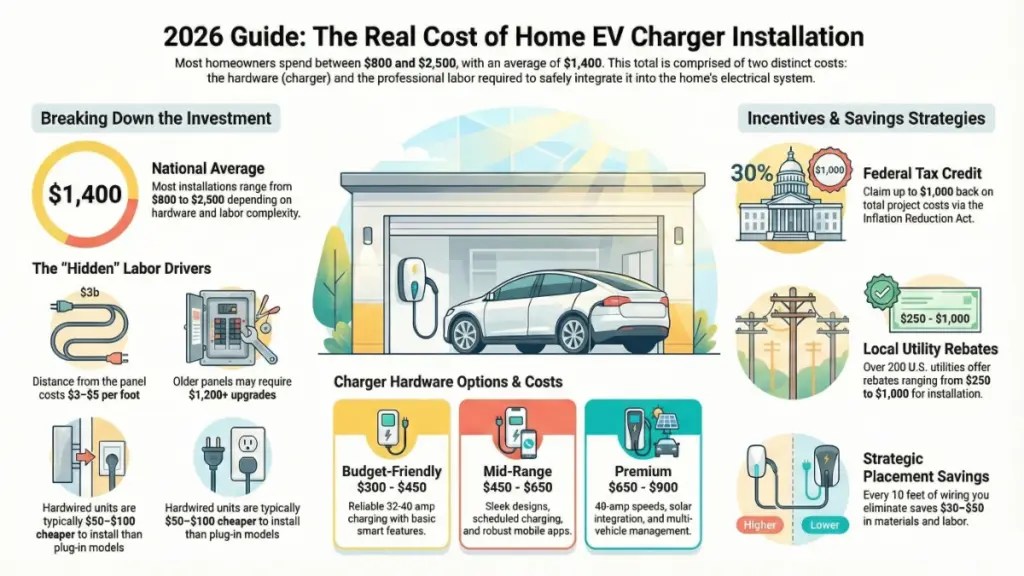
The short answer: Most homeowners spend between $800 and $2,500 for a complete Level 2 home charger installation in 2026, with the national average hovering around $1,400. However, your actual cost depends on several key factors—your electrical panel’s capacity, the distance from your panel to your garage, local permit requirements, and which charger you choose.
In this guide, I’ll break down exactly what goes into these costs, share real-world examples from recent installations, and show you legitimate ways to reduce your expenses (including rebates you might not know about). By the end, you’ll know what to budget and how to avoid overpaying.
Understanding the Two Main Cost Components
When you’re budgeting for home EV charging, you’re really paying for two separate things: the charging equipment itself and the professional installation. Let’s tackle each one.
The Charger Hardware ($300-$900)
Your Level 2 home charger (technically called an EVSE, or Electric Vehicle Supply Equipment) is where you’ll see the widest price variation. Think of it like choosing a smartphone—you can get a perfectly functional model or splurge on premium features you might not actually need.
Budget-friendly options ($300-$450): Brands like ChargePoint Home Flex, Emporia, and Grizzl-E offer reliable hardwired units with basic smart features. Furthermore, these handle 32-40 amps and will fully charge most EVs overnight without issue. Honestly? For most people, these are more than adequate.
Mid-range options ($450-$650): This is where you’ll find popular models like the JuiceBox 40 or Wallbox Pulsar Plus. Essentially, you’re paying for sleeker designs, better apps, and features like scheduled charging during off-peak hours (which can significantly reduce your electricity costs if your utility offers time-of-use rates).
Premium options ($650-$900): Tesla’s Wall Connector, Enel X JuiceBox Pro, and similar units offer faster charging speeds (up to 48 amps), more sophisticated energy management, and integration with home solar systems. Consequently, they’re worth it if you have a larger battery EV or you’re charging multiple vehicles.
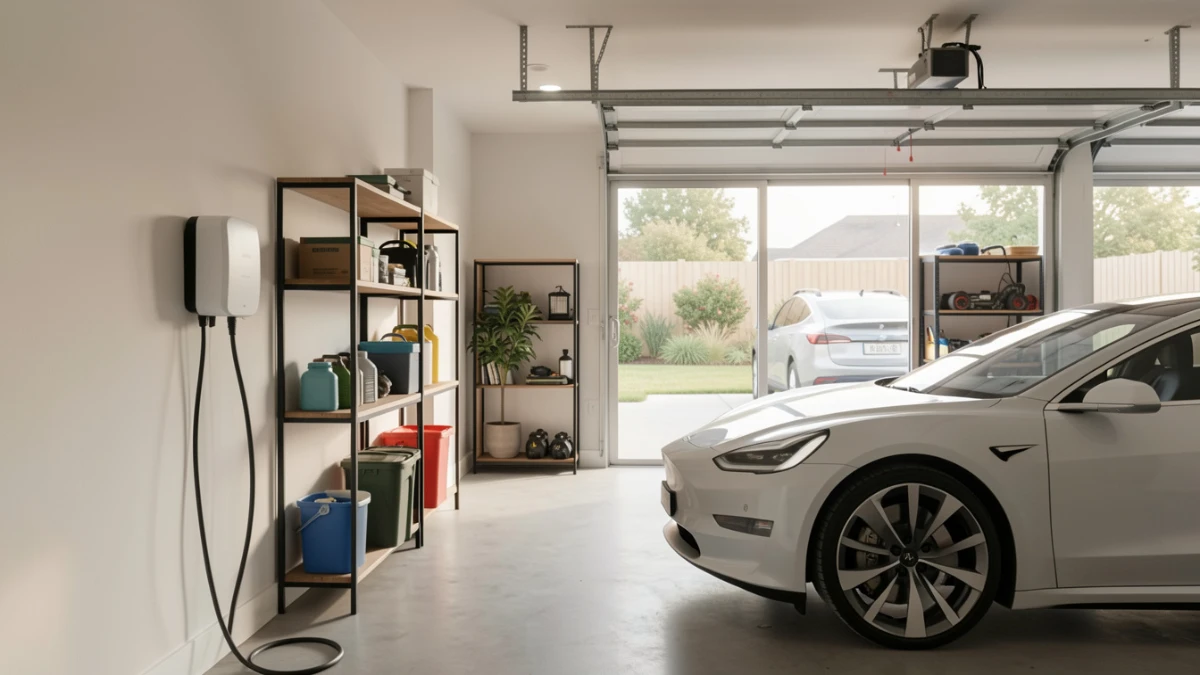
Here’s something important many people miss: hardwired units are typically $50-$100 cheaper to install than plug-in models because they don’t require installing a dedicated 240V outlet. Unless you plan to take the charger with you when move, I’d recommend going hardwired.
Professional Installation Costs ($500-$1,600)
This is where the real variability comes in, and where I see people get surprised. Specifically, your installation cost depends on three main factors:
Your Electrical Panel’s Capacity
If your home’s electrical panel has available capacity (at least 40-50 amps of unused space), you’re in luck—installation is straightforward. Nevertheless, here’s the reality check: about 35% of homes built before 2000 need some level of electrical upgrade. Moreover, a panel upgrade adds $1,200-$2,500 to your project, though there are federal tax credits that can offset this (more on that shortly).
Distance from Panel to Charging Location
Electricians typically charge $3-$5 per linear foot of wiring needed. For instance, if your garage shares a wall with your electrical panel room, you might only need 20 feet of wire. On the other hand, if your panel is on the opposite side of the house, you could need 80-100 feet, adding $300-$500 to your installation.
Complexity of the Wire Run
Running wire through an unfinished basement or exposed garage framing is straightforward. In contrast, snaking wires through finished walls, under concrete slabs, or through tight crawlspaces? That’s when labor hours multiply. As a result, expect to pay 30-50% more for complicated wire runs.
Real-World Installation Examples from 2026
Let me share some actual scenarios from recent installations to give you a better sense of what different situations cost.
Example 1: The Simple Installation
- Home: 2015 construction, attached garage
- Electrical panel: 200-amp service, 50 amps available
- Distance: 25 feet from panel to garage wall
- Charger: ChargePoint Home Flex (hardwired)
- Total cost: $950 ($400 charger + $550 installation)
Example 2: The Moderate Installation
- Home: 2004 construction, detached garage
- Electrical panel: 200-amp service, minimal available capacity
- Distance: 60 feet from panel to garage
- Charger: Wallbox Pulsar Plus
- Added: 40-amp subpanel in garage for future expansion
- Total cost: $1,850 ($520 charger + $1,330 installation)
Example 3: The Complex Installation
- Home: 1985 construction, attached garage
- Electrical panel: 150-amp service requiring upgrade
- Distance: 40 feet with finished basement wire run
- Charger: JuiceBox 40
- Added: Panel upgrade to 200-amp service
- Total cost: $3,400 ($450 charger + $950 installation + $2,000 panel upgrade)
Notice how the third example is nearly four times the cost of the first? Therefore, I always recommend getting your electrical panel assessed before you buy your EV if possible.
Hidden Costs and Extras to Consider
Beyond the basic installation, there are a few additional expenses that might pop up:
Permit Fees ($50-$200)
Most municipalities require electrical permits for 240V installations. Generally, your electrician should handle this, but the cost gets passed to you. Additionally, some areas waive or reduce permit fees for EV charger installations—worth asking your local building department.
Trenching for Detached Garages ($500-$1,500)
If your charger location requires running underground conduit, you’ll need trenching work. The cost varies dramatically based on distance and what’s in the way (landscaping, driveways, sidewalks).
WiFi Extenders or Mesh Systems ($100-$300)
Many smart chargers need a reliable WiFi connection. Consequently, if your garage has spotty coverage, you might need to upgrade your network. Not strictly necessary, but you’ll miss out on useful features like remote monitoring and scheduled charging.
Weatherproof Enclosures for Outdoor Installations ($80-$200)
Most residential chargers are outdoor-rated, but if you’re mounting the unit in an exposed location, a protective enclosure provides extra peace of mind and can extend the equipment’s lifespan.
Rebates, Incentives, and Tax Credits That Lower Your Costs
Here’s the good news: you probably won’t pay the full installation cost out of pocket. In fact, there are several incentive programs available in 2026:
Federal Tax Credit (30% of Installation Costs)
Thanks to the Inflation Reduction Act’s Alternative Fuel Vehicle Refueling Property Credit, you can claim 30% of your total installation cost (up to $1,000) when you file your taxes. Furthermore, this applies to both the charger hardware and installation labor.
For example, if your total project costs $1,500, you’ll get $450 back when you file. Similarly, if it costs $3,333 or more, you’ll hit the $1,000 maximum credit. Meanwhile, the credit applies to installations completed through December 31, 2032, so there’s no rush—but why wait?
Important note: This is a tax credit, not a deduction, meaning it directly reduces your tax bill dollar-for-dollar. Therefore, you’ll need to file IRS Form 8911 with your return. Keep all receipts and documentation.
Utility Company Rebates ($250-$1,000)
This is where things get really interesting. Currently, over 200 utility companies across the U.S. now offer EV charger installation rebates or incentives. Some are quite generous:
- Pacific Gas & Electric (California): Up to $1,000 rebate for income-qualified customers
- Xcel Energy (Colorado, Minnesota, others): $500-$1,300 depending on program tier
- Duke Energy (North Carolina, South Carolina): $400-$600 rebates
- National Grid (Massachusetts, New York): $500-$1,000 for residential installations
Additionally, many utilities also offer discounted off-peak electricity rates specifically for EV charging. For instance, Southern California Edison’s EV-TOU-5 plan offers charging rates as low as 15 cents per kWh during super off-peak hours (midnight to 6 AM), compared to 40+ cents during peak afternoon hours.
Check your utility’s website under “electrification programs” or “EV charging incentives.” Bear in mind, some require you to enroll before installation, so do this research early.
State and Local Programs
Several states have additional incentive programs:
- California: Self-Generation Incentive Program offers credits for smart chargers paired with solar
- Colorado: State tax credit up to $1,500 for home charging equipment
- Maryland: State tax credit covering 40% of installation costs (up to $700)
- Massachusetts: MOR-EV program offers additional rebates beyond utility incentives
Check the Alternative Fuels Data Center (https://afdc.energy.gov/laws/state) for a comprehensive list of state and local incentives. Importantly, these programs change frequently, and new ones launch throughout the year.
Employer Programs
Don’t overlook employer benefits. In recent years, some companies now offer EV charging installation stipends as part of their sustainability or employee benefit programs. For example, Ford, GM, and several tech companies provide $500-$1,000 toward home charger installation for employees who purchase or lease EVs. Worth asking your HR department.
How to Choose a Qualified Installer (and Avoid Bad Ones)
Finding the right electrician can make a huge difference in both cost and quality. Here’s what I’ve learned works:
Get Multiple Quotes (But Not Too Many)
Request detailed written estimates from 3-4 licensed electricians who have specific EV charger installation experience. Notably, more than four quotes becomes time-consuming without much additional benefit.
A good quote should itemize:
- Labor hours and hourly rate
- Materials needed (wire gauge, breaker size, conduit)
- Permit fees
- Any potential complications they’ve identified
- Timeline for completion
Be wary of quotes that seem unusually low—they often indicate the electrician hasn’t properly assessed the scope of work or might cut corners.
Verify Their EV Charging Experience
Installing an EV charger isn’t particularly complex for a skilled electrician, but there are nuances. Ask potential installers:
- How many EV chargers have they installed in the past year?
- Are they familiar with your specific charger brand?
- Do they handle permit applications and inspections?
- What warranty or guarantee do they offer on their work?
Electricians who’ve installed 20+ chargers will work more efficiently and anticipate problems before they arise.
Check the Charger Manufacturer’s Installer Network
Many charger manufacturers (ChargePoint, Wallbox, JuiceBox) maintain networks of certified installers. Specifically, these electricians have received specific training on the products and often complete installations faster. ChargePoint’s installer network, for example, typically charges 10-15% less than going through independent contractors because of volume agreements.
Some manufacturers bundle installation quotes when you purchase the charger directly from them. In particular, ChargePoint offers a “ChargePoint Home Flex Installation Package” where you get the charger plus professional installation at a set price based on your address and electrical setup.
Red Flags to Watch For
Avoid electricians who:
- Don’t ask detailed questions about your electrical panel
- Offer to skip the permit process “to save you money”
- Can’t provide proof of licensing and insurance
- Require large upfront deposits (50%+ of total cost)
- Rush you to make a decision
Remember, you’re establishing a 240V circuit that carries significant current. Therefore, this isn’t the place to cut corners or choose the cheapest option without vetting quality.
DIY Installation: Should You Do It Yourself?
I get asked this constantly: “Can I just install the charger myself and save the $500-$1,500?”
The honest answer: Unless you’re a licensed electrician or have extensive electrical experience, I strongly recommend against DIY installation. Here’s why:
Safety Concerns
You’re working with 240V circuits carrying 32-50 amps—enough to cause serious injury or start a fire if installed incorrectly. Consequently, one improperly sized wire or loose connection creates a significant hazard.
Permit and Code Compliance
Most jurisdictions require permitted work and final inspection for any new 240V circuit. Therefore, if you install it yourself without permits, you could face problems when selling your home, or worse, have insurance claims denied if there’s ever an electrical fire.
Warranty Implications
Many charger manufacturers require professional installation to maintain product warranties. Similarly, some homeowner’s insurance policies have similar requirements.
Lost Incentives
Some utility rebate programs require professional installation by a licensed electrician to qualify.
What You CAN Do Yourself
If you want to save money through DIY work, consider prepping the installation site—clearing the wall area, deciding on exact charger placement, or even running conduit along an exposed route (though the electrician should still pull and connect the wiring). In turn, this might save you an hour of labor ($100-$150).
The bottom line: unless you really know what you’re doing, the $500-$1,500 you’d save isn’t worth the risks and potential headaches.
Smart Ways to Reduce Your Installation Costs
Beyond incentives and rebates, here are practical strategies that can legitimately lower your expenses:
Choose the Optimal Location Strategically
Installing your charger on the garage wall closest to your electrical panel can save hundreds in wiring costs. Specifically, every 10 feet of distance you eliminate saves $30-$50. I’ve seen people save $400+ just by reconsidering where they park their EV.
Combine with Other Electrical Work
If you’re already planning electrical upgrades—rewiring a room, installing solar panels, upgrading your panel—adding the EV charger installation at the same time reduces overall labor costs. Moreover, electricians charge less per project when they can tackle multiple jobs in one visit.
Consider a Lower-Amperage Charger
A 32-amp charger costs less to install than a 48-amp unit because it requires a smaller breaker and potentially thinner wire. Unless you have a large-battery EV (100+ kWh) and absolutely need the fastest charging speeds, a 32-amp charger will still fully charge most EVs overnight.
Time Your Installation Strategically
Electricians are typically less busy (and sometimes offer better rates) during late fall and winter months. Therefore, if your EV purchase timeline is flexible, scheduling installation during slower seasons might save 10-15%.
Negotiate if You’re Getting Multiple Chargers
Planning to install chargers for two EVs? In that case, some electricians will discount the second installation since they’re already mobilized on-site and sharing permit costs.
Join EV Owner Groups
Local EV clubs and online forums often share recommendations for affordable, reliable installers. Furthermore, some communities even negotiate group rates when multiple members install chargers around the same time.
What About Portable Level 2 Chargers?
There’s another option worth considering: portable Level 2 charging stations that plug into existing 240V outlets (like your dryer outlet).
Typically, these units cost $400-$600 and don’t require professional installation if you already have an accessible 240V outlet. The catch? Your dryer outlet needs to be in or very near your garage, which isn’t the case for most homes.
However, if you do have a conveniently located dryer outlet, you might need a simple NEMA 14-50 outlet installed in your garage ($250-$400), which is significantly cheaper than a dedicated circuit for a hardwired charger.
Pros of Portable Chargers
- Lower upfront cost
- Portability if you move or want to take it on trips
- No hardwiring required
- Easier to upgrade later
Cons of Portable Chargers
- Slightly slower charging speeds
- The cord/plug creates a tripping hazard
- Some HOAs have aesthetic concerns about visible cords
- Can’t leverage some utility smart-charging programs
Generally, I recommend portable units for renters or people who aren’t certain about their long-term housing situation. In contrast, for homeowners planning to stay put for several years, a hardwired unit is the better investment.
Looking Ahead: Installation Costs in 2026 and Beyond
The EV charging installation market is maturing rapidly. Here’s what I’m seeing for the near future:
Prices Are Stabilizing
After years of fluctuation, installation costs have leveled off. Notably, the influx of new electricians getting trained in EV installations has increased competition, which helps keep prices reasonable. I expect the $800-$2,500 range to hold steady through 2026-2027.
More Streamlined Permit Processes
Many municipalities are adopting standardized EV charger installation permits and same-day approval processes. As a result, this reduces both time and cost. Some cities (like San Francisco and Seattle) now offer online permit applications that are approved within 24-48 hours.
Smarter Chargers as Standard
Features that were premium two years ago—WiFi connectivity, scheduled charging, energy monitoring—are now standard on even budget-friendly models. Therefore, you’re getting more value at every price point.
Improved Electrical Panels
Newer homes built in 2023 and beyond are increasingly being designed with “EV-ready” electrical panels that include pre-wired circuits or extra capacity specifically for EV charging, making future installations much simpler and cheaper.
Making Your Decision: What’s Right for Your Situation?
After all this information, how do you decide what to do? Let me break it down by common situations:
If Your Panel Has Available Capacity
Budget $900-$1,400 total. Specifically, choose a mid-range charger like the ChargePoint Home Flex or Wallbox Pulsar Plus and get quotes from 3 electricians. After the federal tax credit, your net cost will be around $600-$1,100.
If You Need a Panel Upgrade
Budget $2,500-$3,500 total, but don’t panic—between the federal tax credit and potential utility rebates, your net cost might drop to $1,500-$2,200. Moreover, the panel upgrade also increases your home’s value and may be necessary for other future electrical needs anyway.
If You Have a Detached Garage
Budget $1,800-$2,800. Consider this an investment in your property. Additionally, a professionally installed EV charger can add value when selling, especially as EV adoption continues accelerating.
If You’re Renting
Go with a portable Level 2 charger ($400-$600) that plugs into an existing or newly installed NEMA 14-50 outlet ($250-$400 for outlet installation). Total investment: $650-$1,000, and you can take it with you.
Your Next Steps
Here’s exactly what to do to move forward:
1. Assess your electrical situation (this week): Check your electrical panel’s capacity or have an electrician do a free assessment. Knowing whether you need a panel upgrade shapes your entire budget.
2. Research incentives (this week): Visit your utility’s website and the AFDC website to identify all available rebates and incentives. Make a list and note any pre-enrollment requirements.
3. Choose your charger (within 2 weeks): Based on your budget and needs, select 2-3 charger models. Read recent reviews, check compatibility with your EV, and compare features you’ll actually use.
4. Get installation quotes (within 2-3 weeks): Contact 3-4 electricians, preferably from your charger manufacturer’s certified installer network. Request itemized written estimates.
5. Schedule installation (within 4-6 weeks): Once you’ve selected your installer, schedule the work. Most installations are completed in 3-6 hours, depending on complexity.
6. File for incentives (immediately after installation): Submit utility rebate applications within their required timeframe, and save all documentation for your tax credit claim.
The shift to electric driving is one of the best decisions I’ve made—both financially and environmentally. Yes, there’s an upfront investment in home charging infrastructure, but between overnight charging convenience, lower fuel costs, and available incentives, that investment pays dividends quickly.
In 2026, with mature technology, competitive pricing, and generous incentive programs, there’s never been a better time to set up home EV charging. Do your homework, get multiple quotes, leverage all available rebates, and you’ll have a professional charging setup that serves you reliably for years to come.
Remember: The average EV owner saves $800-$1,200 annually on fuel costs compared to gasoline. Consequently, your charging installation typically pays for itself within 12-18 months—and then you’re saving money every month thereafter while charging conveniently at home. That’s a pretty compelling investment.