Have you ever wondered why electric car drivers often brag about rarely touching their brake pedals? Or how EVs manage to extend their range just by driving normally? The secret lies in one of the most elegant engineering solutions in modern vehicles: regenerative braking.
If you’ve been curious about this technology—whether you’re considering an EV purchase or just fascinated by how things work—you’re in the right place. Regenerative braking isn’t just a fancy feature; it’s a fundamental game-changer that makes electric vehicles more efficient, extends their range, and even saves you money on brake maintenance. In this article, you’ll discover exactly how regenerative brakes capture energy that would otherwise be wasted, understand the technology that makes it possible, and learn why this system is revolutionizing how we think about vehicle efficiency.
What Is Regenerative Braking? The Basics Explained
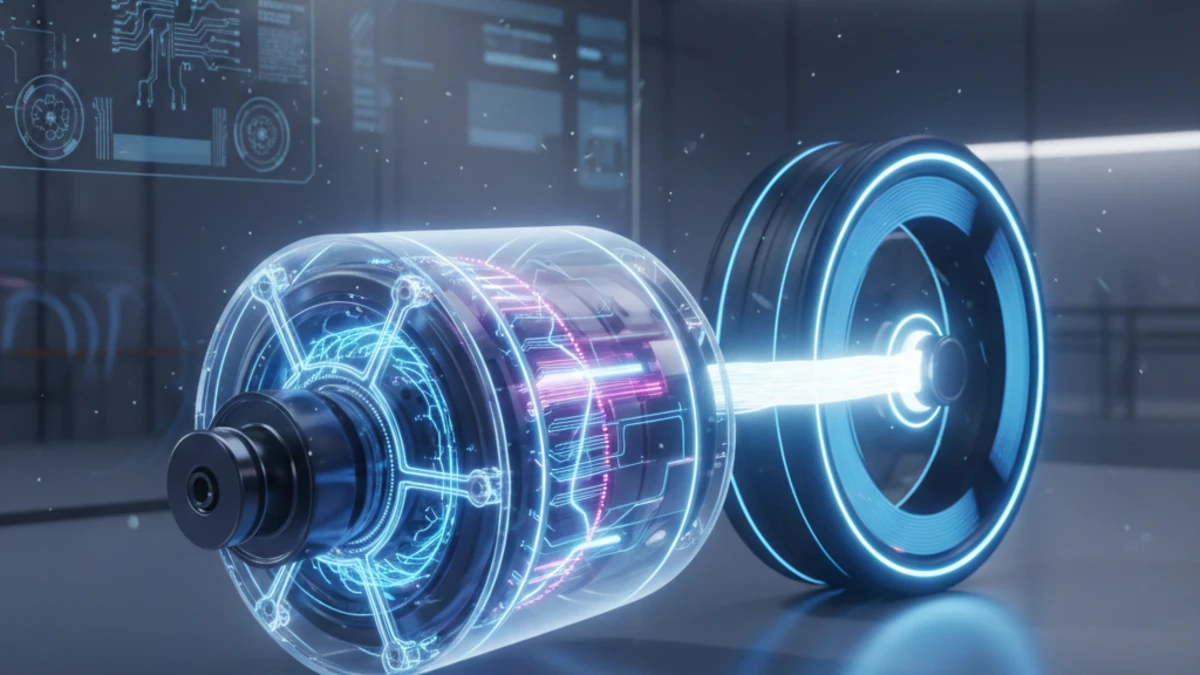
At its core, regenerative braking is a system that converts your vehicle’s kinetic energy (motion) back into electrical energy that’s stored in the battery. Think of it like this: when you’re driving, the battery sends power to the electric motor to move your car forward. With regenerative braking, that process essentially runs in reverse—when you slow down, the motor switches roles and becomes a generator, converting the energy of your moving vehicle back into electricity.
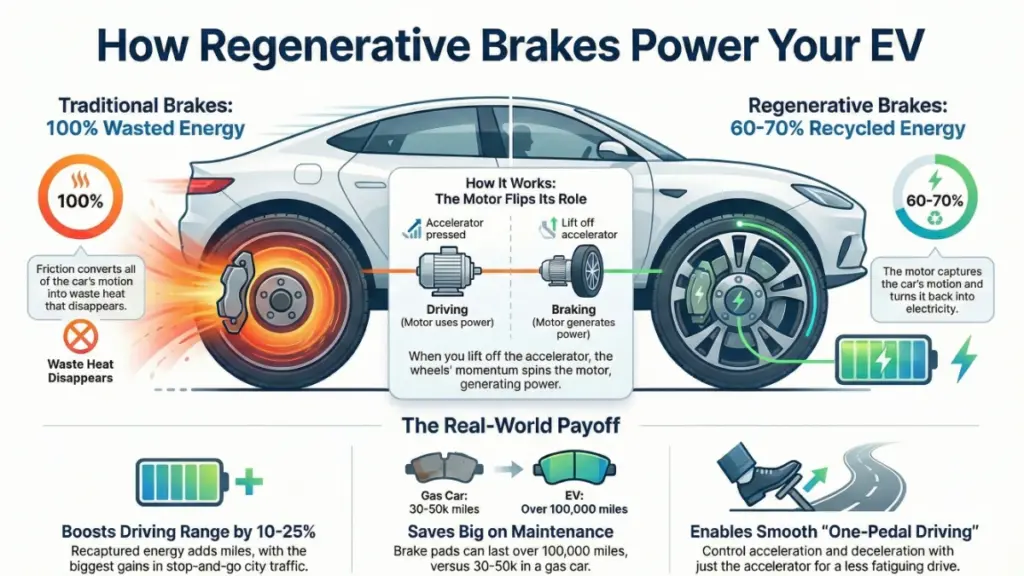
In a traditional gas-powered car, hitting the brakes creates friction between brake pads and rotors, which converts your motion into heat that simply dissipates into the air. That’s energy literally going up in smoke. Regenerative braking, on the other hand, captures a significant portion of that energy—typically between 60-70% of the kinetic energy—and feeds it back into your battery. It’s like getting a small recharge every time you slow down or coast downhill.
Here’s what makes it so clever:
- Your electric motor does double duty as both a motor and a generator
- Energy that would be wasted as heat instead extends your driving range
- You can drive for miles in city traffic using minimal friction braking
- The system works automatically whenever you lift off the accelerator
This isn’t just a nice efficiency bonus—regenerative braking can extend your EV’s range by 10-25% in typical driving conditions, and even more in stop-and-go city traffic or mountainous terrain where you’re constantly slowing down.
The Science Behind the Magic: How It Actually Works
Let’s dive into the fascinating physics that makes regenerative braking possible. Don’t worry—I’ll keep this grounded in practical terms rather than drowning you in equations.
The Motor-Generator Flip
Every electric motor operates on the principle of electromagnetic induction, discovered by Michael Faraday back in 1831. When electricity flows through wire coils in a magnetic field, it creates rotational force (torque) that spins the motor. Here’s the brilliant part: this process is completely reversible.
When you’re accelerating, electrical current from the battery flows into the motor, creating a rotating magnetic field that turns the wheels. But when you lift your foot off the accelerator, the system flips. The wheels keep spinning due to your car’s momentum, which now forces the motor to spin. This mechanical rotation through the motor’s magnetic field generates electrical current—the motor has become a generator. That current flows back to the battery as usable energy.
The process in simple steps:
- You lift off the accelerator – The power controller cuts power to the motor
- Momentum keeps wheels spinning – Your car’s forward motion continues naturally
- Motor becomes a generator – Spinning through magnetic fields creates electrical current
- Energy flows to battery – Generated electricity charges your battery pack
- You feel deceleration – This energy conversion creates resistance, slowing the car
Controlling the Deceleration Force
One of the most impressive aspects of regenerative braking is how smoothly it can be controlled. The vehicle’s computer continuously monitors your speed, battery charge level, and how quickly you’re decelerating. It then adjusts the amount of resistance (technically called “regenerative braking torque”) to match your desired slowdown rate.
When you need gentle deceleration—like coasting to a stop sign—the system applies light regenerative force. Need to slow quickly? The system ramps up the resistance, capturing more energy while providing stronger braking force. Modern EVs like the Tesla Model 3, Chevy Bolt, or Hyundai Ioniq 5 can achieve up to 0.3g of deceleration through regenerative braking alone, which handles about 90% of normal driving situations without touching the friction brakes.
The computer also monitors battery temperature and charge state. If your battery is already at 100% charge or extremely cold, the system automatically reduces regenerative braking intensity since the battery can’t safely accept the additional charge. This is why many EV drivers notice less regenerative braking on cold mornings or after fully charging overnight.
One-Pedal Driving: The Revolutionary Experience
Once you understand how regenerative braking works, you can appreciate why “one-pedal driving” has become one of the most beloved features of electric vehicle ownership. And trust me, once you experience it, it’s hard to go back to conventional driving.
What Is One-Pedal Driving?
One-pedal driving means you can control both acceleration and most braking using just the accelerator pedal. Press down to go, lift up to slow down or stop. The regenerative braking is calibrated strong enough that in many situations—like city driving or parking lots—you rarely need to touch the actual brake pedal at all.
The first time you experience it, it feels slightly odd. You lift off the accelerator expecting to coast, and the car immediately begins slowing down noticeably. Within a few miles, though, most drivers report that it becomes completely intuitive and actually feels more natural than traditional braking. You’re essentially using your right foot to directly control your speed at all times, rather than switching between two pedals.
Benefits EV owners rave about:
- Smoother traffic flow – Gradual, controlled deceleration instead of on-off braking
- Reduced fatigue – Less foot movement in stop-and-go traffic means less driver exhaustion
- Better efficiency – Maximum energy recovery since you’re using regen constantly
- Extended brake life – Some EV owners go 100,000+ miles on original brake pads
- Enhanced control – More precise speed management, especially downhill or in parking situations
Different manufacturers offer varying levels of one-pedal driving intensity. The Nissan Leaf’s “e-Pedal” and Chevy Bolt’s “Low” mode will bring the car to a complete stop and hold it there, while Tesla’s regenerative braking requires you to use the friction brakes for the final stopping. Some vehicles, like the Porsche Taycan or BMW i4, let you adjust the regenerative braking strength through multiple settings, letting you choose how aggressively the car slows when you lift off.
Hybrid Systems: Blending Regenerative and Friction Braking
While pure EVs can rely heavily on regenerative braking, they still need traditional friction brakes for emergency stops and final stopping power. The real engineering challenge is making these two systems work together seamlessly—something called “blended braking.”
How Blended Braking Works
When you press the brake pedal in a modern EV or hybrid, you’re not directly controlling brake pads clamping down on rotors like in a traditional car. Instead, you’re sending a signal to the vehicle’s computer system about how much deceleration you want. The computer then decides how much of that braking force should come from regenerative braking versus friction braking.
Here’s what happens in a typical braking scenario:
Light to moderate braking (most driving situations):
- The system uses regenerative braking almost exclusively
- Captures maximum energy while providing smooth deceleration
- Friction brakes remain disengaged unless needed
Aggressive braking (emergency stops, rapid deceleration):
- Regenerative braking provides initial force but hits its limits quickly
- Friction brakes seamlessly engage to provide additional stopping power
- Blending is so smooth you typically can’t feel the transition
Very low-speed stopping (parking, traffic creep):
- Regenerative effectiveness decreases at low speeds (under 5-10 mph)
- Friction brakes handle final stopping and holding the vehicle stationary
- Some systems use electronic parking brake to hold position
The brilliance of modern blended braking systems is that you shouldn’t notice where regenerative ends and friction begins. Engineers spend countless hours calibrating the brake pedal feel to be progressive and predictable. The 2024 Ford F-150 Lightning, for example, underwent extensive brake tuning to ensure the pedal feels natural despite the complex energy recovery happening behind the scenes.
The Brake-By-Wire Revolution
Most modern EVs use “brake-by-wire” systems, where your brake pedal connects to electronic sensors rather than being mechanically linked to the brake calipers. This might sound concerning—no direct mechanical connection?—but it actually provides crucial advantages.
The electronic system can instantly adjust the ratio of regenerative to friction braking based on conditions you might not even be aware of: battery charge level, brake temperature, road surface conditions detected by traction control, and even which wheels have the most grip. This sophisticated coordination would be impossible with purely mechanical brakes.
Don’t worry about safety—all brake-by-wire systems include multiple redundancies. If the electronic system fails, there’s always a backup mechanical braking system. You’ll never be in a situation where pressing the brake pedal does nothing.
Real-World Efficiency: How Much Energy Do You Actually Recover?
Let’s talk numbers, because understanding the actual efficiency impact helps you appreciate why regenerative braking matters so much.
Energy Recovery Rates
Modern regenerative braking systems typically capture 60-70% of the kinetic energy during braking events. That might not sound perfect, but it’s remarkably efficient considering the physics involved. The remaining 30-40% is lost to various inefficiencies:
- Electrical resistance in wiring and components (generates heat)
- Motor inefficiency during generation mode (no motor is 100% efficient)
- Battery charging losses (chemical reactions aren’t perfectly efficient)
- Aerodynamic drag and rolling resistance (these continue regardless)
To put this in perspective, traditional friction brakes convert 100% of kinetic energy to waste heat—zero is recovered. So recovering 60-70% represents a massive improvement in overall efficiency.
Range Extension Benefits
The real-world range impact varies dramatically based on your driving conditions:
City driving / Heavy traffic:
- Range improvement: 20-30% compared to no regenerative braking
- Why it shines: Constant acceleration and deceleration cycles maximize energy recovery
- Example: A 250-mile EPA-rated EV might achieve 280-300 miles in urban conditions
Highway driving:
- Range improvement: 5-10% compared to no regenerative braking
- Why it’s less dramatic: Fewer braking events, more steady-state cruising
- Example: Same 250-mile rated vehicle might see only 260-270 miles on highway
Mountain descent:
- Range improvement: Can actually increase range despite distance traveled
- Why it’s remarkable: Gravity provides free energy that regenerative braking captures
- Real example: EV drivers report gaining 20-30 miles of range on long mountain descents
A 2023 study by the Idaho National Laboratory found that regenerative braking recovered an average of 22% of total energy used during mixed driving conditions across multiple EV models. For a typical EV consuming 30 kWh per 100 miles, that’s 6.6 kWh recovered—enough for an additional 22 miles of range, essentially for free.
The Maintenance Savings Bonus
Beyond efficiency, there’s a significant practical benefit: dramatically reduced brake wear. Traditional brake systems rely on friction materials that wear down every time you brake—brake pads, rotors, and even brake fluid eventually need replacement.
With regenerative braking handling most of your daily stopping, friction brakes see minimal use:
- Brake pad life: Many EV owners report 100,000-150,000 miles on original pads (versus 30,000-50,000 in gas cars)
- Rotor life: Often lasting the entire vehicle lifetime with proper use
- Brake fluid: Requires less frequent replacement due to reduced heat cycling
Some EV owners joke that their biggest brake maintenance concern is rust developing on rotors from lack of use. There’s actually some truth to this—EV service advisors recommend occasionally using friction brakes more aggressively to clean surface oxidation and maintain optimal performance.
The Technology Behind Different EV Models
Not all regenerative braking systems are created equal. Manufacturers take different approaches based on their engineering philosophies, and understanding these differences can help if you’re shopping for an EV.
Adjustable Regenerative Braking Strength
Many modern EVs offer multiple regenerative braking modes, letting you customize how aggressively the car slows when you lift off the accelerator:
Strong/Max Regen (one-pedal driving):
- Examples: Nissan Leaf e-Pedal, Chevy Bolt “Low” mode, Tesla Model 3 (Standard setting)
- Behavior: Significant deceleration immediately upon lift-off, can bring car to complete stop
- Best for: City driving, maximizing efficiency, drivers who embrace one-pedal style
- Recovery: Maximum energy capture from every deceleration
Medium Regen (moderate):
- Examples: BMW i4 “Medium” setting, Hyundai Ioniq 5 Level 2
- Behavior: Noticeable slowdown but more gradual, similar to engine braking in gas cars
- Best for: Drivers transitioning to EVs, mixed driving conditions
- Recovery: Good energy capture while maintaining familiar feel
Low/Coast (minimal regen):
- Examples: Porsche Taycan in Coast mode, Audi e-tron “Dynamic” mode
- Behavior: Car coasts freely when you lift off, like a traditional automatic transmission
- Best for: Highway cruising, drivers who prefer traditional driving feel
- Recovery: Energy captured only when brake pedal is pressed
Some vehicles go even further. The Hyundai Ioniq 5 and Kia EV6 feature paddle shifters that let you adjust regenerative strength on the fly—increase it for steeper downhills or city traffic, decrease it for highway cruising. It’s a level of control that becomes genuinely useful once you’re familiar with the system.
Specialized Regenerative Systems
Rear-wheel Drive vs. All-wheel Drive:
EVs with motors on both axles (AWD) have an interesting advantage. They can use both motors for regenerative braking, potentially capturing more energy and providing more powerful deceleration. The Tesla Model Y Performance, for example, can generate up to 70 kW of regenerative braking power with both motors working together.
Single-motor EVs (typically RWD or FWD) are limited to one motor’s generating capacity, but this is rarely a practical limitation for normal driving. You’ll only notice the difference during very aggressive deceleration from high speeds.
Performance-Oriented Systems:
Vehicles like the Porsche Taycan, Lucid Air, or BMW i4 M50 calibrate their regenerative braking with driving dynamics in mind. They reduce regenerative intensity during aggressive cornering (to avoid upsetting vehicle balance) and blend regenerative and friction braking more seamlessly during performance driving. The Taycan’s engineering team spent significant time ensuring that brake pedal feel remained consistent and predictable even during track use—a challenge when regenerative braking availability changes based on battery temperature and charge state.
Common Questions and Misconceptions
Let’s address some of the most frequent questions EV drivers and curious shoppers have about regenerative braking.
“Does regenerative braking charge the battery while driving?”
Not exactly. Regenerative braking only captures energy when you’re slowing down—it converts kinetic energy (motion) into electrical energy. It doesn’t generate power from nothing or charge the battery while maintaining speed.
However, downhill driving is a special case. If you’re descending a mountain and need to brake to control your speed, regenerative braking captures the gravitational potential energy and can actually add range. Many EV drivers report arriving at the bottom of long mountain descents with more battery charge than when they started.
“Can you turn off regenerative braking?”
Most EVs let you reduce regenerative braking intensity, but you typically can’t disable it entirely. Even in the lowest regen setting, lifting off the accelerator produces some regenerative effect—though it might feel similar to the engine braking in a gas-powered car.
Why keep some level active? Because capturing any amount of energy is better than wasting it all as heat. Plus, that subtle resistance when you lift off provides better vehicle control and more intuitive speed management.
“What happens if the battery is full?”
This is a clever bit of engineering. When your battery reaches 100% state of charge, the vehicle’s computer reduces or temporarily disables regenerative braking since the battery can’t safely accept additional charge. You’ll notice reduced deceleration when lifting off the accelerator, and the system relies more on friction brakes.
This is why experienced EV owners often recommend charging to only 80-90% for daily use. It’s healthier for the battery’s long-term lifespan and ensures you have full regenerative braking capability available—which is especially important if you live in hilly terrain and need that energy-absorbing capacity to control your descent safely.
“Does it work in cold weather?”
Yes, but with some limitations. Lithium-ion batteries don’t accept charge as readily when they’re very cold. If you start driving on a freezing morning with a cold battery, you might notice significantly reduced regenerative braking until the battery warms up.
Modern EVs address this with battery thermal management systems that pre-condition (warm or cool) the battery. If you precondition your EV while it’s still plugged in—a feature most EVs offer through their apps—the battery reaches optimal temperature before you start driving, ensuring full regenerative braking capability from the start.
The Future of Regenerative Braking Technology
The automotive industry continues innovating on regenerative braking technology, with some exciting developments on the horizon for 2025 and beyond.
Advanced Predictive Systems
Newer EVs are incorporating GPS data, navigation routing, and forward-facing cameras to predict when you’ll need to slow down. Imagine approaching a sharp curve or stop sign: the system recognizes this ahead of time and can begin gentle regenerative braking before you even lift off the accelerator, optimizing energy recovery while maintaining smooth driving.
Mercedes-Benz’s EQS already implements “predictive efficiency” that adjusts regenerative braking based on upcoming road conditions. When following GPS navigation, it knows if you’re approaching a slower speed zone or sharp turn and can pre-adjust the regenerative intensity to maximize efficiency without you needing to intervene.
Integration with Advanced Driver Assistance
As vehicles become more automated, regenerative braking plays a crucial role in efficiency. Adaptive cruise control systems in EVs like the Tesla Model 3 or Ford Mustang Mach-E use regenerative braking to maintain following distance, constantly capturing energy during micro-adjustments that friction brakes would waste.
Future systems will become even more sophisticated, using vehicle-to-vehicle (V2V) communication to anticipate traffic flow changes and optimize regenerative braking accordingly. Picture your EV knowing that traffic is slowing down a quarter-mile ahead and beginning gentle regenerative deceleration well before you can see the brake lights—maximizing energy recovery while reducing range anxiety.
Higher Recovery Efficiency
Current regenerative braking systems recover 60-70% of kinetic energy, but research continues into improving this figure. Advances in motor design, power electronics efficiency, and battery charging algorithms could push recovery rates toward 75-80% in the next generation of EVs.
Some manufacturers are experimenting with regenerative suspension systems that capture energy from vehicle motion over bumps, and regenerative shock absorbers that convert damping forces into electrical energy. While these additions won’t dramatically increase range (perhaps 2-3%), every bit helps, and the technology demonstrates the industry’s commitment to squeezing efficiency from every possible source.
Making the Most of Regenerative Braking: Practical Tips
If you’re already driving an EV or about to make the switch, here are some practical strategies to maximize the benefits of regenerative braking:
1. Embrace one-pedal driving Give yourself a week to adjust to the strongest regenerative setting your vehicle offers. The initial weirdness fades quickly, and you’ll discover smoother, more efficient driving.
2. Look farther ahead Anticipating traffic flow becomes even more important. Spotting brake lights early lets you lift off the accelerator sooner, maximizing regenerative braking time and energy capture.
3. Learn your vehicle’s characteristics Spend time understanding how your specific EV’s regenerative braking responds. How much does it slow? At what speeds is it most effective? This knowledge helps you drive more efficiently and confidently.
4. Use terrain to your advantage When approaching downhills, consider increasing regenerative strength. Not only do you capture more energy, but you also maintain safer speeds without overheating friction brakes.
5. Don’t charge to 100% daily Unless you need maximum range for a specific trip, charging to 80-90% preserves battery health and ensures full regenerative braking capability is available when you drive.
6. Pre-condition in winter Use your vehicle’s scheduled departure or preconditioning feature on cold mornings. Warming the battery while plugged in ensures you have full regenerative braking from the moment you start driving.
Key Takeaways: Why Regenerative Braking Matters
Regenerative braking represents one of the fundamental advantages that makes electric vehicles more efficient than their gas-powered counterparts. By transforming your electric motor into a generator during deceleration, this elegant system captures 60-70% of the energy that would otherwise be wasted as heat, extending your range by 10-25% in typical driving and even more in city conditions.
Beyond efficiency, regenerative braking delivers tangible benefits you’ll appreciate daily: dramatically reduced brake wear (with many owners exceeding 100,000 miles on original brake pads), the intuitive control of one-pedal driving that reduces driver fatigue, and the smooth, refined driving experience that comes from seamless deceleration without jerky friction braking.
Understanding how regenerative braking works—that reversible motor-generator magic—helps you appreciate the sophistication of modern EVs and empowers you to drive them more efficiently. Whether you’re considering an electric vehicle purchase or already enjoying one, regenerative braking is working quietly in the background to make every trip more sustainable and economical.
The technology continues evolving, with predictive systems, improved efficiency, and tighter integration with autonomous driving features on the horizon. But even today’s regenerative braking systems demonstrate why electric vehicles aren’t just about zero emissions—they’re about fundamentally smarter, more efficient transportation that captures energy instead of wasting it.
The next time you’re coasting to a stop in an EV, remember: you’re not just slowing down, you’re charging up. And that’s pretty remarkable.