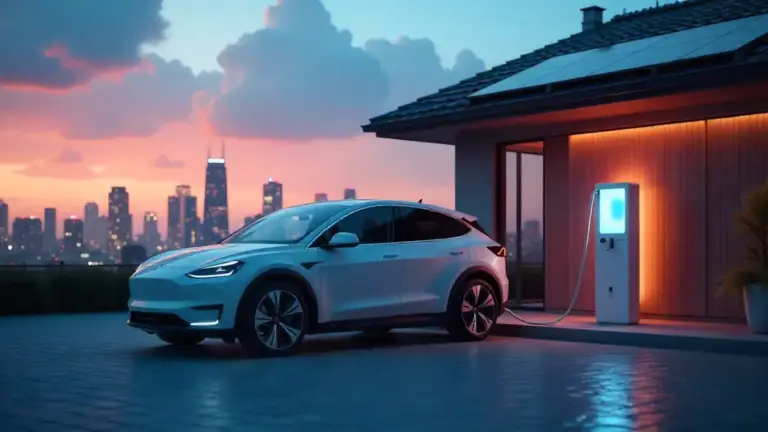
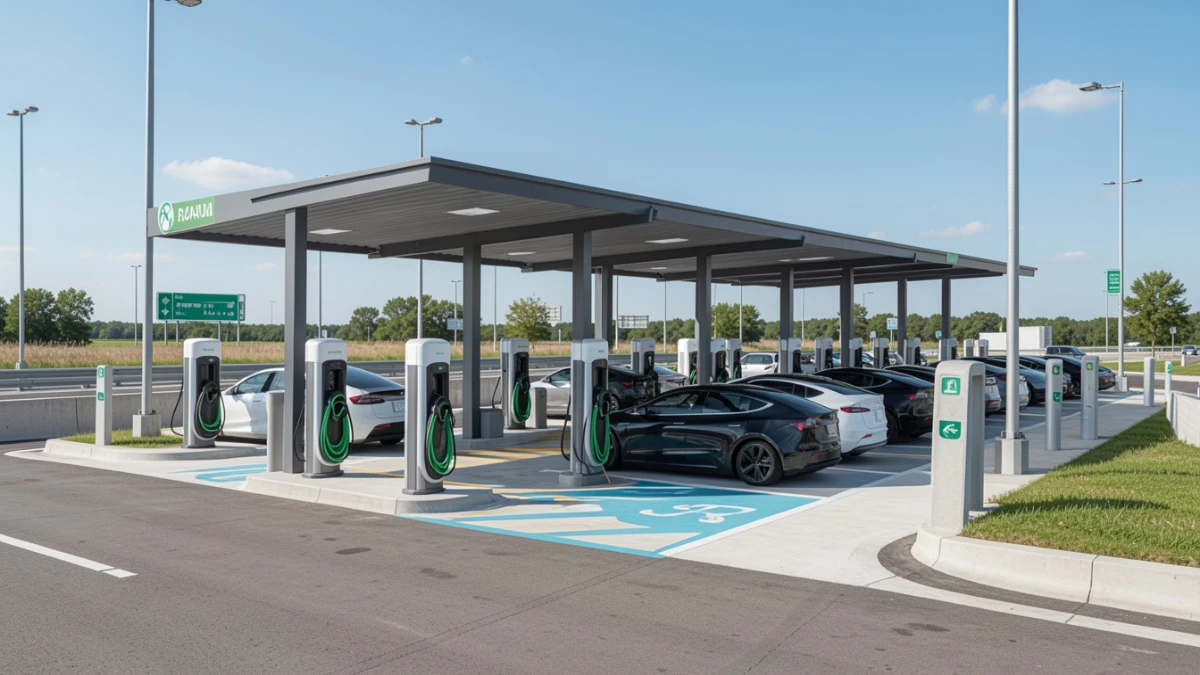
America’s EV charging network has expanded rapidly, reaching around 80,000 public charging locations and nearly 250,000 charging ports by 2026. Fast-charging infrastructure is growing faster than EV adoption, improving road-trip convenience and daily usability. Private investment is driving most expansion, while Tesla, ChargePoint, EVgo, and Electrify America continue building larger, faster, and more reliable charging networks nationwide.
If you’re shopping for an electric vehicle, one question probably looms larger than range or price: will I actually be able to charge this thing when I’m away from home? It’s a fair worry. A few years ago, the answer might have been a nervous “probably.” Today, it’s a much more confident “yes—and the network is growing faster than ever.”
In this article, I’ll walk you through where the US public charging network stands right now, how the different charging levels and networks fit together, what’s driving the recent growth spurt, and what to expect as you plan your own charging strategy—whether that’s a daily commute or a cross-country road trip.
Just How Big Is the US Charging Network Now?
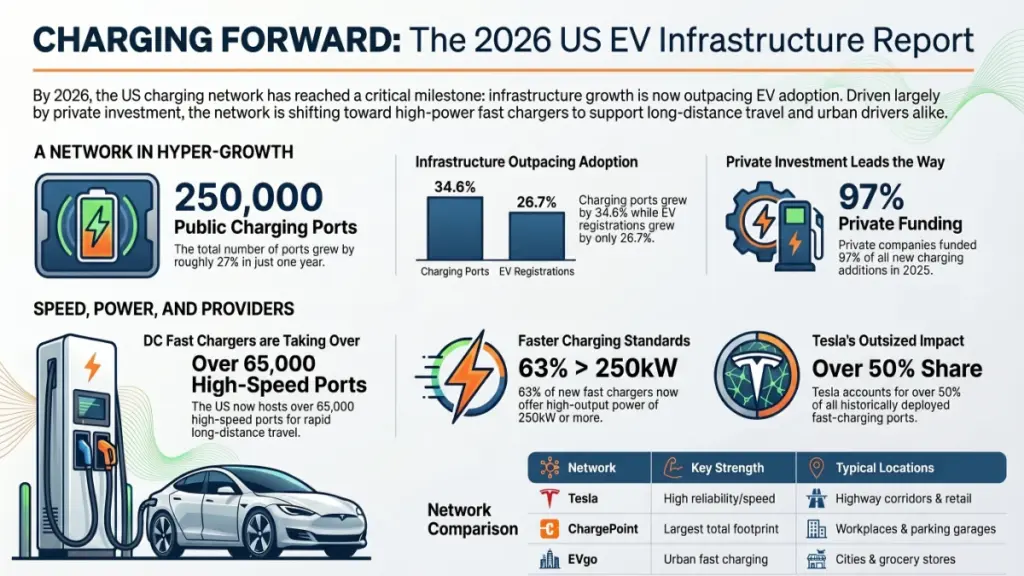
Here’s the short answer: there are now roughly 80,000 public charging station locations across the country, hosting close to 250,000 individual charging ports, and that total has grown by about 27% since the start of 2025.
That’s a remarkable jump. For context, in 2024 there were around 180,000 public charging ports, and that number climbed past 242,000 in 2025—a 34.6% increase in a single year. For the first time, infrastructure growth actually outpaced the growth in EV ownership itself, which is a notable shift.
It’s worth pausing on why that matters. For years, the worry was that EV adoption would outrun the charging network, leaving drivers stranded or stuck in long lines. The 2025 numbers suggest the opposite is happening: while EV registrations grew about 26.7% nationwide, the charging network grew even faster.
Of course, growth isn’t evenly distributed. California alone is home to roughly 19,400 charging stations with about 64,500 chargers—around a quarter of the entire US total, largely because it also has the most EVs on the road by a wide margin. Meanwhile, some states still lag noticeably behind.
[Image suggestion: A US map showing charging station density by state, with California, New York, Florida, and Texas highlighted as leaders]
Level 2 vs. DC Fast Charging: Knowing the Difference
If you’ve spent any time browsing a charging app, you’ve probably seen terms like “Level 2” and “DC fast charging” tossed around. Understanding the difference is key to planning your charging strategy.
Think of it like the difference between topping off your phone overnight versus using a rapid charger at a coffee shop—both get the job done, but on very different timelines.
- Level 2 chargers: These make up the bulk of the public network—about 74% of all public ports—and typically add 10 to 20 miles of range per hour. They’re common at workplaces, shopping centers, hotels, and apartment complexes.
- DC fast chargers (DCFC): These are the road-trip workhorses, delivering roughly 180 to 240 miles of range per hour. As of late 2025, the US had passed 65,000 public DC fast-charging ports, up sharply from under 51,000 at the start of the year.
That fast-charging growth is especially significant because it’s the segment that matters most for long-distance travel and for drivers who don’t have reliable home charging. The network has been adding fast chargers at an average pace of about 45 new ports per day.
There’s also a quality shift happening alongside the quantity increase. New stations are increasingly being built with higher power output—63% of fast-charging ports deployed in the second quarter of 2025 were capable of 250 kilowatts or more, up from 47% just a quarter earlier. In plain terms: not only are there more fast chargers, but they’re getting genuinely faster too.
Who’s Building All of This? The Major Charging Networks
When you open a charging app for the first time, the list of networks can feel overwhelming. Here’s a quick rundown of who’s leading the charge (pun very much intended).
Tesla, ChargePoint, and EVgo have been the fastest-moving networks in recent fast-charger deployment. Tesla in particular has played an outsized role—accounting for about 40% of new fast-charging ports added in a recent quarter, and holding more than half of all fast-charging ports historically deployed. That dominance has become even more relevant since Tesla opened much of its Supercharger network to other EV brands using adapters or native NACS ports.
Beyond Tesla, Electrify America and EV Connect round out the list of major players, each with different strengths—some focus on highway corridors, others on workplace and retail locations, and some specialize in software platforms that businesses use to manage their own charging stations.
[Image suggestion: Side-by-side logos or icons of major charging networks—Tesla/NACS, ChargePoint, EVgo, Electrify America]
A Quick Look: Charging Networks at a Glance
| Network | Known For | Typical Locations |
|---|---|---|
| Tesla Supercharger | High reliability, fast speeds, expanding to non-Tesla EVs | Highway corridors, retail centers |
| ChargePoint | Largest overall network footprint | Workplaces, parking garages, retail |
| EVgo | Urban fast charging | Cities, grocery stores, retail |
| Electrify America | High-power highway charging | Walmart locations, travel corridors |
What’s Driving the Growth—And What Could Slow It Down
So what’s behind this surge? A big part of it comes down to private investment rather than government funding. NEVI-funded sites—the federal infrastructure program—contributed only about 3% of total new charging additions in 2025, meaning the vast majority of new stations came from private companies betting on EV demand.
That’s an important detail, because it shows the charging buildout isn’t solely dependent on federal dollars. Even with policy uncertainty, 2025 turned out to be a record year for fast-charging deployment, with industry data showing strong growth in infrastructure, usage, and reliability—despite media narratives suggesting weakening EV demand.
That said, the funding picture isn’t entirely settled. The federal government’s proposed 2027 budget would cut more than $500 million from the NEVI program, and by December 2025, sixteen states had sued over the administration’s refusal to approve new infrastructure funding. It’s a reminder that while the charging network’s momentum looks strong on paper, the policy landscape around it is still shifting.
Looking ahead, forecasters remain optimistic. Industry analysts project over 19,500 new fast-charging ports in 2026 alone, pushing the national total toward 90,000 fast-charging ports—and if that trajectory holds, the US could reach 100,000 public fast-charging ports by 2027.
Common Questions About Public Charging
Is the public charging network reliable now? Reliability has improved noticeably. Networks have been investing in larger stations—often with 10 or more stalls—and higher uptime monitoring, which has reduced the once-common frustration of arriving to find half the chargers out of service.
Do I really need to use public charging often? Probably not as much as you’d think, if you can charge at home. Home charging is generally cheaper than public charging due to lower residential utility rates. Public charging tends to matter most for road trips, apartment dwellers without home charging access, or unexpected top-ups.
Are charging stations evenly spread across the country? Not quite. California, Nevada, and the New England states have the highest charger coverage, while a band of states stretching from Louisiana through Montana lags behind. If you live in a less-covered region, it’s worth checking local availability before relying heavily on public charging for daily use.
Key Takeaways
- The US public charging network has grown to roughly 80,000 stations and nearly 250,000 ports, with growth now outpacing EV adoption itself.
- Level 2 chargers dominate by volume, but DC fast chargers are growing quickly and getting more powerful—over 65,000 fast ports nationwide as of late 2025.
- Private investment, not federal funding, has driven most recent growth, though policy disputes over federal programs could affect future expansion.
- Coverage varies significantly by region, so it pays to check what’s actually available near you before assuming.
If you’re considering an EV, the charging landscape today looks dramatically better than it did even two years ago—and by most forecasts, it’s only going to keep improving. The best next step? Pull up a charging map app for your area and see what’s actually within reach of your daily routine. You might be surprised how close you already are to a reliable charging spot.