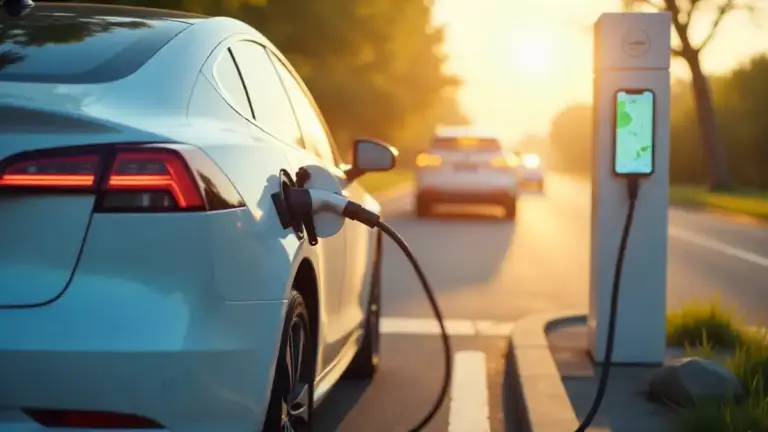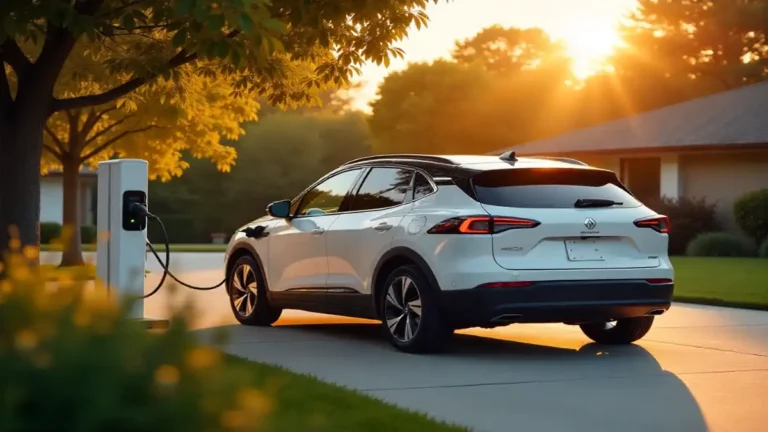
TL;DR: Cargar tu coche eléctrico con energía solar o eólica reduce tus emisiones entre 70-90% comparado con uno de gasolina. Una instalación solar doméstica se paga en 7-10 años y luego tu carga es prácticamente gratis durante décadas. Si no tienes techo propio, existen programas comunitarios de renovables por $5-15 al mes. La tecnología ya está madura, los incentivos fiscales son históricos, y tu bolsillo y el planeta lo agradecen.
Introduction: Can You Really Charge Your EV for Free?
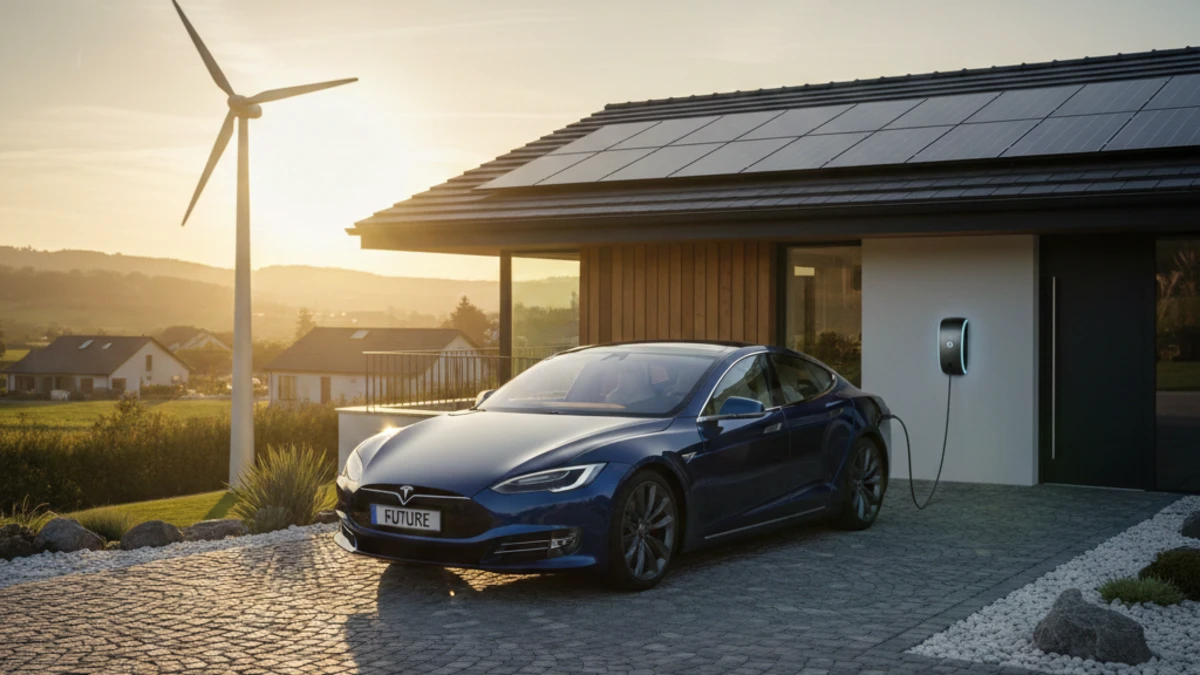
Imagine never paying for gasoline again—and never paying for electricity to charge your car either. Picture this: every morning, your electric vehicle is fully charged using clean energy generated right from your own rooftop, with zero emissions, zero utility bills, and complete energy independence.
Sounds like a dream? For thousands of EV owners across the United States, this is already daily reality.
But here’s the critical question that every prospective EV buyer should ask: Does pairing an electric vehicle with solar panels or wind energy actually make financial and environmental sense? And more importantly, how significant is the real-world impact on your carbon footprint?
The answer is compelling. Integrating EVs with renewable energy sources like solar and wind represents one of the most impactful steps toward sustainable transportation available today. While electric vehicles charged on the standard utility grid are already substantially cleaner than gasoline-powered cars, adding renewable energy to the equation can slash your vehicle’s lifetime carbon emissions by an remarkable 70–90% compared to conventional internal combustion engines.
In this comprehensive guide, we’ll explore exactly how solar and wind integration works for electric vehicles, examine the tangible benefits for homeowners and renters alike, break down the financial considerations, and forecast where this technology is headed in the coming decade. Whether you’re a current EV owner or planning your first electric vehicle purchase, this article will provide the actionable insights you need to make informed decisions about clean transportation.
Why Your EV’s Energy Source Matters More Than You Think
The Hidden Truth About Electric Vehicle Emissions
A common misconception persists among consumers: simply purchasing an electric vehicle automatically equates to environmental responsibility. While it’s accurate that EVs produce zero direct tailpipe emissions—a significant advantage in urban air quality—the electricity powering these vehicles must originate from somewhere.
As of 2025, the United States electrical grid remains a complex mixture of energy sources. Natural gas, coal, nuclear power, and increasingly, renewable sources all contribute to the nation’s electricity supply. According to the U.S. Energy Information Administration (EIA), the average carbon intensity of the American grid currently stands at approximately 400 grams of CO₂ per kilowatt-hour (kWh).
To put this in perspective: while 400 gCO₂/kWh represents a dramatic improvement over gasoline combustion, it remains far from the zero-emission ideal that many EV buyers envision.
The fundamental principle is straightforward yet profound: the cleanliness of your electric vehicle directly correlates with the cleanliness of the electricity used to charge it. This relationship makes your choice of energy source one of the most consequential decisions in maximizing your EV’s environmental benefits.
Grid Charging vs. Renewable Charging: A Comparative Analysis
Let’s examine concrete numbers to illustrate this difference. Consider the Tesla Model 3 Long Range, equipped with a 75 kWh battery pack:
- Grid Charging: A full charge on the average U.S. electrical grid generates approximately 30 kg of CO₂
- Solar Charging: The same full charge using residential solar power produces merely 1.5–3.8 kg of CO₂
This represents a emissions reduction of roughly 90%—a figure that compounds dramatically over the vehicle’s operational lifetime.
For a typical American driver covering 15,000 miles annually, the environmental advantages become staggering:
| Comparison Metric | Annual CO₂ Avoided |
|---|---|
| Solar EV vs. Grid EV | 3+ metric tons |
| Solar EV vs. Gasoline Car | 5+ metric tons |
These aren’t abstract statistics—they represent real atmospheric carbon that solar-powered EV drivers prevent from entering our climate system every single year.
Energy Source Comparison Table
The following breakdown demonstrates how various electricity sources compare across emissions, cost, and EV compatibility:
| Energy Source | CO₂ Emissions (gCO₂/kWh) | Cost per kWh (Average) | EV Compatibility |
|---|---|---|---|
| Utility Grid (U.S. Average) | ~400 | $0.13–$0.18 | Standard charging |
| Residential Solar | ~20–50 | $0.06–$0.10* | Ideal for home charging |
| Wind Power | ~7–15 | $0.02–$0.05* | Grid integration |
| Hydropower | ~4–30 | $0.03–$0.07 | Grid integration |
| Coal (Reference) | ~820–1,000 | $0.08–$0.15 | High-emission charging |
*Levelized cost of energy (LCOE) for owned residential/utility-scale systems. Sources: NREL, EIA, IPCC (2024)
Solar Power and Electric Vehicles: A Perfect Partnership
Why Solar Dominates Residential Renewable Energy
Among all renewable energy options available to EV owners, residential solar panel installations represent the most accessible and personally rewarding choice. There’s an undeniable satisfaction in literally driving on sunlight—and fortunately, the economic and environmental mathematics strongly support this enthusiasm.
How Home Solar + EV Integration Functions
Modern residential solar installations in the United States typically generate between 10–15 kWh daily per kilowatt of installed panel capacity. A standard 7 kW system—now the most common residential installation size—can produce 70–105 kWh of electricity during optimal sunny conditions.
Most contemporary electric vehicles consume approximately 3–4 miles of range per kWh of electricity consumed. This efficiency means that a 7 kW solar array could theoretically provide sufficient energy to drive 200–350 miles per day—far exceeding the average American’s daily commute of just 37 miles.
The critical component enabling this synergy is smart charging technology. Modern EVs and home charging equipment offer sophisticated scheduling capabilities:
- Tesla Wall Connector: Integrated solar monitoring and charging optimization
- ChargePoint Home Flex: App-based scheduling for peak solar hours
- Emporia Level 2 Charger: Real-time solar production matching
Advanced systems like the SolarEdge Home platform or Enphase IQ ecosystem can automatically route surplus solar energy directly to your EV charger in real-time, maximizing self-consumption and minimizing grid dependence.
The Role of Home Battery Storage
Integrating energy storage solutions like the Tesla Powerwall 3 or Enphase IQ Battery 5P elevates the solar + EV combination to unprecedented levels of self-sufficiency. Rather than exporting excess solar generation to the utility grid for modest net metering credits, home batteries store this energy for EV charging during evening hours or cloudy periods.
This three-component ecosystem—solar panels + home battery + electric vehicle—creates a remarkably autonomous energy system. Early adopters in solar-friendly states including California, Arizona, Nevada, and Florida report achieving 80–100% energy independence during summer months, covering both household consumption and EV charging entirely through solar generation.
Financial Analysis: The Economics of Solar EV Charging
The economic case for solar-powered electric vehicle charging is increasingly compelling as electricity rates rise and solar costs decline.
Current Grid Charging Costs:
- Average U.S. electricity rate: ~$0.16 per kWh
- Full charge cost for mid-size EV (Hyundai Ioniq 6, Chevy Equinox EV): $9–12
- Annual charging costs (twice weekly): $900–$1,200
Solar Charging Economics:
- Marginal charging cost post-payback: Near $0
- Typical system payback period: 7–10 years
- Federal tax credit: 30% under Inflation Reduction Act (IRA) Section 25D
When combined with eliminated gasoline expenses and potential home energy savings, the return on investment for a solar + EV system ranks among the strongest financial decisions available to homeowners today.
Wind Energy: The Cleanest Power Source for EVs
Wind Power’s Environmental Superiority
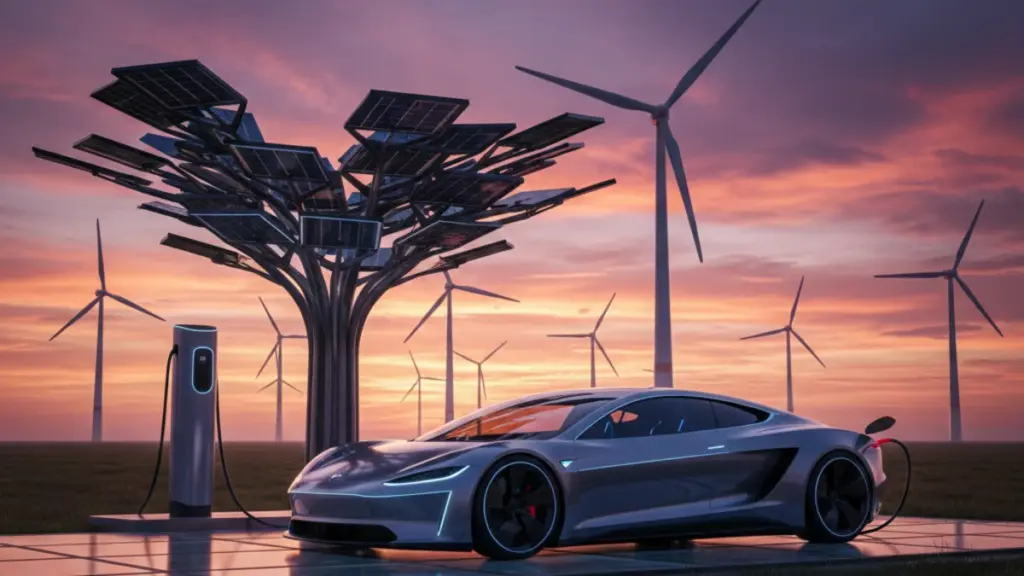
While solar energy dominates residential renewable discussions, wind power actually represents the cleanest form of electricity generation currently available. Wind turbines produce merely 7–15 grams of CO₂ per kWh across their full lifecycle—significantly lower than solar’s 20–50 grams.
For individual EV drivers, direct wind energy access typically involves enrolling in utility green tariff programs or purchasing Renewable Energy Certificates (RECs). These programs allow consumers to pay modest premiums—usually $5–15 monthly—to ensure their household electricity consumption is matched with wind generation on the grid.
Community Solar and Wind Programs
Not every EV owner can install rooftop solar. Renters, apartment dwellers, and homeowners with shaded or unsuitable roofs still have excellent renewable options through community solar and wind subscriptions.
These programs, now available in over 40 states, allow participants to subscribe to shares of local solar or wind farms and receive corresponding credits on their utility bills. Leading providers include:
- Arcadia: Nationwide clean energy matching
- EnergySage Community: Local project aggregation
- Utility Co-ops: Regional renewable programs
Many of these services offer specific green energy options that can be directly correlated with your EV charging consumption, ensuring your vehicle runs on verified renewable electricity.
Grid Decarbonization: The Bigger Picture
Even without personal renewable energy subscriptions, the electrical grid is undergoing rapid decarbonization. Wind and solar collectively accounted for over 25% of U.S. electricity generation in early 2025—a dramatic increase from just 10% in 2015, according to EIA data.
This trend creates a compelling argument for purchasing an EV today rather than waiting. Unlike gasoline vehicles, which remain locked to petroleum’s carbon intensity for their entire operational life, electric vehicles automatically become cleaner as the grid incorporates more renewable sources. A vehicle purchased in 2025 will operate on progressively cleaner electricity throughout its 15–20 year lifespan.
Practical Implementation: Your Solar + EV Action Plan
Assessing Your Home’s Solar Potential
Before committing to a solar installation, evaluate these critical factors:
Roof Characteristics:
- Orientation: South-facing roofs at 30–45 degree angles maximize sun exposure in the Northern Hemisphere
- Shading: Trees, chimneys, and neighboring structures significantly impact output
- Condition: Roofs should have minimum 10 years remaining lifespan to match typical 25-year panel warranties
Financial Considerations:
- State-level rebates and incentives vary dramatically
- Net metering policies affect long-term ROI
- Local electricity rates determine payback periods
Free Assessment Tools:
- Google Project Sunroof: Satellite-based solar potential analysis
- EnergySage: Comprehensive quote comparison platform
Charging Infrastructure Requirements
To maximize solar charging benefits, Level 2 home charging (240V) is essential. Unlike the standard Level 1 (120V) charging cables included with most EVs, Level 2 equipment delivers 25–50 miles of range per hour, enabling full vehicle charges in 6–10 hours—perfectly aligned with overnight solar battery discharge.
Federal Incentive: The Alternative Fuel Vehicle Refueling Property Credit (IRS Form 8911) currently provides a 30% tax credit on home EV charger installation costs, capped at $1,000 for individual taxpayers.
EV Models with Advanced Energy Management
Several 2025 electric vehicles offer bidirectional charging capabilities that enhance solar integration:
| Vehicle | V2G/V2H Capability | Key Feature |
|---|---|---|
| Ford F-150 Lightning | Ford Intelligent Backup Power | Full home backup capability |
| Ford Explorer EV | Bidirectional charging | Integrated energy management |
| Nissan LEAF | CHAdeMO V2G hardware | Pioneer in vehicle-to-grid technology |
| Hyundai Ioniq 5/6 | V2L (Vehicle-to-Load) | Standard power outlet functionality |
| Volkswagen ID.4 | Upcoming V2G capability | European rollout, U.S. expected late 2025 |
Vehicle-to-Grid (V2G) technology transforms your EV battery into a mobile home battery, enabling stored solar energy to power your residence during peak demand periods or even generate grid credits through utility programs.
The Future of EV and Renewable Energy Integration
Smart Charging and Grid Flexibility
Utilities and automotive manufacturers are increasingly collaborating to utilize electric vehicles as Distributed Energy Resources (DERs). Innovative programs demonstrate this evolution:
- PG&E EV Rate Plans (California): Time-of-use optimization for grid balancing
- Enel X JuiceNet Platform: Aggregated EV charging management
- Ford Power My Home Initiative: Vehicle-grid integration services
The International Energy Agency (IEA) projects over 300 million EVs globally by 2030. This fleet represents a massive, distributed energy storage network capable of addressing renewable energy’s traditional intermittency challenges. Imagine millions of vehicle batteries smoothing solar and wind fluctuations—transforming transportation infrastructure into grid stabilization assets.
Declining Costs, Increasing Accessibility
The economic trajectory for renewable energy continues favorably downward:
- Residential solar costs have plummeted 90% since 2010 (IRENA, 2024)
- Utility-scale wind is now consistently the cheapest new electricity source globally
- Battery storage costs continue declining 15–20% annually
These trends mean that delaying solar + EV adoption increasingly represents lost financial and environmental opportunities.
Next-Generation Battery Technology
Range anxiety—the concern about charging availability during long trips or extended cloudy periods—diminishes rapidly with advancing battery technology. Solid-state batteries, expected in commercial EV production by 2026–2028, promise:
- 1.5–2x higher energy density than current lithium-ion cells
- 500+ mile ranges becoming mainstream standard
- Reduced charging frequency and grid dependence
As EV ranges extend, the occasions requiring grid electricity rather than home solar shrink correspondingly, enhancing the renewable energy value proposition.
Conclusion: Achieving Truly Zero-Carbon Transportation
Electric vehicles already represent massive improvements over internal combustion engines regarding lifetime emissions and energy efficiency. However, the full potential of electric transportation unlocks only when paired with clean energy generation.
Key Takeaways for Prospective and Current EV Owners:
- Emissions Impact: Solar or wind charging reduces vehicle carbon emissions by 70–90% compared to gasoline vehicles
- Financial Returns: Home solar + Level 2 charger configurations typically achieve payback in 7–10 years, providing effectively free EV charging for decades thereafter
- Accessibility: Green energy subscriptions and community solar programs enable renters and apartment residents to access renewable EV charging
- Improving Trajectory: The electrical grid decarbonizes continuously, meaning today’s EV purchases automatically become cleaner over time
- Emerging Technologies: V2G and smart charging developments increasingly make EV-renewable energy integration bidirectional and financially rewarding
Whether you’re optimizing an existing electric vehicle or researching your first EV purchase, integrating renewable energy represents the single most impactful upgrade available. The technology has matured, financial incentives are historically favorable, and the environmental mathematics are undeniable.
The cleanest mile you’ll ever drive is one powered entirely by the sun or wind. The infrastructure exists today to make this reality. The only question remaining is when you’ll begin your journey toward truly sustainable transportation.
Sources: U.S. Energy Information Administration (EIA), National Renewable Energy Laboratory (NREL), International Energy Agency (IEA), International Renewable Energy Agency (IRENA), Intergovernmental Panel on Climate Change (IPCC) — Data current as of February 2025-2026.