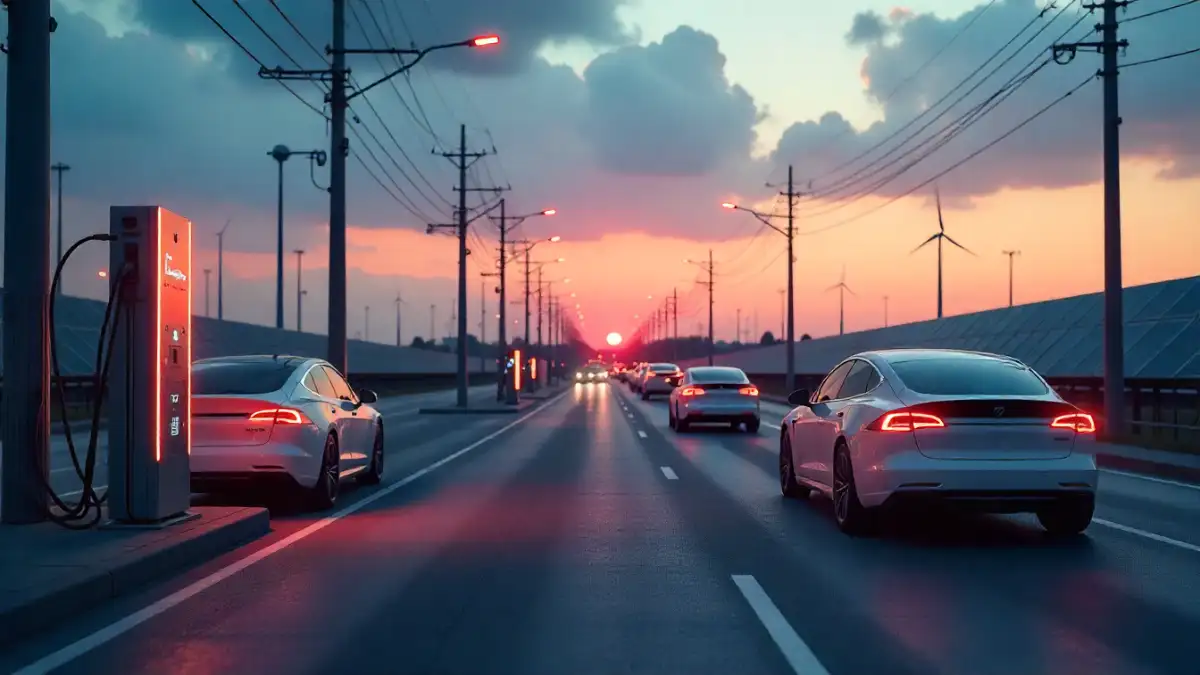
Picture this: it’s 6 PM on a sweltering summer evening. You’ve just pulled into your driveway after a long commute. Like thousands of your neighbors, you plug in your electric car to charge. The air conditioner blasts inside your home. Dinner cooks in the oven. The TV plays in the living room. Now multiply that scene across your entire city. What happens to the electricity grid?
This question keeps utility companies, policymakers, and energy experts awake at night. It’s one of the most fascinating challenges facing our electric future. EVs are rapidly shifting from novelty to mainstream. They’re not just changing how we drive. They’re fundamentally reshaping how we think about electricity itself.
But here’s the exciting part: electric cars do present real challenges to our power infrastructure. However, they also offer unprecedented opportunities. They can make our grid smarter, cleaner, and more resilient than ever before.
Let’s dive into this electrifying transformation. We’ll explore what it really means for our energy future.
The Challenge: When Everyone Plugs In at Once
Here’s the uncomfortable truth: our electricity grid wasn’t designed for millions of vehicles that need charging. The typical EV battery holds 60-100 kilowatt-hours of energy. That’s roughly equivalent to what an average home uses in two to three days. When you plug in that car, you’re essentially adding another house worth of electricity demand to the grid.
The real problem isn’t the total amount of electricity needed. We actually have enough generating capacity overall. The issue is when people want to charge. Right now, most EV owners do exactly what seems logical. They come home from work and immediately plug in.
Unfortunately, this happens during peak demand hours—roughly 5 PM to 9 PM. Electricity usage is already at its highest during this window. Everyone’s home. They’re running appliances, adjusting thermostats, and turning on lights.
California’s Wake-Up Call
California provides a perfect real-world example of this challenge. The state has over 1 million electric vehicles on the road. That’s more than any other state. On hot summer days, the grid is already stretched thin during evening hours.
In September 2022, California officials took an unprecedented step. They asked EV owners to avoid charging during peak hours to prevent blackouts. It was a wake-up call. It showed us the grid wasn’t quite ready for the EV revolution we’ve been eagerly anticipating.
Think about it this way: adding a Level 2 home charger is like adding a central air conditioning unit to your home. Both draw similar amounts of power. Now imagine if every house on your street added one simultaneously. Then picture them all turning on at the same time. You can see why utility companies are paying attention.
Grid Stability: Walking a Tightrope
The Balancing Act
Keeping the electricity grid stable is like conducting a massive orchestra. Supply and demand must match perfectly at every single moment. Too much demand and not enough supply? You get brownouts or blackouts. Too much supply and not enough demand? Equipment damage and system failures occur. Grid operators perform this balancing act 24/7. Electric vehicles add a new, unpredictable instrument to the ensemble.
The challenge isn’t just about raw capacity. It’s about ramping capability. Power plants can’t instantly adjust their output, especially older coal and nuclear facilities. Engineers designed them to run at steady levels. But when thousands of EVs start charging simultaneously, demand can spike rapidly.
Natural gas “peaker plants” can respond quickly. However, they’re expensive to operate. Ironically, they’re not particularly clean either. This somewhat defeats the environmental purpose of driving electric in the first place.
Infrastructure Limitations
There’s also the infrastructure issue. Your local distribution system wasn’t necessarily built for this future. The transformers on utility poles and the wires running to homes have limitations. In some older neighborhoods, transformers already operate near their limits.
A 2021 study by the Pacific Northwest National Laboratory revealed concerning findings. In certain scenarios, high EV adoption could overload local distribution transformers. This would require billions of dollars in infrastructure upgrades.
But here’s where the story takes an optimistic turn: these challenges are entirely solvable. The solutions are already being deployed across the country.
Smart Charging: The Game-Changing Solution
The beauty of electric vehicles is clear: they’re not just dumb loads on the grid. They’re smart, connected devices that can communicate and respond to grid conditions. This opens up possibilities that were impossible with gasoline cars.
How Smart Charging Works
Smart charging systems can automatically shift when your car charges. They base this on grid conditions, electricity prices, and your driving needs. Let’s say you typically leave for work at 8 AM. You need a full charge by then. Your car doesn’t actually need to start charging the moment you plug it in at 6 PM.
It could wait until 11 PM or 2 AM. Demand is low during these hours. Electricity is cheaper. The grid has excess capacity. Often, this electricity comes from wind power that would otherwise go to waste. You wake up to a fully charged car. You’ve saved money. You’ve helped the grid stay balanced.
Real Money Savings
Many utility companies now offer time-of-use rates specifically designed for EV owners. In some areas, overnight electricity costs one-third the price of peak-hour power. The savings are real. If you’re charging a 75 kWh battery, the difference could be $15 versus $5 for a full charge. Over a year, that’s meaningful money back in your pocket. You earn this just for being flexible about when your car charges.
Remote Control and Automation
Even better, modern EVs and chargers offer remote control. You can manage them through apps. Some integrate directly with utility demand response programs. During times of grid stress, utilities can automatically reduce or pause charging. This happens across thousands of vehicles simultaneously.
Owners barely notice because their cars still get the charge they need. The charging just shifts by a few hours. It’s a win-win situation for everyone involved.
Vehicle-to-Grid: The Revolutionary Opportunity
Now let’s talk about the most exciting development in this entire conversation: bidirectional charging. Many people call it vehicle-to-grid (V2G) technology. This is where electric cars transform from challenge to solution. They arguably become the most valuable asset our grid has ever had.
The Basic Concept
Here’s how it works: your EV battery doesn’t just take electricity from the grid. It can also give it back when needed. Your car sits parked about 95% of the time. Think about it—how many hours per day does your vehicle actually drive? During that time, it’s essentially a massive battery just sitting there. V2G technology allows that stored energy to flow back to your home or even to the grid during peak demand periods.
A Real-World Scenario
Imagine this scenario: It’s a hot summer afternoon. The grid is stressed. Your EV is parked at work, fully charged with 80 kWh of energy. A V2G system could discharge a small portion of that energy. Let’s say 20 kWh flows back to the grid for a few hours. This helps meet peak demand.
You get paid for the service. You still have plenty of charge to drive home. It’s like getting paid to own a battery that you were going to own anyway.
Current V2G Technology
Ford’s F-150 Lightning already offers this capability. Its Ford Intelligent Backup Power system can power your entire home for days during an outage. The Nissan Leaf has had V2G capability in some markets for years. As this technology becomes standard, we’re talking about potentially millions of mobile batteries. They create a distributed storage network worth hundreds of gigawatt-hours. That’s far more than all the stationary batteries we could afford to build.
The Scale of Opportunity
California estimates that by 2030, EV batteries on the road could provide 10-15 gigawatts of grid support capacity. To put that in perspective, that’s equivalent to 10-15 large power plants. Instead of building expensive new infrastructure, we’re using infrastructure people buy anyway. The economics are compelling.
Renewable Energy Integration: EVs as the Missing Piece
Here’s where everything comes together beautifully. Renewable energy faces a major challenge, particularly solar and wind. They’re intermittent. The sun doesn’t shine at night. Wind doesn’t blow consistently. This creates a mismatch problem. We often generate the most renewable energy exactly when we need it least.
Solving the Solar Timing Problem
Enter electric vehicles as mobile energy storage. In California, solar panels generate massive amounts of electricity during midday. They often produce more than the grid can use. Prices sometimes go negative. Utilities literally pay people to take the power.
But by evening, solar production drops off. Everyone comes home. We fire up those gas peaker plants. It’s frustratingly inefficient.
EVs Bridge the Gap
With smart charging and V2G, EVs become the bridge. You charge during the sunny afternoon when renewable energy is abundant and cheap. Sometimes it’s even free. You discharge during the evening peak when the grid needs support.
Suddenly, we’re using clean electrons that would have been wasted. We’re reducing the need for fossil fuel plants during peak hours. The environmental and economic benefits multiply.
Proven Benefits
A 2023 study by the National Renewable Energy Laboratory found significant potential. Optimized EV charging could increase renewable energy utilization by up to 30% in some grid regions. That’s not just good for the environment. It’s good economics.
Renewable energy is now the cheapest form of new electricity generation. Using more of it means lower costs for everyone. The math works out in every direction.
The Storage Solution We Needed
Think of EVs as the energy storage solution we desperately needed but couldn’t afford to build. Stationary battery installations cost $200-$400 per kilowatt-hour. EV batteries are different. Manufacturers mass-produce them. They’re constantly improving. They’re already built into the vehicle price.
We’re essentially getting grid storage as a bonus feature of the transportation revolution. It’s an elegant solution to multiple problems simultaneously.
What This Means for You
If you’re an EV owner or considering becoming one, here are some practical takeaways:
Take advantage of time-of-use rates. Contact your utility company. Ask about EV-specific rates. Setting your car to charge overnight automatically can save you hundreds of dollars annually. It helps the grid at the same time.
Invest in a smart charger. Modern Level 2 home chargers with smart features cost only slightly more than basic models. They offer scheduling and monitoring. They provide potential integration with demand response programs that pay you for flexibility.
Consider your future charging needs realistically. Most people don’t need to charge to 100% every night. Your daily driving might be 30-40 miles. Your car might have 250+ miles of range. You could charge just 2-3 times per week during off-peak hours. This maximizes your cost savings and grid benefits.
Stay informed about V2G capabilities. If you’re shopping for an EV, bidirectional charging capability might become increasingly valuable. It’s not essential today. But it could save you money and provide backup power in the future.
The Road Ahead
The relationship between electric vehicles and the grid is evolving rapidly. Yes, there are real challenges. Peak demand, infrastructure limitations, and coordination complexity all present obstacles. But the opportunities far outweigh them.
Building a Better System
We’re not just electrifying transportation. We’re creating a smarter, more flexible, more sustainable energy system. Utilities, automakers, and technology companies recognize this. They’re investing billions in solutions. These include upgraded infrastructure, smart charging platforms, V2G systems, and AI-powered grid management.
Proven Success
Pilot programs across the country are proving these concepts work. They’re not just theoretical. They’re delivering results in the real world, not just on paper. The technology is ready. The business models are emerging. The regulatory frameworks are developing.
A Transformed Grid
The grid that powered your grandparents’ lives is changing. That old system featured one-way flow from massive central power plants to passive consumers. It’s becoming a dynamic, two-way network. Millions of connected devices work together in this new system. Your car is one of them. They balance supply and demand intelligently.
The Bottom Line
Electric vehicles aren’t a burden on our electricity grid. They’re the catalyst for transforming it into something far better than what we have today. That’s an opportunity worth getting excited about.
Every time you plug in your EV, you’re doing more than charging your car. This is especially true during off-peak hours. You’re helping build the clean energy future we all want to see. That’s the real power of electric vehicles.