
Remember when your grandparents told you about the first time they saw a jet plane? How it seemed impossible that something so massive could slice through the sky at 500 miles per hour? Well, buckle up—because we’re about to do it again. The next decade of transportation isn’t just going to change how fast we move; it’s going to rewrite the entire playbook on what “distance” even means.
I’m talking about electric vertical takeoff and landing aircraft (eVTOLs) zipping between city centers like airborne Ubers, and Hyperloop pods shooting through near-vacuum tubes at speeds that would make a bullet train jealous. And here’s the kicker: they’re doing it with zero emissions. If that sounds like science fiction, I don’t blame you. But the prototypes are flying, the test tracks are operational, and the investment dollars are pouring in. The future isn’t just coming—it’s taxiing down the runway right now.
The Sky Is No Longer the Limit: Understanding eVTOL Technology
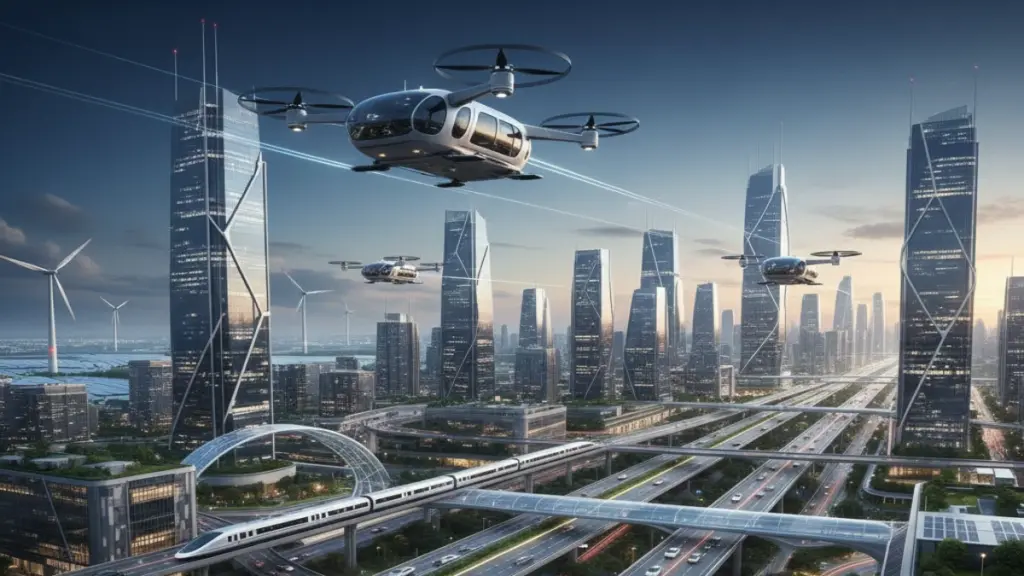
Let’s start with something that sounds absolutely bonkers until you really think about it: electric flying taxis. These aren’t your grandfather’s helicopters—they’re whisper-quiet, emission-free aircraft designed to hop over traffic jams and deliver you from downtown to the airport in minutes instead of hours.
What Exactly Is an eVTOL?
Think of an eVTOL as the lovechild of a drone and a small plane. They take off and land vertically (like a helicopter), but once airborne, many transition to forward flight (like an airplane) for better efficiency. Most designs feature multiple rotors powered entirely by batteries, making them quieter and cleaner than anything we’ve seen in personal aviation before.
Companies like Joby Aviation, Lilium, and Archer Aviation aren’t just sketching these machines on cocktail napkins—they’ve got working prototypes in the air. Joby’s aircraft, for instance, can carry four passengers plus a pilot for up to 150 miles on a single charge, cruising at 200 mph. That’s faster than driving from Cleveland to Columbus and doing it while you catch up on emails or stare out the window at the traffic you’re leaving behind.
The Battery Breakthrough Making It Possible
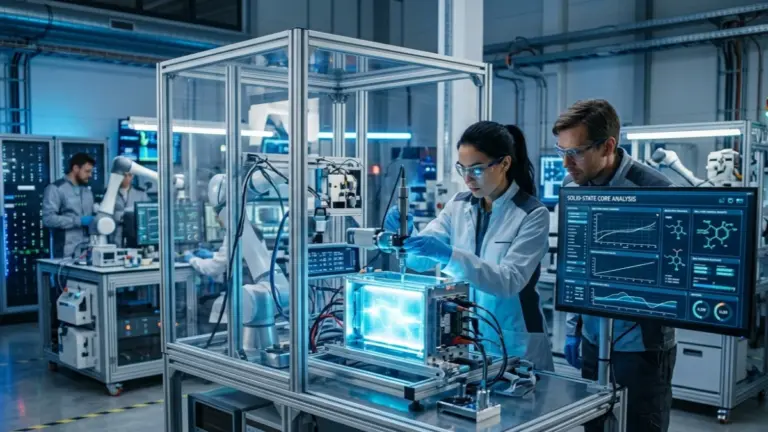
Here’s where we need to talk about the elephant in the hangar: batteries. For years, the dream of electric flight was held back by a simple problem—batteries are heavy, and in aviation, weight is everything. But solid-state batteries are changing that equation.
Unlike the lithium-ion batteries in your phone or EV (which use liquid electrolytes), solid-state batteries use, well, solid electrolytes. This might sound like a minor detail, but it’s revolutionary. Solid-state batteries pack more energy into less weight, charge faster, and are significantly safer because they’re less prone to catching fire. Companies like QuantumScape and Solid Power are racing to commercialize these technologies, and they’re projecting energy densities that could double what we get from current lithium-ion cells.
What does this mean for you? It means an eVTOL could fly farther, carry more passengers, and spend less time tethered to a charging station. By 2030, industry experts predict solid-state batteries will be powering not just flying taxis but the entire next generation of electric aircraft. We’re talking about regional flights between cities without burning a drop of jet fuel.
The Real-World Experience
I had the chance to watch a Joby test flight in California last year, and I’ll be honest—it was surreal. The aircraft lifted off with barely a whisper, nothing like the rotor-slapping thunder of a helicopter. It hovered, tilted, and shot forward with the grace of something that belonged in a movie. The pilot told me the controls were surprisingly intuitive, more like flying a large drone than wrestling with a traditional aircraft.
But here’s what really stuck with me: the potential for everyday people. We’re not talking about toys for the ultra-wealthy (though yes, early adopters will pay a premium). Companies are designing these systems for urban mobility—think $3-5 per mile rides that compete with ground-based ride-sharing once economies of scale kick in. Imagine cutting your commute from 90 minutes in traffic to 15 minutes in the air. That’s not a luxury; that’s a game-changer for quality of life.
Hyperloop: Redefining What “Fast” Means
Now, let’s shift from the sky to something even more radical: the Hyperloop. If eVTOLs are the future of urban hopping, Hyperloop is the future of intercity—and potentially transcontinental—travel.
The Science Behind the Speed
The concept is deceptively simple: put a pod in a tube, remove most of the air to eliminate drag, and use magnetic levitation or air bearings to propel it forward. Without air resistance and friction, you can reach speeds of 600-700 mph—faster than most commercial jets—while consuming a fraction of the energy.
Elon Musk didn’t invent the idea (that credit goes back to engineers in the 1970s and earlier), but he did reignite interest in 2013 with a white paper outlining a modern approach. Since then, companies like Virgin Hyperloop, Hyperloop Transportation Technologies (HyperloopTT), and several others have built test tracks and conducted crewed test runs.
Virgin Hyperloop’s XP-2 pod hit 107 mph on a 500-meter test track in Nevada in 2020—with passengers on board. That might not sound supersonic, but remember, they’re proving the concept on a short track. The full-scale vision involves pods moving at 670 mph through tubes spanning hundreds of miles. You could leave Los Angeles and arrive in San Francisco in 30 minutes. Cleveland to Chicago? Under an hour.
Hydrogen Propulsion: The Missing Piece
Here’s where things get even more interesting. While most Hyperloop designs rely on electricity to power the magnetic levitation and linear motors, hydrogen fuel cells are emerging as a complementary technology for long-haul routes where continuous power infrastructure might be challenging.
Hydrogen fuel cells generate electricity by combining hydrogen and oxygen, producing only water vapor as a byproduct. They’re energy-dense, refuel quickly, and could power auxiliary systems or even primary propulsion in hybrid Hyperloop designs. Companies like Alstom have already deployed hydrogen-powered trains in Germany, proving the technology works at commercial scale.
For Hyperloop, hydrogen could solve the “last-mile” problem—providing onboard power for HVAC, lighting, and emergency systems without requiring constant connection to the grid. Some visionaries are even exploring hydrogen-powered compressors to maintain the low-pressure environment inside the tubes, reducing the need for massive external pumping stations.
The Practical Challenges (And They’re Big)
Let’s be real: Hyperloop faces enormous hurdles. Building hundreds of miles of vacuum-sealed tubes is expensive—estimates range from $25 million to $100 million per mile depending on terrain. You need land rights, environmental clearances, and public buy-in. There are legitimate safety questions about what happens in an emergency when you’re traveling at 600 mph in a sealed tube.
But here’s what gives me hope: humanity has tackled these problems before. The Interstate Highway System was considered impossibly expensive until Eisenhower made it a priority. High-speed rail in Japan and Europe faced similar skepticism. The difference now is that we have better materials, smarter engineering software, and a climate crisis that’s forcing us to rethink how we move people and goods.
Several pilot routes are in development—Saudi Arabia’s proposed connection between Jeddah and Riyadh, India’s Mumbai-Pune route, and feasibility studies in the Netherlands. If even one of these gets built and operates successfully, the floodgates will open.
The Battery and Hydrogen Revolution: Powering the Shift
Both eVTOLs and Hyperloops share a common dependency: next-generation energy storage and propulsion systems. Let’s dig deeper into the technologies making these visions viable.
Solid-State Batteries: The Holy Grail
I mentioned solid-state batteries earlier, but they deserve more attention because they’re the linchpin for so much of what we’re discussing. Traditional lithium-ion batteries have served us well, but they’re nearing their theoretical limits. Solid-state batteries promise:
- Higher Energy Density: Up to twice the watt-hours per kilogram, meaning longer range or lighter weight.
- Faster Charging: Some designs could achieve full charges in 10-15 minutes without degrading the battery.
- Improved Safety: No liquid electrolyte means no leaking and far less fire risk.
- Longer Lifespan: Potentially thousands more charge cycles before capacity degrades.
Toyota has announced plans to commercialize solid-state batteries by 2027-2028, targeting their electric vehicles first before scaling to other applications. BMW, Ford, and Volkswagen are all investing heavily in the technology. For aviation and high-speed rail applications, solid-state batteries could enable routes and operating profiles that are simply impossible today.
Hydrogen: The Long-Haul Champion
While batteries excel at short-to-medium distances, hydrogen shines for long-haul applications. A kilogram of hydrogen contains about three times the energy of a kilogram of gasoline, and fuel cells convert that energy to electricity with impressive efficiency (50-60% compared to internal combustion engines’ 20-30%).
The challenge has always been production and storage. Most hydrogen today is produced from natural gas, which isn’t carbon-neutral. But green hydrogen—produced by splitting water using renewable electricity—is rapidly becoming cost-competitive. Bloomberg New Energy Finance projects green hydrogen costs will drop below $2 per kilogram by 2030 in many markets, making it viable for transportation.
For aircraft, hydrogen presents unique opportunities. Airbus is developing three concept planes under its ZEROe program, including a turbofan design that burns liquid hydrogen instead of jet fuel. They’re targeting 2035 for entry into service. Imagine crossing the Atlantic on a plane that emits nothing but water vapor.
The Synergy Between Technologies
Here’s what excites me most: these technologies don’t compete—they complement each other. Solid-state batteries are perfect for shorter urban hops in eVTOLs and for initial acceleration in Hyperloop pods. Hydrogen fuel cells take over for sustained high-speed travel and longer distances. Smart grid integration means renewable energy generated during off-peak hours can produce hydrogen or charge batteries for peak travel times.
We’re not picking winners and losers; we’re building an ecosystem where each technology does what it does best.
The Infrastructure Challenge: Building the Future
Technology is only half the equation. The other half? Infrastructure. And this is where things get complicated—and expensive.
Vertiports: The New Transportation Hubs
If eVTOLs are going to replace ground transportation for certain trips, we need places for them to take off and land. Enter vertiports—dedicated facilities designed for electric aircraft operations. These aren’t massive airports; think more like heliports on steroids, with charging stations, passenger lounges, and air traffic management systems.
Cities like Los Angeles, Singapore, and Dubai are already planning vertiport networks. Urban Air Mobility (UAM) companies envision a hub-and-spoke model where you could walk to a neighborhood vertiport, fly to a central transit hub, and continue your journey by high-speed rail or Hyperloop. The key is integration—making transitions seamless so flying becomes just another mode in your multi-modal journey.
The cost? Estimates range from $5 million to $15 million per vertiport depending on size and location. That’s significant, but compare it to the billions required for new highways or subway lines, and suddenly it looks reasonable.
Hyperloop Tubes: Engineering Marvels
Building Hyperloop infrastructure is a different beast entirely. You’re not just laying track—you’re constructing hundreds of miles of precision-engineered tubes that maintain near-vacuum conditions while withstanding earthquakes, temperature fluctuations, and the occasional tornado.
The tubes themselves need to be incredibly strong yet lightweight, with airtight seals at every joint. Magnetic levitation systems require precise alignment and continuous power. Stations need to safely transition pods from atmospheric pressure to near-vacuum and back. And you need redundant safety systems for emergencies—airlocks, emergency exits, communication systems, and rapid repressurization capabilities.
Virgin Hyperloop’s test facility in West Virginia gives us a glimpse of what’s possible. Their 500-meter tube cost approximately $500 million to build—a staggering sum for such a short distance, but remember, they’re proving out every system from scratch. Production routes would benefit from economies of scale, standardized components, and streamlined construction techniques.
The Regulatory Maze
Perhaps the biggest infrastructure challenge isn’t physical—it’s regulatory. Aviation authorities worldwide are scrambling to create certification frameworks for eVTOLs. How do you license pilots? What maintenance standards apply? Who controls the airspace between buildings in dense urban areas?
Similarly, Hyperloop needs entirely new regulatory frameworks. Is it rail? Is it aviation? The answer is neither and both. The U.S. Department of Transportation issued guidance in 2020 treating Hyperloop as rail under a non-traditional track structure, but that’s just the beginning. Every country will need to develop safety standards, testing protocols, and operational guidelines.
This isn’t a complaint—it’s reality. Good regulation takes time, and rushing it would be dangerous. But it means the timeline for widespread adoption is longer than pure technology development would suggest.
The Market Reality: When Will You Actually Ride One?
So, after all this talk about flying taxis and tube trains, when can you actually book a ticket? Let’s ground ourselves in realistic timelines and market expectations.
eVTOL Timeline: Sooner Than You Think
The eVTOL industry is moving fast. Multiple companies are targeting commercial operations by 2025-2026, primarily for short urban routes. Joby Aviation partnered with Delta Air Lines to offer flights between Manhattan and JFK Airport—potentially cutting a 60-90 minute car ride to a 7-minute flight.
Will these early services be expensive? Absolutely. Initial pricing will likely be $200-500 per trip, positioning them as premium options for business travelers and affluent commuters. But history shows that transportation costs drop dramatically with scale. Airlines once charged inflation-adjusted equivalents of thousands of dollars for cross-country flights that now cost $200.
By 2030, I’d expect to see eVTOL services operating in 20-30 major cities worldwide, with prices dropping to $50-150 per trip as production scales and battery costs fall. By 2035, they could be ubiquitous in major metros, priced competitively with premium ride-sharing.
Hyperloop Timeline: Longer, But Getting Real
Hyperloop is on a longer timeline, largely due to infrastructure requirements. The first commercial routes are likely to emerge around 2028-2030, probably in places like the Middle East or India where governments are willing to fund megaprojects and regulatory pathways are clearer.
Initial routes will be relatively short—100-200 miles—connecting major cities or airports. Think Abu Dhabi to Dubai, or Mumbai to Pune. These will serve as proof-of-concept for the technology and safety systems. If successful, we could see North American and European routes by the mid-2030s.
Pricing is harder to predict, but early estimates suggest costs comparable to business-class air travel—$150-300 for a 200-mile journey. As systems mature and operating costs decline, prices should fall toward economy airfare or even high-speed rail levels.
The Adoption Curve
Here’s what I tell people who ask when these technologies will be “mainstream”: transportation infrastructure changes in decades, not years. The first commercial jet flew in 1952, but jets didn’t dominate until the 1970s. The iPhone launched in 2007, but smartphones didn’t hit 50% global penetration until 2015.
New transportation modes follow similar patterns. Early adopters pay premiums and tolerate rough edges. Early majority waits for proven safety and better economics. Laggards finally switch when the old option becomes inconvenient or expensive.
We’re entering the early adopter phase for eVTOLs and the innovation phase for Hyperloop. Mainstream adoption is 10-15 years out for urban air mobility and 15-20 years for Hyperloop. That might sound far away, but for infrastructure that will serve us for 50+ years, it’s right around the corner.
Environmental Impact: The Zero-Emission Promise
Let’s address the elephant in the room—or should I say, the carbon dioxide in the atmosphere. Are these technologies genuinely green, or just greenwashing with extra steps?
The Electric Aviation Carbon Equation
eVTOLs powered by solid-state batteries are zero-emission at the point of use, but we need to account for the full lifecycle. Battery production is energy-intensive, and the electricity charging them must come from somewhere. If you’re charging batteries with coal-fired power, you’re just moving emissions around, not eliminating them.
The good news? Grid electricity is getting cleaner fast. In the U.S., renewables now generate over 25% of electricity and that share is growing. In countries like Norway, Iceland, and Costa Rica, the grid is already predominantly renewable. As more wind and solar come online, the carbon footprint of electric flight drops proportionally.
Studies by Joby Aviation suggest their aircraft could reduce emissions by 50-70% compared to ground transportation on typical routes, even accounting for current grid mix. As grids decarbonize, that advantage grows. By 2035, with projected renewable energy growth, eVTOLs could be genuinely carbon-neutral in many markets.
Hyperloop’s Energy Efficiency
Hyperloop is even more impressive from an energy standpoint. Because pods travel in near-vacuum with minimal friction, energy consumption per passenger-mile is dramatically lower than trains, cars, or planes. Virgin Hyperloop estimates their system uses about one-third the energy of high-speed rail per passenger and one-tenth that of short-haul flights.
Moreover, Hyperloop tubes can be covered with solar panels, potentially generating more electricity than the system consumes. A 300-mile Hyperloop route in a sunny climate could generate 50-100 megawatts of solar power, far exceeding operational needs and feeding excess back to the grid.
The construction footprint is significant—concrete, steel, and electronics all have embodied carbon—but lifecycle analyses suggest Hyperloop routes could become carbon-negative within 10-15 years of operation when accounting for displaced emissions from cars and planes.
The Hydrogen Question
Hydrogen gets complicated. If produced from natural gas (gray hydrogen), it offers no climate benefit. If produced from renewable electricity (green hydrogen), it’s essentially a battery—a way to store and transport renewable energy.
The aviation industry is betting big on green hydrogen for long-haul flights. Airbus’s ZEROe concepts could cut aviation emissions by 50-75% compared to kerosene-powered jets. For an industry that accounts for about 2-3% of global CO2 emissions, that’s enormous.
The challenge is scaling green hydrogen production fast enough. Current global capacity is tiny—less than 1% of total hydrogen production. But investment is flooding in. The International Energy Agency projects green hydrogen production could increase 100-fold by 2030. If that happens, we could have genuinely zero-emission long-distance travel by the late 2030s.
Conclusion: The Future Is Accelerating
So, what does all this mean for you, sitting there reading this article? It means the way you think about distance is about to fundamentally change.
Your kids might grow up in a world where “I can’t make that meeting, it’s in another city” sounds as quaint as “I can’t call you, I’m not at home” sounds to you now. Where weekend trips to places 500 miles away are as casual as driving across town. Where the morning commute means a 10-minute flight instead of a 90-minute crawl through traffic.
The technologies we’ve discussed—solid-state batteries, hydrogen propulsion, eVTOLs, and Hyperloop—aren’t science fiction anymore. They’re engineering challenges being solved by brilliant teams with billion-dollar backing and government support. The first generation of these systems will be expensive and limited, just like early cell phones and internet access. But the trajectory is clear.
Here’s my advice: Pay attention. When eVTOL services launch in your city, try them. When Hyperloop routes open, book a ticket. These aren’t just faster ways to get from A to B—they’re the beginning of a fundamental reorganization of how we live, work, and connect with each other.
The boundaries of distance are collapsing. The future isn’t just coming—it’s already in motion. And honestly? I can’t wait to see where it takes us.