TL;DR
EV insurance runs 5-20% higher than gas cars due to expensive batteries and specialized repairs, though gaps are narrowing. Shop 4-5 insurers aggressively—quotes vary $500-1,500/year. Key discounts: green vehicle (5-10%), safety tech, low mileage, home charging. Verify battery coverage terms and consider charging equipment protection. Tesla Insurance cuts 20-40% for safe drivers in 12 states. Despite higher premiums, fuel/maintenance savings of $1,500-2,500/year typically outweigh insurance costs.
You’ve made the leap to electric—or you’re seriously considering it. The environmental benefits are clear, the performance is exhilarating, and those gas station visits? History. But here’s a question that catches many new EV owners off guard: Will my car insurance cost more?
The short answer: It depends, but often yes—at least initially. Electric vehicle insurance typically runs 5-20% higher than comparable gas-powered cars, though this gap is narrowing as EVs become mainstream. The reasons are multifaceted: higher vehicle values, specialized repair requirements, and expensive battery systems. However, some insurers now offer EV-specific discounts that can offset these premiums, and the total cost of ownership often still favors electric.
In this comprehensive guide, I’ll walk you through everything you need to understand about insuring your electric vehicle. We’ll explore why EV insurance differs from traditional coverage, which factors affect your premiums most significantly, what specialized coverage options exist (including battery protection), and how to find the best rates. Whether you’re already driving electric or weighing your options, you’ll finish this article knowing exactly how to navigate the EV insurance landscape in 2025.
Why Electric Car Insurance Costs Differ From Gas Cars
Let’s cut straight to what matters: electric vehicles aren’t just gas cars with different engines. They’re fundamentally different machines, and insurance companies price them accordingly.
Higher Vehicle Replacement Values
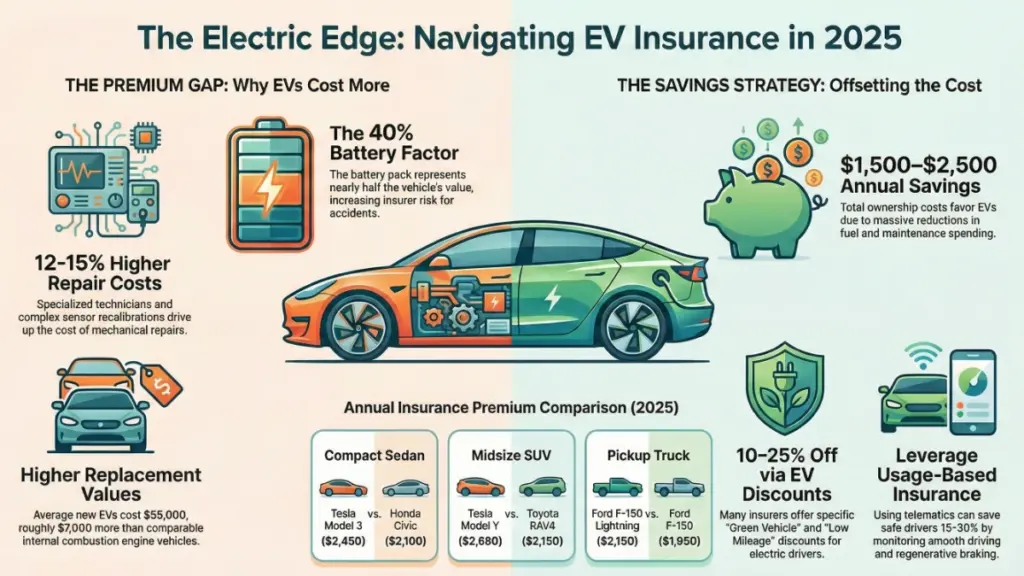
Even with prices dropping, EVs still command premium prices. The average new electric vehicle in 2025 costs approximately $55,000, compared to around $48,000 for traditional vehicles. When you’re insuring a more expensive asset, collision and comprehensive coverage premiums naturally rise. A Tesla Model Y Long Range, for instance, starts at $48,990, while a comparable Toyota RAV4 Hybrid begins at $32,475. That $16,000 difference translates directly to higher insurance costs.
Specialized Repair Requirements
Here’s where it gets interesting. When your EV needs bodywork, you can’t just take it to any corner shop. Many repairs require certified EV technicians and specialized equipment due to high-voltage electrical systems. According to a 2024 study by Mitchell International, EV repairs cost an average of 12-15% more than similar repairs on gas vehicles. Parts availability remains challenging for some models, leading to longer repair times and higher rental car costs that insurers must cover.
Even seemingly minor accidents can become expensive. That front bumper houses radar sensors, cameras, and sometimes LIDAR systems for advanced driver assistance features. What might be a $1,500 repair on a Honda Accord could easily reach $4,000 on a Tesla Model 3 due to sensor recalibration requirements.
The Battery Factor
This is the big one. Your EV’s battery pack represents 30-40% of the vehicle’s total value. A replacement battery for a long-range EV can cost anywhere from $10,000 to $20,000, though prices continue declining. Insurance companies factor this substantial potential claim into your premiums.
The good news? Battery failures are actually quite rare. Modern EV batteries typically come with 8-year/100,000-mile warranties, and real-world data shows most retain 80-90% capacity after 200,000 miles. Still, the possibility of a catastrophic battery failure—especially from accidents involving battery pack damage—keeps insurers cautious.
Theft and Safety Considerations
EVs present a mixed picture here. On one hand, they’re equipped with advanced security features, GPS tracking, and over-the-air updates that can disable stolen vehicles. Tesla vehicles, for example, are notoriously difficult to steal due to their digital key systems.
On the other hand, certain EV models rank among the most stolen vehicles. The 2024 Insurance Institute for Highway Safety (IIHS) report notes that luxury EVs and specific high-performance models attract thieves targeting expensive components—particularly those lithium-ion battery cells.
Safety ratings generally favor EVs. The low center of gravity (thanks to floor-mounted batteries) reduces rollover risk, and many EVs achieve top safety scores. This should reduce insurance costs, but it’s often offset by those higher repair expenses we discussed.
Key Factors That Impact Your EV Insurance Rates
Not all electric vehicles cost the same to insure, and not all drivers pay identical premiums. Understanding these variables helps you anticipate costs and potentially reduce them.
Vehicle Make and Model
The spread is wider than you might think. According to 2025 data from Insure.com, here’s the annual average insurance cost for popular EVs:
- Chevrolet Bolt EV: $1,850 (most affordable)
- Nissan Leaf: $1,920
- Ford F-150 Lightning: $2,150
- Hyundai Ioniq 5: $2,240
- Tesla Model 3: $2,450
- Tesla Model Y: $2,680
- Rivian R1T: $3,120
- Lucid Air: $3,650
- Tesla Model S: $3,890 (among the highest)
Why such variation? Performance capabilities play a huge role. A Lucid Air Sapphire with its 1,234 horsepower will cost significantly more to insure than a Nissan Leaf. Theft rates, repair costs, safety ratings, and even how existing owners drive these vehicles all factor into insurers’ calculations.
Your Driving Record and Location
This isn’t unique to EVs, but it matters enormously. A clean driving record can save you 20-40% compared to someone with accidents or violations. Your ZIP code matters too—urban areas with higher theft and accident rates mean higher premiums, regardless of what you drive.
Living in a state with robust EV infrastructure can work in your favor. Some insurers offer location-based discounts in areas with abundant charging stations and EV-certified repair facilities, since these factors reduce claim complexities.
Coverage Levels and Deductibles
You have choices here, and they significantly impact your premium:
- Liability only: Meets state minimums but leaves you vulnerable if your EV is damaged or stolen
- Standard full coverage: Includes collision and comprehensive with typical deductibles ($500-$1,000)
- Enhanced coverage: Lower deductibles ($250-$500) with additional protections
Raising your deductible from $500 to $1,000 typically reduces premiums by 10-15%, but ensure you can afford that higher out-of-pocket expense if you need to file a claim.
Annual Mileage
EVs shine here. Most EV owners drive fewer annual miles than gas car owners—often because they use their EVs primarily for commuting and local trips while relying on gas vehicles for long road trips. Lower mileage equals lower risk, which translates to lower premiums. If you’re driving under 10,000 miles annually, make sure your insurer knows and adjusts your rate accordingly.
Credit Score and Insurance History
In most states, insurers use credit-based insurance scores to predict claim likelihood. A strong credit score can reduce your EV insurance premium by 10-25%. Maintaining continuous coverage also helps—gaps in insurance history often trigger higher rates.
EV-Specific Coverage Options You Should Consider
Standard auto insurance covers the basics, but electric vehicles introduce unique scenarios worth considering.
Battery Coverage: Beyond the Warranty
Your manufacturer’s battery warranty covers defects and degradation beyond normal wear, but it doesn’t cover everything. Here’s what to think about:
Most standard comprehensive coverage includes battery damage from accidents, fires, theft, or vandalism. However, you should specifically confirm with your insurer whether battery replacement is covered at full replacement cost or actual cash value (which accounts for depreciation). The difference can be thousands of dollars.
Some specialized EV insurers now offer enhanced battery protection that covers:
- Battery fires unrelated to accidents
- Damage from power surges during charging
- Thermal runaway events (rare but catastrophic battery failures)
- Rental car coverage specifically for extended battery repairs
Tesla Insurance and some other EV-focused providers automatically include comprehensive battery coverage, while traditional insurers may require specific policy language or endorsements.
Charging Equipment Protection
Your home charging station represents a significant investment—typically $500-$2,000 for the equipment plus installation. Standard homeowners insurance might cover your Level 2 charger, but it’s worth verifying. Some auto insurers offer endorsements that cover:
- Theft or vandalism of home charging equipment
- Damage from power surges or electrical issues
- Public charging station damage to your vehicle’s charging port
This coverage costs around $50-$100 annually but provides peace of mind if your $1,200 home charger gets damaged.
Roadside Assistance for EVs
Traditional roadside assistance assumes you might run out of gas. EV-specific programs understand you might run out of electrons. Look for coverage that includes:
- Mobile charging services: Some providers dispatch mobile charging units or tow to the nearest charging station (not just any service station)
- Flat tire service: Many EVs don’t carry spare tires due to weight considerations
- Winching and extraction: Important if your EV gets stuck, given their heavier weight
- Extended towing distance: Standard plans offer 5-10 miles; EVs often need 25-50 miles to reach compatible charging
AAA, Better World Club, and manufacturer-provided roadside programs offer EV-specific services. Tesla includes this for 4 years/50,000 miles; Rivian offers 5 years/60,000 miles.
Gap Insurance
Here’s an uncomfortable truth: new EVs depreciate faster than many gas vehicles, primarily due to rapidly advancing technology and federal tax credits applying only to new purchases. If you financed your EV with less than 20% down, gap insurance deserves serious consideration.
Gap insurance covers the difference between your insurance payout (actual cash value) and what you still owe on your loan if your EV is totaled. Given that a new EV can depreciate 20-30% in the first year, this protection prevents you from owing thousands on a vehicle you no longer have.
Cost: typically $400-$600 for the loan term, or about $20-$40 annually if purchased through your auto insurer.
How to Get the Best EV Insurance Rates
You have leverage here—use it. The EV insurance market is competitive and evolving rapidly.
Shop Around Aggressively
This cannot be overstated. Insurance premiums for identical coverage on the same EV can vary by $500-$1,500 annually between providers. Get quotes from at least 4-5 insurers, including:
- Traditional major carriers: State Farm, GEICO, Progressive, Allstate
- EV-specialized insurers: Tesla Insurance, Nationwide EV program, Travelers EV coverage
- Usage-based providers: Root, Metromile (now part of Lemonade)
- Regional carriers: Often overlooked but sometimes offer competitive rates
Leverage EV-Specific Discounts
Many insurers now offer discounts specifically for electric vehicles:
- Green vehicle discount: 5-10% off for driving an EV (State Farm, Farmers)
- Safety technology discount: For advanced driver assistance systems (ADAS)
- Low mileage discount: Many EVs qualify due to typical usage patterns
- Home charging discount: Some insurers reward home charging capability
- Multi-policy bundling: Combine auto and home insurance for 15-25% savings
Ask explicitly about each discount. Insurers don’t always volunteer them.
Consider Usage-Based Insurance
EVs are perfect candidates for telematics programs. These monitor your actual driving behavior—speed, braking, cornering, time of day—and adjust premiums accordingly. Safe drivers can save 15-30% through programs like:
- Progressive’s Snapshot
- State Farm’s Drive Safe & Save
- Allstate’s Drivewise
- Root’s app-based model
Many EV drivers naturally drive smoothly to maximize range, making them ideal candidates for usage-based discounts.
Tesla Insurance: A Special Case
If you drive a Tesla, the company’s proprietary insurance program (available in 12 states as of early 2025) deserves consideration. It uses real-time driving data from your vehicle’s sensors to calculate premiums monthly based on your actual Safety Score.
Advantages:
- Potentially 20-40% lower rates for safe drivers
- Seamless integration with vehicle data
- Deep understanding of Tesla repair costs
Disadvantages:
- Only available in select states (California, Texas, Illinois, Ohio, Virginia, Maryland, Nevada, Oregon, Arizona, Colorado, Utah, Minnesota)
- Privacy considerations around continuous vehicle monitoring
- Premiums can increase if your Safety Score drops
Compare Tesla Insurance quotes against traditional insurers to determine your best option.
Maintain Excellent Driving Habits
With EVs, this matters even more. Many insurers are implementing or piloting programs that specifically monitor EV driving behaviors, including:
- Regenerative braking usage (smooth driving indicator)
- Rapid acceleration patterns
- Charging habits and battery management
- Use of Autopilot or driver assistance features
The better your driving record and habits, the more negotiating power you have when shopping for coverage.
Comparing EV Insurance Costs: Electric vs. Gas
Let’s make this concrete with real-world comparisons. These figures represent average annual premiums for full coverage (collision, comprehensive, liability) based on 2025 industry data:
Compact Sedans
- Tesla Model 3 (electric): $2,450
- Honda Civic (gas): $2,100
- Difference: +$350 (17%)
Midsize SUVs
- Tesla Model Y (electric): $2,680
- Toyota RAV4 (gas): $2,150
- Ford Mustang Mach-E (electric): $2,520
- Honda CR-V (gas): $2,080
- Average difference: +$470 (21%)
Pickup Trucks
- Ford F-150 Lightning (electric): $2,150
- Ford F-150 (gas): $1,950
- Rivian R1T (electric): $3,120
- Chevrolet Silverado (gas): $1,890
- Average difference: +$315 (15%)
Luxury Sedans
- Tesla Model S (electric): $3,890
- BMW 5 Series (gas): $3,200
- Mercedes EQS (electric): $3,650
- Mercedes E-Class (gas): $2,980
- Average difference: +$680 (20%)
The Budget EV Exception
Interestingly, affordable EVs often show smaller insurance premiums differences:
- Chevrolet Bolt EV: $1,850
- Nissan Leaf: $1,920
- Chevrolet Bolt EUV: $1,950
Compare these to similar compact gas cars ($1,750-$1,900), and the gap shrinks to 5-10% or sometimes disappears entirely. These vehicles have lower replacement costs, simpler technology, and established repair networks—all factors that reduce insurance company risk.
The Total Cost Picture
While insurance might cost more, remember the broader financial context. Electric vehicle owners typically save:
- $1,000-$2,000 annually on fuel (depending on local electricity and gas prices)
- $300-$500 annually on maintenance (no oil changes, fewer brake repairs)
- Potential HOV lane access and parking benefits
That extra $350-$500 in annual insurance becomes far less significant when viewed against $1,500-$2,500 in total annual savings. Your total cost of ownership almost certainly favors the EV, even with slightly higher insurance premiums.
Common EV Insurance Myths Debunked
Let’s clear up some persistent misconceptions I hear regularly:
Myth 1: “EV insurance is always drastically more expensive”
Reality: While often higher, the difference is typically 5-20%, not the 50-100% some people fear. For affordable EVs like the Bolt or Leaf, insurance can cost nearly the same as equivalent gas cars. The gap continues narrowing as EVs become mainstream and insurers gain more data.
Myth 2: “Battery fires make EVs uninsurable or extremely expensive”
Reality: Statistically, EVs catch fire far less frequently than gas vehicles. According to the National Transportation Safety Board, EVs experience approximately 25 fires per 100,000 vehicles compared to 1,530 fires per 100,000 for gasoline vehicles. While EV battery fires are more challenging to extinguish, their rarity means this doesn’t significantly impact premiums.
Myth 3: “If my battery degrades, insurance covers replacement”
Reality: Insurance covers sudden, accidental battery damage, not gradual degradation from normal use. That’s covered under your manufacturer’s warranty. Know the distinction—it’s crucial when evaluating coverage needs.
Myth 4: “Older EVs become uninsurable as batteries age”
Reality: As long as your EV is roadworthy and passes inspections, it remains insurable. However, older EVs with diminished battery capacity may see reduced actual cash value payouts if totaled, since their market value has decreased.
Myth 5: “All insurers treat EVs the same way”
Reality: Insurance company approaches vary wildly. Some treat EVs as higher-risk specialty vehicles, while others recognize their safety advantages and offer discounts. This variation is precisely why shopping around matters so much.
The Future of EV Insurance: What’s Coming
The EV insurance landscape is evolving rapidly. Here’s what industry insiders expect over the next 2-3 years:
Dynamic, Data-Driven Pricing
Expect more insurers to follow Tesla’s lead with real-time usage-based models. As EVs inherently collect extensive driving data, insurers will increasingly use this information to offer personalized premiums that adjust monthly based on actual driving behavior rather than demographic estimates.
Declining Premium Gaps
As repair networks expand, parts become more available, and insurers accumulate EV claims data, the insurance cost gap should continue narrowing. Some analysts predict parity with gas vehicles by 2027-2028 for mainstream EV models.
Battery Technology Improvements
Next-generation batteries promise improved safety, longer life, and lower replacement costs. Solid-state batteries, expected in production vehicles by 2026-2027, may significantly reduce insurance concerns around battery damage and replacement.
Specialized EV Insurance Products
Look for more comprehensive, EV-specific insurance bundles that include home charging equipment, extended battery coverage, public charging damage protection, and cybersecurity coverage (protecting against remote vehicle hacking) all in integrated packages.
Vehicle-to-Grid (V2G) Considerations
As EVs increasingly participate in vehicle-to-grid programs—using your battery to supply power back to the electrical grid during peak demand—insurance products will need to address battery wear from this bidirectional charging and potential equipment failures.
Key Takeaways: Your Action Plan
Let’s bring this home with what actually matters for your situation.
What You Need to Remember:
- EV insurance typically costs 5-20% more than comparable gas vehicles, but the gap is narrowing and varies significantly by model and insurer.
- Battery coverage is usually included in comprehensive insurance for accident damage, but verify whether you’re covered at replacement cost or depreciated value.
- Shop aggressively—price variations between insurers for identical EV coverage can reach $1,500 annually.
- Leverage EV-specific discounts: green vehicle, safety technology, low mileage, and home charging discounts can reduce premiums by 10-25% combined.
- Consider usage-based insurance—EVs and their drivers typically perform exceptionally well in telematics programs.
- Total cost of ownership still favors EVs—even with higher insurance, you’ll likely save $1,500-$2,500 annually through lower fuel and maintenance costs.
Your Next Steps:
Start gathering quotes from at least four different insurers. Include one traditional major carrier, one EV-specialist if available in your state, and one usage-based provider. Ask specifically about battery coverage, charging equipment protection, and all available EV discounts.
Review your current driving patterns and annual mileage. If you drive fewer than 12,000 miles annually or have a consistently safe driving record, emphasize these factors when negotiating rates.
If you’re still shopping for an EV, factor insurance costs into your model comparison. That $5,000 price difference between two vehicles might narrow to $3,000 once you account for varying insurance premiums.
The electric vehicle revolution isn’t just transforming transportation—it’s reshaping insurance too. While navigating EV insurance requires slightly more research than insuring a traditional vehicle, the rewards extend far beyond lower emissions. With the right coverage and insurer, you’ll protect your investment without breaking your budget, leaving you free to enjoy the remarkable experience of electric driving.