Electric scooters are best for short, flat commutes under 8 miles, offering portability and lower cost. Electric bikes excel for longer distances, hills, and carrying cargo, with better comfort and range. Scooters are easy to store and ideal for city travel, while e-bikes can replace car trips. Your choice depends on distance, terrain, storage space, and whether you prioritize convenience or versatility.
You’ve decided it’s time to ditch the car for your daily commute—or at least cut back on it. Smart move. But now you’re staring at a choice that trips up a lot of people: do you go with an electric scooter or an electric bike? They’re both battery-powered, they both zip you through city streets, and they both make your neighbors a little envious. So what’s actually different?
Quite a lot, it turns out. The right choice depends on where you ride, how far you go, how much you want to carry—and honestly, whether you want to work a little or coast the whole way. Let’s break it all down so you can stop second-guessing and start riding.
What You’re Actually Comparing
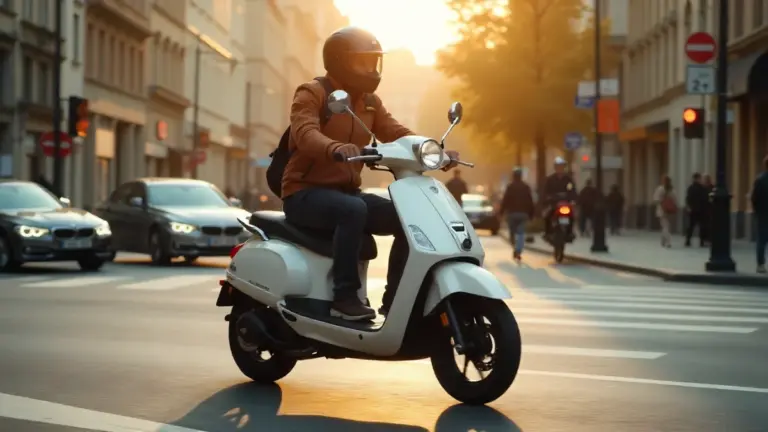
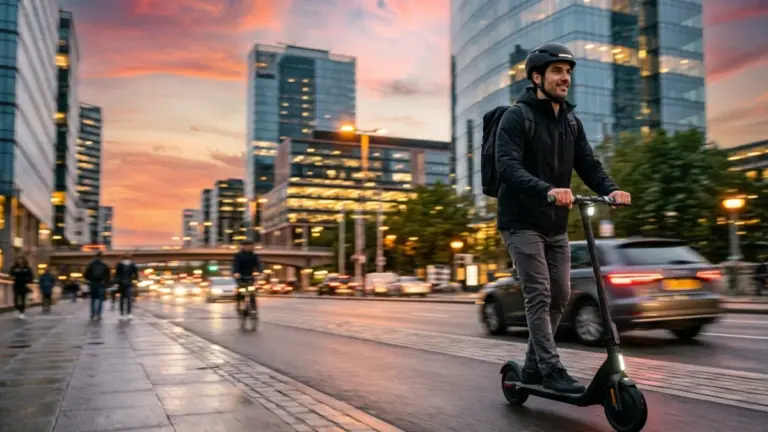
Before diving into the details, let’s get clear on what each category really means in 2025. “Electric scooters” here refers to stand-up, kick-style scooters with a motor—think Segway Ninebot, Xiaomi, or Unagi—not the moped-style scooters you’d sit on. Electric bikes (e-bikes) are bicycles with an integrated motor that either assists your pedaling (pedal-assist) or propels you on throttle alone.
That fundamental difference—standing versus pedaling—shapes almost every other comparison that follows.
Head-to-Head: Electric Scooter vs Electric Bike
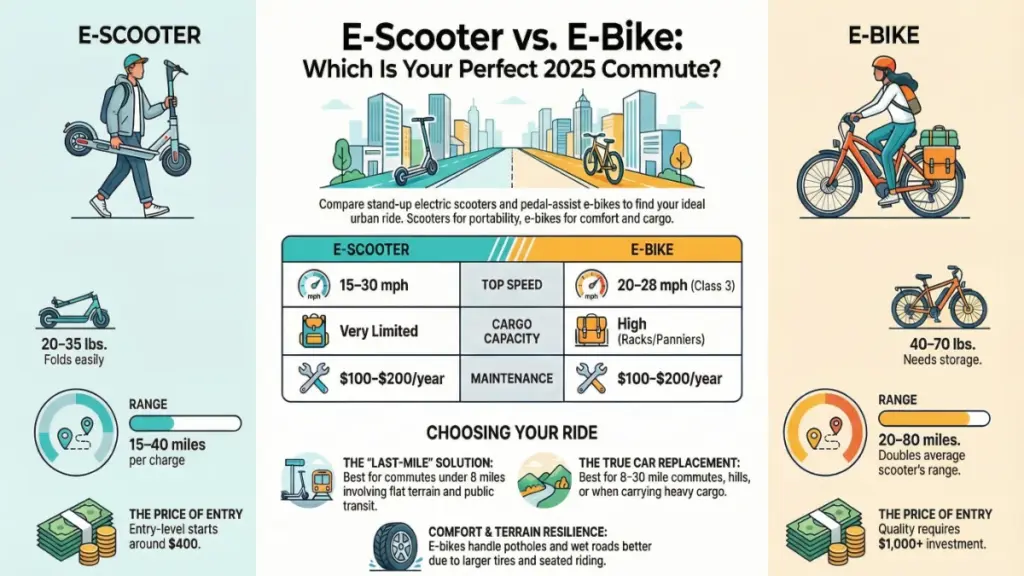
| Feature | Electric Scooter | Electric Bike |
|---|---|---|
| Typical price range | $300–$2,500 | $800–$5,000+ |
| Average range | 15–40 miles | 20–80 miles |
| Top speed | 15–30 mph | 20–28 mph (Class 3) |
| Weight | 20–35 lbs | 40–70 lbs |
| Portability | Folds, carries indoors | Bulky, needs secure storage |
| Fitness benefit | Minimal | Moderate (pedal-assist) |
| Cargo capacity | Very limited | Racks, bags, panniers |
| Weather resilience | Fair (wet roads risky) | Good (wider tires, better grip) |
| Rider fatigue | Low-moderate (standing) | Very low (seated, assisted) |
| Learning curve | Minutes | Familiar if you ride bikes |
The Case for an Electric Scooter
If you live in a dense city and your commute is under 10 miles each way, an electric scooter might be the most practical thing you’ve ever bought. Here’s why.
Portability that actually matters. This is the scooter’s killer feature. A folding e-scooter like the Segway Ninebot Max G2 (around $800) or the Xiaomi Electric Scooter 4 Pro folds down in seconds, fits under your office desk, and slides into a closet at home. You’re not hunting for a bike rack or worrying about theft—you just bring it inside. If your commute involves a train or bus, this is huge. Most transit systems allow folded scooters on board. Try doing that with an e-bike.
Lower upfront cost. A solid entry-level e-scooter runs $400–$700. That’s a meaningful difference compared to e-bikes, where $1,000 typically buys you the bare minimum of quality. For casual, short-distance riders who just want to stop paying for rideshares, the scooter math is hard to argue with.
Where scooters fall short. Standing for 20 minutes isn’t terrible—until it is. On longer rides, especially on rough pavement, your legs and back will start voicing their opinions. Wet roads are also genuinely hazardous on small scooter wheels; the tires are tiny, and grip disappears fast. And if you need to carry groceries, a laptop bag, and a gym kit? You’re going to struggle.
Many urban scooter commuters report that rides over 5–6 miles become physically uncomfortable, especially on roads with potholes or elevation changes. A scooter shines brightest as a “last mile” solution—getting you from the transit stop to the office.
The Case for an Electric Bike
E-bikes have exploded in popularity for good reason. In 2024, Americans bought over 1 million e-bikes—more than twice the number of electric cars sold that year. They’re versatile, comfortable, and they genuinely replace car trips in a way scooters simply can’t.
Comfort and range that go the distance. Sitting down changes everything. On an e-bike, a 15-mile commute feels manageable in a way that would exhaust most people on a stand-up scooter. Add pedal-assist—where the motor amplifies your effort rather than replacing it—and you arrive at work without the sweaty-shirt problem. Bikes like the Rad Power RadCity 5 Plus or the Aventon Level 2 offer 40–60 mile ranges on a single charge, handling commutes that scooters simply can’t touch.
Cargo, hills, and real-world utility. Need to pick up groceries on the way home? Throw panniers or a rear rack on an e-bike. Dealing with a hilly neighborhood? The motor handles it. E-bikes manage real-world terrain—rain, hills, gravel paths—far better than their smaller-wheeled cousins. If you’re replacing a car trip, not just a rideshare app, the e-bike is almost always the better tool.
Where e-bikes are inconvenient. The weight is real. Even a lighter e-bike like the Lectric XP Lite clocks in around 46 lbs—significantly more than any folding scooter. Living in a third-floor walkup? You’ll feel it. Storage matters too: e-bikes need a secure outdoor spot or indoor space that most urban apartments simply don’t have. And the price jump is steep—quality drops fast below $1,000, with the sweet spot sitting around $1,500–$2,500.
Which One Is Right for Your Situation?
Choose an electric scooter if:
- Your commute is under 8 miles each way
- You need to carry it indoors or onto public transit
- Your budget is under $1,000
- You live in a flat, urban area
- You mainly need it as a “last mile” connector
Choose an electric bike if:
- Your commute is 8–30 miles each way
- You need to carry cargo, groceries, or gear
- You’re aiming to replace car trips entirely
- Your route has hills or varied terrain
- Comfort on longer rides is a priority
Legal Considerations: Know Before You Ride
This part trips people up, so pay attention. In most U.S. states, Class 1 and Class 2 e-bikes (up to 20 mph) are treated like regular bicycles—no license, no registration, bike lanes permitted. Class 3 e-bikes (up to 28 mph) have some added restrictions in certain states.
Electric scooters are murkier. Many cities have confusing rules about where you can legally ride them—sidewalk vs. road vs. bike lane—and some require helmets or set minimum age limits. Before you buy, check your local regulations. The People for Bikes foundation maintains a regularly updated state-by-state guide at peopleforbikes.org, and your city’s Department of Transportation website is the best source for scooter-specific rules.
Battery Life, Charging, and Long-Term Costs
Both types use lithium-ion batteries and cost roughly $0.05–$0.15 to fully charge—essentially negligible. What matters more is battery longevity. Most quality batteries are rated for 500–1,000 charge cycles before significant capacity loss. A replacement e-bike battery runs $300–$600; a scooter battery costs $100–$300. Factor that into your 3–5 year cost of ownership.
Maintenance differs too. E-bikes have all the usual bicycle components—tires, brakes, cables, chains—plus the electrical system. Scooters are mechanically simpler, but their smaller tires puncture more easily and wear faster. Budget around $100–$200 per year for routine upkeep on either vehicle if you’re riding regularly.
The Bottom Line
Here’s the honest truth: neither is universally better. An electric scooter is an exceptional urban tool for short, flat commutes where portability is everything. An electric bike is a genuine car replacement for longer distances, varied terrain, and riders who want comfort and cargo capacity.
If you’re still torn, ask yourself one question: How far do I actually need to go, and do I need to carry anything? Under 8 miles with nothing to haul? Get the scooter. Anything beyond that with real-world demands? The e-bike will pay you back in comfort and capability every single day.
Either way, you’re making a smart move. Both options will save you money, reduce your carbon footprint, and make your commute more enjoyable than staring at a dashboard in traffic. That’s a win any way you look at it.