

Motorized wheelchairs in 2026 offer greater independence through improved batteries, smarter controls, and longer range. This guide explains power wheelchair types, realistic range expectations, costs, insurance coverage, maintenance, and how to choose the right model for your lifestyle. Whether for indoor mobility or outdoor adventures, modern power chairs are becoming lighter, more efficient, and more capable than ever before.
If you’ve ever pushed a manual wheelchair up a long ramp, you already know the question that matters most: how much easier could this be with a motor? The short answer is — a lot easier. In fact, a quality motorized wheelchair can turn a 20-minute grocery run into a 5-minute errand, open up hiking trails that manual chairs simply can’t handle, and give you back hours of energy every single day.
In this guide, I’ll walk you through everything you need to know about motorized wheelchairs in 2026. That includes how they work, what the different types offer, what they cost, and how far they’ll really take you on a charge. I’ll also cover how to pick the right one for your life, not just your diagnosis. After all, I’ve spent years covering electric mobility technology, and the same innovations reshaping electric cars are quietly transforming power wheelchairs too.
What Is a Motorized Wheelchair, Exactly?
A motorized wheelchair, also called a power wheelchair or electric wheelchair, is a mobility device propelled by an electric motor rather than manual effort. Typically, it’s controlled with a joystick, sip-and-puff system, or head array. Unlike manual chairs, which rely entirely on the user or a caregiver for propulsion, power chairs use rechargeable batteries to drive one or more motors connected to the wheels.
Overall, modern power wheelchairs generally fall into three categories:
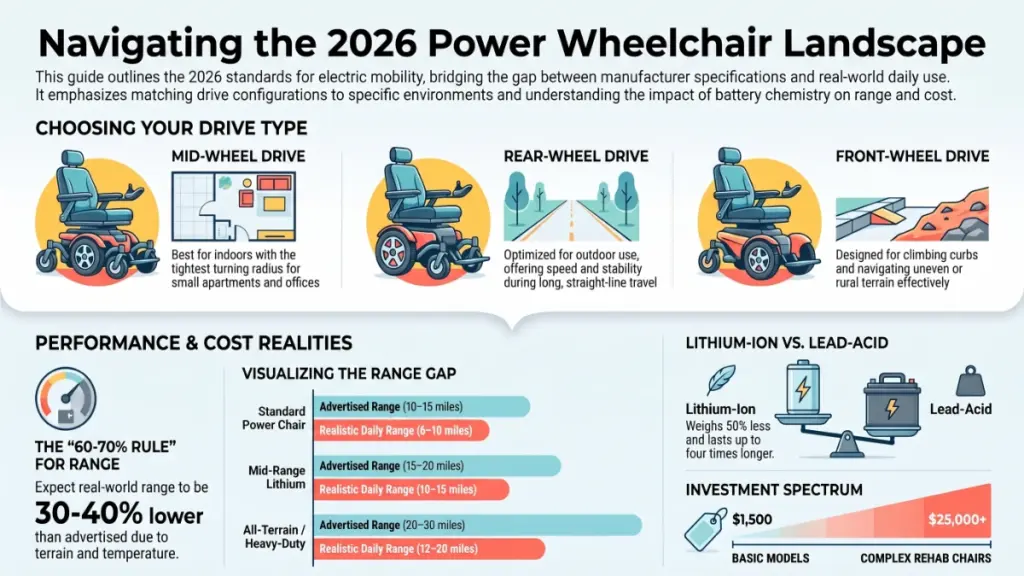
- Rear-wheel drive: Fast and stable at higher speeds, favored for outdoor use and long, straight-line travel.
- Mid-wheel drive: The tightest turning radius, making it ideal for small apartments, offices, and stores.
- Front-wheel drive: Strong at climbing curbs and uneven terrain, with a moderate turning radius.
In addition, there’s a hybrid category worth knowing about: power-assist wheelchairs. These add a motor to what is otherwise a manual chair, giving users a boost on inclines without a bulkier power base.
How Motorized Wheelchairs Actually Work
At the core of every power wheelchair sits a battery pack, one or two electric motors, and a control system. Essentially, it’s a smaller-scale version of the same architecture found in an electric car, since stored energy gets converted into torque, delivered smoothly and precisely.
Key components include:
- Batteries — Usually sealed lead-acid (SLA), gel-cell, or increasingly, lithium-ion
- Motors — Typically 1 motor per drive wheel, ranging from 200W to over 400W on heavy-duty models
- Controller — Interprets joystick or alternative input and manages speed, acceleration, and braking
- Suspension — On higher-end and all-terrain models, helps smooth out rough surfaces
Meanwhile, lithium-ion batteries are becoming the standard for premium models, and for good reason: they’re roughly half the weight of lead-acid batteries, charge faster, and last longer, often lasting 800–2,000 charge cycles versus 300–500. On top of that, they don’t degrade as quickly when partially charged. That said, the tradeoff is upfront cost, since lithium battery packs can add $1,500–$3,000 to a chair’s price.
Range, Speed, and Battery Life: What to Actually Expect
This is the question I get asked most, and it deserves an honest answer: manufacturer range estimates are almost always best-case scenarios. In practice, real-world range depends heavily on user weight, terrain, temperature, and incline.
| Chair Type | Advertised Range | Realistic Daily Range | Top Speed |
|---|---|---|---|
| Standard indoor/outdoor power chair | 10–15 miles | 6–10 miles | 4–5 mph |
| Mid-range lithium power chair | 15–20 miles | 10–15 miles | 5–6 mph |
| All-terrain / heavy-duty power chair | 20–30 miles | 12–20 miles | 6–8 mph |
| Power-assist add-on (manual chair) | 8–12 miles | 5–8 miles | 4 mph |
As a rule of thumb borrowed from the EV world, plan around 60–70% of the advertised range for everyday use. This matters most in cold weather or hilly areas, since cold temperatures alone can reduce battery output by 10–20%, just as they do in electric vehicles.
As for charging, times typically run 6–8 hours for lead-acid batteries, and 3–5 hours for lithium models. Most users charge overnight, which fits well into daily routines, so just plan around it if you’re traveling.
What Does a Motorized Wheelchair Cost in 2026?
Cost is often the biggest barrier for buyers, since pricing varies widely based on features, battery type, and whether the chair is custom-fitted for complex medical needs.
- Basic power wheelchairs: $1,500–$3,500
- Mid-range chairs with better suspension and lithium options: $3,500–$8,000
- Complex rehab power chairs (tilt, recline, elevate): $8,000–$25,000+
- Power-assist add-on devices: $1,500–$6,000
Fortunately, Medicare Part B, Medicaid, and most private insurers cover a significant portion of these costs when deemed medically necessary. However, the approval process requires documentation from your physician and often a face-to-face mobility evaluation. Additionally, veterans may qualify for coverage through the VA, while nonprofit organizations and manufacturer financing programs can help close any remaining gaps.
Before buying, it’s worth asking your supplier:
- Is this chair covered under my specific insurance plan, and what’s my out-of-pocket estimate?
- What’s the warranty on the battery versus the frame and electronics?
- Are loaner chairs available during repairs?
Choosing the Right Chair for Your Life
The best power wheelchair isn’t the one with the flashiest spec sheet, but rather the one that matches how you actually live. Ultimately, a few honest questions here can save you thousands of dollars and months of frustration.
Consider your primary environment:
- Mostly indoors and tight spaces → mid-wheel drive
- Mixed indoor/outdoor, longer distances → front-wheel or rear-wheel drive
- Rural, uneven, or unpaved terrain → all-terrain power chair with enhanced suspension
Consider your body and daily needs:
- Do you need tilt or recline functions for pressure relief?
- Will you be transferring in and out of the chair often, or living in it most of the day?
- Would elevating leg rests or seat elevation help you reach countertops and shelves?
Consider transport, too:
- Power chairs are heavy, often 150–350 lbs. So, if you’re transporting one in a vehicle regularly, look into portable or travel power chairs, or a wheelchair-accessible vehicle with a ramp.
Above all, I always tell people to sit in the chair, in the store or showroom, for at least 20–30 minutes before deciding. That’s because minor comfort issues in a five-minute test often become significant after a full day of use.
Maintenance and Common Misconceptions
A well-maintained power wheelchair can last 5–7 years, sometimes longer. Typically, batteries are the component most likely to need replacement, usually every 1–3 years depending on chemistry and usage.
Common misconceptions worth clearing up:
- “Power wheelchairs can’t get wet.” In reality, most are rated for light rain, but submersion or heavy downpours can damage electronics, so check your model’s IP rating to be sure.
- “All power chairs fold up for the car.” Actually, many do not. Folding and travel-friendly models are a distinct category, so confirm this before buying if portability matters to you.
- “Lithium batteries are dangerous.” On the contrary, reputable manufacturers use the same safety-tested chemistry found in laptops and EVs, with built-in battery management systems that prevent overheating.
Overall, routine care goes a long way toward extending the life of your chair. That means keeping tires properly inflated, cleaning contacts, and avoiding letting the battery fully drain repeatedly.
The Road Ahead: What’s Changing in 2026 and Beyond
The mobility device industry is benefiting from the same battery research driving electric cars forward. For instance, solid-state battery prototypes, more efficient brushless motors, and smarter onboard computers are starting to filter down from EVs into power wheelchairs, promising longer range, lighter frames, and smarter obstacle detection in the years ahead. Meanwhile, a handful of manufacturers are already piloting stair-climbing power chairs and self-balancing models that traverse curbs and rough terrain with far more confidence than today’s standard chairs.
Key Takeaways
- Motorized wheelchairs use battery-powered motors controlled by a joystick or alternative input, with rear-wheel, mid-wheel, and front-wheel drive suited to different environments.
- Real-world range is typically 60–70% of advertised figures, so plan accordingly, especially in cold weather.
- Costs range from roughly $1,500 for basic models to $25,000+ for complex rehab chairs, with insurance often covering a meaningful portion.
- Match the chair to your environment, body needs, and transport situation, not just the spec sheet.
- Lithium-ion batteries cost more upfront but offer real advantages in weight, charge time, and longevity.
In short, if you’re in the market, start with a hands-on evaluation from a certified mobility specialist or occupational therapist, since they can assess your specific needs and help you navigate insurance paperwork. Ultimately, the right chair isn’t just a mobility aid, but rather a genuine expansion of your independence.