Are you eyeing an electric vehicle but concerned about the price tag? Here’s the good news: government incentives could slash thousands of dollars off your purchase price. As someone who closely follows the EV market, I’ve watched these incentives evolve dramatically over the past few years. Understanding them can mean the difference between a good deal and a great one.
In this comprehensive guide, I’ll walk you through everything you need to know about federal tax credits, state rebates, and local incentives available in 2025. You’ll learn which vehicles qualify, how to claim your savings, and insider tips to maximize your benefits. Whether you’re a first-time EV buyer or upgrading from an older model, this article will help you navigate the incentive landscape and potentially save $7,500 or more on your next electric vehicle.
Understanding the Federal EV Tax Credit in 2025
The federal EV tax credit remains the most substantial incentive available to American buyers. However, it’s gotten more complex since the Inflation Reduction Act reshaped the rules. Let me break down how it works today.
How Much Can You Actually Save?
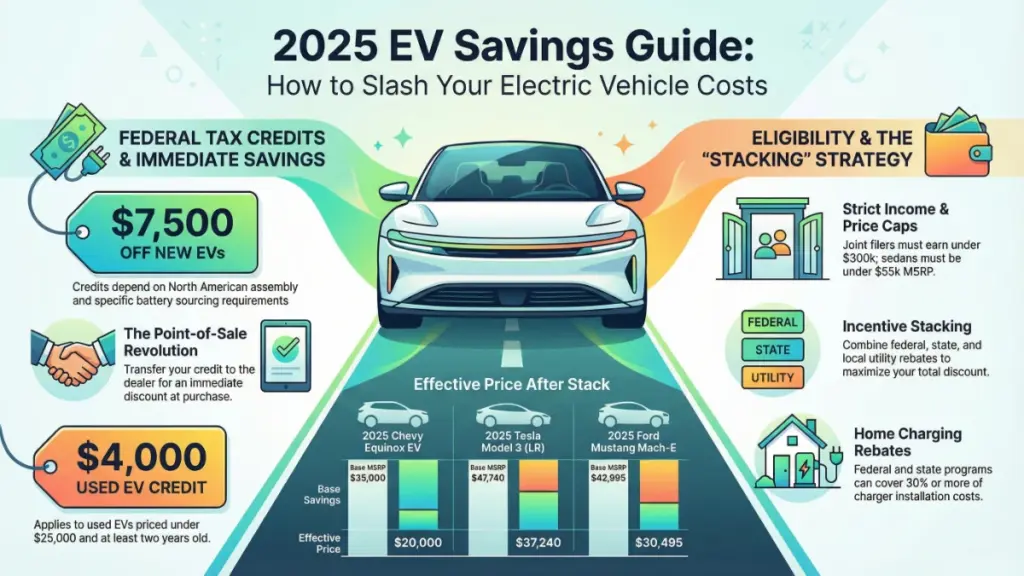
The federal government offers up to $7,500 in tax credits for new electric vehicles and up to $4,000 for used EVs purchased in 2025. That’s real money coming back to you—but there’s a catch. Actually, there are several catches, which is why understanding the fine print matters so much.
For new vehicles, you can receive the full $7,500 if the vehicle meets both battery component requirements. Specifically, you’ll get $3,750 for meeting the critical minerals sourcing requirement. Additionally, you’ll receive another $3,750 for meeting the battery component manufacturing requirement. If a vehicle only meets one criterion, you’ll get half the credit.
Vehicle Eligibility Requirements
Not every electric vehicle qualifies for the federal credit anymore. Consequently, understanding the rules is essential before making your purchase. Here’s what needs to align:
Price caps matter: First, new sedans must cost less than $55,000. Meanwhile, SUVs, trucks, and vans can’t exceed $80,000. These are manufacturer’s suggested retail prices (MSRP), so that loaded trim package might push you over the limit.
North American assembly requirement: Furthermore, the vehicle must undergo final assembly in North America. The IRS maintains an updated list of eligible vehicles on their website, and it changes quarterly as automakers adjust their supply chains.
Battery sourcing restrictions: This is where it gets technical. A qualifying percentage of critical minerals must be extracted or processed in the US or a country with a free trade agreement. Moreover, battery components must be manufactured or assembled in North America. These percentages increase each year, making compliance progressively stricter.
Income Limits You Need to Know
The federal credit includes income caps designed to target middle-class buyers. For 2025, you won’t qualify if your modified adjusted gross income exceeds:
- $300,000 for married couples filing jointly
- $225,000 for heads of household
- $150,000 for single filers
Here’s something many buyers miss: these limits apply to the year you take delivery of the vehicle, not when you order it. Therefore, if you’re close to the threshold, strategic timing of your purchase could save your eligibility.
The Point-of-Sale Credit Revolution
Starting in 2024 and continuing through 2025, you can now transfer your tax credit to the dealer at purchase. As a result, you’ll receive an immediate discount rather than waiting until tax time. This is a game-changer for buyers who might not have $7,500 in tax liability or who simply need the savings upfront.
When you use the point-of-sale option, the dealer reduces your purchase price by the credit amount. Then, they claim the credit from the IRS. It’s cleaner, faster, and helps with down payments or monthly loan calculations. However, you’ll need to register through the IRS Energy Credits Online portal beforehand. Plus, your dealer must participate in the program.
State and Local Incentives: The Hidden Goldmine
While the federal credit grabs headlines, state and local incentives can add thousands more in savings. In fact, they often stack with federal benefits. The variation is enormous, so your location significantly impacts your total savings potential.
Top State Programs for 2025
California continues leading the pack with aggressive EV adoption goals. The Clean Vehicle Rebate Project (CVRP) offers up to $7,500 for qualifying buyers. Even better, enhanced rebates for low-income residents reach $9,500. California also provides purchase rebates for used EVs and additional incentives for replacing older, high-polluting vehicles.
Colorado offers one of the most generous programs outside California, with tax credits up to $5,000 for new EVs and $2,500 for used models. What makes Colorado’s program particularly appealing is that it’s a tax credit rather than a rebate. Consequently, you see the savings at purchase when combined with the federal point-of-sale option.
New York provides rebates through Drive Clean Rebate program, offering up to $2,000 for battery electric vehicles. Additionally, New York includes substantial incentives for charging equipment installation and special programs for low-to-moderate income residents.
New Jersey offers point-of-sale incentives up to $4,000 through the Charge Up New Jersey program. As a result, it’s one of the most straightforward programs to access. The Garden State has also invested heavily in charging infrastructure, thereby addressing range anxiety concerns.
Massachusetts provides the MOR-EV rebate of up to $3,500 for new EVs and $1,500 for used vehicles. Furthermore, Massachusetts offers enhanced incentives for income-eligible buyers and has special programs for municipalities and businesses.
Regional and Municipal Programs Worth Exploring
Don’t overlook local utility company incentives. Many electric utilities offer rebates ranging from $500 to $2,500 for EV purchases. In addition, they provide extra incentives for installing home charging equipment. For example:
- Austin Energy in Texas offers rebates up to $4,000 for EVs
- Sacramento Municipal Utility District provides up to $2,500 in combined EV and charging incentives
- Portland General Electric offers $2,500 for EV purchases plus charging rebates
Some cities add their own incentives on top of state and federal programs. For instance, Los Angeles has special programs for replacing older vehicles with EVs. Meanwhile, Seattle offers parking benefits and access to HOV lanes for EV drivers.
Used EV Tax Credit: The Smart Buyer’s Secret
The used EV tax credit represents one of the best-kept secrets in the incentive landscape. Starting in 2023 and fully operational in 2025, this credit makes pre-owned electric vehicles significantly more affordable.
How the Used EV Credit Works
You can claim up to $4,000 or 30% of the sale price (whichever is less) when purchasing a qualified used EV. The vehicle must be:
- At least 2 years old from the original sale date
- Priced at $25,000 or less
- Sold by a licensed dealer (private party sales don’t qualify)
- Not previously claimed for this credit by another buyer
Income limits are lower than new vehicle credits: $150,000 for joint filers, $112,500 for heads of household, and $75,000 for single filers. However, the credit is refundable, meaning you can receive it even if your tax liability is less than $4,000. This represents a significant advantage over the non-refundable new vehicle credit.
Why This Opens Up EV Ownership
A three-year-old Chevrolet Bolt or Nissan Leaf might cost $15,000 to $18,000 used. With the $4,000 credit, your effective price drops to $11,000 to $14,000. Ultimately, this makes them competitive with used gasoline vehicles while offering dramatically lower operating costs.
I’ve seen savvy buyers combine this credit with state rebates and utility incentives. As a result, they get into EVs for under $10,000. The used market has exploded with off-lease vehicles from 2021-2022, when automakers were ramping up EV production. These vehicles typically have 20,000 to 40,000 miles, plenty of battery warranty remaining, and prices that trigger the federal credit.
Charging Infrastructure Incentives
The cost of an EV doesn’t end at purchase—you’ll need charging equipment. Fortunately, incentives exist here too, and they’re often overlooked in the initial buying excitement.
Federal Charging Equipment Tax Credit
The Alternative Fuel Vehicle Refueling Property Credit covers 30% of the cost of installing charging equipment, up to $1,000 for residential installations. For 2025, this credit has been extended and expanded under recent infrastructure legislation.
Commercial properties can claim significantly higher credits—up to $100,000 per location. Therefore, these incentives encourage businesses to install public charging stations. If you’re installing charging at a business or rental property, these incentives can completely offset your costs.
State and Utility Charging Rebates
Many states offer separate incentives for home charging equipment installation:
- California: Up to $2,000 through various utility programs
- Massachusetts: Up to $1,500 for Level 2 home chargers
- Maryland: Rebates covering 50% of costs up to $700
Utility companies often provide the most generous charging incentives because they’re eager to increase electricity sales during off-peak hours. In fact, some utilities even offer free overnight charging for EV owners. Alternatively, they provide special time-of-use rates that make charging during off-peak hours extremely cheap—sometimes just pennies per kilowatt-hour.
Your total investment in home charging might be $600 to $1,500 after incentives, depending on your electrical setup. That’s a one-time cost that provides years of convenient home charging. Moreover, it can add value to your property if you sell.
Maximizing Your Total Incentive Package
Here’s where strategic thinking pays off. The real art is stacking multiple incentives to maximize your savings.
The Stacking Strategy
Let’s walk through a real-world example. Imagine you’re buying a 2025 Chevrolet Equinox EV (MSRP around $35,000) in Colorado:
- Federal tax credit: $7,500
- Colorado state credit: $5,000
- Local utility rebate: $1,500
- Charging equipment incentives: $1,000
Your total incentive package: $15,000 on a $35,000 vehicle. Consequently, this brings your effective price to $20,000. That’s a 43% discount before negotiating the purchase price or considering trade-in value.
Even better, most of these incentives don’t count as taxable income. The federal tax credit reduces your tax liability rather than increasing your income. Similarly, many state rebates are also excluded from taxable income calculations.
Timing Considerations
Understanding timing can make or break your incentive eligibility:
Quarter-end updates: The IRS updates the eligible vehicle list quarterly. If your desired vehicle doesn’t currently qualify due to battery sourcing rules, it might become eligible in the next quarter as manufacturers adjust their supply chains.
End-of-year tax planning: If you’re close to income limits, consider whether taking delivery in December or January makes a difference. This depends on your income for that tax year.
State budget cycles: Some state rebate programs operate on a first-come, first-served basis with limited annual funding. For example, California’s CVRP has occasionally paused when funds run out, then restarted the next fiscal year. Applying early in the funding cycle can secure your rebate.
Manufacturer promotions: Automakers sometimes offer additional incentives that stack with government programs, especially on models they’re trying to move. Watch for end-of-model-year deals that can add thousands more in savings.
Special Programs and Additional Benefits
Beyond direct purchase incentives, EV owners enjoy numerous benefits that improve the overall value proposition.
HOV Lane Access
Many states grant EVs access to high-occupancy vehicle (HOV) or carpool lanes regardless of passenger count. In congested metro areas like Los Angeles, San Francisco, Washington D.C., and Atlanta, this perk alone can save 30-60 minutes of daily commuting time. Subsequently, some states issue special license plates or stickers to identify eligible vehicles.
This benefit has real economic value—saving an hour per day of commuting time equates to roughly 250 hours annually. Therefore, it’s worth thousands of dollars in productivity and reduced stress.
Workplace Charging Programs
Many employers now offer free charging as a benefit to employees. This effectively provides free “fuel” for your commute, potentially saving $50-150 monthly compared to gasoline costs. Furthermore, some companies even offer incentive programs or matching funds for employees who purchase EVs.
Toll and Parking Discounts
Various states and municipalities offer:
- Reduced toll rates for EVs
- Free or reduced-price parking in downtown areas
- Preferred parking spots with charging stations
- Exemption from congestion pricing in cities like New York
These benefits vary widely by location but can add up to hundreds of dollars in annual savings.
Extended Warranties and Battery Guarantees
While not direct government incentives, federal regulations require automakers to warranty EV batteries for at least 8 years or 100,000 miles. Many manufacturers exceed this requirement, offering 10-year/150,000-mile coverage. This regulatory requirement reduces long-term ownership risk and provides peace of mind about the most expensive component.
How to Claim Your Incentives: A Step-by-Step Guide
Understanding what you qualify for is one thing. However, actually claiming your incentives requires following specific procedures.
For Federal Tax Credits (New Vehicles)
Point-of-sale option (recommended):
- First, register on the IRS Energy Credits Online portal before purchase
- Next, provide your dealer with time-of-sale report confirmation
- Then, dealer applies credit as a discount at purchase
- Finally, file Form 8936 with your tax return to report the transfer
Traditional tax filing method:
- First, obtain dealer report confirming vehicle eligibility
- Then, file IRS Form 8936 with your tax return
- Next, credit reduces your tax liability (non-refundable)
- Finally, receive benefit when you file your return
For State Rebates and Credits
Most state programs require:
- Application submission within 6-12 months of purchase
- Proof of purchase documentation (sales contract, registration)
- Proof of residency (utility bill, driver’s license)
- Income verification for income-qualified programs
Processing times vary from 4-12 weeks for rebates. Meanwhile, tax credits typically reduce your state tax liability on your annual return.
For Used EV Credit
- First, verify the vehicle hasn’t been previously claimed for this credit
- Next, obtain seller’s report confirming eligibility
- Then, use point-of-sale option or claim on Form 8936 when filing
- Remember, this credit is refundable, so you’ll receive it even if you don’t owe taxes
Documentation to Keep
Maintain these documents for at least three years after claiming:
- Complete sales contract showing final price
- VIN verification and eligibility confirmation
- Dealer time-of-sale report
- State rebate approval notices
- Charging equipment installation receipts and permits
Incentives for Businesses and Fleets
Business and fleet buyers access enhanced incentive structures. As a result, EVs can become extremely attractive from a total cost of ownership perspective.
Commercial EV Tax Credits
Businesses purchasing qualified commercial clean vehicles can claim credits of:
- Up to $7,500 for vehicles under 14,000 pounds GVWR
- Up to $40,000 for larger commercial vehicles and trucks
These credits have fewer restrictions than consumer credits, particularly regarding battery sourcing requirements. Additionally, the credits can be claimed against business tax liability or monetized through the point-of-sale mechanism.
Accelerated Depreciation
EVs qualify for Section 179 expensing, allowing businesses to deduct the full purchase price (up to certain limits) in the year of purchase rather than depreciating over time. Combined with bonus depreciation rules, this can provide substantial first-year tax benefits for business buyers.
Fleet Electrification Grants
Various federal and state programs offer grants for fleet electrification:
- EPA Clean School Bus Program: Up to $375,000 per electric school bus
- USDA Rural Energy for America Program: Grants and loans for rural business fleet electrification
- State-specific fleet programs: California, New York, and other states offer substantial incentives for commercial fleet conversions
The Future of EV Incentives: What’s Coming
The incentive landscape continues evolving as governments refine policies. Consequently, they aim to accelerate EV adoption while managing costs and supporting domestic manufacturing.
Upcoming Changes Through 2027
The battery sourcing requirements become progressively stricter, with the percentage of North American content increasing each year. This means some vehicles currently qualifying may lose eligibility unless manufacturers restructure their supply chains. However, massive investments in domestic battery production should expand the list of qualifying vehicles over time.
Several states have announced plans to increase EV incentives through 2026-2027. They’re placing particular focus on used vehicles and lower-income buyers. Washington, Oregon, Illinois, and Pennsylvania have all passed legislation expanding their EV incentive programs.
Potential New Incentive Structures
Policy discussions include:
Income-scaled incentives: Providing larger credits to lower-income buyers while reducing or eliminating incentives for high-income purchasers.
Feebates: Programs that tax high-emission vehicles to fund rebates for zero-emission vehicles. Therefore, this creates self-funding incentive systems.
Charging infrastructure expansion: Substantial federal funding ($7.5 billion from the Infrastructure Investment and Jobs Act) continues flowing to expand public charging networks nationwide. As a result, this addresses range anxiety concerns.
Carbon credit trading: Some states are developing systems allowing consumers to monetize EV ownership through carbon credit programs.
Common Pitfalls and How to Avoid Them
After helping friends and family navigate EV purchases, I’ve seen several recurring mistakes. Unfortunately, these errors cost people money or eligibility.
Mistake #1: Assuming All EVs Qualify
Not all electric vehicles qualify for federal credits, even if they’re fully electric. Always check the IRS Qualified Vehicles List before purchasing. This list updates quarterly, and vehicles can gain or lose eligibility based on battery sourcing changes.
Don’t rely on dealer representations alone—verify eligibility yourself on fueleconomy.gov or the IRS website. I’ve heard stories of buyers assuming they’d get the credit only to discover their vehicle didn’t qualify.
Mistake #2: Exceeding Income Limits
If you’re near the income thresholds, be strategic about timing. Your modified adjusted gross income for the year of delivery determines eligibility. For instance, a December purchase in a high-income year versus a January purchase in a lower-income year could mean a $7,500 difference.
For households with variable income (bonuses, capital gains, self-employment), consult a tax professional about timing strategies.
Mistake #3: Missing State Application Deadlines
State rebate programs typically have application windows—often 6-12 months from purchase date. Missing these deadlines forfeits potentially thousands of dollars. Therefore, set calendar reminders and gather documentation immediately after purchase.
Mistake #4: Leasing Instead of Buying (Sometimes)
Leasing can be advantageous because the leasing company can claim the federal credit. Then, they pass savings through lower lease payments. However, you won’t be eligible to claim the credit yourself. Do the math on total cost over your ownership period.
For used EVs, you must purchase to claim the used EV credit—leasing doesn’t qualify.
Mistake #5: Forgetting About Tax Liability
The federal new vehicle credit is non-refundable. If your total federal tax liability is only $5,000, you can only use $5,000 of the $7,500 credit. Unfortunately, the remaining $2,500 disappears—it doesn’t carry forward or generate a refund.
The point-of-sale option helps here. As a result, you get the full discount regardless of your tax situation, though it’s technically an advance on your tax credit.
Real-World Cost Comparison: Gas vs. Electric
Let’s ground all these incentives in practical numbers by comparing actual ownership costs.
Purchase Price After Incentives
2025 Tesla Model 3 Long Range ($47,740 MSRP):
- Federal credit: -$7,500
- California CVRP: -$2,000
- Utility rebate: -$1,000
- Effective price: $37,240
2025 Ford Mustang Mach-E ($42,995 MSRP):
- Federal credit: -$7,500
- Colorado credit: -$5,000
- Effective price: $30,495
Compare these to similarly equipped gasoline vehicles in the $35,000-45,000 range. Clearly, EVs become price-competitive before considering operating cost savings.
Operating Cost Savings
Beyond purchase incentives, EVs deliver ongoing savings:
Electricity vs. Gasoline: At $0.13/kWh (national average) and 3 miles per kWh efficiency, electricity costs about $0.04 per mile. In contrast, gasoline at $3.50/gallon in a 30 mpg vehicle costs $0.12 per mile—three times higher.
For 12,000 annual miles, that’s $480 in electricity versus $1,440 in gasoline. Ultimately, this saves you $960 annually on fuel alone.
Maintenance: EVs require no oil changes, transmission service, or exhaust system repairs. Most EV owners spend $300-500 annually on maintenance (tire rotations, brake fluid, cabin filters). On the other hand, comparable gasoline vehicles cost $800-1,200. That’s another $400-600 annual savings.
Total 5-year savings: $960 fuel + $500 maintenance = $1,460 annually × 5 years = $7,300 in operating cost savings. This comes on top of purchase incentives.
Key Takeaways: Your Action Plan
After digesting all this information, here’s your practical roadmap to maximizing EV purchase incentives:
Research before shopping: First, check the IRS qualified vehicles list. Then, research your state’s incentive programs. Finally, contact your utility company about EV rebates. Knowledge is leverage in negotiations.
Verify your eligibility: Calculate your modified adjusted gross income for the purchase year. If you’re close to limits, consider timing strategies with a tax professional.
Stack incentives strategically: Combine federal, state, local, and utility incentives. The total package often exceeds $10,000. Moreover, these programs are designed to work together.
Use the point-of-sale option: Take the federal credit as an immediate discount if possible. It helps with down payments and eliminates uncertainty about tax liability.
Document everything: Keep comprehensive records of all purchases, applications, and correspondence. You’ll need these for tax filings and potential audits.
Apply for state rebates immediately: Don’t procrastinate on rebate applications. Set reminders and gather documentation right after purchase.
Consider used EVs: The used EV credit makes three-year-old models incredibly affordable. Combined with state programs, you might get into an EV for under $12,000.
The landscape of EV incentives has never been more favorable for buyers. Yes, the rules are complex, but navigating them successfully can save you $10,000-15,000 or more. Furthermore, with operating costs dramatically lower than gasoline vehicles, the total cost of EV ownership is increasingly attractive, even without considering environmental benefits.
As battery technology improves and charging infrastructure expands, EVs are transitioning from early adopter territory to mainstream transportation. Government incentives are accelerating this transition, making 2025 an excellent time to make the switch. Do your homework, understand the incentives available in your area, and you might be surprised at how affordable electric vehicle ownership has become.
Ready to start your EV journey? Visit fueleconomy.gov to research qualified vehicles. Then, check your state’s energy office website for local incentives. Finally, contact your electric utility about their EV programs. The perfect electric vehicle for your needs—at a price that makes sense—might be closer than you think.