The Magic Under the Hood (Or Lack Thereof)
Remember the first time you popped the hood of an electric car and saw… almost nothing? Where’s the engine? Where are all those belts, hoses, and mysterious fluid reservoirs? If you’ve experienced that moment of confusion, you’re not alone. I had the same reaction when I first peered under the frunk (that’s “front trunk” in EV-speak) of a Tesla Model 3.
Here’s the beautiful truth: electric cars are surprisingly simple machines. While gas-powered cars have thousands of moving parts working in controlled explosions to push you down the road, EVs operate on a principle you learned in elementary school science class. Remember those experiments with magnets and copper wire? That’s essentially what’s happening in an electric car—just scaled up in the most impressive way possible.
In this guide, we’re going to pull back the curtain on electric vehicle technology. Whether you’re considering making the switch to an EV or you’re just curious about how these quiet, smooth-riding vehicles actually work, I’ll walk you through everything in plain English. No engineering degree required, I promise.
The Heart of the Matter: The Electric Motor
Let’s start with what replaces that conventional engine: the electric motor. And here’s where things get interesting—an electric motor is actually far simpler than an internal combustion engine.
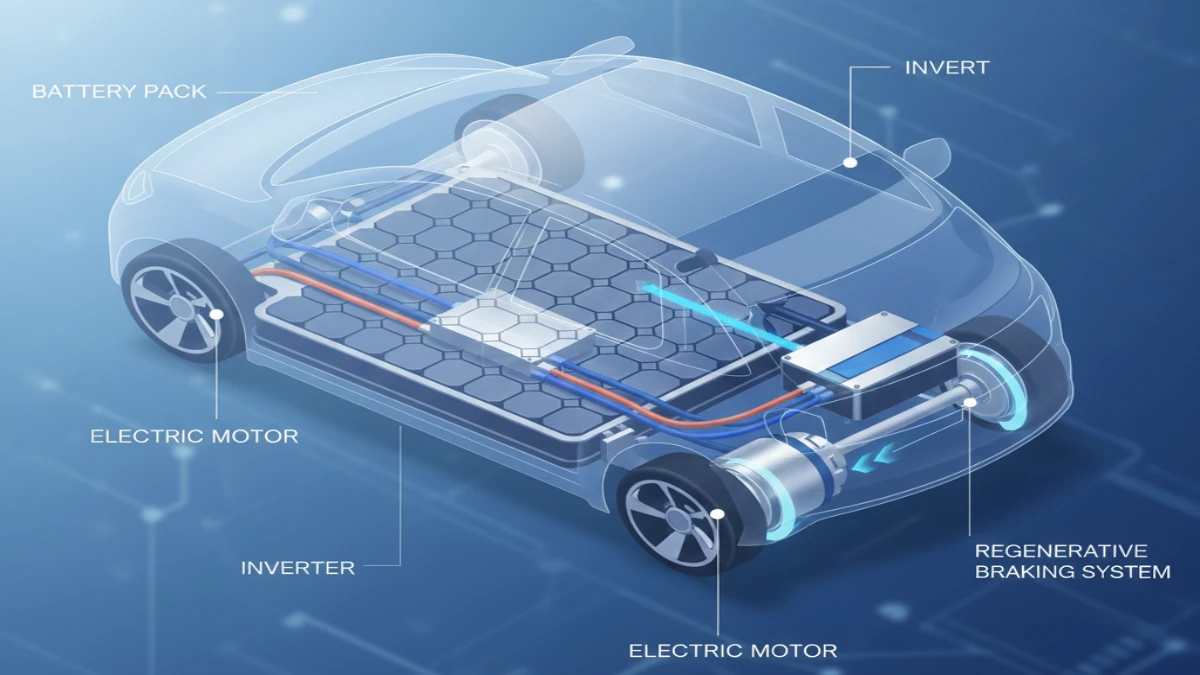
At its core, an electric motor uses electromagnetic force to create motion. Picture this: you have a stationary outer part (called the stator) with electromagnets arranged in a circle, and a rotating inner part (called the rotor) in the middle. When electricity flows through the stator’s electromagnets, they create magnetic fields that push and pull against magnets in the rotor, causing it to spin. That spinning motion is what turns your wheels.
The genius of this system? It happens instantly. Unlike a gas engine that needs to reach certain RPMs to deliver power, an electric motor provides maximum torque the moment you press the accelerator. This is why even modestly-priced EVs like the Chevrolet Bolt can leave sports cars in the dust at a stoplight. That instant acceleration isn’t just a party trick—it makes merging onto highways safer and city driving more responsive.
Most modern EVs use what’s called a permanent magnet synchronous motor or an AC induction motor. The Nissan Leaf uses the former, while Tesla famously uses induction motors in many of their vehicles. Without getting too technical, the main difference is that permanent magnet motors use rare-earth magnets in the rotor, while induction motors create their magnetic field through electricity. Both work brilliantly, just with slightly different characteristics in terms of efficiency and power delivery.
Here’s what amazes me: a typical EV motor is about the size of a watermelon, yet it can produce 200-300 horsepower or more. Compare that to a gas engine that needs to be the size of a large suitcase to produce similar power, and you start to understand why EVs have so much extra storage space.
The Battery Pack: Your Electric Fuel Tank
If the motor is the heart, the battery pack is definitely the lifeblood of an electric vehicle. This is where all that electricity lives, and it’s probably the most misunderstood component of an EV.
First, let’s clear something up: we’re not talking about a single big battery like the one in your phone or laptop. An EV battery pack is actually made up of thousands of individual cells—think of them as AA batteries on steroids. These cells are organized into modules, and those modules are arranged into a large, flat pack that typically sits low in the vehicle’s floor, between the axles.
Take the Tesla Model 3 Long Range, for example. It contains around 4,416 individual cylindrical cells arranged into modules. The entire pack weighs about 1,060 pounds and stores roughly 82 kilowatt-hours (kWh) of energy. That’s enough electricity to power an average American home for about three days, all packaged in a case about six inches thick.
The chemistry inside these cells is typically lithium-ion, similar to your phone battery but optimized for durability and power delivery. Lithium-ion won the battery technology race because it offers an excellent balance of energy density (how much power you can store in a given space), longevity, and cost. Different manufacturers use slightly different chemistries—some use nickel-cobalt-aluminum (NCA), others use nickel-manganese-cobalt (NMC), and increasingly, lithium-iron-phosphate (LFP) for more affordable models. Each has its own trade-offs in terms of range, cost, and lifespan.
One question I hear constantly: “Don’t these batteries degrade quickly?” Here’s the reality—yes, they do degrade, but much slower than most people think. Modern EV batteries are typically warranted for 8 years or 100,000 miles, and real-world data shows most retain about 90% of their capacity after that period. Tesla data indicates their batteries are losing only about 12% capacity after 200,000 miles. That’s remarkable durability for something people worry about constantly.
The battery pack also includes sophisticated thermal management systems—liquid cooling channels, heating elements, and sensors that monitor each cell’s temperature. Why? Because lithium-ion batteries are Goldilocks about temperature. They don’t like being too hot (degrades the chemistry) or too cold (reduces performance). That’s why your EV might take a few minutes to “precondition” the battery in extreme weather before fast charging.
The Power Electronics: The Brain Behind the Operation
Now we need to talk about the less glamorous but absolutely critical components that make everything work together: the power electronics.
The inverter is probably the most important piece of this puzzle. Remember how I said the battery stores DC (direct current) electricity? Well, electric motors run on AC (alternating current). The inverter’s job is to convert that DC power from the battery into the AC power the motor needs, and it does this thousands of times per second. It’s also responsible for controlling exactly how much power goes to the motor based on your accelerator input.
Think of the inverter as a translator and traffic controller rolled into one. When you press the accelerator pedal, you’re essentially sending a request to the inverter saying “I want to go faster.” The inverter then figures out how to modulate the electrical current going to the motor to make that happen smoothly and efficiently.
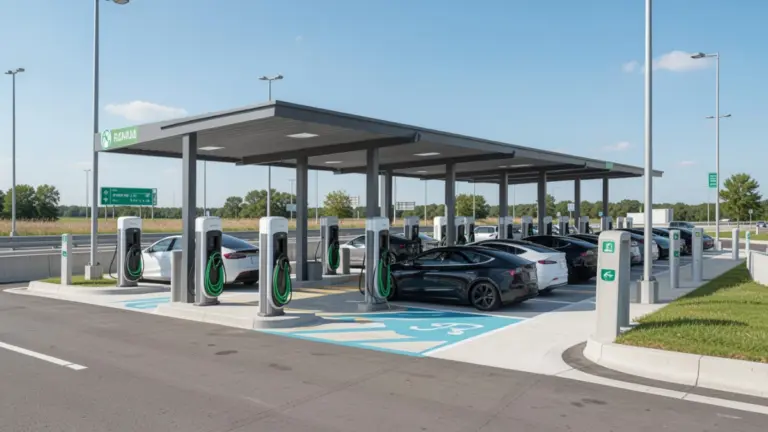
The onboard charger is another crucial component. When you plug your EV into a charging station, AC electricity from the grid needs to be converted to DC to charge the battery. The onboard charger handles this conversion. This is different from DC fast charging, where the conversion happens in the charging station itself, allowing for much faster charging speeds—which is why DC fast chargers can add 200 miles of range in 30 minutes while a regular Level 2 charger might take 8 hours for the same amount.
The DC-DC converter is like a step-down transformer for your car. While the main battery pack operates at high voltage (typically 400 volts, or 800 volts in newer vehicles like the Porsche Taycan), your car’s accessories—lights, radio, power windows—run on 12 volts, just like in a conventional car. The DC-DC converter steps down that high voltage to power these systems. Most EVs still have a traditional 12-volt battery to run these accessories, which is why you can still get stranded if that small battery dies, even if your main pack is fully charged.
Regenerative Braking: Free Energy While You Slow Down
Here’s one of my favorite features of electric cars: regenerative braking. This is where EVs turn physics in their favor and actually recover energy that would otherwise be wasted.
In a conventional car, when you brake, friction between your brake pads and rotors converts your car’s kinetic energy into heat, which dissipates into the air. It’s pure waste. But in an EV, when you lift off the accelerator or press the brake pedal, the motor essentially runs in reverse, becoming a generator. The resistance from generating electricity slows the car down, and that electricity flows back into the battery.
The first time you experience strong regenerative braking—like in a Tesla with “one-pedal driving” enabled—it feels weird. You can almost drive the entire car using just the accelerator pedal: press to go, release to slow down. But once you get used to it, going back to a gas car feels primitive. Why would I want to waste all that energy as heat?
The efficiency gains here are substantial. In city driving with lots of stops and starts, regenerative braking can recover 20-30% of the energy you’d otherwise lose. This is one reason why EVs are most efficient in city driving, unlike gas cars which are most efficient on highways. Every time you slow down for a red light or come down a hill, you’re putting energy back in the tank.
Different EVs offer different levels of regenerative braking control. Some, like the Nissan Leaf, have an e-Pedal mode that enables strong regeneration. Others, like many Volkswagen EVs, let you adjust the level using paddle shifters. The Porsche Taycan even blends regenerative braking with traditional friction brakes so seamlessly you can’t feel the transition.
Putting It All Together: From Plug to Pavement
So how does everything work together when you’re actually driving? Let’s walk through a typical journey.
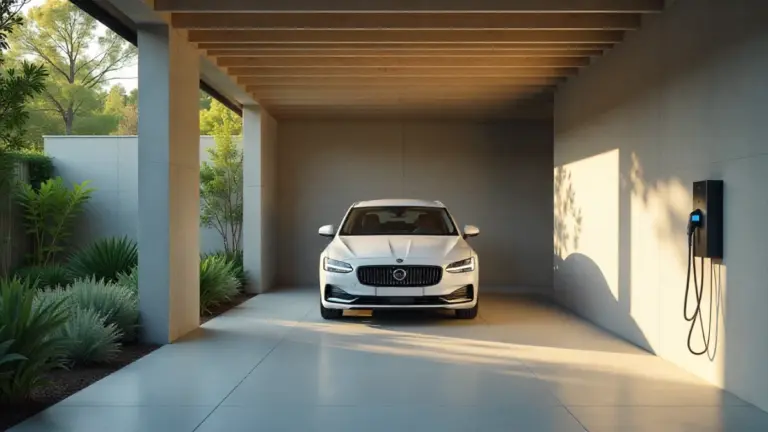
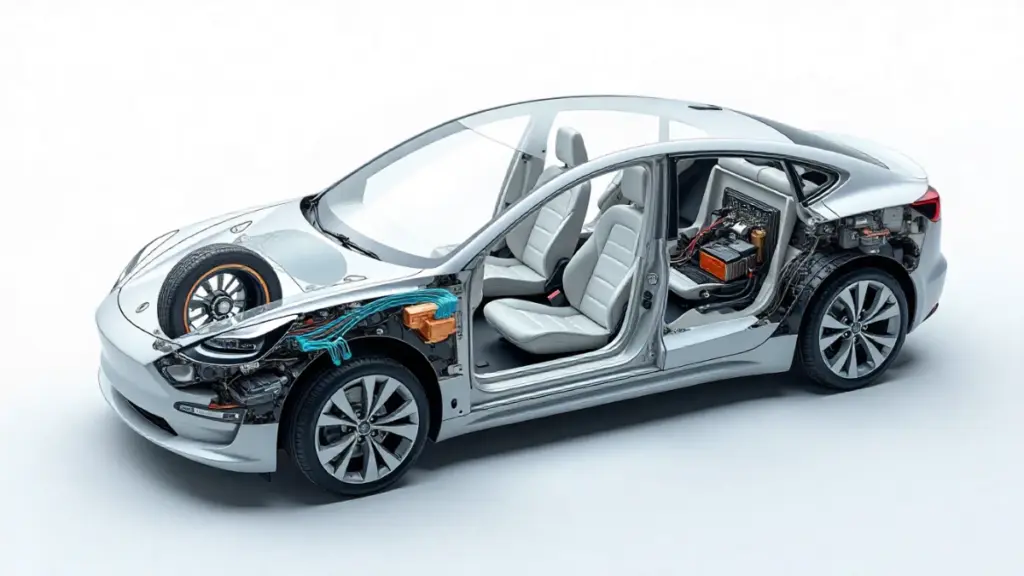
You start your day by unplugging your EV from your home charger. Overnight, the onboard charger converted AC power from your house into DC and stored it in your battery pack. The battery management system made sure each cell charged evenly and maintained the optimal temperature.
You press the start button (or in some EVs, just sit down—there is no start button). The 12-volt battery powers up the vehicle’s computers and control systems, which then activate the high-voltage system. The battery management system checks that everything is safe and ready.
You press the accelerator. A signal goes from the pedal to the vehicle’s computer, which tells the inverter to start sending power to the motor. The inverter rapidly switches DC current from the battery into AC current for the motor, controlling the frequency to determine how fast the motor spins. The motor’s electromagnetic fields engage, the rotor spins, and through a single-speed transmission (no shifting required!), that rotation goes directly to the wheels.
As you drive, the battery management system constantly monitors cell voltages, temperatures, and current flow. It balances the cells, keeping them within safe parameters. If it’s hot outside, coolant circulates through the battery pack. If it’s cold, heating elements warm the cells to maintain efficiency.
When you arrive at your destination, you lift off the accelerator. Immediately, the motor switches to generator mode, creating resistance that slows the car while converting kinetic energy back into electricity. The inverter now works in reverse, converting that AC from the motor back into DC to charge the battery. You might not even need to touch the brake pedal.
All of this happens silently, smoothly, and with fewer than 20 moving parts in the entire drivetrain. Compare that to the 2,000+ moving parts in a conventional powertrain, with its pistons, valves, timing belts, and transmission gears.
Why This Design Matters
Understanding how electric cars work helps explain why they drive so differently from gas vehicles—and why many people, once they’ve driven an EV, find it hard to go back.
That instant torque from the electric motor? It’s not just about acceleration bragging rights. It makes the car feel more responsive in everyday driving. Merging into traffic, passing on two-lane roads, or just navigating busy city streets—everything feels more effortless.
The simplicity of the drivetrain translates to lower maintenance. No oil changes (because there’s no oil), no transmission fluid, no spark plugs, no timing belts. The main things you need to maintain are tires, windshield washer fluid, cabin air filters, and brake fluid (and your brakes last much longer because of regenerative braking). Some EV owners report going 100,000 miles without needing to replace brake pads.
The low center of gravity from that heavy battery pack mounted in the floor? It fundamentally changes how the car handles. EVs feel planted and stable through corners in a way that defies their often considerable weight. The BMW iX, despite weighing over 5,600 pounds, handles with surprising agility because all that mass sits low and central.
The Future Is Getting Even Better
Electric car technology isn’t standing still. The EVs available today are dramatically better than those from just five years ago, and the pace of innovation continues to accelerate.
Battery technology is improving rapidly. Solid-state batteries, which replace the liquid electrolyte in current lithium-ion cells with a solid material, promise even higher energy density and faster charging. Toyota and others are targeting commercial solid-state batteries by the late 2020s. Silicon anode technology is already being implemented by companies like Mercedes-Benz in their EQS and EQE models, offering 10-15% more range from the same size battery.
Charging infrastructure is expanding and getting faster. While today’s fastest chargers max out around 350 kW, next-generation chargers promise 500 kW or more. For context, a 350 kW charger can add about 200 miles of range to a Hyundai Ioniq 5 in just 18 minutes. Future 500+ kW chargers could potentially match that in 10 minutes.
Motor efficiency keeps improving too. New motor designs using less or even no rare-earth elements are being developed, making EVs more sustainable and less dependent on complex global supply chains. BMW’s fifth-generation electric drivetrain, used in the i4 and iX, is about 93% efficient—meaning 93% of the electrical energy from the battery makes it to the wheels. Compare that to a gas engine, which typically achieves only 20-30% efficiency.
So, How Do Electric Cars Work? Simply Brilliantly.
At the end of the day, electric cars work through an elegant combination of physics principles we’ve understood for over a century, refined by modern technology and materials science. Electricity from the battery flows through an inverter to an electric motor, creating electromagnetic forces that spin the motor and turn the wheels. When you slow down, the system reverses, turning the motor into a generator and putting energy back into the battery.
What makes EVs special isn’t just that they’re cleaner or quieter—though they are both. It’s that the fundamental physics of electric propulsion is simply better suited to moving cars around. The instant torque delivery, the simplicity of the drivetrain, the efficiency of the energy conversion, the packaging advantages—all of these stem from the basic way electric motors work.
If you’ve been curious about EVs but intimidated by the technology, I hope this guide helps demystify things. These aren’t science fiction vehicles or complicated electronics on wheels. They’re logical machines that use electricity to create motion in the most straightforward way possible. And once you understand how they work, the advantages become even more apparent.
The next time you see an electric car gliding silently past you, you’ll know exactly what’s happening under that floor pan—thousands of battery cells feeding power through an inverter to a compact motor, all working together in remarkable harmony. It’s technology that’s both incredibly sophisticated and surprisingly simple. And that, perhaps, is the most elegant part of all.